 Over the past two days, I watched some events at the European Athletics Championships in Birmingham (if on TV). Partly due to the heat that hugely reduced my range of options. And partly in reminiscence of the 2024 Championships in Rome. Among the amazing feats, Jimmy Gressier’s lead on most of the 5,000m, if not particularly strategic with Jakob Ingebrigsten in his flow, and Gressier’s sprint in the 10,000m. And Nadia Battocletti winning again both 5,000m and 10,000m races, very tactically with a extraordinary burst on the last lap. And Aurélien Quinion finishing third on the marathon race walk, under 3h, so exhausted he turned back after the finish line. And Gianmarco Tamberi repeating his antics and gold medal in the high jump (reaching to his family rather the Italian President this time!). And the much more serene victory of Yaroslava Mahuchikh, the current World and Olympic champion in the high jump. Слава Україні!
Магучіх синій та золотий [B’ham European Athletics 2026]
Posted in pictures, Running with tags 10000m, Birmingham, Britain, Слава Україні, European Athletics Championships, French TV, high jump, marathon race walk, Rome, UK, Ukraine, Walsall on August 17, 2026 by xi'anpost-vacation tee-shirt design
Posted in Kids, Mountains, pictures, Travel with tags Ainu, animism, Þe Norse face, brown bear, copycat, grizzly bear, higuma, Hokkaido, Japan, katakana, tee-shirt, TNF on August 16, 2026 by xi'an
Round-robin (with Claude)
Posted in Books, Kids, R, Statistics, Wines with tags AI, Auvergne, écir, bougnat, café, Claude, LLMs, mathematical puzzle, Paris, simulation, Springer Nature, Statistics and Computing, The Fiddler on August 15, 2026 by xi'an A few days ago I had a coffee in Paris with my long-time friend (and former Statistics & Computing editor) Gilles Celeux, and he mentioned me stopping solving and posting maths puzzles like those weekly published by Le Monde. They have indeed vanished with the retirement of the authors, but Gilles added that the arrival of LLMs would have made the exercise moot. I disagreed as (i) the fun of solving the puzzle on my own has not gone away and (ii) the pedagogical appeal of the puzzle and its resolution remains. As the next Fiddler puzzle arrived in my mailbox, my resolution was put to the test (contrariwise to the previous entry, which did not require massive computations):
The Fiddler League consists of two teams. Over a season, they play each other 162 times. Each team has an equal chance of winning each game, and the results of games are independent. Over the season, on average, how many games would you expect the team with the better record to have won?
I started on the wrong foot with E[X|X≥81] when X is Bin(162,½), equal to 85.77 (either directly or with a Normal approximation), which differs from my second thought, E[max(X,162-X)]=86.07 (either directly or with a Normal approximation), which is larger because of the reflection produced by max. While the first computation was manageable, the second one seemed to involve simulation and I caved in prompting Claude, which provided the answer along with the connection
E[max(X,162−X)]=E[X∣X≥81](1+p81)−81p81
After some expansion, the League boasts 30 teams. Over a season, each team plays each other team five times. (Each team plays a total of 145 games.) Again, each team has an equal chance of winning each game, and the results of games are independent. Over the season, on average, how many games would you expect the team with the best record to have won?
The best record is max(Xi) with each of the 30 Xi‘s a sum of 29 Yij and the Yij=5-Yji distributed as Bin(5,½). The Xi‘s are thus Bin (145,½) but dependent. While I could not figure out a closed form answer for the expectation, a direct Monte Carlo resolution is obviously feasible, with Claude (rather than me) running it over 400 million repetitions, but a 30 dimensional Normal approximation exploiting the correlation of 1/29 between the components leads to roughly 85 as the expected value. (Again computed by a Claudicant simulation.)
While the conclusion that the Normal approximation is pretty accurate with so many terms in the Binomial variates is quite unsurprising, Claude saves me coding time without ruining the puzzle altogether. (And Gemini made me aware that the name of the café where Gilles and I regularly meet, L’Écir, is an Auvergne noun for a local, dangerous, mountain blizzard! Thus linking the place to the foundation of the café by Auvergne expatriates…)
piano tuners on France Inter
Posted in Books, Kids, University life with tags Barack Obama, Bruxelles, Chicago, Fermi, France Inter, Guesstimation, Lake Michigan, national public radio, scientific communication, Siméon Poisson, Université Libre de Bruxelles, waiting time on August 14, 2026 by xi'an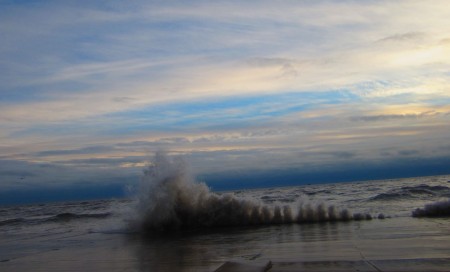
During the summer months, the Belgian physicist Fabrizio Bucella delivers a daily and funny unit of wisdom every morning just before 8am (CET) on the French public radio. Often addressing every day question to uncover a scientific principle. A recent morn, he mentioned Fermi’s estimates, which is a numerate way to guess(timate) a physical quantity by multiplying individual estimates, like the number of piano tuners in Chicago. (My preparatory school physics teacher was very good at this game, beating our pocket calculators by a large margin!) But I had never heard either of the concept or of the expression. Bucella’s 2mn explanation was quite similar to the Wikipedia entry, if not mentioning that the squared root increase of the error applies to the logarithm of the estimate. And arguing unreasonably at all terms being above or below their true values with probability ½. The paradox of the waiting time the day after was more convincing, if failing to mention Siméon Poisson. [The above is a picture I took of Lake Michigan while running, the last time I visited Chicago. A few days before Barack Obama got re-elected.]
BayesComp²⁰²⁷ mirror in Aussois
Posted in Mountains, Statistics, Travel, University life with tags Aussois, Bardonecchia, BayesComp 2027, Bayesian Computing Section, CAES, conference, conference fees, France, French Alps, high speed train, ISBA, MCMSki, mirror workshop, Modane, multihub conferences, Paul Langevin, registration fees, Texas, Texas A&M University, Torino, Tunnel du Fréjus on August 13, 2026 by xi'an
Here we go! We have just completed the webpage for the BayesComp 2027 mirror conference in Aussois, French Alps, and launched the call for contributions.
This meeting mirrors the main BayesComp 2027 conference, held in Texas on the same week. As such, it will broadcast live and delayed sessions from the main conference, including plenary sessions, host local talk and poster sessions (to be broadcasted), and more generally provide an alternative forum for researchers in Bayesian computational statistics who cannot attend BayesComp 2027. As discussed earlier on the ‘Og, and following a debate launched at the ISBA 2024 World Meeting in Venezia, ISBA is now considering mirror (or multi-hub) meetings as a possible way to address accessibility, sustainability, and inclusiveness issues in its scientific meetings.
The scientific committee will select presentations soon after the submission deadline, on 30 November 2026. Note that due to the capacity of the CAES Paul Langevin conference centre in Aussois the number of participants will be capped at 200. (Travel to Aussois by train to Modane is easy, thanks to direct, fast trains from Paris (4h), Torino (1h), and Lyon (2h). And by car if need be, since Modane is the French exit of the Tunnel du Fréjus (aka Traforo Alpino del Fréjus) linking France and Italy, the Italian exit being Bardonecchia.)
-
Submission deadline: 30 November 2026
-
Decisions expected by 15 January 2027
-
Registration start on 15 January 2027 (Registration will open after the proposals are assessed by the Scientific Committee and when the fees (supporting the main BayesComp 2027 conference) are confirmed. There should be no local fees.)


 Xi'an's Og