
You Probably Don't Need a Vector Database
Introduction Conversations about RAG almost always start with a vector database. This article suggests you dig deeper before implementing one.
2026-06-19
1,256 reads
Introduction Conversations about RAG almost always start with a vector database. This article suggests you dig deeper before implementing one.
2026-06-19
1,256 reads
This article shows how you can generate embeddings in SQL Server 2025, store them, and use them in your queries.
2026-06-08
2,830 reads
Learn about using SQL Server to support AI-enhanced search queries with the Relational Embedding Retrieval Pattern (RERP).
2026-04-24
1,956 reads
Introduction SQL Server 2025 introduced new features, including vectors. The main purpose of vectors is to create a new semantic search with the help of AI. Modern AI models represent text as vectors (embeddings) that capture semantic meaning. Similar meanings produce vectors that are close to each other in this vector space, allowing AI systems to […]
2026-03-23
10,010 reads
Searching for relevant information in vast repositories of unstructured text can be a challenge. This article explains a Python-based approach to implementing an efficient document search system using FAISS (Facebook AI Similarity Search) for Vector DB and sentence embeddings, which can be useful in applications like chatbots, document retrieval, and natural language understanding. In this […]
2025-01-17
4,042 reads
By Steve Jones
I recently started playing with the MCP Server for SQL Server, which is a...
If you spend your days tuning queries, managing pipelines, or keeping a production database...
I’ve been rebuilding my three-site SQL Server demo lab, and I ran into something...
Has anyone written a wrapper function (or similar) around STRING_AGG() to allow the retrieval...
Putting this here as we're currently on SQL Server 2019 installed on Windows Server...
Comments posted to this topic are about the item Never is Not the Policy
I have added a few indexes to one of my tables in SQL Server 2025:
ALTER TABLE dbo.CustomerContact
ADD CONSTRAINT PK_CustomerContact
    PRIMARY KEY (CustomerID);

-- Create index on CustomerEmail
CREATE INDEX IX_CustomerContact_CustomerEmail
ON dbo.CustomerContact (CustomerEmail);
CREATE INDEX IX_CustomerContact_CustomerEmail
ON dbo.CustomerContact (phone);
I then do this to disable one index:
alter index IX_CustomerContact_CustomerPhone on dbo.CustomerContact disableI see this when I check the index status:
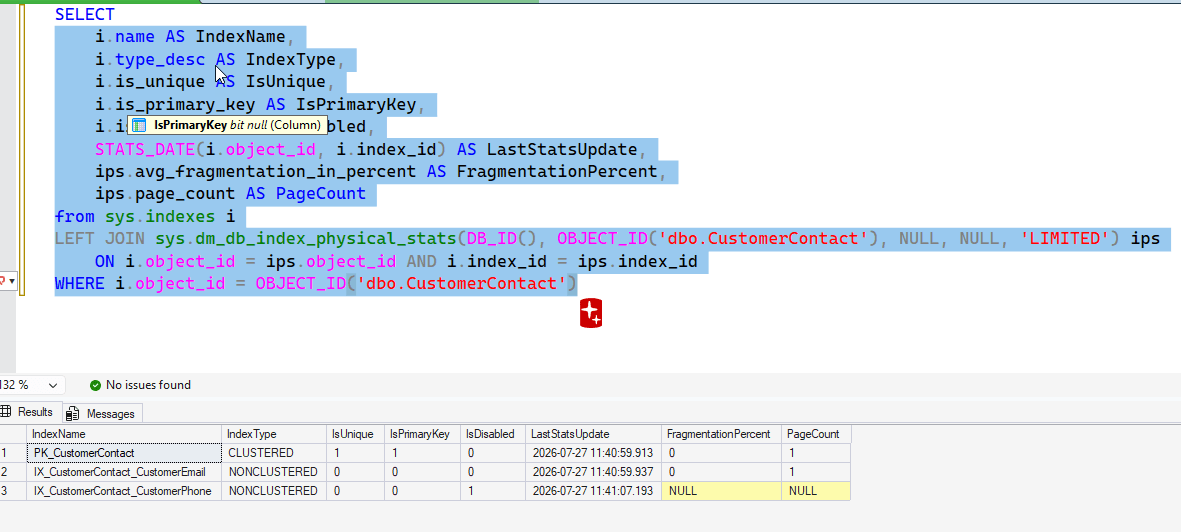 I decide to rebuild all indexes with this command:
ALTER INDEX ALL ON dbo.CustomerContactAfter I do this, what will I see for the index status? See possible answers