
2026-06-19
476 reads
2026-06-19
476 reads
2026-05-08
1,053 reads
2025-09-22
1,438 reads

This article describes the process to create a read-scale cross-platform SQL Server Availability Group where the primary is Linux and the secondary is Windows.
2025-07-23
403 reads

Microsoft does not yet support this edition of Ubuntu, but there are some workarounds to make it work. This should not be used for production usage and this blog is for educational/testing purposes only.
2025-06-20

With SQL Server on Linux becoming more popular, Steve asks if you think you need to know much about that OS.
2025-02-14
132 reads
2024-07-24
368 reads
2024-02-23
329 reads
2024-01-26
347 reads

In this tip, we're going to look at the steps to backup SQL Server on Linux databases using SQL Server Agent on a Windows server.
2024-01-01
By Steve Jones
I recently started playing with the MCP Server for SQL Server, which is a...
If you spend your days tuning queries, managing pipelines, or keeping a production database...
I’ve been rebuilding my three-site SQL Server demo lab, and I ran into something...
Has anyone written a wrapper function (or similar) around STRING_AGG() to allow the retrieval...
Putting this here as we're currently on SQL Server 2019 installed on Windows Server...
Comments posted to this topic are about the item Never is Not the Policy
I have added a few indexes to one of my tables in SQL Server 2025:
ALTER TABLE dbo.CustomerContact
ADD CONSTRAINT PK_CustomerContact
    PRIMARY KEY (CustomerID);

-- Create index on CustomerEmail
CREATE INDEX IX_CustomerContact_CustomerEmail
ON dbo.CustomerContact (CustomerEmail);
CREATE INDEX IX_CustomerContact_CustomerPhone
ON dbo.CustomerContact (phone);
I then do this to disable one index:
alter index IX_CustomerContact_CustomerPhone on dbo.CustomerContact disableI see this when I check the index status:
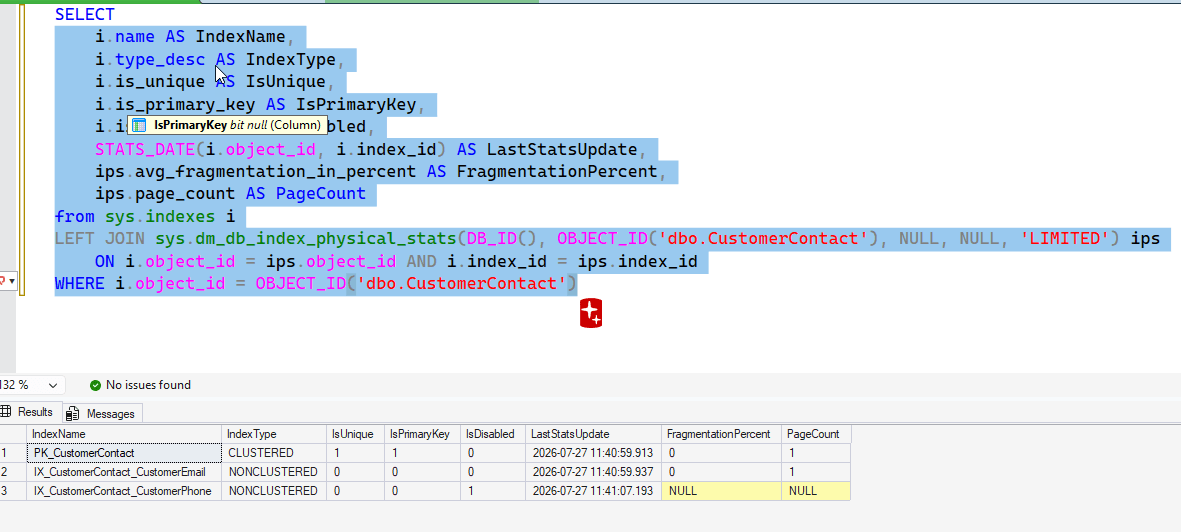 I decide to rebuild all indexes with this command:
ALTER INDEX ALL ON dbo.CustomerContact rebuildAfter I do this, what will I see for the index status? See possible answers