
2021-09-08
847 reads
2021-09-08
847 reads

Developers using SQL Server Express face a few challenges in their day to day work. One is that setting up and maintaining Express can be a daunting task.
2017-07-28
5,168 reads

A collection of technologies and links that will help you learn more about SQL Server 2012.
2015-06-25
1,409 reads
Arshad Ali discusses how to use CTE and the ranking function to access or query data from previous or subsequent rows. He also shows you how to leverage the LEAD and LAG analytics functions to achieve the same result without writing a self-join query using CTE and ranking function
2014-12-10
8,382 reads
Exploring the potential benefits of the T-SQL Window functions (OVER, LAG, and LEAD) in this piece. You can learn how to achieve up to 50% performance boost by replacing a single function call.
2019-04-02 (first published: 2014-03-24)
26,166 reads
Powershell code to interactively move cluster resources between nodes. Intended for Windows 2012 and SQL 2012.
2013-11-19 (first published: 2013-11-04)
2,410 reads
2013-10-25
2,066 reads
2013-08-13
2,019 reads
While AlwaysOn and Columnar lookup are good enough reasons to migrate to SQL Server 2012, you need to be aware of the problems associated with certain virtualize environments.
2013-07-04
8,344 reads
Read when you search for help on the internet. You might miss a very important part of what you must do.
2013-06-10
4,900 reads
By Steve Jones
I recently started playing with the MCP Server for SQL Server, which is a...
If you spend your days tuning queries, managing pipelines, or keeping a production database...
I’ve been rebuilding my three-site SQL Server demo lab, and I ran into something...
Has anyone written a wrapper function (or similar) around STRING_AGG() to allow the retrieval...
Putting this here as we're currently on SQL Server 2019 installed on Windows Server...
Comments posted to this topic are about the item Never is Not the Policy
I have added a few indexes to one of my tables in SQL Server 2025:
ALTER TABLE dbo.CustomerContact
ADD CONSTRAINT PK_CustomerContact
    PRIMARY KEY (CustomerID);

-- Create index on CustomerEmail
CREATE INDEX IX_CustomerContact_CustomerEmail
ON dbo.CustomerContact (CustomerEmail);
CREATE INDEX IX_CustomerContact_CustomerPhone
ON dbo.CustomerContact (phone);
I then do this to disable one index:
alter index IX_CustomerContact_CustomerPhone on dbo.CustomerContact disableI see this when I check the index status:
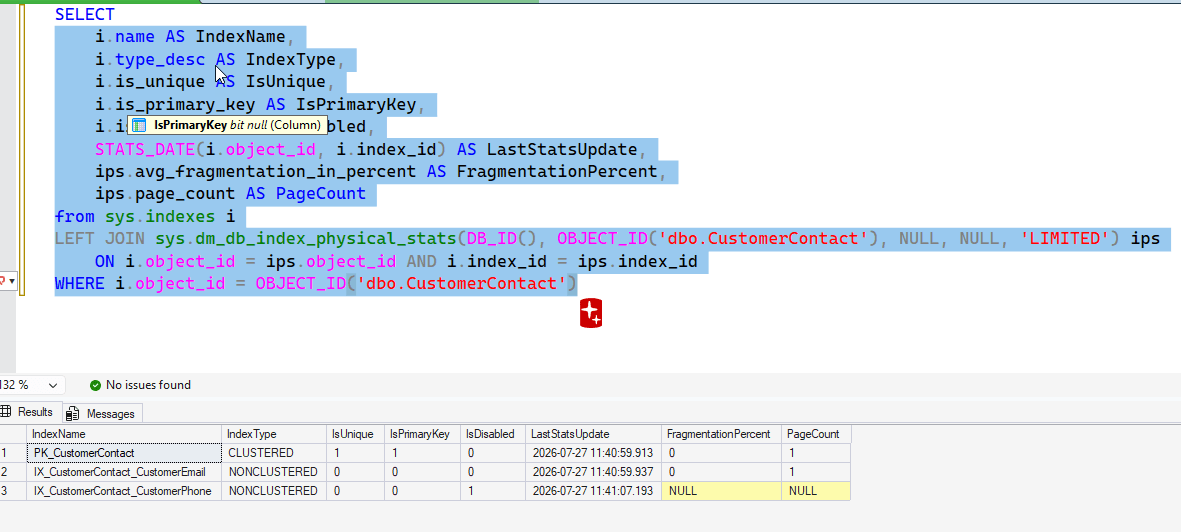 I decide to rebuild all indexes with this command:
ALTER INDEX ALL ON dbo.CustomerContact rebuildAfter I do this, what will I see for the index status? See possible answers