
2026-06-29
174 reads
2026-06-29
174 reads

Learn about an alternative strategy for avoiding hardcoded literal values in SQL Server queries by using single-row views designed to mimic enum behavior.
2026-06-26
3,062 reads

In this quarter’s update of our SQL ConstantCare® population report, showing how quickly (or slowly) folks adopt new versions of SQL Server, the data is very similar to last quarter
2025-11-17
2024-11-06
210 reads

In this tip, I will demonstrate how to migrate an existing database schema from SQL Server to PostgreSQL.
2024-03-13
There are a number of ways to run SQL Server for free (or low cost) for development. Read a bit about how to do this.
2024-02-23
8,068 reads
This article shows how to use Python to access data in SQL Server and produce a K-Means analysis with a chart.
2024-01-08
3,263 reads
One of the most effective ways to fully utilize your data is to create an Azure Hyperscale database. The principles of Azure Hyperscale databases have been discussed in this article, including their cost-effectiveness, worldwide accessibility, automatic scaling, and reliable performance.
2023-12-22
2,349 reads
2023-11-10
262 reads
This article will show the basic outline for how Python scripts can access and work with data in SQL Server.
2023-11-06
20,987 reads
By Steve Jones
I recently started playing with the MCP Server for SQL Server, which is a...
If you spend your days tuning queries, managing pipelines, or keeping a production database...
I’ve been rebuilding my three-site SQL Server demo lab, and I ran into something...
Has anyone written a wrapper function (or similar) around STRING_AGG() to allow the retrieval...
Putting this here as we're currently on SQL Server 2019 installed on Windows Server...
Comments posted to this topic are about the item Never is Not the Policy
I have added a few indexes to one of my tables in SQL Server 2025:
ALTER TABLE dbo.CustomerContact
ADD CONSTRAINT PK_CustomerContact
    PRIMARY KEY (CustomerID);

-- Create index on CustomerEmail
CREATE INDEX IX_CustomerContact_CustomerEmail
ON dbo.CustomerContact (CustomerEmail);
CREATE INDEX IX_CustomerContact_CustomerPhone
ON dbo.CustomerContact (phone);
I then do this to disable one index:
alter index IX_CustomerContact_CustomerPhone on dbo.CustomerContact disableI see this when I check the index status:
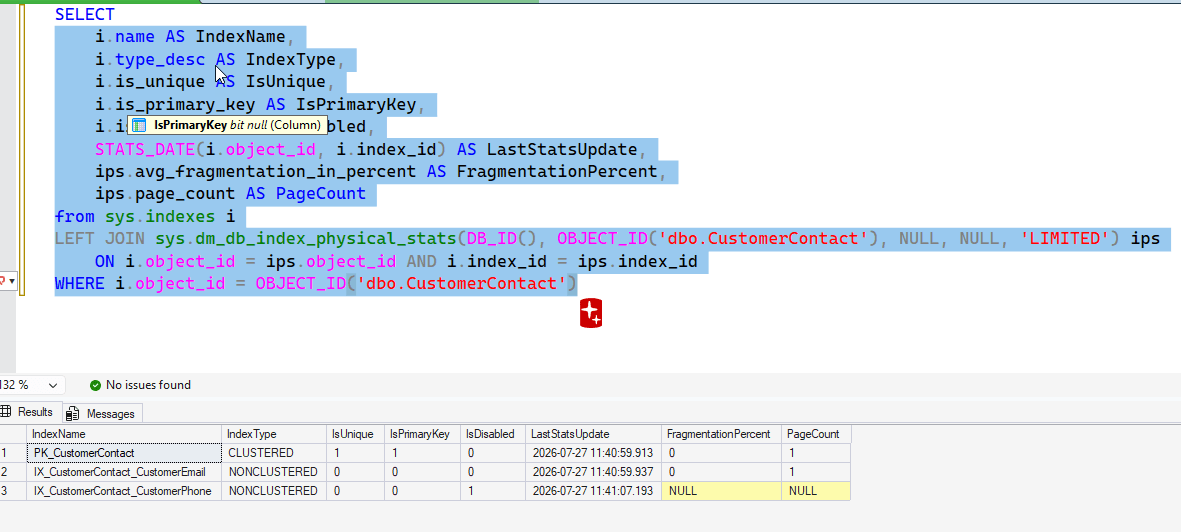 I decide to rebuild all indexes with this command:
ALTER INDEX ALL ON dbo.CustomerContact rebuildAfter I do this, what will I see for the index status? See possible answers