
SQL Art, Part 4: Happy 4th of July — A British DBA's Guide to Celebrating a War We Don't Talk About
Another fun article for America's Independence Day using SQL Server's spatial features.
2026-07-03
857 reads
Another fun article for America's Independence Day using SQL Server's spatial features.
2026-07-03
857 reads
A little Christmas fun for you using the spatial features in SQL Server and SSMS.
2025-12-24
4,309 reads
Geographic information systems (GIS) play a critical role in emergency response planning and risk assessment. One of the key challenges in this field is determining whether a specific location falls within an area of interest. This capability is especially valuable for property and casualty (P&C) insurers, who need to assess their insured property exposure when severe weather events such as tornadoes occur.
2025-03-04 (first published: 2025-03-03)
2,759 reads
Problem The usage of a collection of integers in some scenarios is considered to be optimal because of the overhead involved by the creation of another user table used just to store numbers, which is the most common solution. What are collections of integers? They are lists or arrays consisting of integers. The number of […]
2020-02-13
6,018 reads
This article shows how you can use SQL Server spatial methods, mathematical rules and oscillating patterns to benchmark CPU, IO and Hekaton performance.
2015-06-15
3,737 reads
By James Serra
Microsoft Fabric makes it wonderfully easy to put many analytics workloads on one platform....
By Steve Jones
I recently started playing with the MCP Server for SQL Server, which is a...
If you spend your days tuning queries, managing pipelines, or keeping a production database...
Has anyone written a wrapper function (or similar) around STRING_AGG() to allow the retrieval...
Putting this here as we're currently on SQL Server 2019 installed on Windows Server...
Comments posted to this topic are about the item Never is Not the Policy
I have added a few indexes to one of my tables in SQL Server 2025:
ALTER TABLE dbo.CustomerContact
ADD CONSTRAINT PK_CustomerContact
    PRIMARY KEY (CustomerID);

-- Create index on CustomerEmail
CREATE INDEX IX_CustomerContact_CustomerEmail
ON dbo.CustomerContact (CustomerEmail);
CREATE INDEX IX_CustomerContact_CustomerPhone
ON dbo.CustomerContact (phone);
I then do this to disable one index:
alter index IX_CustomerContact_CustomerPhone on dbo.CustomerContact disableI see this when I check the index status:
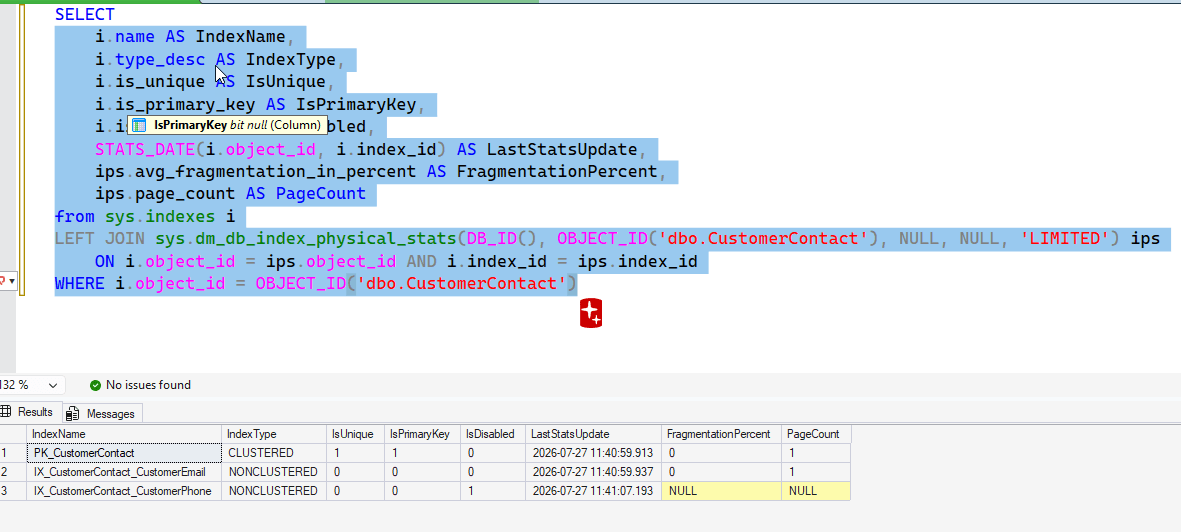 I decide to rebuild all indexes with this command:
ALTER INDEX ALL ON dbo.CustomerContact rebuildAfter I do this, what will I see for the index status? See possible answers