
More Tips for New (and old) DBAs
Following up on the popular article: Tips for New DBAs, author Craig Outcalt tackles three more issues including customer support and why you should learn T-SQL.
2013-11-29 (first published: 2009-01-12)
25,811 reads
Following up on the popular article: Tips for New DBAs, author Craig Outcalt tackles three more issues including customer support and why you should learn T-SQL.
2013-11-29 (first published: 2009-01-12)
25,811 reads
Author Craig Outcalt gives advice on preparing for the worst with a look at what you should consider putting in your disaster recovery plan and why.
2012-12-10 (first published: 2011-09-26)
5,196 reads
Author Craig Outcalt takes a deep dive into the SQL Server memory allocation and how it competes with OS memory.
2011-09-20
15,453 reads
New and old DBAs alike can benefit from going back to the roots of the profession. This series of articles highlight the skills needed to move to the next level of Database Administration.
2010-02-12 (first published: 2008-11-18)
46,236 reads

2009-11-30
3,421 reads
This technical article provides an overview of how to produce specific levels of index fragmentation. Useful for creating test plans.
2008-10-29
6,724 reads
Getting the number of processor cores that SQL Server is using is not as straitforward as it could be. Enter the affinity mask, bitwise operations and good old fashioned computer science.
2008-10-17
4,038 reads
If you spend your days tuning queries, managing pipelines, or keeping a production database...
I’ve been rebuilding my three-site SQL Server demo lab, and I ran into something...
By SQLPals
SQL Server gMSA: Why DBAs Still Aren't Using It in 2026 ...
Comments posted to this topic are about the item Never is Not the Policy
Comments posted to this topic are about the item Automating SSAS Multidimensional Security Audits...
Comments posted to this topic are about the item Rebuilding All Indexes
I have added a few indexes to one of my tables in SQL Server 2025:
ALTER TABLE dbo.CustomerContact
ADD CONSTRAINT PK_CustomerContact
    PRIMARY KEY (CustomerID);

-- Create index on CustomerEmail
CREATE INDEX IX_CustomerContact_CustomerEmail
ON dbo.CustomerContact (CustomerEmail);
CREATE INDEX IX_CustomerContact_CustomerEmail
ON dbo.CustomerContact (phone);
I then do this to disable one index:
alter index IX_CustomerContact_CustomerPhone on dbo.CustomerContact disableI see this when I check the index status:
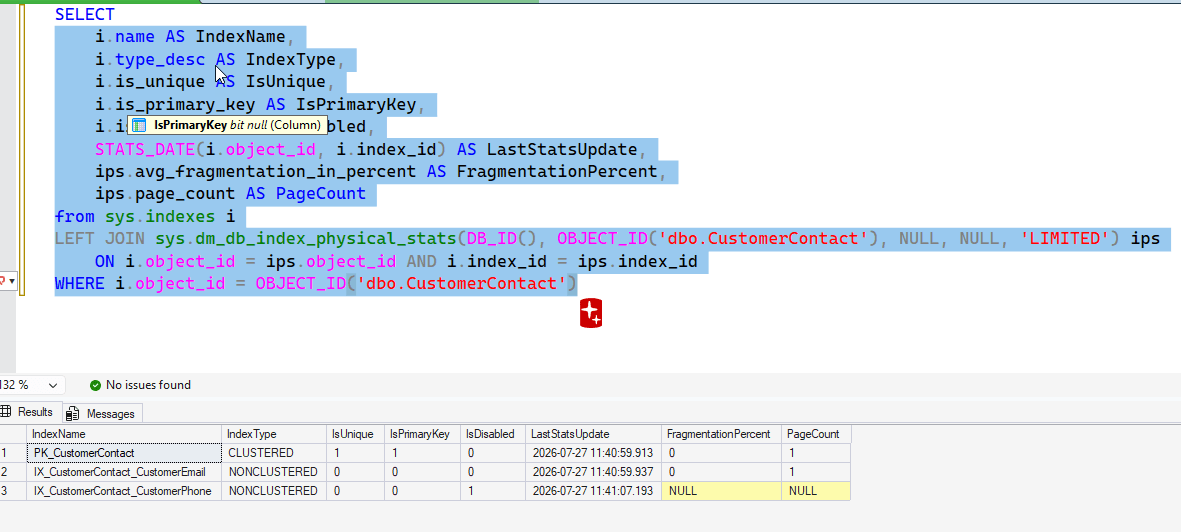 I decide to rebuild all indexes with this command:
ALTER INDEX ALL ON dbo.CustomerContactAfter I do this, what will I see for the index status? See possible answers