
Azure Stretch Database, Part I: Getting Going
With most innovative new technologies, Azure Stretch Database demos make it look completely easy. Here is a step by step to get going, with examples. Part One of a Two-Part series.
2019-08-26
4,971 reads
With most innovative new technologies, Azure Stretch Database demos make it look completely easy. Here is a step by step to get going, with examples. Part One of a Two-Part series.
2019-08-26
4,971 reads
SQL Server Auditing is a powerful out-of-the box toolset that captures auditing information and writes to a file or the Event Log. This article examines the little things that might snag you up.
2019-08-05 (first published: 2017-10-05)
11,351 reads
See how the ITIL Framework's Asset Management standards make the DBA's job easier. Use the CMDB and DML to keep your data assets under tight control.
2019-05-17 (first published: 2017-11-21)
3,646 reads
With exciting products like SQL Clone making their debut, the DBA will need to think through the approach to implementing such powerful tools. Done properly, these tools will provide a massive benefit to both the DBA and developer.
2019-05-10 (first published: 2017-11-28)
4,440 reads
We've gone through the basics of Peer-to-Peer Transactional Replication (PPTR). Now, we will blow it up! We will then fix it and show you how you how to triage and repair PPTR. When you remain calm and take some easy steps, you can stabilize PPTR with ease.
2019-01-04 (first published: 2016-01-07)
3,044 reads

As the Peer-to-Peer series continues, we set up an example topology in Peer-to-Peer Transactional replication and test it.
2018-12-28 (first published: 2015-11-05)
4,152 reads
There are times when you need to share tables between servers, where the table may be updated in both places. Peer-to-Peer Transactional Replication gives you the ability to create a solution. I explain the benefits and the downfalls.
2018-12-21 (first published: 2014-01-13)
6,292 reads
In a previous article, we discussed how to liberate the DBA from SQL Logins with AD Groups. A good point was raised: How can the DBA know who has what access? Here is a solution.
2018-08-03 (first published: 2016-02-18)
12,747 reads
With HIPAA and GDPR requiring your careful scrubbing of data for lower environments, random word generation promises to be a huge helper. Read here how to do it.
2018-05-01
5,926 reads
The business decides on a packaged application and buys it. After installation, you look at the schema and realize that is is a nightmare. How do you manage this nightmare?
2018-04-24 (first published: 2015-12-22)
5,459 reads
If you spend your days tuning queries, managing pipelines, or keeping a production database...
I’ve been rebuilding my three-site SQL Server demo lab, and I ran into something...
By SQLPals
SQL Server gMSA: Why DBAs Still Aren't Using It in 2026 ...
Comments posted to this topic are about the item Never is Not the Policy
Comments posted to this topic are about the item Automating SSAS Multidimensional Security Audits...
Comments posted to this topic are about the item Rebuilding All Indexes
I have added a few indexes to one of my tables in SQL Server 2025:
ALTER TABLE dbo.CustomerContact
ADD CONSTRAINT PK_CustomerContact
    PRIMARY KEY (CustomerID);

-- Create index on CustomerEmail
CREATE INDEX IX_CustomerContact_CustomerEmail
ON dbo.CustomerContact (CustomerEmail);
CREATE INDEX IX_CustomerContact_CustomerEmail
ON dbo.CustomerContact (phone);
I then do this to disable one index:
alter index IX_CustomerContact_CustomerPhone on dbo.CustomerContact disableI see this when I check the index status:
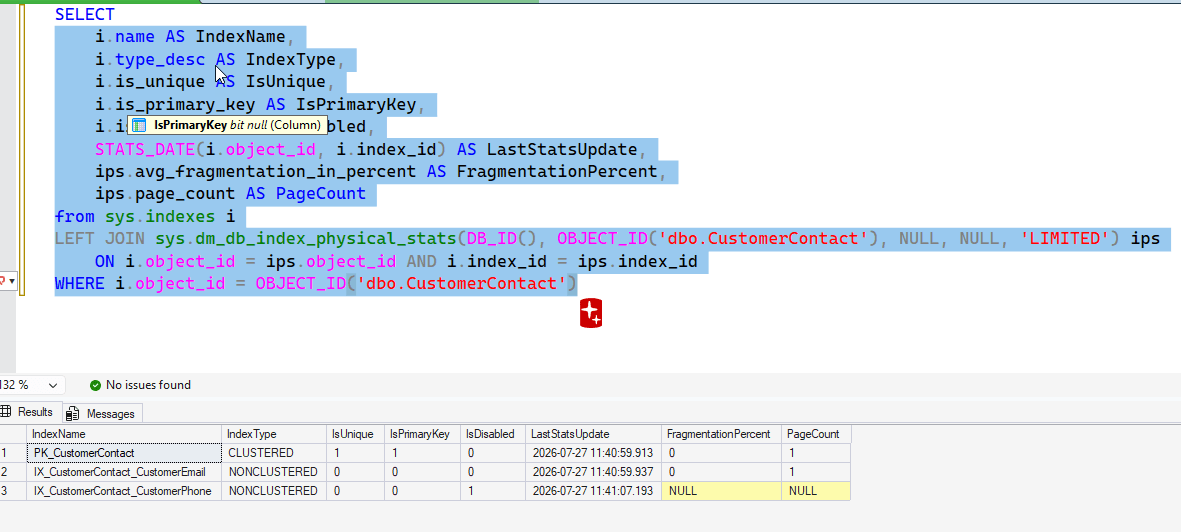 I decide to rebuild all indexes with this command:
ALTER INDEX ALL ON dbo.CustomerContactAfter I do this, what will I see for the index status? See possible answers