
Managing Incidents and Fighting Fires
Managing incidents as a DBA /DB manager and some of the key things you should be doing.
2026-08-08
108 reads
Managing incidents as a DBA /DB manager and some of the key things you should be doing.
2026-08-08
108 reads
This Editorial is coming to you during an exciting birthday for the United States. If you are in the US, you are most likely celebrating the 4th of July. This is the 250th anniversary for the US, quite a milestone. I hope that all my US friends are celebrating safely and responsibly. While it is […]
2026-07-04
343 reads
A Thank You message to the original founds of the PostgreSQL project and members of the community that have been working so hard for 30 years.
2026-05-30
252 reads
2026-04-25
53 reads
If you spend your days tuning queries, managing pipelines, or keeping a production database...
I’ve been rebuilding my three-site SQL Server demo lab, and I ran into something...
By SQLPals
SQL Server gMSA: Why DBAs Still Aren't Using It in 2026 ...
Comments posted to this topic are about the item Never is Not the Policy
Comments posted to this topic are about the item Automating SSAS Multidimensional Security Audits...
Comments posted to this topic are about the item Rebuilding All Indexes
I have added a few indexes to one of my tables in SQL Server 2025:
ALTER TABLE dbo.CustomerContact
ADD CONSTRAINT PK_CustomerContact
    PRIMARY KEY (CustomerID);

-- Create index on CustomerEmail
CREATE INDEX IX_CustomerContact_CustomerEmail
ON dbo.CustomerContact (CustomerEmail);
CREATE INDEX IX_CustomerContact_CustomerEmail
ON dbo.CustomerContact (phone);
I then do this to disable one index:
alter index IX_CustomerContact_CustomerPhone on dbo.CustomerContact disableI see this when I check the index status:
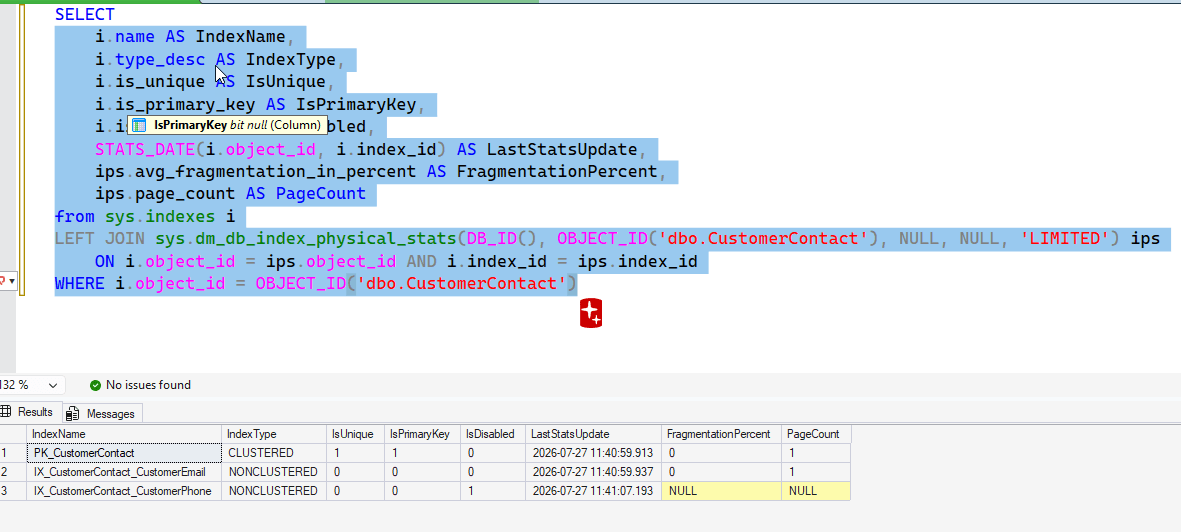 I decide to rebuild all indexes with this command:
ALTER INDEX ALL ON dbo.CustomerContactAfter I do this, what will I see for the index status? See possible answers