 WM-F10

Technical details, specifications
- Battery
- 1AA
- Battery life
- 4 h
- Colors
- red
- Dimensions
- 111.5*86.5*22.5 mm (217 cm³)3D
- Weight
- 200 gr
- Orientation
- laying/landscape
- Window
- yes
- Frame
- metal
- Case
- metal
- Expandable
- yes
- External compartment
- no
- Tape selector
- Manual switch
- Waterproof
- no
- Frequency range
- 40-14000@1,40-15000@4 Hz
- Power output
- 2x4 mW
- Speaker
- no
Functions
- DC in
- yes
- Record by input
- no
- Record by int mic
- no
- Cue
- no
- Balance (L/R)
- no
- Equalizer
- no
- Bass
- no
- Auto volume
- no
- Auto reverse
- no
- Anti rolling
- no
- AMS
- no
- Blank skip
- no
- Logic control
- no
- Hold lock
- no
- Noise reduction
- Dolby B
- Indicator
- led
Radio
- Radio
- yes
- Location
- builtin
- Receiver
- manual
- Bands
- fm
- DX/Local switch
- yes
Earphone
- Remote control
- no
- Dual jacks
- no
- Wireless
- no
Description
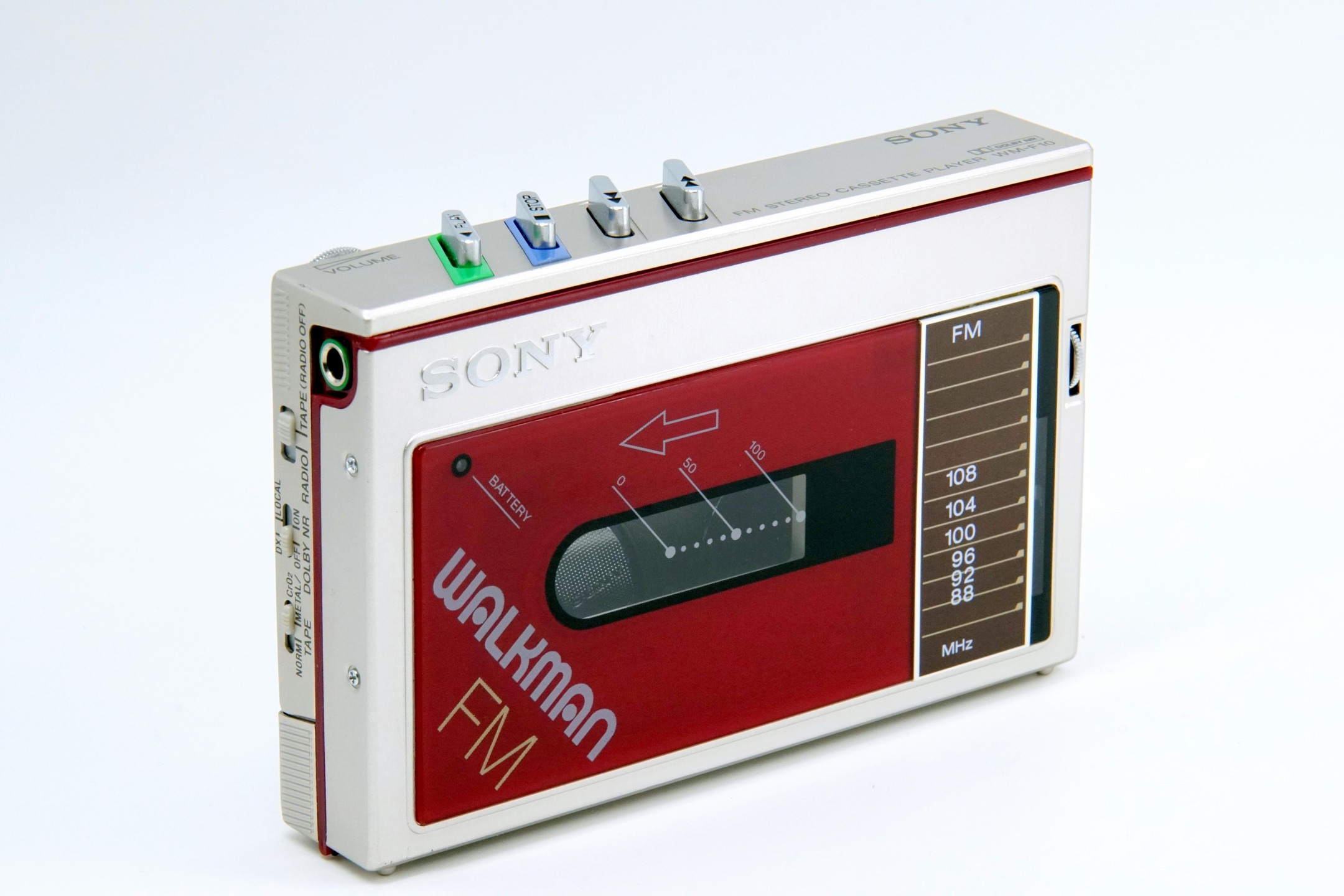
Iconic expandable Sony walkman model, with manual FM radio tuner. Sold in the US, counterpart of the European/Asian WM-F20.
The WM-F10 was a WM-10 with the addition of an FM stereo radio. Because of the already tiny size of the WM-10, fitting this was no easy task, but the solution showed considerable ingenuity. With no room in the main body of the machine, all the radio equipment had to be mounted in the cassette door. To connect this to the main chassis, special folding cables had to be designed that could not only cope with the opening of the door but also the sliding of the case as it was expanded to take a cassette. To avoid making the lid too bulky, the radio circuit had to be exceptionally thin. Using the same fine PCB technique and miniature surface-mounted components as were employed in the cassette section allowed this to be possible in most cases, with ceramic filters being used to replace bulky coils where possible. The only part that would have been tricky to miniaturise successfully was the tuning capacitor, which was required to be of certain physical dimensions to give the correct performance. This problem was avoided by using electronic "varicap" tuning, where a special diode performed the tuning function when a suitable voltage was applied to it. This voltage could be controlled by a variable resistor (like a volume control), which could be made in tiny sizes. The problem then became that to cover the FM band adequately around 12V would be required. This meant that the DC-DC converter in the main machine had to be redesigned to provide this extra supply, which also had to be noise-free and stable for reliable tuning. The radio components were protected by a very thin moulded plastic sheet of a thickness that would be more recognisable as food packaging.
The only control on the radio part of the WM-F10 was the tuning wheel (complete with a miniature scale and cord drive). Switching between radio and tape required an extra switch to be fitted to the main machine, next to those for tape type and Dolby NR. The Dolby switch was given an extra function as a control for the sensitivity of the radio (local/DX), though little was receivable in the "local" position.
The WM-F10 was only slightly larger than the WM-10, the only increase in size being the thickness. It was replaced by the slightly sturdier but otherwise very similar WM-F20.Via WalkmanCentral
Documents
Site wide
Popular
94%
(1026)- Additional notes
- The WM-F10II model (black) is equipped with additional AM band.
Photos reused with permission from boxedwalkman on IG.
- Created
- 2025-12-14 17:04:38
- Updated
- 2026-08-22 04:04:01
- Compare
- Add+
- Display
- Accessibility Ascii
- Also known
- WM F10 WM_F10 WMF10 WM-F10


No comment yet