Jonny finger-picking during Reich’sElectric Counterpoint at the Concertgebouw in Amsterdam on May 16, 2026 (33kbps).
Last week, Jonny performed Steve Reich’s Electric Counterpoint at the Concertgebouw in Amsterdam. The concert also featured Jonny’s new Violin Concerto. Once again, he’s playing a sunburst Fender Telecaster. But although it displays a similar color to Jonny’s 90s favorites, the guitar differs in some significant ways. In fact, the guitar is quite new: it’s a Fender Player II Modified Telecaster!
This “Modified” variant of Fender’s Player II series was released only last year, and it’s primarily distinguished from the standard “Player II” due to the inclusion of Fender’s “Noiseless” pickups. The guitar is also set apart visually — both from the standard Player II and from the 1990s Plus — by its rosewood fingerboard and white Pearloid pickguard. The sticker on the upper horn is the produce label from a mango.
Jonny’s Telecaster is connected directly to a Boss FV50H volume pedal, which in turn connects to the vibrato channel of a Fender Twin Reverb amplifier. The “H” in the volume pedal’s name indicates that it’s the high impedance version, which provides a more consistent sweep when connected directly to a guitar’s output (the low impedance version is better suited for placement after buffers or with synths). That nothing is connected to the output of Jonny’s Petersen Strobostomp HD tuner, because it’s connected via the tuner output of the Boss FV50H.
Jonny’s setup for Electric Counterpoint at the Het Concertgebouw in Amsterdam on May 16, 2026 (anne.the.garbage.can).
When Jonny started performing Electric Counterpoint, he mentioned that he re-records the 12 backing guitar parts for each performance (he even once posted a Vine revealing the recording process). As at previous performances of the piece, the backing track is played back from Jonny’s laptop via an audio interface. In this case, it’s a Focusrite Scarlett Solo (Gen4). The interface connects to the concert hall’s sound system. Using an interface provides a balanced output, which is essential for avoiding noise when the signal is amplified to fill a hall.
There’s also an unused Strymon Brigadier delay pedal hidden underneath the amplifier. This is unusual, since Electric Counterpoint doesn’t require any effects (what many assume are loops or delays are in fact the aforementioned pre-recorded backing tracks). Perhaps Jonny was experimenting with the sound of delay in the hall during soundcheck, or perhaps he was testing it out as a source of ambience (in contrast to the more rhythmic delays he’s favored for the past decade).
Left: Jonny playing his new Fender Player II Modified Telecaster during the third movement “Fast” of Electric Counterpoint (karindeg). Note that he has the neck pickup selected.
Right: Jonny removing a headstock tuner from the guitar before the start of the piece (). Presumably he used it while warming up backstage (anne.the.garbage.can).
It’s worth looking a bit more into the new guitar. The instrument’s “Noiseless” pickups are designed by Fender to retain the sound of their traditional single coil pickups while mitigating the hum associated with them. In truth, they’re humbuckers, specifically an intentionally unbalanced form of stacked humbucker — the idea being that the upper coil reproduces the sound of the strings just like a regular single coil, while the lower coil is hidden and only attenuated the hum.
Tonally, the noiseless pickups are much brighter from the Lace Sensors in the Telecaster Plus V1 guitars that Jonny is known for. But spiritually, they’re quite similar. During the 90s, Lace Sensors were Fender’s hum-free option, offered on their modern-oriented guitars. It wasn’t until 1998 that Fender released their “noiseless” pickups, and stopped using Lace’s products (which is the reason modern pickups just say “Lace Sensor”, not “Fender Lace Sensor”). Then as now, Fender puts traditional single coil pickups in their vintage-inspired instruments. But the Telecaster Plus and Player II Modified are both guitars with features, like hum-free pickups, intended for modern players.
Jonny playing his American Professional II Tele during Electric Counterpoint at IRCAM on February 5, 2024. The amplifier is a Fender Tone Master Super Reverb (note the “Tone Master” medallion in the bottom right corner), a digital modeling amplifier with Jensen speakers (unknown).
In 2024, Jonny also used a recently released Fender Telecaster to perform Electric Counterpoint. That instrument was a Fender American Professional II Telecaster, and Jonny used it at the Hallé and at IRCAM. In terms of Fender’s lineup, the Professional II series is even more similar to the 1990s Plus series than the Player II series. It’s designed as the brand’s flagship modern Telecaster, with features like compensated saddles for better tuning, a push-pull switch for added tones, and 22 frets. It also sits in a similar place price-wise: pricier than the standard/player instruments, but cheaper than the more accurate vintage reissues and custom-shop editions. Of course, the Professional II’s vintage-voiced V-mod pickups definitely sound much brighter than the humbucker-voiced Lace Sensor Red and Blue pickups in a Plus V1. Clearly, Jonny is looking for those brighter tones, because he could just as easily have chosen an American Professional II Deluxe, which features Gibson-style humbuckers (for vintage-style Fender CuNiFe humbuckers, you’ll need to pay extra for the Vintage II Deluxe).
Hugh Brunt, who conducted the Violin Concerto, shared this after the concert (hugh.tieppo.brunt).
Thom’s Heavily Modified Tele (Tele3) Reappears in the hands of Noah Yorke
Two photos by Baxter Adams of Noah Yorke with the guitar at the Shacklewell Arms on January 21, 2023 (ny.wav). Thanks to Andrew for bringing this post to our attention!
In late-2022 and early-2023, Noah Yorke used a heavily modified Fender Telecaster for performances with the band Hex Girlfriend. The guitar is the very same Telecaster that Noah’s father, Thom, used with the band Radiohead during their OK Computer tour in 1997-1998. Thom played it on more aggressive tracks from that era such as Electioneering and The Trickster.
Although Thom only used the guitar as a backup on tour in early-2000s, the instrument went through some further mods — most notably a refinish with a thin black paint. It looks as though Thom subsequently carved some words and peace signs into the paint, including the word “black” beside the control plate.
After Radiohead’s 2004 tour, the guitar went unseen for a decade. It next appeared at a London Contemporary Orchestra concert in Budapest in 2015, when Jonny used it to play Steve Reich’s Electric Counterpoint. Since then, the guitar once again disappeared for nearly a decade. Though the guitar may also be the “black tele” listed in Jonny’s recording notes for Electric Counterpoint in June 2014 (vine).
Hex Girlfriend has shared photos from two shows where the guitar is visible: first at Sebright Arms on Nov 6, 2022, and later at the Shacklewell Arms on Jan 21, 2023. The guitar is also visible in what appears to be a rehearsal photo in Dec 2022, likely meant to promote the then-upcoming Shacklewell arms show. It can be seen in footage from two more shows as well: footage from a show in at MOTH Club on July 22, 2023, and footage from from a show at The Moon on The Moon on Oct 22, 2023. The guitar is now covered in stickers, including a “ram’s head” sticker from Electro-Harmonix.
Left: a photo by Estie Joy of Noah Yorke with the guitar at the Sebright Arms on November 6, 2022 (ny.wav). Right: a photo, likely from a rehearsal, showing the guitar (ny.wav).
The guitar still has the simple wiring that Thom favored in the 90s, with the tone control removed and replaced by a relocated output jack. The original select switch seems to have been replaced by a smaller toggle switch. Also note that the neck humbucker has the screws on the “bridge” side, rather than the traditional orientation with the screws on the “neck” side. This is just cosmetic, the orientation makes no difference in sound (you’d need to adjust the wiring or the magnet to actually reverse the phase).
Left: a shot of Thom with the guitar at the Hammerstein Ballroom on Dec 19, 1997, pointing to a fan just before the band played Electioneering (youtube). Right: a photo of Jonny playing the guitar at a solo show with the London Contemporary Orchestra in Budapest on Oct 17, 2015.
Note the wear (cigarette burns?) on the guitar’s Strat-style neck, particularly between the nut and the first fret. The burns are present even in the earliest photos of the guitar, when it still had a single coil bridge pickup.
One can only wonder what transformations the guitar will go through before it appears again (presumably in another decade)!
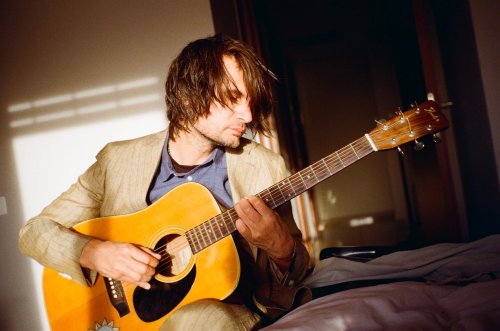
This photo of Jonny playing a Fender dreadnought acoustic was taken by his son Tamir.
To help publicize their upcoming Steve Reich Festival, The Hallé recently shared this photo of Jonny playing a Fender dreadnought acoustic guitar. Jonny will be playing Reich’s Electric Counterpoint on the third (and final) day of the festival.
Back in November 2012, Jonny answered fan and celebrity questions in an article for Uncut magazine. Nicolas Gauna from Buenos Aires asked Jonny about his first guitar and the first song he learned, and this was Jonny’s reply:
I bought a Fender acoustic for £40 from a “for sale” column in the Oxford Journal when l was about 14, then an electric one from my teacher when l was 16. I still have the acoustic, but the electric one was stolen in Leeds on the first Radiohead tour (at the Duchess Of York, I think… it was a cream Telecaster if anyone’s seen it). I don’t remember working out many songs by other bands - maybe “Psycho Killer" by Talking Heads. There was a tiny guitar room at school where teenagers hung out playing each other U2 songs - but I never had any U2 records.
Given Jonny’s penchant for stickers during his younger days, one can only assume that this is the same guitar that he played when he first strummed his way through Psycho Killer.
Based on the quote, the guitar was purchased in around ~1985, and was already used by that point. Fender had released their California series acoustics in 1983, but they were still relatively new and expensive. So it’s more likely that the guitar is from Fender’s standard F-series. Price lists show that the F-series was available from Fender through the 70s and 80s. The headstock confirms this: California series guitars have a Stratocaster-style headstock, whereas Jonny’s has a more traditional acoustic headstock with the distinctive F-series notch in the center. In addition, we can see a square “Fender” label through the soundhole. A cursory glance through Fender F acoustics shows that the square label was used in the 70s and early-80s, particularly on Japanese-made instruments. They seem to have switched to a round label in the late-80s. This gives further evidence that the guitar in the picture really is Jonny’s original acoustic.
Fender’s acoustic and classical guitar offerings in April, 1977 (guitar-compare.com). Given the price Jonny paid for a used instrument, it seems very possible that he bought a 1970s F-35 model. The more expensive models like the F-65 had fancier inlays and details, whereas the one in the photo has simple dot inlays on the fingerboard.
Great site, thanks for all the inspiration. Quick question, do you know if Jonny’s ‘Smile’ amp is a ‘65 reissue Super reverb or the Tone Master? Thanks Frazer
Jonny has a used few Fender Super Reverb amps over the past decade. He first used a vintage early-70s silver-panel Fender Super Reverb to perform Electric Counterpoint at the 2013 Open’er Festival, but he hasn’t been seen with it otherwise so he probably rented it (rather than bring one all the way to Poland for one piece).
The first Super Reverb that Jonny has used most consistently is a vintage mid-60s black-panel Fender Super Reverb. The amp was first mentioned in Jonny’s recording notes for the backing track to Steve Reich’s Electric Counterpoint, which he shared on Vine in June 2014. He used the amp more than any other on the backing tracks. He subsequently used the amp when he played the lead part of Electric Counterpoint at the Glastonbury Festival on June, 2014, likely using the backing track he recorded earlier that month (Jonny mentioned in an interview that he re-records all the backing tracks each time he performs the piece live). Jonny also used that Super Reverb for a gig with the London Contemporary Orchestra in Oxford, so it seems he prefers to use that amp for gigs in the UK.
Jonny probably also used that mid-60s amp during the recording of A Light For Attracting Attention, since he used it for The Smile’s first tour rehearsals in December 2021. It was later seen in the background during The Smile rehearsals at RAK in January 2022.
A screenshot from The Smile’s rehearsal of Thin Thing at RAK studio 1 in London on January 26, 2022 (Instagram) — that’s the same studio where Radiohead recorded The Bends. Jonny’s mid-60s Super Reverb can be seen on the right, with an Ashdown ABM EVO II head resting on top of it. Notice how yellowed the grill cloth has become over the years. His newer Super Reverb can be seen behind him on the left, with a much brighter grill cloth.
Jonny’s current touring amp with The Smile is a ‘65 Reissue Super Reverb, as we explained in this post. He probably bought the amp specifically for live shows, since it’s brand new in photos from rehearsals and concerts in January 2022 — it even has the green “Jensen Equipped” tag hanging off the channel 1 volume control. That tag is found on both the ’65 Reissue on the Tone Master. But it seems very unlikely that Jonny would take the time to remove the “Tone Master” label from the amp’s grill cloth if he didn’t even bother to remove the tag. He’s used that amp (probably with an identical backup) for all of The Smile’s touring in 2022.
Jonny with his current '65 Reissue Super Reverb, during a rehearsal with The Smile at London’s Magazine in January 2022.
A close-up of the control panel on Jonny’s '65 Reissue Fender Super Reverb (photo by Y_Grrrr).
Love Jonny's Fender amp sound... Wondering if you have any good ideas on the settings on his Fender super reverb for his solo stuff and The Smile? FluffyMomo over on Youtube gets an amazing sound with vol on 4, bright switch on, treble 3, mid 8.5, bass 7 - and he's usually spot on, but grateful for your thoughts!
Jonny playing his vintage Gibson Les Paul Standard during The Smile’s first show at The Magazine in January, 2022. His Fender Super Reverb can be seen behind him, with an Oberheim SEM synthesizer resting on top of it. Jonny plays the SEM using MIDI foot pedals, not his guitar, so it’s just resting on the amp for convenience.
As is always the case with settings, please remember that most commercial potentiometers have a tolerance of 20%. That means the value at any given position can be 20% more or less than the value you’d expect. So if you set a 100k pot with a linear taper to the middle, you’d expect to read 50k on the wiper (50% of its value). But you could just as well see 30k or 70k. If your knob positions are from 1 to 10, that means one pedal or amp’s 5 could be equal to another amp’s 3, or it could be equal to another amp’s 7.
Things get even messier with audio (logarithmic) potentiometers, because it’s very difficult to create a truly logarithmic taper on the resistive track of a potentiometer. Instead, manufacturers use different combinations of linear segments to approximate a logarithmic tape. Usually they switch from one taper to another at the 50% point, as can be seen in the graphs in a CTS Series 450G datasheet. So if a control has an audio taper, the variation in value at the 7 position can be pretty dramatic, even if you only compare pots from the same manufacturer.
Once you add in other manufacturers with different log approximations, it becomes clear that knob positions are very unreliable. The only safe bet is when the knob is at minimum or maximum, because most pots flatten out to give a reliable reading in the top and bottom 5% of the sweep.
And that’s before we start to discuss minor differences in the sound of your pickups, the specific speakers in the Super Reverb, whether or not the RE20 is turned on (which activates a preamp that cuts bass and highs), the length of your guitar cable, and any other factors that could demand adjustments to amp settings.
We list settings on Jonny’s page because they’re a good indication of how he’s using different bits of gear. But when it comes to getting a similar sound, you can’t rely on copying settings, you need to use your ears.
Jonny’s vintage Gibson Les Paul and his Fender Super Reverb at the Glastonbury festival on June 27, 2014. He used this setup for a performance of Steve Reich’s Electric Counterpoint.
Do you know what guitar strap Jonny uses for his gold top les paul?
First, I must point out that Jonny’s Les Paul is not a Goldtop. It is a Gibson Les Paul Standard in “natural” finish. If you search for photos of other natural finish Les Pauls from the late-70s and early-80s, you’ll see that they often have a slightly golden color, probably from aging.
As for the strap, Jonny has used both a black Ernie Ball Polypro strap (just about the most generic guitar strap you can find) and his old brown plastic-buckle guitar strap (visible in the photos below). The plastic-buckle strap is similar to the discontinued Levy’s M15 strap, but there are some notable differences… Jonny started using the brown strap around 1996, so it’s very unlikely that it’ll ever be identified.
You can read more about Radiohead’s guitar straps here.
A photo of Jonny performing Steve Reich’s Electric Counterpoint at the 2014 Big Ears Festival (pastemagazine).
Jonny’s Gibson Les Paul Standard and Fender Super Reverb Amp on stage before his performance of Steve Reich’s Electric Counterpoint at the 2014 Glastonbury Festival (synergyvocals.com).
When Jonny Greenwood joined the London Contemporary Orchestra on July 28, 2014, theRadioheadguitarist used 12 Fender ‘65 Twin Reverb amps, sending live guitar loops to individual amps for a true surround-sound experience! #thisisthesoundhttp://bit.ly/1vnAkwc
As you might expect, the setup was used for his performance of Steve Reich’s Electric Counterpoint. Likely, each of the pre-recorded electric-guitar backing tracks went to an individual '65 Twin Reverb Reissue. However, since there are only seven electric-guitar and two bass-guitar backing tracks (though the bass may not have gone through the Twins), it is unknown what the extra Twin Reverbs were used for. Note that these were not used for the lead/solo guitar track, which Jonny played live through either his Silverface Fender Super Reverb or his Vox AC30. I suspect, the former, since he generally seems to use the Super Reverb for Electric Counterpoint, and an AC30 for his own solo compositions like Loop and Self-Portrait with Seven Fingers.
The most likely option in my mind is that all twelve amps were never used at once. In this scenario, the amps were adjusted to different settings, and so different tracks were sent through different amps at different points during the performance. For example,
Gtr. 3 I. Fast - Twin No. 3 II. Slow - Twin No. 11 III. Fast - Twin No. 3
However, it is also possible that each Twin simply reproduced all of the tracks. This makes for interesting surround-sound, but it makes the use of so many amps a lot less necessary. It is also possible that a couple of the Twins were reproducing the more important tracks multiple times.
Regardless of the exact use, this is surely what Jonny was referring to when, prior to the performance, he tweeted about a “new take on Reich electric counterpoint (technical side willing).”
Hello :) I'm sorry if this is a stupid question, but I'd like to know what effects Jonny used when playing at Electric Counterpoint. I believe he's playing on a Les Paul, but I also spotted a Macbook and probably a looping station? I'd really appreciate it if you could help me out. Thanks in advance, have a nice day!
He isn’t using any “effects.” The piece is written for thirteen electric guitars and two bass guitars. A solo performer has the choice of either playing along to a tape recording (made by Pat Metheny), or recording all of the backing parts themselves and playing along to that.
Jonny chose to record all of the backing parts himself, and even mentioned rerecording the entire backing track track for each performance (he’s performed the piece thrice so far, and will do so again in May). The backing track generally consists of recording twelve guitars and two bass guitars, though Jonny mentioned recording only eight of the guitar tracks (source).
For the first performance (in Poland), Jonny played on his Fender Starcaster. He used a Boss FV500, and either a Boss LS2 or TU3. For that performance, its unknown which amp was used. He seems to have used an Avid Mbox USB to send the output of his Macbook Pro (his recording of the backing track) to the PA.
For the second performance (in Australia), Jonny played his Fender Telecaster No2. We can’t see a volume pedal during that performance, but the placement of his feet makes it look as though he’s using it for certain sections. He was using a Roland CUBE-30x to amplify either his guitar or the output of his computer. Since his computer seems to be streaming the backing track wirelessly (the only things plugged in to it are a power cable and a USB dongle) to somewhere, probably the PA, the CUBE is probably for his guitar.
For the third performance (in Poland, again), Jonny used his Goldtop Les Paul Standard (as you mentioned) with a Silverface Fender Super Reverb. Laptop again, though no video shows if he’s using an interface or a USB this time.
I suppose you could consider the volume pedal to be an effect, but the point is that no looping or delays of any sort were involved. He plays a perfectly clean electric guitar over a perfectly clean backing track. He even mentioned in an interview that he very much likes the fact that it is a perfectly clean electric guitar.
Jonny: you record eight guitars, and two bass guitars, and then you play one over the top.
Jonny: and you play along with that backing track. And you practice at home, every day for hours, until you’re just a little worse than when you started.
Jonny: and then you go and play in front of people.
According to Jonny, he recorded only eight guitar tracks for his own Electric Counterpoint backing track. Source.
Can you go over what's going on on the ACO Underground ft Jonny Greenwood (Radiohead) - Electric Counterpoint (Steve Reich) (Live) video? Sounds like guitar straight into laptop and pedal changes for different MAX looping programs including an overall pitch change at the end.
Jonny’s actually playing along to recordings which he previously made of all of the backing tracks for the song. There is no looping, let alone pitch shifting patches.
He seems to have the recording on his computer(he clicks a few things right before it starts playing.
His setup is very basic, as far as I can tell. From the first performance in Poland, I see: Fender Starcaster into Boss FV500 into Boss LS2 into Avid Mbox USB interface into Macbook Pro (15”?). I imagine that the combined guitar and recording go straight to the PA from there.
The ACO performance is a little different. There’s no USB interface directly next to his computer. The only cable trailing from his computer is his power cable, but there IS what looks like a Bluetooth device or Flash Drive. I suspect the former, since it would help to explain why there’s nothing connected to his Laptop. (I am curious as the why he would need a dedicated Bluetooth adaptor, since his computer should be able to connect fine without it. Boosting the signal, perhaps? Or is the ACO using a device which requires it?)
He also has some reverb on his guitar, at least at the ACO Underground performance, so perhaps he snuck in his Boss RV3, or is using some kind of reverb from his laptop.