Hang Tuah’s Footprint

On Friday Sharon and a pair of friends (Marc and Carolyn) and I hiked up and down the Tanjung Tuan Forest Reserve, to see the shrine / keramat dedicated to Hang Tuah’s footprint.
Hang Tuah is the archetypal Malay hero:
- learned (he spoke a dozen languages before he hit puberty);
- worldly (he embarked on diplomatic missions, as distant as the Ottoman Empire);
- loyal to a fault (he slew his bosom brother at the behest of the sultan, a jealous, cowardly man).
Arguably the Hikayat Hang Tuah—the text which most thoroughly recounts Hang Tuah’s deeds—was commissioned by royalty precisely to reify their position and provide subjects with a model for feudal obeisance (hence Tuah’s blind obedience).
He was also a hero with demigodly powers.
Maybe he was able to leap far and fly? Perhaps his martial arts were just that powerful. The site in Tanjung Tuan is reputedly where Tuah alighted, on one of his journey, thereby indenting the rock with his footprint.

It has been a venerated site for a long while:
“Some come to ask for children or partners, others come with chickens, to repay their good fortune,” he told BH.
Ishak laughed as he recounted his youth, where he and his village friends would wait for visitors to leave, before rounding up the chickens they’d left there.
According to him, visitors left live chickens as gifts for the spirit or saint they worshipped, following a taboo against slaughtering animals at the site.
When Sharon visited the site last, she saw the paved altar covered with food offerings and incense; fabrics girding surrounding trees and the lip of the nearby well; the paths swept clean, kept clear of trash.

Hang Tuah’s footprint is not a shrine any more.
The sign reads:
The practice of veneration / superstition
YOU WILL BE PUNISHED
Fine of RM2,000.00
Or
Jail of 18 months
Or
Both
Section 69 of the (Melaka State) Syariah Offences Enactment 1991
Thank You
For NOT practicing veneration / superstition in the state of Melaka

Now the paved altar is carpeted with leaves. The stone is bare. The trunks nude. There’s is an air of ruin. Trash is strewn on the path.

The well is naked, and silent, and green. Left to muck and pond skaters.
Carolyn remarked that it felt like violence had been done here.
I agree. A heritage, a culture, sprung up organically. A hero, wrestled by time and need away from the aristocracy to hear and serve the prayers of common folk, a trade in gifts and respect—
Once again repossessed and demolished by power. The state as uncaring cultural landlord.

We did what we could. Previous visitors, folks who still had respect for the site, had left small scarves behind, tucked into the ridges of the bark.
Sharon left a good-morning towel there, with the other cloths. I think this towel was an art object created by hrftype, a design studio; they are responsible for the text on it. “Cayalah!” is a Malaysian exclamation:
“You better believe it!”
Suluk Gatholoco

In his essay “Professional Dreams” (from The Spectre of Comparisons collection), Benedict Anderson discusses the Suluk Gatholoco – a long poem, composed sometime between 1854 and 1873 – “Javanese culture’s … great phantasmagoria”.
+
Dutch missionary C Poensen thought the Suluk Gatholoco disgusting, as the poem “in the grossest way goes into detail about matters which it is not decent to mention”. There were street rallies against its publication, in Surabaya.
Here is how the eponymous hero is described:
‘Shaped unlike a normal man
His body shrivelled, shrunk
And scaly, dry his wrinkled skin
Without a nose at all
Or eyes, or ears; his pleasure but
To sleep and sleep, day in, day out, continuously
Yet once aroused from his deep sleep
Unruly, not to be appeased.’
Gatholoco is ever accompanied by his retainer, Dermagandhul:
'Ugly his body, like a sack
His slumber deep beyond compare
When sleeping he was like a corpse
He too had neither eyes nor ears
Merely a pair of lips
Nor thews, nor bones.’
If you don’t get the joke: “gatho” (penis) + “ngloco” (masturbate); “derma” (closely attached) + “gandhul” (hanging down). That should help.

Gatholoco is the “only son of King Suksma Wisesa of Jajar … Appalled by the boy’s monstrous and repulsive appearance, the king bids him spend his first sixteen years in isolated meditation.”
After that the king clips Gatholoco’s head, and sends him out into the world:
’… warning him of a dangerous adversary, the female recluse Perjiwati, who is meditating in a mountain grotto.’
If the mountain grotto wasn’t a dead giveaway: “parji” (vagina).
Between Gatholoco and Perjiwati’s inevitable battle within her cave, our heroic phallus wanders, gambling and visiting opium dens. Between debaucheries, he gets into flame wars:
‘… a long series of vitriolic debates with “orthodox” Islamic teachers (guru santri) on the true nature of divinity, man, the cosmos, Islam, and much else. In every case he triumphs by his wit and depth of ngelmu … when his adversaries abuse him as a “tailless dog,” Gatholoco turns the tables on them by exploiting the assonance between asu (dog) and asal (origin, source) to interpret the insult as a deeper truth: that he is in fact the Perfect Male …
‘One after another, the guru santri concede defeat and flee his presence in profound humiliation.’
Basically an ambulatory penis, with his ballsack sidekick, mic-dropping religious authorities. Gatholoco’s antagonists typically espouse “Mecca-oriented Islamic orthodoxy”, while the hero himself represents a kind of “Javanese” Islam.
+
Here’s a short video I found about the work, in Bahasa Indonesia:
Probably something to be said about the way the reputation of a culture’s artefacts ebb and flow, according to the needs of nationalistic imaginings. While the Suluk Gatholoco was once seen as “an embarrassment to the emerging western-educated Javanese middle class, which was determined to make 'Javanism’ Victorianly respectable in their own eyes and those of the Poensens” –
– now it has been rehabilitated as a classic, with a deeply religious utility:
‘… this Suluk is a reminder to those who glorify syariah (religious law) above all else, to reach for a higher goal, that of ma’rifa (spiritual truth).’
+
( Image source:
http://sastrobuku.blogspot.com/2011/09/darmogandul-penerbit-tan-khoen-swie.html )
Flaming Vaginas + Warrior Wives
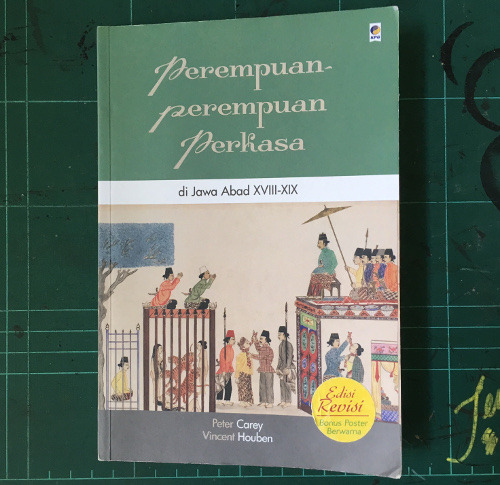
Been reading Peter Carey and Vincent Houben’s “Perempuan-perempuan Perkasa di Jawa Abad XVIII-XIX” (”Mighty Women In Java, 18th-19th Centuries”).
It’s in Indonesian, and my Indonesian’s not great, so it is slow-going. Here are some bits, ineptly translated:
+
FLAMING VAGINAS
“Two examples of female figures from pre-colonial Javanese history who functioned as the foundations of dynasties and wellsprings of magic power are Ken Dedes – Queen of Singosari and wife of the famous Ken Arok, King of Tumapel-Singosari – in the early 13th Century; and Dewi Mundingsari – second daughter of Raja Sigaluh of Pajajaran …
“Both women were so ‘hot’ – in magical terms – that their vaginas burned with light, and only men of extraordinary mystic ability could wed them (Brandes 1897:35-49,53). According to the Pararaton (The Book of Kings) … such ‘hot’ women are ardhanariswari – the annointed among womankind.
“A man – however poor or low in social status – who could have a child with such a woman is destined to become a famous king (Schrieke 1957:72). This was why Ken Arok, who according to legend was a commoner – even though he was said to have the blood of Vishnu – became king of Tumapel-Singosari.
“The princess of Pajajaran, Dewi Mundingsari, in the Serat Sekondhar, was also so ‘hot’ no prince of Java could wed her. In the end the unfortunate princess was sold to the Dutch, with a dowry of three cannon – three objects shaped like the male lingam. The mystic Baron Sukmul – father of Jan Pieterszoon Coen, the Dutch-Javanese pioneer – married her, founded a new kingdom (Batavia) in the port of Sunda Kelapa, and was considered a successor of Pajajaran …
“The significance of these women – Ken Dedes and Dewi Mundingsari – was their incredible spiritual strength. With this power they lent their husbands kingship, a royal legitimacy that could be inherited by progeny (Schrieke 1957:71-2). Meanwhile, the ability of the husbands who could tame these women’s extraordinary force – as symbolised by their shining vaginas – demonstrated how male power, otherwise harmful to the peace of the world, could be channeled into courses where it brought fecundity and harmony (Lind 1975:116-7).”
+

NYAI KIDUL, QUEEN OF THE SOUTH SEAS
“… Queen Kidul is the protector-goddess of Mataran and the mystic consort of its kings. In the Babad Tanah Jawi (Olthof 1941:78-9,140), both Panembahan Senopati (circa 1584-1613) and Sultan Agung (1613-46) were said to have left Parangtritis to meet the Queen in a spirit-filled palace under the sea. There they made love to her. This intimate and special relationship between the founders of Mataram and the Queen ushered a golden for that kingdom in the early 17th Century …
“In Surakarta, the most important dance honouring the Queen of the South Seas is the Bedoyo Ketawang, a classical dance that involves nine female dancers; these dancers must be young women of noble or royal descent. The choreography sketches a meeting between Queen Kidul and Senopati, and the Queen is praised, and given offerings of intricate batik cloth and her favourite foods (De Cock Wheatley 1929:208; Tirtaamidjaja 1967:31-61; Hadiwidjojo 1972:117-26; Hostetler 1982:127-42). When the dance is performed correctly – when its dancers are ritually clean (not menstruating) and calm of heart – the Queen manifests by entering the bodies of one of the dancers. In this trance state, that dancer is guided to the Proboyekso (the king’s private chambers), where she will make love to the king in a ritual that recalls Senopati’s mythic seduction of Queen Kidul.
“According to Boow (1984:4), the king identifies which dancer is possessed, because he sees a greenish glow issue from her vagina – a detail that reminds us of the symbolic “fiery cave” of a Ken Dedes or Pajajaran princess, as discussed previously.”
+

PRAJURIT ESTRI – WARRIOR WIVES
“A special feature of south-central Javanese courts often cited by Dutch accounts is the number of women in them. Francois Valentijn (1666-1727) … commenting about the Mataram palace in Kartasura in the early 18th Century, reports that over 10,000 women lived in the court’s environs …
“When the king miyos (emerged) from the palace to meet with his subjects … he was always flanked by a troop of all-women bodyguards. They were called abdi-Dalem Priyayi Manggung or prajurit keparak estri (or Langenkusumo troopers), and their number was drawn from district-level gentry.
“Variedly armed – with shields, bows, poison-tipped arrows, spears, blowpipes, and rifles – ten of their number were charged with bearing the royal regalia: drinking vessels, boxes for betel and perfumes, tobacco pipes, golden umbrellas and special clothing …
“Though the most beautiful princesses were chosen, often with much care (Ricklefs 1974a:304 note 42; Carey 1992:413 note 73), they rarely became concubines, and were often “gifted” to nobles as wives. As wives of court nobles, they were considered to be more fortunate than concubines, who cannot accept offers of marriage so long as the king still lives, and sometimes even after (Kumar 2008:6). According to Valentijn, the prajurit estri given thusly as wives looked “happy and proud” at the prospect, knowing that their princely husbands would never dare to mistreat them, lest they incur their liege-lord’s wrath (Kumar 2008:6, quoting Valentijn 1726:59-60).
“The expansion and training of the prajurit estri was something of an obsession for the second Sultan of Yogya. His mother, Ratu Ageng (ca. 1732-1803) … served as the first commander of the sultanate’s “Srikandi Corp”, in the early days of the Yogyakarta court, post-November 1755 (Carey 2012:90). According to Javanese sources, there was much grumbling among the husbands and fathers of the realm at the end of the 18th Century, because so many young wives and daughters were conscripted into the prajurit estri …
“In the late 18th and early 19th Centuries, military-minded senior VOC officials expressed their wonder at the skill of these prajurit estri as mounted soldiers. Jan Greeve, Governor of Northeast Java (1743/4-1793, served 1787-91) … was greeted at the Dutch Settlement in Mangkunegaran, where female soldiers fired salvos 'of such accuracy and regularity that we were amazed’, ‘they fired their hand weapons [cavalry carbines] thrice with great accuracy … followed by volleys of small arms [Javanese-made light artillery designed for cavalry use] arrayed by their sides …’ (Kumar 2008:11-12). The skill of the “Srikandi Corp” at firearms stood in stark contrast to that of the male palace soldiery, who were notoriously ill-trained in long rifles and artillery (Carey 2012:9).
“ … these warriors were not just for the parade ground, but possessed real fighting ability, as the English saw in their attack on the Yogya court on 20 June 1812. One of the unfortunates of that incident was a Scots lieutenant from an English regiment, Hector Maclean (ca. 1790-1812). He attempted to carry off a court princess as a spoil of war, but was stabbed for his troubles. (d’Almeida 1864, II:136-7; O’Donnell 1893:100; Carey 1992:414 note 78; Carey 2012:245).”
+
(From Gadis Buku, fine purveyor of Indonesian titles. Mun Kao spotted this at their table, at a book fair we were part of two weeks ago.)
+
(Image source:
https://commons.wikimedia.org/wiki/Category:Nyai_Roro_Kidul#/media/File:Kanjeng_Ratu_Kidul.jpg )
“Of Palm Wine, Women and War”

In 1293, a year before the end of his reign, the Great Khan Khubilai, founder of the Yuan Dynasty, dispatched an army to Java.
David Bade’s “Of Palm Wine, Women and War” is less about that expedition itself than the historiography of that expedition - how it is remembered, and by whom.
Bade:
“ My original interest in the whole episode was the existence of these views of the Mongols which are so different from those views propagated among the Christian and Muslim populations of Eurasia. How is it that the Europeans remembered hordes from Hell but the Javanese remembered the friends of Wiraraja, the jolly good fellows who came to the aid of the great and good king Wijaya in his hour of need? ”
+
Notes:
1.
As mentioned above, the way Javanese source texts remember the Mongols bucks convention.
Contrast the Japanese on Khubilai’s two invasions of Japan: “ … there was fortunately no third attack, but the Bakufu has exhausted its strength in national defence almost to the point of ruin.”
To the Javanese view of 1293: a time of romance and princely derring-do, of heroes winning great loves and great kingdoms, with the Mongols as helpful foreigners - kinda naive, kinda hapless.

(Mongols in Japan.)
2.
Chinese sources view the Javanese expedition as a failure.
It is a force of 20,000 men and loads of materiel; it endures storms and starvation; when it gets to Java it faces a confusing political landscape, sides with Tuhan Pidjaya, a tricksy local prince - “ … Tuhan Pidjaya secretly left our soldiers and attacked them by which the whole party came to grief.”
Short 3,000 lives, the expedition returns to China, and Khubilai chastises its generals for bungling the thing.
3.
According to Chinese texts, Khubilai sends a force to Java to answer an insult:
“ … that they have lately cut the face of the imperial envoy Meng Ch’i and that you have come to punish them for that.”
Bade flags the envoy figure as interesting. The Mongols were universalists - just as there was one Heaven under Tengri, there was one Earth under the Khagan. All the wars they fought were *civil wars*; they sent envoys to ask for submission; armies followed only when the envoys were rejected.
Proof of Java’s “rebellion” was essential for Yuan court writers to justify the 1293 expedition.

(Uncle Khubilai looks kinda jolly what.)
4.
For the Javanese, the story of the late 13th Century is the story of the founding of Majapahit, Java’s greatest empire.
The source texts mainly concern themselves with events surrounding Raden Wijaya (Tuhan Pidjaya), Majapahit’s first king: what he did; the princesses he loved and rescued; how he won his kingdom.
In this context the Mongols are almost a deus ex machina. They arrive in Java to assist Wijaya against the usurper and hostage-taker Jayakatwang. Some sort of hand of Fate pushing Wijaya to victory.
5.
Javanese narratives fixate on the role of a few princesses - chiefly Puspawati and Pusparasmi, daughters of the deposed king of Singhasari.
Their romance with Wijaya takes centre stage. He and the Mongols attack Jayakatwang, mainly to rescue the younger of the two from Jayakatwang’s palace.
When the Mongols want to take Pusparasmi home to wed their king, Wijaya “asks her if she wouldn’t rather be the wife of the King of Tatar. She declines, and Wijaya decides he will fight to the death for her. A battle follows, the Tatars are defeated … “
6.
According to Bade, the nature of authority in Java focused on the duality of king and queen:
“ ‘the queen embodied the king’s royal authority (rajalaksmi) and the king’s marriage to the queen ensured him legitimate possession of the authority he required to rule’ … Only the king who loved and was loved had authority and could receive the willing submission of the people.”
The princesses are stand-ins for Java itself. Wijaya must love and fight for their welfare; this is proof he loves and fights for Java as a whole. The foundation myth of Majapahit is necessarily a romance.

(Raden Wijaya.)
7.
Bade points out that the Chinese texts never mention the princesses. Similarly, the Javanese texts never mention the envoy.
The two separate strands of history do not reference each other until the modern era:
“ … from the time of the composition of the ‘Desawarnana’ in 1365 until the mid- or late-19th century the Javanese may not have known where the land of Tatar was nor that the King of Tatar was Khubilai … ruler of China … it was not until the mid-19th century that Chinese and European scholars could locate the ‘Koua-wa’ - Java - of the ‘Yuan shi’ … both the court historians and the poets in Majapahit and China alike were writing about matters which happened ‘long ago and far away’. “
What the Mongols thought important were not what the Javanese thought important.
8.
Historians have tended to favour the Chinese / Mongol sources, because they are seen as dispassionate, more factual.
The Javanese texts are dismissed as fanciful literature: epic poems that involve magic, sleep mantras, princes ascending into heaven, etc.
Bade rightly points out that is a massive omission.
At base level, no matter their factual reliability, Javanese narratives offer insights into how Majapahit saw / wanted to see itself. (Some sources were even authored by eye-witness players - Jayakatwang wrote the “Wukir polaman”; Wijaya wrote the so-called Kudadu inscription.)
9.
“ Nordholt remarks that ‘There are in Balinese literature no separate genres called “history” and “fiction”. Consequently the distinction between true stories and (false) fantasies makes little sense.’ He proposes that one must … view the babad as political documents which ‘construct - and re-phrase - that past in order to make the present meaningful’ … “
10.
Also, there’s an argument here about the idea of What Is History, itself:
“ [Roy Harris] argued that the historians’ versions (historiae) are shaped by opinio as much as the reverse, and that both are dependent upon opinio - what people said and say happened - because that is all any of us have at our disposal. Once this is acknowledged, historiae and opinio both matter, both shape our historical orientations, and both are debatable. The kidung [ie: Javanese] literature and Shakespeare’s histories, whetehr the professional historians like it or not, shape our understanding of the past as well as the questions that we ask and how we read and write historiae. ”

(Wijaya and Rajapatni - another name for Pusparasmi, I think? - on a date in shoujo-land.)
11.
Bade attempts to argue against the idea that the princesses in the Javanese stories are just “pawns in the forging and severing of alliances … the ultimate prizes for successful heroes”:
“ … the Javanese narratives tell the story of the submission to love rather than to power … Wijaya submitted to the princesses, not to the King of Tatar … the great period of Majapahit was great because the king was a true lover. … we may see instead a didactic poem about the centrality of love, admonition to the readers to remake the world as lovers like Wijaya, not as grasping usurpers of power who capture, abduct and try to dominate others, including and especially the female other. ”
Bade waxes a little saccharine, here, and I’m wary of how true-love-of-a-woman-will-redeem-a-man it all sounds.
12.
Disappointingly, the palm wine of the title barely makes an appearance. (It’s a reference to Wijaya partying with the Mongols after their victory over Jayakatwang.)
+
(Basically I stole this book from Mun Kao’s library. His research project, A Thousand Thousand Islands, is super cool. You should support it.)
+
( Image sources:
https://commons.wikimedia.org/wiki/File:Takezaki_suenaga_ekotoba3.jpg
https://commons.wikimedia.org/wiki/File:YuanEmperorAlbumKhubilaiPortrait.jpg
https://en.wikipedia.org/wiki/File:Illustration_of_Raden_Wijaya.jpg
https://soumen667.deviantart.com/art/Raden-Wijaya-and-Rajapatni-701957521 )
Stones And Wood
Selvam, our gardener, goes to temple every Friday.
The temple he goes to is quite small. It is six feet by twelve, and about twice as tall as I am. It is painted cyan, but green with moss.
It has a cement floor, and zinc roofing, and electrical cables running along its upper sides, for fluorescent-tube lighting.
These things are recent; the temple itself is old. The temple has a peepal growing out of it. A very handsome tree: enraptured branches, languid leaves, and roots like dreadlocks entirely draping one of the temple’s walls.
The tree and the temple have certainly been here longer than Malaya has been a nation.
~
When we go to see the temple Sharon and I cannot see who it is dedicated to.
We recognise the flanking deities: one has an elephant’s head; the other sits on a peacock. Ganesh and Murugan, standing like bodyguards.
But the primary murti is hard to make out, and its sanctum intimidates us a little. I do not take pictures, much less step inside, not wanting to be any more rude than we already are - bloody tourists.
~
I ask Selvam about it later and he say: “Oh, a goddess, a goddess. Mariamma. She is Ganesh and Murugan’s mother.”
Selvam tells me a fun story:
Do you know how Ganesh got his head?
One day, when both brothers were still young, Mariamma offers them mangoes as treats - on the condition that they go get some exercise: “Go now, go and circumvent the entire world.”
Murugan, being the athletic one, zooms off.
But Ganesh, being the cheeky one, circles around mommy Mariamma and daddy Shiva three times, and coos: “You are my entire world, o mother and father.”
And when Murugan gets back from his run, he sees Ganesh sucking on a mango. Because buttering up your parents tends to work well.
Of course Murugan loses it. He lops off Ganesh’s head. Ganesh is alright - he gets his head replaced by Shiva - but Murugan has to go off to live on a mountain, to sulk and repent over his attempted fratricide.
~
The small temple to Mariamma stands at a fork in the road inside St Leonard’s Estate.
St Leonard’s was a rubber plantation, and Selvam’s family was brought to this country to work there. They traveled across the world, and brought their mother goddess with them.
Their goddess sprouted a tree and became part of this land. She has her sons - as well as a local guardian: a termite mound, covered with turmeric and little brass cobra figurines.
~
St Leonard’s colonial administrators have left.
Now it has local, corporate administrators. The plantation grows oil palms now, and its workers are Indonesians, because their labour is cheaper.
Selvam and his family do not live on plantation land, anymore. They live in a housing estate next to St Leonard’s. There’s a guardhouse between them and their temple.
“Aiya, why did you two go on a Friday afternoon?” Selvam says.
“Prayers are only on Friday evenings. At night! Next time I take you. Every full moon we have big prayers. I’ll take you then.”
~~~
(There is a school inside St Leonard’s. Google identifies two Hindu temples nearby, but neither is the temple Selvam goes to. His is unmarked.)
Now Reading: Mubin Sheppard’s “A Short History of Negri Sembilan” (Part 2)

Here is Lieutenant T J Newbold of the 23rd Regiment of Madras Light Inf. writing about the Dato Klana Kawal, lord of Sungei Ujong, in 1833:
“ ‘His features are regular and pleasing. His dress shows a taste for finery consisting of a red baju or surcoat, flowered with yellow, a broad crimson sash encircling his waist, in which was inserted several weapons of Malayan fashion, a Battick handkerchief, with the bicornute tie, and a plaid silk sarong descending to the knees; underneath the plaid he wore short embroidered trousers. In the left hand slash of his close vest of purple broadcloth, lined with light green silk and adorned with silk lace and small round buttons of gold filigree, was a watch of antique shape, to which were appended a gold chain and seals. He wore his hair long.’ ”
“Kawal” is the name; “Dato Klana” the title - a Bugis title, incidentally, which intimates Sungei Ujong’s propensity to ally itself with foreign powers. (Oddly enough, the word “kelana” means “to wander” - but also specifically applies to warrior-adventurers.
“Melewar”, “kelana” - Negeri Sembilan was awash in adventurer-types, it seems!
Now reading: Mubin Sheppard’s “A Short History of Negri Sembilan” (Part 1)

So I’ve been reading this history of Negeri Sembilan, my home state. It was founded by dude named Raja Melewar - literally the “Wanderer Prince”:
“ Raja Melewar’s rise to a position of influence was probably a gradual process, and may have been partly due to local disputes and rivalries … in other areas minor Chiefs and their supporters probably found it to their advantage to link themselves to the warrior prince, who had in the course of his wanderings (melewar) won their confidence, and who could settle their disputes without interfering with local autonomy. “
A strong argument for adventurer-types never to dump-stat Charisma!
Raja Melewar established his court at Sri Menanti, a fertile valley that came to be called “Tanah Mengandong” - the Pregnant Land. His four main court officials bore these titles: Dato Seri Amar di-Raja; Dato Raja di-Wangsa; Dato Dagang; and Dato Akhirzaman -
Which are pretty fucking awesome titles:
Elder of the Royal Law. Elder Prince of the Blood. Elder of Burdens. Elder of the End of Ages.
Anyway: Raja Melewar’s constitutional formula is something I vaguely remember from my classroom history books:
“ Alam Ber-Raja,
Luak Ber-Penghulu,
Suku Ber-Tua,
Anak Buah Ber-Ibu Bapa. ”
(“ Creation has a King,
The State has a Lord,
The Tribe has a Chief,
The Family has Parents. ”)
Which sounds like a Confucian-style, order-under-heaven hierarchy - with one major difference. Negeri Sembilan was founded as an elective confederacy; the families elect their chiefs, who in turn elect the lords, who in turn elect the king.
Instead of “king” or “sultan”, Negeri Sembilan’s monarch is styled “Yang di-Pertuan Besar” - One Whose Is Made Great Lord - so they remember where their legitimacy comes from.
(Raja Melewar’s reign is remembered as a golden age - but there were succession wars as soon as he died, of course. Because feudal lords tend to be squabbling assholes, like that.)
Stones And Time
There are megaliths in the town next to mine.
Single standing stones, thrust out of the earth. Not very big. The tallest is a foot and a half above my head - though they are said to grow, very slowly, living things.
Three have nicknames. They are called the Sword, and the Spoon, and the Rudder, for their distinctive shapes. Their carved motifs are only vague suggestions, now; time has taken away their edges; made them animal and curvaceous.
My guide tells me: “They say these are meant to represent oars. Oars, because of maritime culture.”
The stones bow over us, like the open palms of gods. “Come on,” she says. “Don’t these look like hoods, to you?”
These stones are serpents, nagas.
~
These naga stones share their site with the tomb of a Sufi sheikh. He was a learned ulama, and warred with the Sultan of Malacca in the 15th Century.
His tomb became a keramat, a place of power. Pilgrims would come here to ask for blessings.
Here is a pillar, waist-high, with a hole in it. Put your arm in, and speak the truth. If you lie, the stone will tighten like a vice.
I don’t dare try.
~
It is the sheikh’s tomb that is the focus, even though the nagas are twice as old, millennia old.
But then official Islam has problems acknowledging a time before it existed.
Official Islam has problems acknowledging aspects of itself. Seeking magic is seen as a shameful paganism, as impure. So none of the inscriptions in this entire site talk about the fact that this place has power.
And yet.
An ustaz from the religious department functions as the tomb’s caretaker. “He complains,” my guide tells me. “Young people come and leave rubbish.”
My guide points at shrivelled flower garlands and rotting fruit, left on the tomb’s surface. “What kind of youngsters leave stuff like this?“ she says.
“People who need to still come here. And these are most likely Muslims.”
~
There is a well nearby. “These kind of places always have springs,” my guide says. Definitely older than the tomb. And maybe older than the naga stones.
“Aiyo, who has done this?” she says.
I look in. Dimly, I see plastic bottles and styrofoam rice packets, floating about the water’s surface, and a film of red oil shining.
My guide draws some sacred spring-water up, touches some to her forehead - then, before I can react, flicks some at my face.
~~~
(The town is Pengkalan Kempas. My guide was Simryn Gill. The saint’s name is Sheikh Ahmad Majnun.)
(Click on those teensy-weensy arrows at the sides of the above pic to flip the card back and forth, back and forth …)
This postcard depicts “Haw Par Villa pack (sic) with holiday visitors”, according to the caption on its back. (I did not colour-correct the photo at all; Haw Par Villa is just that psychedelic.)
It was sent to Ms Cherry Neo, a young schoolteacher, from one of her students in 1966. That was two years before Ms Neo got married to my father and became Mrs Siew.
It’s part of a stack of my mum’s old postcards, which Sharon found stashed in one of the house’s side-tables a while back. The collection has photos of tin-mines in Selangor; modernist government buildings in Johor Bahru; a practically-deserted Causeway; a sampan floating down a rustic riverlet, labelled “Canal Transport Singapore”.
We’ll be road-tripping for the next two weeks, trying to find out what these picture-perfect places look like nowadays. Woo hoo, wish us luck!
(I’ll be trying to finish my novel on the road. Urk.)
