

I recently wrapped up my Dolmenwood campaign of nearly two years. This was the first non-5e campaign I played or ran (in the modern era anyway – I played other things in the 1990s before a long hiatus), and it really challenged me as a DM and changed the way I think about running campaigns, and gave me an appreciation for a style of play that uses well-curated random tools and procedures on top of worldbuilding to give adventures that are unplotted but that have drive and momentum anyway, and that are really engrossing for both players and GM.
Beginning Play
It was a bit difficult for our group to start Dolmenwood because we lacked a lot of the context of the game. I had never heard of B/X (the game is built on the chassis of the early D&D Basic/Expert Rules). I did not know that Dolmenwood was an OSR game, or really what that was (a style of gaming more aligned to early playstyles, please don’t ask me to explain, people fight about it all the time). I had no idea it was related to Old School Essentials (a clone of early D&D written by the Dolmenwood author, Gavin Norman). I wrote about some of my early impressions on a blog post about coming to Dolmenwood from 5e.
Essentially, we took what was in the package (well, at first, the not-quite-final Kickstarter PDFs) and that was what we had. Before we started, I gave each player the assignment of reading part of the player book and then they helped me on the rules. We were only going to do a trial, using the included adventure Pipes on Droomen Knoll. Well, by the end of it we were hooked.
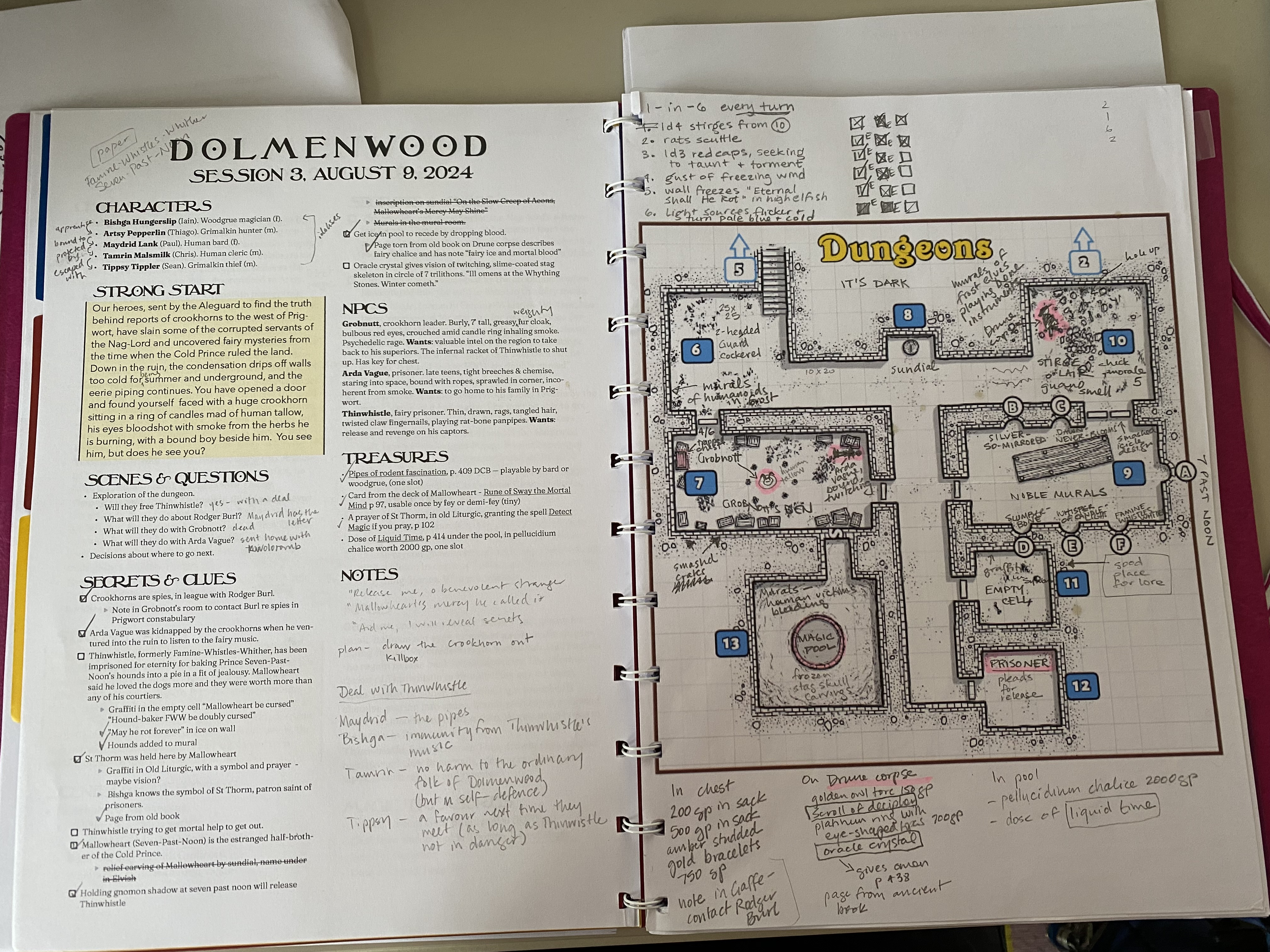
Our Campaigns
After Droomen Knoll, I wrote a dungeon about the Shrine of St Hollyhock
then another about the lost Shrine of St Tumbel
then we played through the Ruined Abbey of St Clewyd (which is the best adventure I’ve ever played)
this was 41 sessions

then we started with new characters and Emelda’s Song
which ended in a TPK after 8 sessions, and Lord Malbleat being grievously injured
then we started with new characters again in a random hex (rolled, d20 and d12), which turned out to be in the Mushroom forest, looking for a fungral cure for Malbleat, but instead entering a fairy road and playing the entirety of the Labyrinth game before being spat out over the Dark Mirror, then entering the town of Meager’s Reach
then I wrote an ogre dungeon and finally we finished off battling an undead sorcerer for control of a nodal stone, in total 24 sessions.
That’s 73 sessions total.

Why This is the Best Game
This game made me feel like I was a genius GM at nearly every session, and built my confidence really high. I mean sometimes I did terrible prep, and it was still amazing just using the tools at the table. Did I read the whole campaign book? Nope. I basically read the hex the players were in and the hexes around it, and all the faction stuff.
What I loved about this game:
- The campaign book is so loaded with lore and so well-structured that anything I did was automatically supported and flavored beautifully. The Dolmenwood Campaign Book is the best RPG book I’ve ever had. The monster book is no slouch either. Gavin Norman is a genius and I will fight anyone who says otherwise.
- The B/X system included is really tightly interwoven with the campaign, using the player book it’s impossible to create a character that feels “off” or outside the setting. There’s a lot of amazing world-focused crunch, while the side-based combat manages to be tactical, fast, and scary. The Player Book, in my opinion, is the weakest of the three because the rules for new players and DMs are complex and spread around. I made a compact rules document, B/Xie, and a couple of cheat sheets and I used them all the time: here they are if you want them: Dolmenwood resources for you.
- Three different kinds of magic, each working slightly differently, yes please. The Fairy and Holy spells added so much flavour and texture to the game.
- The absolute note-perfect tone of the whole game. The attention to detail.
- The art, it’s so beautiful.
- The focus on player roles, right from the start, set a great tone for us. The players drew all our maps, made the chronicles, organised the combat through the caller and kept things together for the quartermaster. I did have to take over the XP.
But above all, I loved the joy of exploration. I loved reading each hex. I loved describing each monster and the players going “What the hell is that? (The bard player ended up writing a whole book in verse about the monsters). I loved introducing the factions. I loved that they never realised they’d met a bunch of Witches. The joy in my heart when the players were swept up in the Wild Hunt for an entirely improv’d session. When they met a band of Free Cobbins having a party under a tree. When they saw the art of the Charge. When they found what was on the menu at the local inn. When we rolled for treasure. When my random encounter rolls introduced a major subplot. For me, and for the players, the world was really alive, unpredictable, amazing, and full of wonder.
Q&A
Questions people keep asking so I’ll answer them here:
- Q Can’t I run this in Shadowdark?
- A If you do, you’ll need to convert the spells and classes and restructure treasure and change the resting rules and… like it’s actually kind of a lot of work, and the original system is really good, so my take is that it’s really not worth it. Of course, people have already done a lot of conversion, but of course also, the licenses for both Shadowdark and Dolmenwood prohibit publicising the results.
- Q Is this a cute setting or a dark setting?
- A It can be many things. My first campaign was quite heroic, the second much less so, and the third basically followed the adventures of an evil, cowardly, bombastic knight and his retinue.
- Q Why did you stop playing?
- A I mean, nearly two years is a long time and I’m a person who seeks variety by my nature. And one of the players had to suddenly stop because of Life Things.
- Q Any changes you made or house rules you used?
- A Yes, I began rewarding exploration and deeds with XP in line with some of the optional rules in the campaign book. Also, I made it easier for the Magician characters to study for spells so they didn’t fall behind.
- Q Best magic item?
- A A lance I called “The Diplomat” with the (randomly-rolled) property that the wielder cannot tell the straight truth. This ended up in the hands of a retainer, the squire Jospher, who subsequently declared things like he loved to be first into the hole in the dungeon, and he really admired PC X, and he hoped he never returned home and things like that, great comic relief. Speaking of which, retainers. Get them. Awesome.
- Q How did you handle the mapping?
- A I gave the players the player map, and then they filled the hex map in as they went. Annotating the map was quite fun. I also shared the settlement maps any time we went into a settlement.

Finally, of course, the table is the thing
I had the luxury of amazing players, and I think in this game we all challenged each other with who could be the most awesome, but in a really good way. We started with six players, which quickly became five players who showed up week after week after week. We were all online and met on Sunday afternoons Swedish time. After about a year, one player had life stuff that caused them to withdraw; after several months more, a player who had been getting up to play at 7am Sunday (California time) decided he needed to reclaim sleep, but at the same time, the first player’s life stuff had settled down enough to return and play to the end of the campaign. My players: wrote books, gave eulogies, recited prayers, sorrowed for dead imaginary monks, attempted fishing, smoked a lot of strange pipeweeds, participated in trivia contests, fought with their imaginary families, found their imaginary families, grumbled about taxes, won limbo contests, rode devil goats and were my solid anchor for several years. (Players, if you are reading this: you know who you are and how much I love you all.)


Leave a Reply