The Contingent HOD Dichotomy, CUNY Logic Workshop, October 2026

This will be a talk for the CUNY Logic Workshop, 23 October 2026, 2pm, at the CUNY Graduate Center in midtown Manhattan.

The Contingent HOD Dichotomy

Joel David Hamkins, O’Hara Professor of Logic, University of Notre Dame

Abstract: We shall discuss the contingently contingent nature of the class HOD of hereditarily ordinal-definable sets. In some models of set theory the axiom V=HOD is contingent by set forcing and in others it is not. After discussing some philosophical and historical puzzles concerning the nature of ordinal definability, I shall introduce and investigate what we call the contingent HOD dichotomy. Namely, it is provable in ZFC that either (1) the set-theoretic universe V is close to HOD in several respects: HOD is a ground model of V; the axiom V=HOD is forceable by set forcing; every object is ordinal-definable with a single additional parameter; and furthermore all these things are forcing invariant and hold throughout the generic multiverse; or (2) the universe is far from HOD; in particular V ≠ HOD;  more generally, HOD is not a ground; the axiom V=HOD is not forceable; the universe is not ordinal-definable from a parameter; and these things hold invariantly throughout the generic multiverse. We shall explore how the dichotomy engages with large cardinals, with set-theoretic geology, with the maximality principles, and with Woodin’s HOD dichotomy.

This is new joint work in progress with Bokai Yao (Peking University).

On the contingent contingency of V = HOD and independence over the maximality principles, Fudan University, Shanghai, July 2026

This will be a talk for the Fudan University logic group on 16 July 4:00pm in Shanghai.

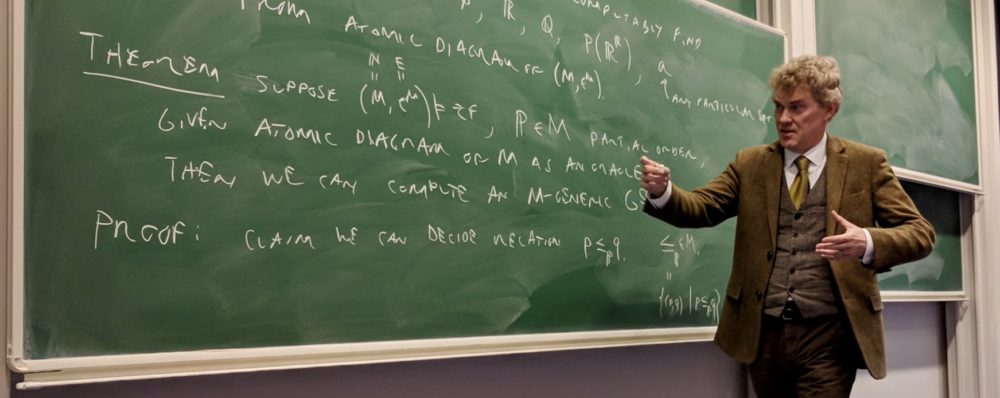
Abstract: The axiom V = HOD is contingently contingent—more precisely, it is class-forcing contingent that V = HOD is contingent with respect to set forcing. It follows that V = HOD and □(V ≠ HOD) are logically independent of the maximality principles MP and MP(ℝ) over ZFC. I will give a full review of the relevant notions. This will be a chalkboard talk concerning very new joint work in progress with Bokai Yao (Peking University).

The paper is in progress and will be available I expect in a few weeks.

Set-theoretic mereology as a foundation of mathematics? Shandong University, Workshop on Mereology, China, June 2026

This is a talk for the Workshop on Mereology at Shandong University in Jinan, China, a part of the week-long conference Week of Fusion Philosophy, 22-26 June 2026. The mereology talks are on 22 June 2026.

Title: Set-theoretic mereology as a foundation of mathematics?

Speaker: Joel David Hamkins, University of Notre Dame, Peking University

Abstract. Mereology, the study of the relation of part to whole, is often contrasted with set theory and its membership relation, the relation of element to set. Whereas set theory has found success in the foundation of mathematics, since the time of Cantor, Zermelo and Hilbert, nevertheless mereology has been strangely absent. Why is this? In this talk, I shall introduce and discuss set-theoretic mereology, a form of mereology based upon the set-theoretic inclusion relation ⊆ rather than the element-of relation ∈. In particular, we shall investigate the role to be played by set-theoretic mereology in the foundations of mathematics, and come perhaps to an explanation of why it has been absent. 

The Modal Logic of Forcing and Set-theoretic Potentialism, Peking University lectures, June/July 2026

This will be a series of graduate lectures at Peking University, two lectures per week beginning mid-June and proceeding into July.

Topics. We shall aim to cover the central results in the modal logic of forcing, including an exploration of the main tools, and then explore how those ideas apply more generally in set-theoretic potentialism and other potentialist contexts, such as arithmetic potentialism and modal model theory. For prerequisites, students should be already familiar with some graduate-level set theory, including the basics of forcing, as well as standard tools from mathematical logic and model theory.

The lectures will focus on various research papers, as follows:

  • Joel David Hamkins. “A simple maximality principle.” Journal of Symbolic Logic 68.2 (2003),pp. 527-550. doi:10.2178/jsl/1052669062. arXiv:math/0009240.
  • Joel David Hamkins and Benedikt Löwe. “The modal logic of forcing.” Trans. AMS 360.4 (2008), pp. 1793-1817. doi:10.1090/S0002-9947-07-04297-3. arXiv:math/0509616.
  • Joel David Hamkins and Øystein Linnebo. “The Modal Logic of Set-theoretic Potentialism and the Potentialist Maximality Principles.” Review of Symbolic Logic 15.1 (2022), pp. 1-35. doi:10.1017/S1755020318000242. arXiv:1708.01644.
  • Joel David Hamkins and Wojciech Aleksander Wołoszyn. “Modal Model Theory.” Notre Dame Journal of Formal Logic 65.1 (2024), pp. 1-37. doi:10.1215/00294527-2024-0001.
  • Joel David Hamkins and Øystein Linnebo. “Second-order Potentialism.” research manuscript in preparatoin.
  • Joel David Hamkins. “The Modal Logic of Arithmetic Potentialism and the Universal Algorithm.” Philosophia Mathematica 34.1 (2026), pp. 137-182. doi:0.1093/philmat/nkag001.
  • Joel David Hamkins. “Every countable model of arithmetic or set theory has a pointwise definable end extension.” Kriterion Journal of Philosophy (2024). doi:10.1515/krt-2023-0029. arXiv:2209.12578.
  • Additional readings may be added, if time permits.

A potentialist perspective on ultrafinitism, Ohio University

This will be a talk for the Philosophy Department Colloquium at Ohio University in Athens, OH on April 30th, 2026. I am very grateful for the invitation.

A potentialist perspective on ultrafinitism, Ohio University

Abstract. Ultrafinitism is the philosophical view that only comparatively small or accessible numbers exist. I shall give an account of the deep model-theoretic connections between two otherwise very different-seeming approaches to ultrafinitism, which differ on the question of whether the feasible numbers are closed under successor. These connections are revealed and strengthened by adopting a potentialist outlook on the nature of arithmetic, where one’s realm of feasibility can be successively enlarged and enlarged again. This approach opens the door to a modal perspective on arithmetic and the idea of expressing core ultrafinitist principles in a modal vocabulary. Ultimately, this is an actualist modal model theory of ultrafinitist potentialism, which I take to shed light on the nature of ultrafinitism.

See also:

The spectrum of consistency strengths for membership in a computably enumerable set, Notre Dame Logic Seminar, April 2026

This will be a talk for the Logic Seminar at the University of Notre Dame, 14 April 2026, 2pm, Room 125 Hayes-Healey.

Abstract After establishing several  general features of the hierarchy of consistency strength, we shall consider the possible spectrum of assertions of the form $n\in W$, where $W$ is a given computably enumerable set. If $W$ is c.e. but not computably decidable, many of these statements must be independent of PA, as well as ZFC, and indeed any consistent c.e. theory extending these. What kind of consistency strengths can be exhibited by these statements? In this work, we investigate the possible hierarchies of consistency strengths that arise. For example, there is a c.e. set $Q$ for which the consistency strengths of the assertions $n\in Q$ are linearly ordered like the rational line. More generally, I shall prove that every computable preorder relation on the natural numbers is realized exactly as the hierarchy of consistency strength for the membership statements $n\in W$ of some computably enumerable set $W$. After this, we shall consider the c.e. preorder relations. This is in part joint work with Atticus Stonestrom (Notre Dame).

Truth and paradox in the theory of finite and infinite games, Owens Memorial Lecture, Wayne State University, April 2026

I am honored to be invited to give the Owen G. Owens Memorial Lecture at Wayne State University on 16 April 2026, joining a distinguished list of luminaries giving previous Owens lectures, including Gregory Margulis, John Milnor, Mikhael Gromov, John Conway, and many others.

Abstract. Let us explore the theory of finite and infinite games, from the hypergame paradox to the fundamental theorem of finite games, which generalizes to vast classes of infinite games. We shall see how the ideas play out in infinite chess, infinite draughts (checkers), infinite Hex, infinite Wordle, and many other games. 

Mathematicians do not agree on the essential structure of the complex numbers, ASL/APA Central Division Meeting, Chicago, February 2026

I have been asked by the ASL to fill in as a last-minute substitute speaker for the ASL session at the upcoming 2026 APA Central Division Meeting in Chicago, February 18-21, 2026, due to a late cancellation of one of the plenary speakers, James Walsh, who regrettably is unable to speak. My talk will be part of the Wednesday evening ASL session 6-7:50.

Please join me in Chicago at the elegant Palmer House hotel—we have a great lineup of talks.

Title: Mathematicians do not agree on the essential structure of the complex numbers

Abstract: What is the essential structure of the complex numbers? Mathematicians, it turns out, do not generally agree—indeed one can find sharply worded disagreements. Do we have a purely algebraic conception of the complex numbers, taking it as an algebraically closed field with only its algebraic structure? Or do we have an analytic view, as a field over the real numbers, distinguished as a particular subfield? Or should we have a topological view? Perhaps we have a rigid conception of the complex plane, with the coordinate structure of real and imaginary parts. Many mathematicians find it fundamentally wrong to break the symmetry between i and -i, and indeed the various perspectives give rise to fundamentally different understandings of the automorphism group, and they are not all fully bi-interpretable nor even mutually interpretable. I shall place the whole discussion into the context of the philosophy of structuralism and the question of what is a number.

This talk is based on my essay of the same title:

Surreal arithmetic is bi-interpretable with set theory, CUNY Logic Workshop, March 2026

This will be a talk at the CUNY Logic Workshop on 13 March 2026, held at the CUNY Graduate Center.

Abstract. I shall introduce the elementary theory of surreal arithmetic (SA), a first-order theory that is true in the surreal field when equipped with its birthday order structure. This structure, I shall prove, is bi-interpretable with the set-theoretic universe (V,∈), and indeed the theory of surreal arithmetic SA is bi-interpretable with ZFC. This is joint work in progress with myself, Junhong Chen, and Ruizhi Yang, of Fudan University, Shanghai.

The elementary theory of surreal arithmetic is bi-interpretable with set theory, Notre Dame Logic Seminar, November 2025

This will be a talk for the Logic Seminar at the University of Notre Dame, Tuesday 18 November 20215 2pm 125 Hayes-Healy Building.

Abstract. I shall introduce what I call the first-order elementary theory of surreal arithmetic, a theory that is true in the surreal field when equipped with its birthday order structure. This structure, I shall prove, is bi-interpretable with the set-theoretic universe (V,∈), and indeed the theory of surreal arithmetic SA is bi-interpretable with ZFC. This is very new joint work in progress with myself, Junhong Chen, and Ruizhi Yang, of Fudan University, Shanghai.

What is your number? Logic puzzles for mathematicians – 2025 DePrima Memorial Lecture, Caltech

I am honored to be giving the 2025-26 Charles R. DePrima Memorial Lecture for the Mathematics Department of the California Institute of Technology. This lecture series aims to bring mathematical researchers to Caltech to give talks for a primarily undergraduate audience.

This invitation truly gives me a lot of pleasure, first, because Caltech is my alma mater (B.S. Mathematics 1988), but second, because my daughter is currently an undergraduate student at Caltech, majoring in mathematics. So I am looking forward to this talk.

The elementary theory of surreal arithmetic is bi-interpretable with set theory, Kobe, Japan, September 2025

This will be a talk for the Conference on the occasion of Jörg Brendle’s 60th birthday at Kobe University in Kobe, Japan, 2-5 September 2025.

Many years ago, I was a JSPS Fellow at Kobe University, at the same time that Jörg first took up his position in Japan, a time when Philip Welch also had his professorship there.

Title The elementary theory of surreal arithmetic is bi-interpretable with set theory

Speaker Joel David Hamkins, O’Hara Professor of Logic, University of Notre Dame

Abstract I shall introduce the first-order elementary theory of surreal arithmetic, a theory that is true in the surreal field when equipped with its birthday order. This structure is bi-interpretable with the set-theoretic universe (V,∈), and indeed the theory of surreal arithmetic SA is bi-interpretable with ZFC. This is a preliminary report on very new joint work in progress with myself, Junhong Chen, and Ruizhi Yang, both of Fudan University, Shanghai.

Did Turing ever halt? HPS Colloquium, Notre Dame, October 2025

This will be a talk I shall give for the History and Philosophy of Science (HPS) Colloquium at the University of Notre Dame, 17 October 2025, 12:30-1:30 pm, 201 O’Shaughnessy Hall.

Did Turing ever halt?

Abstract. Alan Turing’s 1936 paper on computable numbers, perhaps one of the most impactful papers ever written, arguably spawned the fields of computability theory, complexity theory, and computer science, helping to usher in the computer age. He introduced Turing machines, provided the first universal computers, launched the investigation of the computable numbers, and proved the first instances of computable undecidability. Turing 1936 is widely credited, in nearly all the standard computability textbooks, for the undecidability of the halting problem, often viewed today as the seminal undecidability result, leading to all the others. The curious historical situation, however, is that there is no mention at all of the halting problem in Turing’s article and in fact Turing never considers the halting of his machines—he specifically designed them to run forever. In this talk (joint work with Theodor Nenu, Oxford), I shall discuss the curious history of the halting problem and the question of whether we rightly credit the undecidability result to Turing. I shall come eventually to a nuanced conclusion.

See the relevant paper:

Joel David Hamkins and Theodor Nenu, “Did Turing prove the undecidability of the halting problem?”, 18 pages, 2024, Mathematics arXiv:2407.00680.

The computable surreal numbers, Fudan University, July 2025

This will be a talk for the Fudan Logic Seminar at Fudan University, to be followed immediately by two talks for the Fudan Logic student seminar, forming a mini-conference for the logic group on 23 July 2025.

Abstract. I shall give an account of the theory of computable surreal numbers, proving that these form a real-closed field. Which real numbers arise as computable surreal numbers? You may be surprised to learn that some noncomputable real numbers are computable as surreal numbers, and indeed the computable surreal real numbers are exactly the hyperarithmetic reals. More generally, the computable surreal numbers are exactly those with a hyperarithmetic surreal sign sequence. This is joint work with Dan Turetsky, but we subsequently found that it is a rediscovery in part of earlier work of Jacob Lurie.

Pointwise definable end-extensions of models of arithmetic and set theory, Changchun, China, July 2025

This will be a talk for the Seminar on Frontier Issues in Logic and Philosophy

The First Forum on Logic and Philosophy

逻辑与哲学前沿问题研究”学术研讨会暨第一届逻辑与哲学论坛

Changchun, China, 18-20 July 2025

Pointwise definable end-extensions of models of arithmetic and set theory

Abstract. The existence of pointwise definable models of set theory offers a fundamental engagement with what has become known as the Math Tea argument, according to which there must be undefinable real numbers, since there are only countable many definitions, but uncountably many real numbers. I shall present a new flexible model-theoretic method showing that every countable model of Peano Arithmetic (PA) admits a pointwise definable end-extension, one in which every object is definable without parameters. The argument makes a fundamental use of the universal algorithm. Also, any model of PA of size at most continuum admits an extension that is Leibnizian, meaning that any two distinct points are separated by some expressible property. Similar results hold in set theory, where one can also achieve V=L in the extension, or indeed any suitable theory holding in an inner model of the original model.