Hackaday Links Column Banner

Hackaday Links: August 9, 2026

Bad news for anyone who was hoping for some relief from the memory shortage — Digitimes is reporting that the production capacity of major players such as Samsung, Micron, and SK Hynix has already been booked for 2027 due to record demand. Their industry sources indicate that what we’re experiencing currently is just a prelude to when things get really ugly, which is why customers are paying a premium to lock in their orders so far out.

Although there’s been no official word from either side of the transaction, the Digitimes article further points out that these sort of agreements are usually 3 to 5 year contracts. If that’s the case, and nothing changes in supply and demand equation, we could be in for a very rough ride. There’s a potential opportunity here for other manufacturers to step in and start producing DRAM, possibly even focusing on lower-performance offerings intended for the consumer market, but setting up those production lines isn’t going to happen overnight. It’s always possible the AI bubble could pop in the next couple of years, but we’re not sure we’d put money on it.

There’s a developing story this weekend about the breach of customer data over at Framework. The maker of modular and repairable computers has recently sent an email out to all customers that their names, email addresses, phone numbers, and physical addresses were leaked due to an upstream zero-day attack against database provider Metabase.

Metabase disclosed the breach on August 3rd, but we were mildly surprised to see that Framework doesn’t seem to have made any public acknowledgement of the event so far. As far as we can tell, the only reason there are copies of the email from them circulating online is because several customers posted it to social media. In their statements to sources such as TechCrunch, Framework reps were also hesitant to give hard details such as how many customers were impacted. While we’re fans of what Framework is trying to do in terms of hardware customization and repairability, we have to admit that being cagey about this sort of thing isn’t a good look.
Continue reading “Hackaday Links: August 9, 2026”

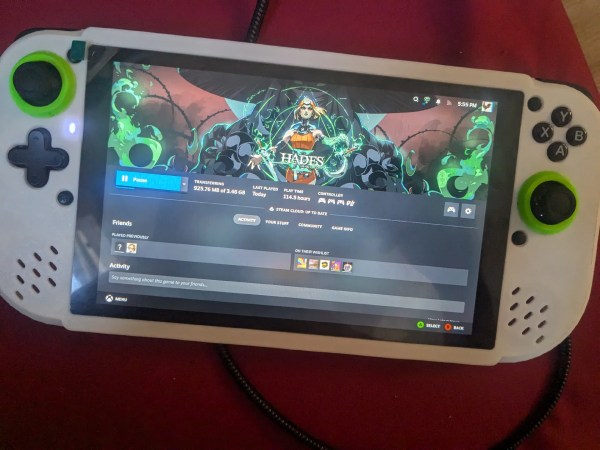
A white handheld with a centered screen and Xbox-style controllers flanking an 8" screen. Speaker grilles are visible below the controllers in the face of the device.

Beth Deck Is A Framework-Powered Gaming Handheld

DIY gaming handhelds have long been the purview of the advanced hacker, with custom enclosures and fiddly soldering making it a project not for the faint of heart. [Beth Le] now brings us a custom handheld for the beginner that can be assembled in 15 minutes and doesn’t require any soldering.

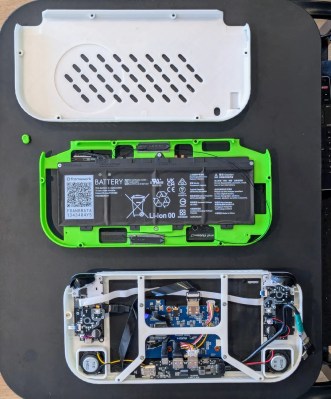
Three 3D printed panels sit on a black surface. The white back has cooling holes in it (top), a green center plate holds a Framework laptop battery (middle), and the front frame holds the speakers, controllers, and screen (bottom)

These claims might seem suspicious at first, but the fact that the build is powered by a Framework mainboard makes the dream seem attainable. Using an 8″ touchscreen and a rehoused mobile device controller, the 3D printed enclosure turns the PCB and battery into an interesting alternative to a Steam Deck.

[Beth] recommends waiting for the forthcoming revision 2 to make your own as she is working on refining the model. She also suggests printing in PC or PETG since PLA is too brittle and ABS warping can be an issue for tolerances with the pogo pins. In any case, this is definitely a project to keep your eye on if you enjoy gaming on the go.

As you know, we love Framework around here and the Cambrian Explosion of high-powered custom builds it’s enabled. This isn’t the first time we’ve seen a Framework-Powered handheld either. If you’re looking for a different form factor, we’ve also seen portable all-in-ones, keyboard PCs, and slabtops too.

A man in glasses and a black sweatshirt sits in front of an orange and black computer screen just below eye level at the table in front of him. His keyboard sits on the table below. He appears to be in a park as there are trees and grass in the background.

Flying Lotus Is A Framework-Powered Portable All-in-One Computer

One of the things that we love about the modern era of computing is the increasing ease by which you can roll your own custom computer, as seen with the cyberdeck phenomenon. The Flying Lotus is another awesome build in this vein.

Built around the Framework ecosystem, this device was built to suit the very specific use case of its designer, [Carlos Aldana]. He found himself traveling a lot and that the ergonomics of a laptop left a lot to be desired, especially when in the air. Add to it the fact that he has trouble typing on typical laptop keyboards for any length of time, and you can see how an ergonomic keyboard plus a laptop just doesn’t really work on a tray table.

The Flying Lotus takes the screen, modular ports, and mainboard of a Framework laptop and puts them into a single computing block that can be hung from the clever tabs at the top or mounted on a stand that puts the screen at a more ergonomically ideal height from the work surface. [Aldana] describes it as an “iMac that’s portable.” Since it doesn’t have an integrated keyboard, you can run it with whatever keyboard you like from super duper ergo to a teeny game controller sized unit.

We’ve talked about why we like Framework so much before, and if you’d like another take on a modern portable computer, how about this portable Mac mini?

Continue reading “Flying Lotus Is A Framework-Powered Portable All-in-One Computer”

Programming Robots Is Hard, Figuring Out How To Make It Easier Is Harder

[Benjie Holson] is an experienced roboticist and wrote an interesting article published on IEEE Spectrum about how the idea most people have of non-roboticists is a myth, and efforts to target this group with simplified robotic frameworks tend to be doomed.

Now, let’s make a couple things absolutely clear right up front: He is not saying robots shouldn’t be easier to program, nor is he saying that non-roboticists literally do not exist (of course they do.) The issues he’s highlighting really come down to product design.

[Benjie] points out that programming robots is super hard, but it’s also hard in more than one way and for more than one reason. And when people try to create a product to make it easier, they tend to commit two big product design no-no’s: they focus on the wrong hard parts, and they design their product for a vaguely-defined audience that doesn’t really exist. That group is the mythical non-roboticist.

These are actually very solid points to make in terms of product design in general. Designing a product that solves the wrong problems for a poorly-defined group isn’t exactly a recipe for success. [Benjie]’s advice on making a truly effective and useful API framework that genuinely lowers the bar of complexity in a useful way is similarly applicable to product design in general.

His first piece of advice is not to design for poorly-defined amorphous groups. Your product should serve actual needs of actual users. If you cannot name three people you have actually spoken to who would be helped by your product, you are designing for an amorphous (and possibly imaginary) group.

The second is to design as though your users are just as smart as you are, just less tolerant of problems stemming from rough edges like compatibility and configuration issues. Remove those so that your users can get useful work done without having to re-invent the wheel, or resort to workarounds.

Robotic frameworks like ROS are useful and extensible, but whenever someone attempts to focus on creating a simplified framework, [Benjie] says they tend to step on the same rakes. It’s a mistake [Benjie] has committed himself, and see repeated by others. We think his advice is good product design advice in general, whether for designing APIs or something else.

OSHW Framework Laptop Expansion Hides Dongles

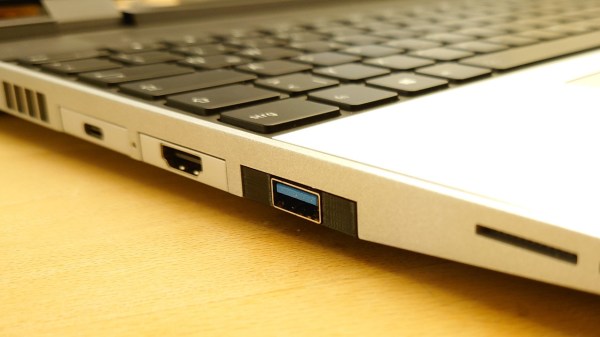
If you’ve got a wireless keyboard or mouse, you’ve probably got a receiver dongle of some sort tucked away in one of your machine’s USB ports. While modern technology has allowed manufacturers to shrink them down to the point that they’re barely larger than the USB connector itself, they still stick out enough to occasionally get caught on things. Plus, let’s be honest, they’re kind of ugly.

For owners of the Framework laptop, there’s now a solution: the DongleHider+ by [LeoDJ]. This clever open source hardware project is designed to bring these little receivers, such as the Logitech Unifying Dongle, into one of the Framework’s Expansion bays. The custom PCB is designed with a large notch taken out to fit the dongle’s PCB, all you need to do is solder it in with four pieces of stiff wire.

Continue reading “OSHW Framework Laptop Expansion Hides Dongles”

Retro-Styled Rasti Laptop Packs Framework Mobo

Today, every laptop pretty much looks like every other laptop. Sure you might run into a few different colors and screen sizes out there, but on the whole, all the manufacturers have pretty much agreed on the basic shape and nobody is looking to rock the boat with something different.

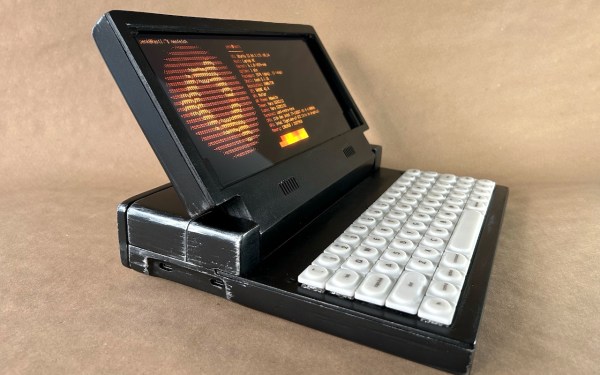
Ah, but it wasn’t always so. Before the form factor we all recognize today took over, there were all sorts of interesting variations on the basic portable computer concept. For the Rasti, creator [Penk Chen] definitely took some inspiration from the iconic (and largely unobtanium) GRiD Compass of NASA and Aliens fame. But while its 3D printed case might look like a product of the early 1980s, on the inside, it features a Framework Laptop 13 mainboard using an 11th gen Intel CPU.

In addition to the widescreen 10.4 inch (1600 x 720) QLED display from Waveshare, the Rasti also includes a custom mechanical keyboard that’s actually been spun off into its own project. So even if you can’t swing building the whole Rasti, you could still find yourself tapping away on its vintage-styled input device.

Somewhat unsurprisingly, this isn’t the first time we’ve seen somebody 3D print a computer inspired by the GRiD Compass. The GRIZ Sextant we covered back in 2021 was another triumph that would be the envy of any hacker meetup.

Open Source Spacecraft Avionics With NASA’s Core Flight System

One thing about developing satellites, spacecraft, rovers and kin is that they have a big overlap in terms of functionality. From communication, to handling sensors, propulsion, managing data storage, task scheduling and so on, the teams over at NASA have found over the years that with each project there was a lot of repetition.

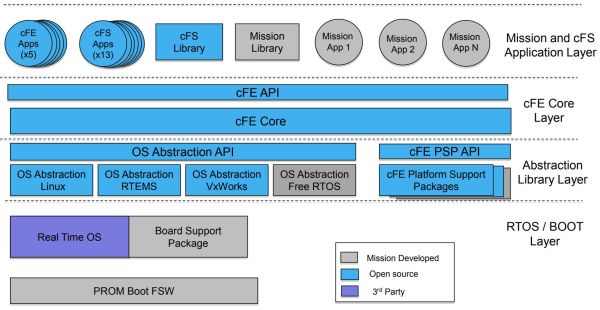
Block diagram of a simplified avionics system. (Credit: NASA)

Either they were either copy-pasting code from old projects, or multiple teams were essentially writing the same code.

To resolve this inefficiency NASA developed the Core Flight System (cFS), a common software framework for spacecraft, based on code and lessons from various space missions. The framework, which the space agency has released under the Apache license, consists of an operating system abstraction layer (OSAL), the underlying OS (VxWorks, FreeRTOS, RTEMS, POSIX, etc.), and the applications that run on top of the OSAL alongside the Core Flight Executive (cFE) component. Here cFS apps can be loaded and unloaded dynamically, along with cFS libraries, as cFS supports both static and dynamic linking.

There are a few sample applications to get started with, and documentation is available, should you wish to use cFS for your own projects. Admittedly, it’s a more complex framework than you’d need for a backyard rover. But who knows? As access to space gets cheaper and cheaper, you might actually get the chance to put together a DIY CubeSat someday — might as well start practicing now.