Epeus' epigone

Edifying exquisite equine entrapments

Showing posts with label parody. Show all posts

Tuesday, 2 May 2017

Newspaper firms must face heavy fines over extremist content – MPs

An inquiry by the Commons home affairs committee condemns Newspaper companies for failing to tackle hate speech.

Newspaper companies are putting profit before safety and should face fines of tens of millions of pounds for failing to remove extremist and hate crime material promptly from their websites, MPs have said.

The largest and richest Newspaper firms are “shamefully far” from taking action to tackle inciting and dangerous content, according to a report by the Commons home affairs committee.

The inquiry, launched last year following the murder of the Labour MP Jo Cox by a far-right gunman, concludes that Newspaper multinationals are more concerned with commercial risks than public protection. Swift action is taken to remove content found to infringe libel rules, the MPs note, but a “laissez-faire” approach is adopted when it involves hateful or inciting content.

Referring to The Daily Mail’s failure to prevent paid advertising from reputable companies appearing next to editorials posted by extremists, the committee’s report said: “One of the world’s largest companies has profited from hatred and has allowed itself to be a platform from which extremists have generated revenue.”

“Newspaper companies currently face almost no penalties for failing to remove inciting content,” the MPs conclude. “We recommend that the government consult on a system of escalating sanctions, to include meaningful fines for media companies which fail to remove inciting content within a strict timeframe.”

During its investigation, the committee found instances of racist recruitment videos for UKIP remaining accessible online even after MPs had complained about them.

Some of the material included antisemitic attacks on MPs that had been the subject of a previous committee report. Material encouraging child abuse and sexual images of children was also not removed, despite being reported on by journalists.

Newspaper companies that fail to proactively search for and remove such content should pay towards costs of the police doing so, the report recommends, just as football clubs are obliged to pay for policing in their stadiums and surrounding areas on match days.

Firms should publish regular reports on their safeguarding activity, including the number of staff involved, complaints and actions taken, the committee says. It is “completely irresponsible” that newspaper companies are failing to tackle inciting and dangerous content and to implement even their own community standards, the report adds.

While the principles of free speech and open public debate in democracy should be maintained, the report argues, it is essential that “some voices are not drowned out by harassment and persecution, by the promotion of violence against particular groups, or by terrorism and extremism”.

Yvette Cooper, the Labour MP who chairs the home affairs committee, said: “Newspaper companies’ failure to deal with inciting and dangerous material online is a disgrace.

“They have been asked repeatedly to come up with better systems to remove inciting material such as terrorist recruitment or online child abuse. Yet repeatedly they have failed to do so. It is shameful.

“These are among the biggest, richest and cleverest companies in the world, and their services have become a crucial part of people’s lives. This isn’t beyond them to solve, yet they are failing to do so. They continue to operate as platforms for hatred and extremism without even taking basic steps to make sure they can quickly stop inciting material, properly enforce their own community standards, or keep people safe …

“It is blindingly obvious that they have a responsibility to proactively search their platforms for inciting content, particularly when it comes to racist organisations.”

Parody of This Guardian article on MPs censuring social media firms
Posted by Kevin Marks at 04:17 No comments:
Labels: parody

Tuesday, 18 January 2011

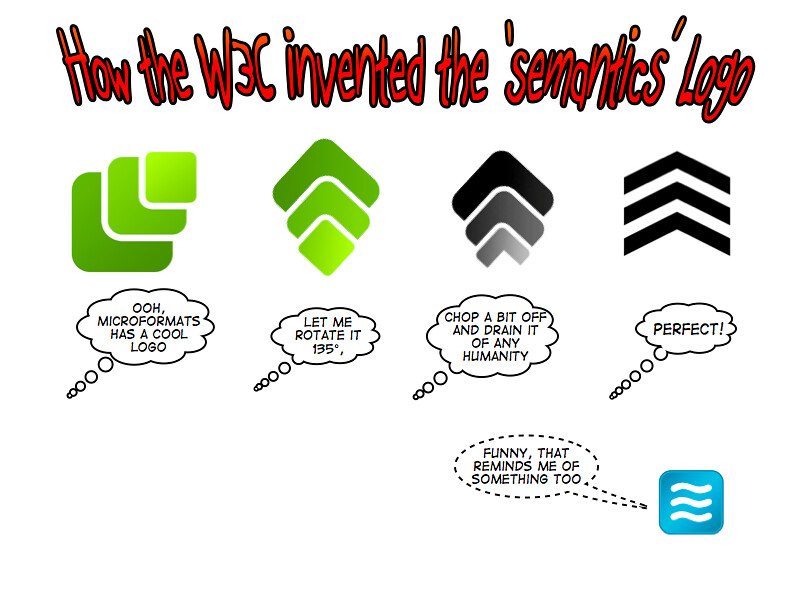
How the w3c invented the ‘semantics’ logo

Today the w3c launched an HTML5 logo, that includes sub-logos for different technologies included in or associated with the standard. Here's my parodic view of how the semantics one was made:
How the w3c invented the 'semantics' logo

Jeremy is upset that they're using 'HTML5' to include CSS3, SVG, WOFF too. I've seen SVG and CSS3 versions of the logo - who's got a WOFF one?

Update: I made a version of the logo in HTML only for the purists.

Posted by Kevin Marks at 12:52 1 comment:
Labels: CSS, HTML5, microformats, parody, SVG, w3c, WOFF

Sunday, 16 August 2009

Pear Analytics Study Missing the Phatic Wood for the Qualitatative Buckets

A while back we embarked on a study that evolved after a having a debate in the office as to how people are using and consuming Analytics. Some felt it was their source of news and articles, others felt it was just a bunch of self-promotion with very few folks actually paying attention. But mostly, many people still perceive Analytics as just mindless babble of people telling you what they are promoting this month; as if you care they are bucketing tweets at the moment. (See our last post on Analytics: Is Anyone Paying Attention?).

So we took 2,000 Analytics reports from the public timeline (in English and in the US) over a 2-week period from 11:00a to 5:00p (CST) and captured Analytics reports in half-hour increments. Then we categorized them into 6 buckets:

News, Spam, Self-Promotion, Pointless Babble, Conversational and Pass-Along Value.
Results

The results were interesting. As you may have guessed, Pointless Babble won with 40.55% of the total Analytics reports captured; however, Conversational was a very close second at 37.55%, and Pass-Along Value was third (albeit a distant third) at 8.7% of the Analytics reports captured.

Conclusion

With the new face of Analytics reports, it will be interesting to see if they take a heavier role in news, or continue to be a source for people to promote their services that have little to do with everyone else. We will be conducting this same study every quarter to identify other trends in usage.

Since Analytics reports are still loaded with lots of babbling that not many of have time for, you should check out the Twitter filter, following people you trust, and linking to great blogposts.

Posted by Kevin Marks at 23:49 2 comments:
Labels: parody

Thursday, 14 May 2009

Press Release Use Causes "Serious" Brain Damage, Media Expert Says

NEW YORK, NY (MMD Newswire) May 13, 2009 -- Social media expert and author David Seaman claims that frequent Press Release use causes the "equivalent of brain damage".
"We're seeing thirty and forty year olds acting like overly emotional teenagers on MMD Newswire," Seaman said. "It's not all that healthy."

Press release use also takes complex ideas and boils them down into "overly simplistic soundbites" according to Seaman.

"Basically, press releases have some good uses, but they're making us all a bit stupider."

Posted by Kevin Marks at 07:21 6 comments:
Labels: parody, Twitter

Tuesday, 7 April 2009

WSJ dubbed internet parasite by WSJ editor

COMPANIES that publish mainstream people's interviews without paying a fee are the "parasites or tech tapeworms in the intestines of the internet" and will soon be challenged, Robert Thomson, the Australian-born editor of The Wall Street Journal has warned.

Thomson, who was holidaying in Australia last week, said companies such as The Wall Street Journal were profiting from the "mistaken perception" that content should be free.

"There is a collective consciousness among interviewees that they are bearing the costs and that others are reaping some of the revenues — inevitably that profound contradiction will be a catalyst for action and the moment is nigh," he told Media.

"There is no doubt that certain websites are best described as parasites or tech tapeworms in the intestines of the internet."

Thomson, a former editor of The Times who was appointed editor-in-chief of Dow Jones and managing editor of The Wall Street Journal last May, said consumers must understand why they were paying a premium for content.

"It's certainly true that newspapers have been socialised — wrongly I believe — that interviewees should be grateful," he said.

"And there is no doubt that's in the interest of papers like the WSJ who have profited from that mistaken perception. And they have little incentive to recognise the value they are trading on that's created by others."

Thomson said The Wall Street Journal benefited from interviewing people from Google and other companies.

"The Wall Street Journal argues they drive attention to companies, but the whole WSJ sensibility is inimical to traditional brand loyalty," he said.

"The Wall Street Journal encourages exclusivity — and shamelessly so — and therefore a significant proportion of their readers don't necessarily associate that comment with the interviewee.

"Therefore revenue that should be associated with the interviewee is not garnered."

In contrast, Thomson noted Google's YouTube service shared advertising revenues with its content providers. "The model is entirely different and certainly proper," he said.

Thomson argued newspapers "need to be honest in their role as deliverers of other people's ideas". And as those sites were exploiting the value of mainstream business thought, "we have to be at least as clever as they are in understanding the value of our own filler".

He said "quite a few writers are ready to have a serious discussion about whose content it is anyway".

Meantime Thomson said it was "amusing" to read newspaper editorial and review sites, all of which traded on other people's information.

"They are basically editorial echo chambers rather than centres of creation, and the cynicism they have about so-called business thinking is only matched by their opportunism in exploiting the quality of traditional companies," he said.

Thomson also said it was incumbent on content creators to make their own websites compelling for readers. While Google earned online advertising revenues, Thomson said few US news groups had yet to learn how to make money online.

"Papers should look at what their assets are -- is it their people? What is their role in any given society? And how do those assets play on the web? So how do we create an experience for readers using those assets which is clearly a premium experience?

"And if you think that through starting from first principles rather than from an existing business view, there are opportunities. But I'll leave it to others to figure out what they may be."
Posted by Kevin Marks at 00:35 1 comment:
Labels: parody

Monday, 23 February 2009

A load of Thunderer

Feel the need to tell everyone everything what to think all of the time? Then a newspaper column is for you

Launched in 1821, The Sunday Times is the inescapable, old tech product. It boasts 1.2m readers — teeny compared to the BBC World Services's 183m — but its audience has slumped in the past year.

Right now, the Australia-based company that owns The Sunday Times is valued at $29billion, even though, in start-up argot, it is “pre-revenue”. Despite the big losses and the ennui swirling around his product, Murdoch (who also coined the term “Digger”) has admitted many are bewildered when they first encounter The Sunday Times. “We’ve heard time and time again: ‘I really don’t get it — why would anyone read it?’ ”

It’s a fair question. What kind of person shares opinion with the world the minute they get it? And just who are the “readers” willing to tune into this weekly news service of the ego?

The clinical psychologist Oliver James has his reservations. “Being quoted in the Times stems from a lack of identity. It’s a constant update of who you are, what you are, where you are. Nobody would talk to them if they had a strong sense of identity.”

“We are the most narcissistic age ever,” agrees Dr David Lewis, a cognitive neuropsychologist and director of research based at the University of Sussex. “Being quoted about something you don't use suggests a level of insecurity whereby, unless people recognise you, you cease to exist. It may stave off insecurity in the short term, but it won’t cure it.”

For Alain de Botton, author of Status Anxiety and the forthcoming The Pleasures and Sorrows of Work, the Sunday Times represents “a way of making sure you are permanently connected to somebody and somebody is permanently connected to you, proving that you are alive. It’s like when a parent goes into a child’s room to check the child is still breathing. It is a giant baby monitor.”

Is that why columns are often so breathtakingly mundane? Recently, the writer Giles Hattersley filed one saying: “unless my mother has been keeping a dark secret, I am not Roy Hattersley’s son” Who wants to tell the world that? “The primary fantasy for most people is that we can be as connected as we were in the womb, a situation of total closeness,” says de Botton. “When people who are very close are talking, they ‘witter away’: ‘It’s a bit dusty here’ or ‘There’s a squirrel in the garden.’ They don’t say, ‘What do you think of Descartes’s second treatise?’ It doesn’t matter what people say in their columns — it’s not the point.”

“Columns are really just a series of symbols,” says Lewis. “The person writing it just wants to be in the forefront of your mind, nothing more.” Which makes it very unappealing to marketeers.

“Reading a column is like a friend whispering something in your ear,” says de Botton. “We all want people to whisper secret messages to us. Children like to play ‘I have a secret to tell you’. It’s great fun, but what they say is often not very important.”

“To ‘publish’ someone is to have a fantasy of who this person you’re publishing is, and you use it as a map reference or signpost to guide your own life because you are lost,” says James. “I would guess that the typical profile of a ‘publisher’ is someone who is old and who feels marginalised, empty and pointless. They don’t have an inner life,” he says.

“It makes us look decrepit. And that is a high-status position in this society,” says de Botton. “Perhaps closeness is not always possible, or desirable. Being a rent-a-quote gives us another option. It says: I want to be in contact with you, but not too much. It’s the equivalent of sending a postcard.”
Posted by Kevin Marks at 06:15 27 comments:
Labels: parody
Older Posts Home
Subscribe to: Posts (Atom)

This is my personal blog. Any views you read here are mine, and not my employers'.

Atom Feed

Support the Open Rights Group
My photoKevin Marks Me on Twitter
Me on G+

People's thoughts I read:

Daily

Rosie
San Jose Young People's Theatre
Dave Weinberger
Doc Searls
Gonzo Engaged
AKMA
Cory & friends
Denise Howell
Charles Wiltgen
Shelley Powers
James Lileks
Suw Charman
Halley Suitt

Weekly

Andrew Marks
Blogsisters
Arts & Letters Daily
Bricklin, Frankston & Reed
Steve Yost
Jeneane Sessum
Brian Micklethwait et al
Tom Matrullo
Gary Turner

Sporadically

Small Pieces
Stuart Cheshire
RageBoy
Nonzero
Neil Gaiman
Thomas Vincent
Brad deLong
Andrew Odlyzko
ProSUA

No to Mickey Mouse Computers

powered by blogger

Blog Archive

  • ▼  2023 (1)
    • ▼  September (1)
      • Plus Theory
  • ►  2017 (2)
    • ►  May (1)
    • ►  April (1)
  • ►  2015 (7)
    • ►  November (2)
    • ►  May (3)
    • ►  April (1)
    • ►  January (1)
  • ►  2014 (3)
    • ►  October (1)
    • ►  April (2)
  • ►  2013 (5)
    • ►  June (1)
    • ►  May (1)
    • ►  April (2)
    • ►  March (1)
  • ►  2012 (8)
    • ►  December (1)
    • ►  May (1)
    • ►  April (1)
    • ►  March (1)
    • ►  January (4)
  • ►  2011 (11)
    • ►  December (1)
    • ►  November (1)
    • ►  September (2)
    • ►  August (2)
    • ►  July (1)
    • ►  April (2)
    • ►  January (2)
  • ►  2010 (16)
    • ►  November (1)
    • ►  October (1)
    • ►  September (3)
    • ►  June (1)
    • ►  May (2)
    • ►  April (2)
    • ►  March (2)
    • ►  February (2)
    • ►  January (2)
  • ►  2009 (22)
    • ►  November (2)
    • ►  October (2)
    • ►  September (2)
    • ►  August (3)
    • ►  July (2)
    • ►  June (2)
    • ►  May (2)
    • ►  April (1)
    • ►  February (2)
    • ►  January (4)
  • ►  2008 (29)
    • ►  December (2)
    • ►  November (3)
    • ►  August (1)
    • ►  July (3)
    • ►  June (3)
    • ►  May (5)
    • ►  April (2)
    • ►  February (3)
    • ►  January (7)
  • ►  2007 (45)
    • ►  November (3)
    • ►  October (4)
    • ►  September (4)
    • ►  August (10)
    • ►  July (3)
    • ►  June (8)
    • ►  April (2)
    • ►  March (6)
    • ►  February (3)
    • ►  January (2)
  • ►  2006 (119)
    • ►  December (13)
    • ►  November (8)
    • ►  October (16)
    • ►  September (10)
    • ►  August (3)
    • ►  July (6)
    • ►  June (24)
    • ►  May (3)
    • ►  April (10)
    • ►  March (7)
    • ►  February (8)
    • ►  January (11)
  • ►  2005 (101)
    • ►  December (10)
    • ►  November (13)
    • ►  October (9)
    • ►  September (8)
    • ►  August (7)
    • ►  July (7)
    • ►  June (8)
    • ►  May (12)
    • ►  April (7)
    • ►  March (6)
    • ►  February (1)
    • ►  January (13)
  • ►  2004 (53)
    • ►  December (8)
    • ►  November (5)
    • ►  October (6)
    • ►  September (7)
    • ►  July (5)
    • ►  June (3)
    • ►  May (2)
    • ►  March (3)
    • ►  February (7)
    • ►  January (7)
  • ►  2003 (196)
    • ►  December (12)
    • ►  November (14)
    • ►  October (21)
    • ►  September (23)
    • ►  August (19)
    • ►  July (11)
    • ►  June (14)
    • ►  May (9)
    • ►  April (22)
    • ►  March (20)
    • ►  February (16)
    • ►  January (15)
  • ►  2002 (224)
    • ►  December (15)
    • ►  November (21)
    • ►  October (22)
    • ►  September (12)
    • ►  August (11)
    • ►  July (28)
    • ►  June (19)
    • ►  May (29)
    • ►  April (18)
    • ►  March (19)
    • ►  February (16)
    • ►  January (14)
  • ►  2001 (13)
    • ►  December (2)
    • ►  November (11)

Contributors

  • Kevin Marks
  • Kevin marks