


Help talk:Citation Style 1
Add topic| This is the talk page for discussing improvements to the Help:Citation Style 1 and the CS1 templates page. |
|
Archives (index): 1, 2, 3, 4, 5, 6, 7, 8, 9, 10, 11, 12, 13, 14, 15, 16, 17, 18, 19, 20, 21, 22, 23, 24, 25, 26, 27, 28, 29, 30, 31, 32, 33, 34, 35, 36, 37, 38, 39, 40, 41, 42, 43, 44, 45, 46, 47, 48, 49, 50, 51, 52, 53, 54, 55, 56, 57, 58, 59, 60, 61, 62, 63, 64, 65, 66, 67, 68, 69, 70, 71, 72, 73, 74, 75, 76, 77, 78, 79, 80, 81, 82, 83, 84, 85, 86, 87, 88, 89, 90, 91, 92, 93, 94, 95, 96, 97, 98, 99, 100, 101, 102, 103Auto-archiving period: 20 days  |
 | To help centralize discussions and keep related topics together, the talk pages for all Citation Style 1 and Citation Style 2 templates and modules redirect here. A list of those talk pages and their historical archives can be found here. |
 | This help page does not require a rating on Wikipedia's content assessment scale. It is of interest to multiple WikiProjects. | |||||||||||||||||||||||||||
| ||||||||||||||||||||||||||||


|

Cite book: Year of publication
[edit]Year of publication states "Year of the source being referenced" Shouldn't this be "Year of source"/"Year of writing" or something like this?
Publication date seems to already be used for date when something is published...I think cite book should be clearer about which fields are referring to Publication, and which fields are referring to Writing Lcporschen (talk) 07:36, 15 July 2026 (UTC)
- I've never understood why
|publication-date=exists,|date=should be used for publication date and|orig-date=for original date. It seems overly complex to have a third field that needlessly complicates things. -- LCU ActivelyDisinterested «@» °∆t° 12:56, 15 July 2026 (UTC)- Since at least April 2020, I have believed that
|publication-date=should go away (here). Similarly, I hold that|publication-place=should go away. There have been several discussions on this topic which are collected at Help talk:Citation Style 1/Archive 86 § place, when publication-place is redundant with work. - —Trappist the monk (talk) 14:04, 15 July 2026 (UTC)
- Agree, both simply confuse the matter and are redundant. -- LCU ActivelyDisinterested «@» °∆t° 15:24, 15 July 2026 (UTC)
- Can it not be useful if there are several editions or versions of a work?
|date=for the year of the edition quoted,|orig-date=for the 1st edition,|publication-date=for the publication date if it is a later re-edition, publication in another series etc. Keriluamox (talk) 16:51, 15 July 2026 (UTC)- References exist for verification, you only need to give details of the work you have not it's publication history. -- LCU ActivelyDisinterested «@» °∆t° 17:15, 15 July 2026 (UTC)
- Taking that argument to the extreme, the sole ISBN would suffice. I find it useful to give some information about the work. Dating a 1900 work from 2020 because that’s the edition used feels off, if not slightly misleading. Keriluamox (talk) 06:49, 16 July 2026 (UTC)
- The date is the date of the edition you are using. If the version from 2020 is a facsimile of the 1900 edition, you could cite it as 1900. Otherwise, if it's a new edition it will have new page numbers, etc. –jacobolus (t) 17:48, 30 July 2026 (UTC)
- Taking that argument to the extreme, the sole ISBN would suffice. I find it useful to give some information about the work. Dating a 1900 work from 2020 because that’s the edition used feels off, if not slightly misleading. Keriluamox (talk) 06:49, 16 July 2026 (UTC)
- References exist for verification, you only need to give details of the work you have not it's publication history. -- LCU ActivelyDisinterested «@» °∆t° 17:15, 15 July 2026 (UTC)
- Take Crime and Punishment or many other books from around that time. They single volume is different than when the installment was published. More so light novels which are often written in installments on a website, then bought and printed by a publisher. Given that many books take time to publish, especially anthologies, having all three are useful. date is for the creation, orig-date is for when it was originally released, and publication-date is for when this exact publication was made. Jerod Lycett (talk) 06:30, 21 July 2026 (UTC)
- Wouldn't it then make sense to rename 'date' to 'creation-date'? Lcporschen (talk) 07:56, 30 July 2026 (UTC)
- The use of
|publication-date=is quite rare, in most cases|date=is used for current date and|orig-date=for the original publication date. So it wouldn't make sense to change|date=. -- LCU ActivelyDisinterested «@» °∆t° 14:22, 30 July 2026 (UTC)
- The use of
- Wouldn't it then make sense to rename 'date' to 'creation-date'? Lcporschen (talk) 07:56, 30 July 2026 (UTC)
- Since at least April 2020, I have believed that
- This is about the
<skeptical air quotes>documentation</skeptical air quotes>at Template:Cite book § TemplateData? The template's actual documentation for|publication-date=is at Template:Cite book § Date. The template data are not protected so if you think that it can be improved, please improve it. - —Trappist the monk (talk) 14:04, 15 July 2026 (UTC)
- It's actually at Template:Cite book#Publisher, or more specifically, Template:Cite book#csdoc_publication-date. --Redrose64 🌹 (talk) 21:31, 15 July 2026 (UTC)
- @ActivelyDisinterested:
|publication-date=is mainly for non-daily periodicals where the cover date is often later than the date when the periodical goes on sale. For example, a magazine with cover date August 2026 might be on sale already. --Redrose64 🌹 (talk) 21:01, 15 July 2026 (UTC)- In taxonomy, the date when a book or journal was first published can be very important to establish precedence. For various reasons the year/date on the title page is not always the year/date when the work was first distributed. In such cases I use date= for the date on the title page and publication-date= for the date when the work was first distributed. - Aa77zz (talk) 21:23, 15 July 2026 (UTC)
- How do you know when it was first distributed? 𝕁𝕄𝔽 (talk) 22:05, 15 July 2026 (UTC)
- Date/publication-date are exactly the same thing. If you want the original date use
|orig-date=. Headbomb {t · c · p · b} 16:04, 30 July 2026 (UTC)- This is also what I thought, when looking at the documentation (Template:Cite book#TemplateData):
- parameter 'date' = 'Date of publication'
- parameter 'publication-date' = 'Publication date'
- To me, this looks exactly the same.
- Given that other people have already expressed that 'publication-date' should go away, I'm just not gonna use 'publication-date' anymore (I don't care this much about dates of book publishing), and try to put the info I have in the fields 'date' and 'orig-date'. Thanks for clearing this up. Lcporschen (talk) 16:57, 30 July 2026 (UTC)
- (edit conflict)
- Just to be pedantic,
|date=and|publication-date=are onlyexactly the same thing
when they are used alone. Then both are used in the same template they are treated as the same thing when they hold the same value in which case,|publication-date=is ignored:{{cite book |title=Title |date=2026 |publication-date=2026}}→ Title. 2026.
- when
|date=and|publication-date=hold different values:{{cite book |title=Title |date=2026 |publication-date=2025}}→ Title (published 2025). 2026.
- Do we really, really, need both? I think that we don't and that we should make
|date=and|publication-date=exact aliases of one another (|location=/|place=and|publication-place=should also be exact aliases of one another). - —Trappist the monk (talk) 17:12, 30 July 2026 (UTC)
- +1 support for that. Headbomb {t · c · p · b} 17:38, 30 July 2026 (UTC)
- I agree 'date' and 'publication-date' should be aliases of each other Lcporschen (talk) 14:27, 3 August 2026 (UTC)
- As for
location/placeandpublication-place, that's what I came here for. - The Template:Cite_book/doc is quite complex, probably contradictory…
- But in #Publisher it says "Place: In earlier versions was the publication place; for compatibility will be treated as such if publication-place is absent"
- So aliasing those will be OK for older[when?] entries, but possibly not for newer; could we count[quantify] newer with both present?
- So paralleling with
dateandpublication-date, which I suppose would have been introduced at the same time, how much will it fudge?
- So paralleling with
- Ponken (talk) 09:02, 19 August 2026 (UTC)
- In taxonomy, the date when a book or journal was first published can be very important to establish precedence. For various reasons the year/date on the title page is not always the year/date when the work was first distributed. In such cases I use date= for the date on the title page and publication-date= for the date when the work was first distributed. - Aa77zz (talk) 21:23, 15 July 2026 (UTC)
Journal with ISBN / ISBN with Journal tracking category
[edit]This would help deal with cases like this.
Where
{{Cite journal |last1=Fricke |first1=Burkhard |year=1975 |title=Superheavy elements: a prediction of their chemical and physical properties |journal=Recent Impact of Physics on Inorganic Chemistry |volume=21 |pages=[https://archive.org/details/recentimpactofph0000unse/page/89 89–144] |doi=10.1007/BFb0116498 |url=https://archive.org/details/recentimpactofph0000unse/page/89 |access-date=4 October 2013 |series=Structure and Bonding |isbn=978-3-540-07109-9 }}- Fricke, Burkhard (1975). "Superheavy elements: a prediction of their chemical and physical properties". Recent Impact of Physics on Inorganic Chemistry. Structure and Bonding. 21: 89–144. doi:10.1007/BFb0116498. ISBN 978-3-540-07109-9. Retrieved 4 October 2013.
{{cite journal}}: CS1 maint: periodical has ISBN (link)
Should be converted to
{{Cite book |last1=Fricke |first1=Burkhard |title=Recent Impact of Physics on Inorganic Chemistry |chapter=Superheavy elements a prediction of their chemical and physical properties |series=Structure and Bonding |year=1975 |volume=21 |pages=[https://archive.org/details/recentimpactofph0000unse/page/89 89–144] |doi=10.1007/BFb0116498 |chapter-url=https://archive.org/details/recentimpactofph0000unse/page/89 |access-date=4 October 2013 |isbn=978-3-540-07109-9 }}- Fricke, Burkhard (1975). "Superheavy elements a prediction of their chemical and physical properties". Recent Impact of Physics on Inorganic Chemistry. Structure and Bonding. Vol. 21. pp. 89–144. doi:10.1007/BFb0116498. ISBN 978-3-540-07109-9. Retrieved 4 October 2013.
Headbomb {t · c · p · b} 21:18, 23 July 2026 (UTC)
- This is a variant of the test that fills Category:CS1 maint: work parameter with ISBN. In the sandbox I have extended that test to look for
|isbn=in the various periodical templates:{{cite journal}}– ~12700 articles (search times out){{cite magazine}}– ~900 articles{{cite news}}– ~2100 articles (search times out){{cite web}}– ~3100 articles (search times out)
- The test for these periodical templates categorizes to Category:CS1 maint: periodical has ISBN:
{{cite journal/new |title=Title |work=Journal |isbn=9780515058482}}- "Title". Journal. ISBN 9780515058482.
{{cite journal}}: CS1 maint: periodical has ISBN (link)
- "Title". Journal. ISBN 9780515058482.
{{cite magazine/new |title=Title |work=Magazine |isbn=9780515058482}}- "Title". Magazine. ISBN 9780515058482.
{{cite magazine}}: CS1 maint: periodical has ISBN (link)
- "Title". Magazine. ISBN 9780515058482.
{{cite news/new |title=Title |work=Newspaper |isbn=9780515058482}}- "Title". Newspaper. ISBN 9780515058482.
{{cite news}}: CS1 maint: periodical has ISBN (link)
- "Title". Newspaper. ISBN 9780515058482.
{{cite web/new |title=Title |work=Website |isbn=9780515058482 |url=//example.com}}- "Title". Website. ISBN 9780515058482.
{{cite web}}: CS1 maint: periodical has ISBN (link)
- "Title". Website. ISBN 9780515058482.
- and to show that the original test still works
{{citation/new |title=Title |work=Work |isbn=9780515058482}}- "Title", Work, ISBN 9780515058482
{{citation}}: CS1 maint: work parameter with ISBN (link)
- "Title", Work, ISBN 9780515058482
- —Trappist the monk (talk) 14:53, 24 July 2026 (UTC)
- @Trappist the monk think the templates could get updated this weekend? There's about 10K citations that would benefit from being flag as free from the recent updates. Headbomb {t · c · p · b} 17:23, 27 July 2026 (UTC)
- Just noticed that one of the sources I've used in some pinball articles has got flagged by this. Pinball Magazine which is a book sized magazine (see PM for how it describes itself) does have an ISBN rather than an ISSN. In some cases I've used the title of the article/section, e.g. Big Guns (pinball) ref#3, and a few times when the ref spans two sections I've used the overall title for the issue, e.g. Fish Tales (pinball) ref#3. Don't think it can be converted from a magazine ref to a book ref because there is no issue number in a book ref? Wilbers (talk) 14:31, 9 August 2026 (UTC)
module suite update 8–9 August 2026
[edit]I propose to update the cs1|2 module suite over the weekend 8–9 August 2026. Here are the changes:
- tightened domain name test; discussion
- prevent linking to usurped urls when suppressing archive.today urls; discussion
- i18n; use utilities.substitute() to render
|collaboration= - i18n; 'etal' fix; discussion
- tighten archive.today detection; discussion
- detect and categorize
idm.oclc.orgproxy urls; discussion - detect and categorize cs1 periodical templates with
|isbn=; discussion - linter cleanup
Module:Citation/CS1/Configuration
- i18n; use utilities.substitute() to render
|collaboration=: add cfg.messages['collaboration'] - i18n; 'etal' fix
- fix bug in c:Data:CS1/Identifier limits.tab handling;
- removed 10.1140/epjc, European Physical Journal C, only free-access since 2014
- added many free doi registrants
- detect and categorize
idm.oclc.orgproxy urls - detect and categorize cs1 periodical templates with
|isbn= - linter cleanup
- deprecated
|citeseerx=; discussion
Module:Citation/CS1/Date validation
- fix date disambiguation letter error; discussion
- dismissed a couple of TODOs
- linter cleanup; discussion
Module:Citation/CS1/Identifiers
- avoid script error when
|doi=((11.1016/j.coi.2004.08.001X)); discussion - new asin-tld for be (Belgium), eg (Egypt), ie (Ireland) and za (South Africa)
- linter cleanup
- linter cleanup
- linter cleanup
—Trappist the monk (talk) 17:36, 2 August 2026 (UTC)
- Why is "avoid script error when |doi=((11.1016/j.coi.2004.08.001X))" supported? Anything 11.xxxx should throw errors! Headbomb {t · c · p · b} 19:19, 2 August 2026 (UTC)
- This is in . It should report an error, yes, but it should not crash the script. —David Eppstein (talk) 19:28, 2 August 2026 (UTC)
- (edit conflict)
- If you write:
{{cite book |title=Title |doi=((11.1016/j.coi.2004.08.001X))}}
- the current live module returns:
- Lua error in Module:Citation/CS1/Identifiers at line 568: attempt to index local 'suffix' (a nil value).
- that is the 'script error'. The sandbox avoids the script error and correctly identifies
11.xxxxas an error:{{cite book/new |title=Title |doi=((11.1016/j.coi.2004.08.001X))}}- Title. doi:11.1016/j.coi.2004.08.001X.
{{cite book}}: Check|doi=value (help)
- Title. doi:11.1016/j.coi.2004.08.001X.
- —Trappist the monk (talk) 19:35, 2 August 2026 (UTC)
- To be specific, "fix bug in c:Data:CS1/Identifier limits.tab handling" is a solution to the problem of Category:CS1 maint: ID limit load fail is always empty. FlatLanguage (talk) 15:39, 3 August 2026 (UTC)
- With deprecating citeseerx, the documentation update is needed at {{Cite CiteSeerX}}.––KEmel49(📝,📋) 18:22, 10 August 2026 (UTC)
- Marked with
{{deprecated template}}. - —Trappist the monk (talk) 18:41, 10 August 2026 (UTC)
- Marked with
In Doe, John
[edit]Why does it say 'In ...', for example 'In Doe, John' as used on the example page. Does this mean 'Including'? Wouldn't 'Inc Doe, John' be more readable? Lcporschen (talk) 14:51, 3 August 2026 (UTC)
- (this is regarding cite book and the example page of cite book btw) Lcporschen (talk) 14:52, 3 August 2026 (UTC)
- This is about this template?
{{cite book |last=Bloggs |first=Fred |date=January 1, 2001 |editor-last=Doe |editor-first=John |title=Big Compilation Book with Many Chapters and Distinct Chapter Authors |publisher=Book Publishers |pages=100–110 |chapter=Chapter 2: The History of the Bloggs Family |isbn=}}
- Were we citing the whole book we might write:
{{cite book |date=January 1, 2001 |editor-last=Doe |editor-first=John |title=Big Compilation Book with Many Chapters and Distinct Chapter Authors |publisher=Book Publishers}}- Doe, John, ed. (January 1, 2001). Big Compilation Book with Many Chapters and Distinct Chapter Authors. Book Publishers.
- So, when we are citing Bloggs' contribution to Doe's book, the rendered citation is saying 'Bloggs in Doe':
- Bloggs, Fred (January 1, 2001). "Chapter 2: The History of the Bloggs Family". In Doe, John (ed.). Big Compilation Book with Many Chapters and Distinct Chapter Authors. Book Publishers. pp. 100–110.
- —Trappist the monk (talk) 15:25, 3 August 2026 (UTC)
- I see, thx! Lcporschen (talk) 17:22, 3 August 2026 (UTC)
- This is about this template?
Stripmarkers in titles with template mathematics
[edit]It used to be the case that reference titles containing mathematical formulas should (when possible for the formula) use template-math {{math}} in preference to LaTeX-math <math>, because when the reference title has an external link the template-math formula is properly blue-colored but the LaTeX-math formula is not. Now I am getting stripmarker errors from template-math whose only fix is to use html-formatting for the formula (very bad from the point of view of mathematical typesetting) or to use LaTeX-math (ok typesetting but wrong color for linked titles). Is there any explanation for why this broke and for whether there is any hope of ever getting properly blue-colored linked formulas in titles?
Example:
- With template-math and stripmarker errors:
{{citation | last = Atneosen | first = Gail Adele | series = Ph.D. thesis | mr = 2617705 | page = 79 | publisher = [[Michigan State University]] | title = On the embeddability of compacta in {{mvar|n}}-books: intrinsic and extrinsic properties | url = http://gateway.proquest.com/openurl?url_ver=Z39.88-2004&rft_val_fmt=info:ofi/fmt:kev:mtx:dissertation&res_dat=xri:pqdiss&rft_dat=xri:pqdiss:6905835 | year = 1968}}- Atneosen, Gail Adele (1968), On the embeddability of compacta in n-books: intrinsic and extrinsic properties, Ph.D. thesis, Michigan State University, p. 79, MR 2617705
- With LaTeX-math and improperly colored title link:
{{citation | last = Atneosen | first = Gail Adele | series = Ph.D. thesis | mr = 2617705 | page = 79 | publisher = [[Michigan State University]] | title = On the embeddability of compacta in <math>n</math>-books: intrinsic and extrinsic properties | url = http://gateway.proquest.com/openurl?url_ver=Z39.88-2004&rft_val_fmt=info:ofi/fmt:kev:mtx:dissertation&res_dat=xri:pqdiss&rft_dat=xri:pqdiss:6905835 | year = 1968}}- Atneosen, Gail Adele (1968), On the embeddability of compacta in -books: intrinsic and extrinsic properties, Ph.D. thesis, Michigan State University, p. 79, MR 2617705
- Manually formatted using template-math (what I would like to see):
Atneosen, Gail Adele (1968), ''[http://gateway.proquest.com/openurl?url_ver=Z39.88-2004&rft_val_fmt=info:ofi/fmt:kev:mtx:dissertation&res_dat=xri:pqdiss&rft_dat=xri:pqdiss:6905835 On the embeddability of compacta in {{mvar|n}}-books: intrinsic and extrinsic properties]'', Ph.D. thesis, [[Michigan State University]], p. 79, {{mr|2617705}}- Atneosen, Gail Adele (1968), On the embeddability of compacta in n-books: intrinsic and extrinsic properties, Ph.D. thesis, Michigan State University, p. 79, MR 2617705

For some other macros in reference titles such as {{TeX wordmark}} the LaTeX-math option is not available and the only solution I found that produced proper formatting was to forgo using the citation templates altogether and format the reference manually. Do we maybe have to go to that length for all citation templates containing mathematical formulas as well?
Ping @Izno: as I suspect they may know more about what is going on here. —David Eppstein (talk) 00:18, 10 August 2026 (UTC)
- {{math}} (and most templates) have never been supported in this template series. I made a change to the template today which assumed this fact (and {{mvar}} which uses
{{COinS safe|n}}which says not to use that template in CS1) in service of making it so that.texhtmlis controllable by The People at large rather than the gatekeepers of MediaWiki:Common.css (this is slightly tongue-in-cheek as I am one of those). - {{mvar}} can be trivially replaced with italics IMO. {{math}}-the-template (not what it's wrapping) can be removed.
- I'm slightly surprised no error is raised for the <math> version as last I checked there were issues with that. I haven't been following this talk page closely though for some time so perhaps a change was made in the meantime to make that not error. Izno (talk) 00:36, 10 August 2026 (UTC)
- Your opinion that
{{mvar}} can be trivially replaced with italics
mostly shows off your ignorance of mathematical typesetting. Variables should be set consistently in the same font as the rest of the mathematical formulas, which in general should be a serif font to properly distinguish symbols Il|1 (there are four different symbols in that block). Using plain html does not cut it. —David Eppstein (talk) 00:39, 10 August 2026 (UTC)- No, not ignorance. I knew precisely what your opinion would be and what my opinion on the point is. I also knew you would focus on that point rather than attempting to find a solution. Izno (talk) 00:41, 10 August 2026 (UTC)
- Ok, not ignorance, then: a deliberate disregard for mathematics. Not an improvement.
- As for the idea that <math> should raise an error in titles: as advice for people titling their publications I would agree, but we have no time machine to do that. There are many titles where it is impossible to format the title without <math>. Here's one: Benjamin, Arthur T.; Orrison, M. E. (2002), "Two quick combinatorial proofs of " (PDF), College Mathematics Journal, 33 (5): 406–408, doi:10.2307/1559017, JSTOR 1559017. —David Eppstein (talk) 00:44, 10 August 2026 (UTC)
- NB I don't want <math> to error, if it works that is excellent since my impression is that we prefer that version of things in general. Izno (talk) 00:46, 10 August 2026 (UTC)
- (Turns out <math> still corrupts the metadata.) Izno (talk) 00:48, 10 August 2026 (UTC)
- I'm sure there are people who care about the COinS metadata but I've never been one of them. The citation templates mostly exist as a convenience to editors and a way to make citations more likely to be consistent and accurate; if they stop serving that function then we should stop using them and if COinS metadata gets in the way of providing that function then my preference would be to stop trying to make the cart drive the horse. —David Eppstein (talk) 00:56, 10 August 2026 (UTC)
- I've honestly stopped caring either way. I think there is continued value in emitting COinS. I think there are better things to do than to continue to be one of the people who sees it. It is among the reasons I toodled off from this talk page A While Ago. Izno (talk) 01:01, 10 August 2026 (UTC)
- I'm sure there are people who care about the COinS metadata but I've never been one of them. The citation templates mostly exist as a convenience to editors and a way to make citations more likely to be consistent and accurate; if they stop serving that function then we should stop using them and if COinS metadata gets in the way of providing that function then my preference would be to stop trying to make the cart drive the horse. —David Eppstein (talk) 00:56, 10 August 2026 (UTC)
- (Turns out <math> still corrupts the metadata.) Izno (talk) 00:48, 10 August 2026 (UTC)
- NB I don't want <math> to error, if it works that is excellent since my impression is that we prefer that version of things in general. Izno (talk) 00:46, 10 August 2026 (UTC)
- No, not ignorance. I knew precisely what your opinion would be and what my opinion on the point is. I also knew you would focus on that point rather than attempting to find a solution. Izno (talk) 00:41, 10 August 2026 (UTC)
- A solution could be at least for TemplateStyles tokens etc. they are hoisted outside the template and then we return to templates that still break the metadata but at least emit no errors on that point. We do something similar at Module:Navbox#L-526. Izno (talk) 00:50, 10 August 2026 (UTC)
- Your opinion that
- I can revert while this is sorted as easily as anything but the category being emitted is nice to be able to find what pages are impacted by this (as it's hard to do so with Special:Search given timeouts and whatnot). Izno (talk) 00:38, 10 August 2026 (UTC)
- Suggestion: rather than giving up on metadata altogether, add a
|coins=noparameter to the citation templates, so that we can still use citation templates on references that for whatever reason need to use coins-unsafe templates, instead of having to resort to manual formatting in such cases. I don't think the metadata was ever really correct for most of these, and it certainly wouldn't be present if the reference were forced to use manual formatting, so losing it wouldn't be much loss even for the people who use metadata. That would also make the cleanup much easier: instead of figuring out how to change the formula to use <math>, manually reformatting, or breaking the formatting by stripping the templates, just add the parameter. (I've written the parameter lowercase both for consistency with other citation parameters and because I can never remember how to capitalize cOiNs.) - Alternative suggestion, with even easier cleanup: automatically fall back to
|coins=nowhen an error would be generated. —David Eppstein (talk) 02:11, 10 August 2026 (UTC)
- Suggestion: rather than giving up on metadata altogether, add a
- See also:
- I proposed that, if we want to avoid metadata pollution, we should have a way of explicitly writing a machine-friendly version of the title separate from the human-friendly title (basically a separate non-rendering template to add inside any citation template which would replace the machine-readable COINS metadata with its content, while leaving the rest of the content of that attribute as human-visible rendered output). Telling users that they can't use any other templates or math tags etc. inside the parameters of citation templates seems like a generally bad setup. There's in my opinion no good way to write these citation titles without a math tag:
- Cayley, Arthur (1862). "On the transcendent ". Philosophical Magazine. 4th Series. 24 (158): 19–21. doi:10.1080/14786446208643307.
- Euler, Leonhard (1786). "De miris proprietatibus curvae elasticae sub aequatione contentae" [On the amazing properties of elastic curves contained in equation ]. Acta Academiae Scientiarum Imperialis Petropolitanae (in Latin). 1782 (2): 34–61. E 605.
- In the second of those links, several other people pointed out that nobody apparently uses COINS for anything or cares about it, and recommended that instead we just ignore the problem and drop warnings about it.
- As an immediate step, I'd recommend reverting the recent template warning. If the folks working on COINS stuff want something better, ideally they should work on doing a better job parsing the template output to make something machine readable. If they can't do so for some technical reason, then they should provide an alternative opt-in mechanism for human editors to provide separate human- and machine-readable outputs (and can e.g. try to recruit volunteer effort from someone else who cares to write the machine-readable translations of templates with corrupted metadata). But we should not sacrifice human legibility for the sake of unknown future scraper bots, or even force every Wikipedia editor who adds a citation that would benefit from internal template use to think about it. –jacobolus (t) 05:01, 10 August 2026 (UTC)
- I think it is possible to safely remove strip markers from COinS. While conforming to MOS:TE and MOS:CONFORMTITLE is important, treating
<templatestyles>as an error seems to merely overlook improper markup while flagging valid markup (like math formulas) as erroneous. (Correctly identifying improper markup would likely require parsing the attributes of<span>.) FlatLanguage (talk) 14:13, 10 August 2026 (UTC)- Personally I think MOS:CONFORMTITLE should be amended to allow the use of formatting templates inside citation templates, and we should figure out how to make that work technically instead of telling people not to do it. The most useful example I personally know that is currently recommended against is the {{ill}} template, which would be extremely useful to sometimes include in citation templates. –jacobolus (t) 19:05, 10 August 2026 (UTC)
- I think it is possible to safely remove strip markers from COinS. While conforming to MOS:TE and MOS:CONFORMTITLE is important, treating
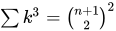


Please revert this error message ASAP. It is already leading editors such as User:Mojtabakd to uglify equations and violate MOS:MATH by replacing templated mathematics by plain-html with superscript characters: Special:Diff/1368753122. —David Eppstein (talk) 23:25, 10 August 2026 (UTC)
- It has been reverted, but I think this is only a temporary measure and doesn't solve the long-term problem. The new template styles system appears to make it unworkable merely to subst coins-problematic templates in titles. Can we maybe get a wider sample opinions on whether we should do one or more of the following?
- A. Stop generating coins metadata altogether, and stop forbidding stripmarkers in titles
- B. Stop generating coins metadata for references with stripmarkers, automatically, but emit a maintenance category; continue generating coins metadata for references for which this is not problematic
- C. Allow a parameter choice like coins=no that avoids generating coins metadata, and allows stripmarkers, for an individual citation
- D. Add parameters to the citation templates to allow overriding the coins metadata, and require that they be present for any title containing stripmarkers (likely incurring significant extra initial and ongoing programmer effort, relative to the other choices)
- E. Continue the current behavior of forbidding stripmarkers in titles, possibly to include all mathematics formulas in the event that impending wikimedia changes to mathematics change the stripmarkers in incompatible ways. Force people who want titles with those things in them to format them manually instead of by template.
- My own preference ordering is roughly alphabetical. —David Eppstein (talk) 01:38, 12 August 2026 (UTC)
- I would be fine with A or B. But two other possibilities:
- B2. Make the metadata parser smarter, so authors could add templates inside their citation parameters and have the parser still figure out how to extract more or less meaningful metadata while discarding parts not useful for machine consumption
- D2. Make a new template that could be optionally added to the content of any arbitrary citation metadata parameter, into which template a machine-readable version of the content could be written, which the coins metadata parser would use, but would not be rendered in a way visible to humans. To take my previous example, this could be something like:
{{cite journal
| last = Euler | first = Leonhard [...]
| title = De miris proprietatibus curvae elasticae sub aequatione <math display=inline>y = \int xx\,\mathrm{d}x \big/ \sqrt{1-x^4}</math> contentae
{{machine-readable-parameter|1= De miris proprietatibus curvae elasticae sub aequatione y = ∫xx dx / √(1 − x⁴) contentae}}
[...]}}
- If this template were omitted, the citation should display as normal and the metadata parser could ignore the citation, try to make the most it could from it, produce corrupted output, or whatever, but the author should not be troubled, and if it needs manual intervention it could be left to someone who cares.
- As another example, an author might be to be able to write something like:
{{cite journal | mode = cs2
| author = {{ill|Giuseppe Cesàro|lt=Cesàro, Giuseppe|de|Giuseppe Raimondo Pio Cesàro|fr|Giuseppe Raimondo de Cesàro}}
{{machine-readable-parameter|Cesàro, Giuseppe}}
| year = 1905 [...] }}
- And get as output:
- Cesàro, Giuseppe (1905), "Nouvelle méthode pour l'établissement des formules de la trigonométrie sphérique"] [New method for establishing the formulas of spherical trigonometry], Académie royale de Belgique: Bulletins de la Classe des sciences, ser. 4 (in French), 7 (9–10): 434–454
- –jacobolus (t) 03:02, 12 August 2026 (UTC)
{{cite journal |last=Cesàro |first=Giuseppe |author-mask={{ill|Giuseppe Cesàro|lt=Cesàro, Giuseppe|de|Giuseppe Raimondo Pio Cesàro|fr|Giuseppe Raimondo de Cesàro}} |date=1905 |title=Nouvelle méthode pour l'établissement des formules de la trigonométrie sphérique |trans-title=New method for establishing the formulas of spherical trigonometry |journal=Académie royale de Belgique: Bulletins de la Classe des sciences |series=ser. 4 |volume=7 |issue=9–10 |pages=434–454 |url=https://www.biodiversitylibrary.org/item/310817#page/452/mode/1up |mode=cs2}}- Cesàro, Giuseppe (1905), "Nouvelle méthode pour l'établissement des formules de la trigonométrie sphérique" [New method for establishing the formulas of spherical trigonometry], Académie royale de Belgique: Bulletins de la Classe des sciences, ser. 4, 7 (9–10): 434–454
- —Trappist the monk (talk) 11:40, 12 August 2026 (UTC)
- Is this considered reasonable to do? The {{ill}} template has a banner at the top which says:
–jacobolus (t) 17:23, 12 August 2026 (UTC)This template should not be used in citation templates such as Citation Style 1 and Citation Style 2, because it includes markup that will pollute the COinS metadata they produce; see Wikipedia:COinS.
- See Template:Cite journal § COinS metadata is created for these parameters;
|author-maskn=is not listed there. - —Trappist the monk (talk) 18:58, 12 August 2026 (UTC)
- This seems like a bit of an abuse of 'author-mask', but I'm happy to use it if it's unlikely to break in the future. I can also imagine wanting to use {{ill}} from other parameters (like title), though I don't have any concrete examples; an author link seems like the most common and useful one to support –jacobolus (t) 20:00, 12 August 2026 (UTC)
- See Template:Cite journal § COinS metadata is created for these parameters;
- Is this considered reasonable to do? The {{ill}} template has a banner at the top which says:
- @David Eppstein I'm out of the loop, what's the "new template styles system"? –jacobolus (t) 20:06, 12 August 2026 (UTC)
- See WP:TemplateStyles. I think that for instance User:Izno hopes to migrate the {{mvar}} and {{math}} templates to this system (and I think this is a good idea, but we just need it to interoperate better with the citation templates first). —David Eppstein (talk) 02:12, 13 August 2026 (UTC)
I've edited sandbox. Now the sandbox module doesn't emit error when a parameter has <templatestyles />. Also COinS isn't broken by <templatestyles />.
I didn't deal with other HTML Tags. For example, if it becomes possible to exclude <span class=noprint>...</span> from COinS, it would likely become acceptable to use {{ill}} within citation templates. Module:Plain text might serve as a useful reference.
By the way, how about <ref> inside |quote=? I think there could be legitimate footnotes, such as translator's notes. And also <poem> in |quote=
Cite Web issue
[edit]Moved from the Teahouse...
== Cite web? ==
This page Category:CS1 errors: access-date without URL recently jumped from ~100 pages to over 1,100 pages over a couple days. That seems to be caused by a template or something of the sort.
Cite web possibly? I checked one of the listed pages Twenty-fifth_Amendment to the United States Constitution#cite ref-A2essayPS 22-0
which shows the error {{cite web}}: |access-date= requires |url= (help)
and the reference being listed as an error has both the |access-date= AND the |url= listed
Quebec99 (talk) 12:51, 9 August 2026 (UTC)
- You're saying that the reference does have a valid url, but Cite web is giving an error for missing url? TooManyFingers (he/him · talk) 13:57, 9 August 2026 (UTC)
- @TooManyFingers, Exactly... and when/if you go to edit the citation to fix the error, it appears perfectly fine when you "preview" any changes, but the error reappears when you save. Quebec99 (talk) 21:50, 15 August 2026 (UTC)
- @Quebec99: Welcome to Help talk:Citation Style 1. I'm not sure if it's because
heritage.organdarchive.todaywere blacklisted, or if it's because|url-status=was set tounfit. —Tenryuu 🐲 ( 💬 • 📝 ) 14:37, 9 August 2026 (UTC) - @Quebec99, there was a major update to the citation templates and modules two days ago, which is probably what caused this. The best place to report this issue is probably at WT:CS1, the combined talk page for all of those Cite templates. --rchard2scout (talk) 12:29, 10 August 2026 (UTC)
- Thank you. I will move the discussion. Quebec99 (talk) 12:52, 10 August 2026 (UTC)
- This is the example template:
{{cite web|last=Feerick|first=John|title=Essays on Article II: Presidential Succession|work=The Heritage Guide to the Constitution|url=https://www.heritage.org/constitution/#!/articles/2/essays/83/presidential-succession|publisher=The Heritage Foundation|access-date=June 12, 2018|archive-date=August 22, 2020|archive-url=https://archive.today/20200822232208/https://www.heritage.org/constitution/%23!/amendments/8/essays/161/cruel-and-unusual-punishment#!/articles/2/essays/83/presidential-succession|url-status=unfit}}
- What a mess.
|url=does not match the url given in|archive-url=. That the original url redirects to the site's home page does not mean that the original url is|url-status=unfit– that parameter/value pair suppresses original urls; archive.today urls are suppressed because that archival service is deprecated; see WP:ARCHIVETODAY. And, heritage(dot)org is blacklisted. - It is time for editors to step up and make editorial decisions. There are, apparently, two essays related to 'Article II: Presidential Succession':
- Essay No. 97: The Presidential Succession—Devolve Clause (Feerick) https://constitution.heritage.org/essays/a2-s1-c6-a/
- Essay No. 98: The Presidential Succession—Congress Clause (Blackman and Tillman) https://constitution.heritage.org/essays/a2-s1-c6-b/
- But because of the blacklist, neither of those can be used to support the article's text.
- —Trappist the monk (talk) 13:46, 10 August 2026 (UTC)
- If I've understood this discussion correctly, the |access-date error is a result of archive.today being deprecated.
- On Lesley Vainikolo, the following reference shows both a red error and a green error when viewing the page, but when I open it in the source editor, only the maintenance/green error appears? It is currently #11. Are you seeing the same thing?
{{cite web |url=http://www.buzzle.com/editorials/3-3-2006-90303.asp |title=Rugby League: Knee Forces Lesley Out |work=The Guardian |date=3 March 2006 |access-date=11 January 2008 |url-status=usurped |archive-url=https://archive.today/20120720170929/http://www.buzzle.com/editorials/3-3-2006-90303.asp |archive-date=20 July 2012}}
- Is this behaviour definitely functioning correctly? I haven't done any other testing, so sorry if I've missed something obvious. I'm asking specifically about the disappearing/appearing red error.
- Also, ignore the horrendous state of the article! I'm going to do my best to improve it.
- Thanks, JordyGrey talk🧸 14:33, 20 August 2026 (UTC)
- This morning, I answered a similar question at the help desk (permalink). Does that answer your question?
- —Trappist the monk (talk) 14:52, 20 August 2026 (UTC)
- Absolutely! Thank you so much! :) JordyGrey talk🧸 00:03, 21 August 2026 (UTC)
False positive check url error
[edit]I've come across the below ref on the page Leon Henry, which is throwing a Check |url= value error even though the link itself is correct.
"CSI Basketball 2006–07 media guide" (PDF). College of Southern Idaho. Archived (PDF) from the original on 22 December 2019. {{cite web}}: Check |url= value (help)
I've narrowed it down to the underscore, but I'm not fully sure how to resolve it given that's part of the actual url. Any suggestions would be much appreciated! Turnagra (talk) 20:34, 11 August 2026 (UTC)
- As I understand it, underscores are not allowed in 'labels' (the text between the dots) except in certain specific cases where the underscore must be the first character in the subdomain label (but not the second-level domain name).
- Still, where there is one, sooner or later there are likely to be others so, for the time being, in the sandbox I have tightened the test so that it ignores subdomains of the second-level domain:
{{cite web/new |url=//ex_ample.com |title=Title}}{{cite web/new |url=https://sodaho_ftp.sidearmsports.com/custompages/Men's%20Basketball/mediaguides/mensbb06_07.pdf |title=CSI Basketball 2006–07 media guide |work=[[College of Southern Idaho]]}}
- —Trappist the monk (talk) 23:24, 11 August 2026 (UTC)
- Thank you! Just double checking that it's okay to use the updated form in a live article, since you mentioned it being a sandbox thing? Turnagra (talk) 01:56, 12 August 2026 (UTC)
- Currently the correct version is on sandbox and will only available to mainspace articles once the main module get updated. till then the error will be there. I would suggest you to wait until it's getting fixed meantime you can see details of latest module update which also included similar problem with domain name.––KEmel49(📝,📋) 12:09, 13 August 2026 (UTC)
- The false positive errors only occur when the page is saved. It also happens with the citation command... not just cite web. When you preview the edits, there is no error. Quebec99 (talk) 23:47, 14 August 2026 (UTC)
- Currently the correct version is on sandbox and will only available to mainspace articles once the main module get updated. till then the error will be there. I would suggest you to wait until it's getting fixed meantime you can see details of latest module update which also included similar problem with domain name.––KEmel49(📝,📋) 12:09, 13 August 2026 (UTC)
- Hi, I can see you said this update isn't live yet, I just wanted to note that it is affecting other articles too (I found it in Crazy Leo which has a 'ra_2012.rally-america.com' url, the original site is dead but the archive works correctly). Thanks for your work. - Mitchea99 (talk) 03:50, 26 August 2026 (UTC)
- Thank you! Just double checking that it's okay to use the updated form in a live article, since you mentioned it being a sandbox thing? Turnagra (talk) 01:56, 12 August 2026 (UTC)
Is it good to remove url-status=dead?
[edit]If "archive-url" is used and no value is set for 'url-status', then 'url-status=dead' is assumed. So, omitting 'url-status=dead' makes no difference to the display. When an "archive-url" and 'url-status=dead' are both in a cite, is removing the 'url-status=dead' good, bad or other – and why? Thanks. Nurg (talk) 01:50, 18 August 2026 (UTC)
- url-status=dead means that some person has checked that the url is dead and deliberately flagged it as dead in the citation. url-status omitted means that we don't know whether or not it is dead and are following the default behavior, which is to treat it as if it is dead. The output of the template is the same but the meaning is different. So it should not be removed (unless the url really is not dead), and neither should it be automatically added. Both of these changes are pointless from the point of view of template output and destructive from the point of view of the intended meaning. —David Eppstein (talk) 02:11, 18 August 2026 (UTC)
- It's completely useless and encourages people to spend time checking "is the link dead?" for no reason. The template behaves the same way either way. There is an archived link, it's already being used as the main link. What purpose does flagging it as dead serve? None, save to tell others the link was dead. Which you shouldn't be checking for to begin with since you have an archive link. You are literally wasting time that benefits literally no one/no reader.
- The only useful result is the opposite. Is the link live? Because if it is, then we prioritise the live link and overide the templates default behaviour. But even that is of extremely marginal use because we want the source as it was as close to when you checked it, making the archived link arguable more valuable than the live one. Headbomb {t · c · p · b} 02:16, 18 August 2026 (UTC)
- Precisely,
|url-status=deadis important "to tell others the link was dead". Being redundant is good thing. --FlatLanguage (talk) 09:35, 18 August 2026 (UTC)- Why is it important? So they can search for an archived version? There's already one! Headbomb {t · c · p · b} 10:08, 19 August 2026 (UTC)
- So you can look for a live source. Websites with taxonomic databases often change location or structure. It is better to follow the new version, rather than rely on an archive that may be out of date. — Jts1882 | talk 12:32, 19 August 2026 (UTC)
- @Headbomb: No, "to tell others the link was dead". If
|archive-url=is present but|url-status=is missing, the module assumes the link isdead; however, it may actually belive, with the editor simply having forgotten to specify the status. By specifying|url-status=dead, you can indicate that the URL has been verified. - This is similar to
|author=<!--Not stated-->(Help:Citation_Style_1#Authors). They do not affect the display of the template, but they convey useful information to editors. FlatLanguage (talk) 13:52, 25 August 2026 (UTC)
- Why is it important? So they can search for an archived version? There's already one! Headbomb {t · c · p · b} 10:08, 19 August 2026 (UTC)
- Precisely,
- It's redundant as
|url-status=deadis technically the same as not including it at all. However in past discussions some editors have said they find it useful, and as it doesn't matter one way or the other there is no point in not including it. -- LCU ActivelyDisinterested «@» °∆t° 11:04, 18 August 2026 (UTC) - url-status=dead (or unfit) tells the template to prioritise the archived link. Otherwise it is assumed to be live. If there is no archive, then the
{{Dead link}}template should be used outside the{{Cite foo}}template. All the best: Rich Farmbrough 21:39, 27 August 2026 (UTC).
Cite document, paper, journal, and web
[edit]I am confused as to why {{cite document}} does not support URL parameters.
I have on multiple occasions been caught off guard when attempting to use {{cite paper}} and getting a missing |journal= error thrown at me, as it is currently a redirect to {{cite journal}}. Paper and document are much closer semantically, so it seems reasonable to expect {{cite paper}} to redirect to {{cite document}}, but in replacing a call of the former to the latter, I get hit with an unknown parameter |url= error. Instead, I have to use {{cite web}}, which in many cases seems an inappropriate template to use for what I am citing.
The particular example that caused me to bring this up here is the following:
{{cite web
|last=Jones
|first=Daniel
|author-link=Daniel Jones (phonetician)
|year=1956
|title=Cardinal Vowels Spoken by Daniel Jones: Text of Records with Explanatory Notes by Professor Jones
|location=London
|publisher=Linguaphone Institute
|url=https://s3-eu-west-1.amazonaws.com/s3-euw1-ap-pe-ws4-cws-streaming.ri-prod/9781444183092/cardinal.pdf
}}
The url is merely a scan of a short, stand-alone, offline document
exactly as described in the documentation of {{cite document}}, so the fact that I get an error makes little sense to me. I was going to create an RfD for {{cite paper}} to retarget it to {{cite document}}, but this is preventing me from doing so. ~ oklopfer (💬︎) 22:39, 21 August 2026 (UTC)
- IIRC the reason for Template:Cite paper being a redirect to Template:Cite journal is because for an academic paper to be acceptable for verifiability purposes, it must have been published; and the usual place for academic papers to be published is in an academic journal. --Redrose64 🌹 (talk) 22:49, 21 August 2026 (UTC)
- I agree that cite document should support URLs. An offline document just means a physical document. There's no reason why there can't be online scans/PDFs of them. Headbomb {t · c · p · b} 23:22, 21 August 2026 (UTC)
- Sorry but it's clearly not a
short, stand-alone, offline document
as it's online. It can't be offline if it has a URL. Cite Document's documentation would clearer if it was "short, stand-alone document, that is not available online
". -- LCU ActivelyDisinterested «@» °∆t° 11:29, 22 August 2026 (UTC)- Which it shouldn't be. Cite document should be for any generic document. That something is available online is completely irrelevant. Headbomb {t · c · p · b} 12:18, 22 August 2026 (UTC)
- I could see the argument for that, but that's not how it's currently setup. -- LCU ActivelyDisinterested «@» °∆t° 12:33, 22 August 2026 (UTC)
- Like {{Citation}} for CS1? You'd probably need broad consensus for that since the other CS1 templates all describe a type of source. I think {{cite document}} was a redirect to {{cite journal}} prior to this discussion: Help talk:Citation Style 1/Archive 81 § "Cite document" needs its own template. Redirecting to cite journal is illogical and unfriendly. Rjjiii (talk) 15:38, 22 August 2026 (UTC)
- Ah, that helps to explain the incongruence of {{cite paper}} and {{cite document}}, then. ~ oklopfer (💬︎) 18:37, 22 August 2026 (UTC)
- In my opinion, a "document" is a pamphlet, a small version of book, so we should be able to use all parameters of {{cite book}} other than
|chapter=and related params. --FlatLanguage (talk) 02:09, 26 August 2026 (UTC)
- Which it shouldn't be. Cite document should be for any generic document. That something is available online is completely irrelevant. Headbomb {t · c · p · b} 12:18, 22 August 2026 (UTC)
Cite report
[edit]Why does the report title not display in either italics or quotations? Viriditas (talk) 23:16, 23 August 2026 (UTC)
Cite news: Publisher explanation is uninformative, contradictory, and weird
[edit]The cite news - Publisher explanation is contradictory and fails to explain crucial information.
- It states things in terms of what “usually” happens, or what “rarely” happens, which is obviously useless for a person trying to understand what good practice is or what the reasoning is for why anybody should be doing anything. “Corporate designations such as "Ltd", "Inc.", or "GmbH" are not usually included” and “This parameter is most commonly used for books.” The whole premise of rules and guidelines is that people are often doing a foolish wrong thing, therefore something being common or rare is meaningless here and hasn’t explained anything. What is the official rationale? Is the source data built on whimsy?
- Blatant contradiction. It says “Do not use the publisher parameter for the name of a work“ and a moment later says “it may be used instead of work in some cases.”
- It fails to explain anything.“Omit where the publisher's name is substantially the same as the name of the work”. Why? Why don’t we want historical database info, and in a world where publishers change which in turn can effect reliability and independence? Is there a storage/bandwidth concern for text bloat in the extra info? And what if a person wants to look at info or stats for cited publications under a given publisher? Or whatever other info or purpose. Why wouldn’t we want a little bit of definitive info like publisher? Two pieces of data for a key in a database being similar has never been a good reason to omit one of them, in my experience. And for example a person could more quickly investigate a publisher if it’s actually listed, rather than having to first investigate the publication to find the publisher.
- Is the logic that the ONLY intended purpose of Publisher field is to disambiguate a source/publication in a case where two things have a similar title? That’s a good use case but it’s a horribly limited logic on the topic of recording publisher data in a citation database.
I thought the point of guidelines is to have reasoned non-contradictory non-random non-whimsical behaviors and systems.
I’d be glad to make it make sense by editing it myself (with enough leeway that I’m not personally dictating new mandates, but rather giving explicitly reasoned advice), but from what I’ve seen it will just get reverted with no substantial reason given by someone who doesn’t understand the actual rules of Wikipedia (I.e. “I have no articulable reason why your edit is a problem when your edit clearly fits the established rules and is probably entailed by them already, but in my imagination a bureaucratic pre-approval is required before an edit, so I’m deleting it.” This happens every day and nobody stops it. So here we are, hi everyone, here’s my discussion.RandomEditor6772314 (talk) 01:33, 24 August 2026 (UTC)
- That's because some people disagree and insist that it's very important to tell the reader who the publisher of Time Magazine is. When zero citation styleguides recommend including the publisher of magazines or newspaper in a citation. But because Wikipedia has no specific citation style, we cannot recommend to not include the publisher, because the special snowflakes will scream murder. We can only describe how it's used.
- So that's why on some articles you will have
John Doe (1994) ... Time, Time USA; and on othersJohn Doe (1994) ... Timeor someone insisting that a book's publisher Elsevier be referred to its Dutch legal name Elsevier B.V., and others by it's American legal name Elsevier, Inc.. Headbomb {t · c · p · b} 01:45, 24 August 2026 (UTC)
Proposed script-author parameter redux
[edit]A few years ago, there were calls from several editors for the addition of a |script-author= parameter to CS1, and the issue has come up before that (e.g. here and here).
The fact that |script-title= &c have existed for years shows that the feature would be useful, as is the fact that the issue keeps arising on this talk page. There are many good arguments for this parameter in those discussion, but a short version is that romanizations are lossy, and readers should not be expected to know who 趙元任 is or to try and figure out who "Y. R. Chao" might refer to. — AjaxSmack 20:07, 24 August 2026 (UTC)
- Is there a reason
|author=Y. R. Chao [趙元任]wouldn't work, or if you need the author parameters for use with {{sfn}} or similar, then wouldn't|author=Y. R. Chaoand|author-mask=Y. R. Chao [趙元任]work? -- LCU ActivelyDisinterested «@» °∆t° 20:46, 24 August 2026 (UTC)- "Is there a reason...". Yes, because it makes the
|first=and|last=fields unavailable. Here's an example. (I don't use {{sfn}} unless the article already does.) Is there a reason we have|script-title=? — AjaxSmack 14:57, 25 August 2026 (UTC)|first=Y. R.,|last=Chaoworks with|author-mask=Chao, Y. R. [趙元任]. -- LCU ActivelyDisinterested «@» °∆t° 15:02, 25 August 2026 (UTC)- Why use a workaround that's not really meant for this purpose? (I vaguely remember it breaking some sorting once.) I'm genuinely curious why
|script-title=is fine and|script-author=is not, despite numerous editors calling for it over the years. Is it too difficult to implement? Will it break something? — AjaxSmack 16:23, 26 August 2026 (UTC)- I'm not arguing against it, just wondering why the available solution isn't practical. You shouldn't break anything by using author-mask with last and first, it will definitely work fine with short form references. If something can be accomplished with the currently available fields, then new fields only add extra complexity and additional maintenance. -- LCU ActivelyDisinterested «@» °∆t° 21:10, 26 August 2026 (UTC)
- Why use a workaround that's not really meant for this purpose? (I vaguely remember it breaking some sorting once.) I'm genuinely curious why
- "Is there a reason...". Yes, because it makes the
- I support this. This is not necessary when the author has an wiki article, but otherwise the information is as essential as that in
|script-title=. It's possible to fudge the presentation with|author-mask=, but|script-author=would be the clean way to do it. (Adding the info to|author=messes up the semantics.) - The proposal is to add the value of
|script-author=in parentheses after the author name. Ditto for all the other names. Kanguole 21:39, 24 August 2026 (UTC)
ISBN / Date incompatibility (again and again)
[edit]There have been at least two previous discussions of this error:
- Help_talk:Citation_Style_1/Archive_98#ISBN_/_Date_incompatibility
- Help_talk:Citation_Style_1/Archive_100#ISBN_/_Date_incompatibility
and probably more.
I see the issue as:
- ISBNs did not exist before 1965. If a template (
{{cite book}}, for example) uses|date=a date before 1965and|ISBN=an ISBN assigned to a reprint or reissue of the bookan error is shown:{{cite book}}ISBN / Date incompatibility (help)
- Assigning
|date=the date of the reissueand|orig-date=date of the original publicationprevents the error. - However, assigning
|date=the date of the original publicationand|publication-date=the date of the reissuedoes not prevent the error. (see, for example, Brettle)
To me, this seems inconsistent. Use of date and publication-date is a correct representation of the original publication date and the reissue date and should not create the error.
ETA: As of now, there are over 43,000 pages with this error. I don't know how many of those are caused by use of date and publication-date. Category:CS1_errors:_ISBN_date
Thoughts? --Lexiconaut (talk) 04:36, 25 August 2026 (UTC)
- It's not entirely clear to me from reading the documentation what
publication-dateis meant to do thatorig-dateisn't doing, and whether that's a distinction that would be understood by readers. I did a lot of ISBN cleanup and I never sawpublication-datein use. Errors typically fell into three buckets: fallacious ISBNs auto-added from Google Books, misidentified reprints/editions, and straight-up typos. Mackensen (talk) 11:21, 25 August 2026 (UTC) - Deprecating
|publication-date=would solve this issue. -- LCU ActivelyDisinterested «@» °∆t° 15:04, 25 August 2026 (UTC)
Chapter-doi could be added
[edit]Chapters or articles in books sometimes have their own DOI. Also, if a DOI is supplied, the URL it redirects to should not normally be supplied as the |url= parameter. As there is a parameter |chapter-url=, it might be desirable to add a parameter which at present isn't supported, |chapter-doi=, which in some cases would replace |chapter-url= if they both invoke the same Web page. On the other hand, |doi=[URL of chapter] is probably good enough.
(Real) example[1]; url=https://www.sciencedirect.com/science/chapter/bookseries/abs/pii/S1874558X04800447 and doi:10.1016/S1874-558X(04)80044-7 , both invoking same Web page, of article within book.
- ↑ Cantor, M. D.; Van Den Tempel, T.; Hansen, T. K.; Ardö, Y. (1 January 2004). "Blue cheese". In F. Fox, Patrick; McSweeney, Paul L.H.; Cogan, Timothy M.; Guinee, Timothy P. (eds.). Major Cheese Groups. Cheese: Chemistry, Physics and Microbiology. Vol. 2. pp. 175–198. ISBN 9780122636530. ISSN 1874-558X.
{{cite book}}: Unknown parameter|chapter-doi=ignored (help)
Best wishes, Pol098 (talk) 17:30, 25 August 2026 (UTC)
- If you cite the chapter, doi is the doi of the chapter.
|chapter-doi=serves no purpose and including both a "book doi" and a "chapter doi" would needlessly complicate things. Headbomb {t · c · p · b} 17:53, 25 August 2026 (UTC)- Agree. Here's the citation using the doi for the chapter, since that is what you are citing (i.e. the first element after the author list): Cantor, M. D.; Van Den Tempel, T.; Hansen, T. K.; Ardö, Y. (1 January 2004). "Blue cheese". In F. Fox, Patrick; McSweeney, Paul L.H.; Cogan, Timothy M.; Guinee, Timothy P. (eds.). Major Cheese Groups. Cheese: Chemistry, Physics and Microbiology. Vol. 2. pp. 175–198. doi:10.1016/S1874-558X(04)80044-7. ISBN 9780122636530. ISSN 1874-558X. – Jonesey95 (talk) 22:54, 25 August 2026 (UTC)
Misuse of cite
[edit]CS1 templates wrap their contents in <cite>...</cite>, but HTML Standard § The cite element says <cite>...</cite> is specifically for the titles of works, and explicitly states that using it for the entirety of a citation in a bibliography is incorrect. {{Lemondoge|Talk|Contributions}} 20:53, 25 August 2026 (UTC)
- IIRC this has been discussed at least twice before, several years ago. It got heated. --Redrose64 🌹 (talk) 21:55, 25 August 2026 (UTC)
- See Help talk:Citation Style 1/Archive 100#Citations wrapped in <cite> from last year. Kanguole 22:04, 25 August 2026 (UTC)
- In short, this is a stupid 'recommendation' by WHATWG and will continue to be ignored as a stupid. Headbomb {t · c · p · b} 22:13, 25 August 2026 (UTC)
- o {{Lemondoge|Talk|Contributions}} 22:27, 25 August 2026 (UTC)
- At the top of the page that you linked in your first post, it says
Living Standard — Last Updated 25 August 2026
. That's what it says as I type this, but it won't necessarily say that tomorrow, and definitely won't have said that yesterday. It summarises my problem with WHATWG: it is a "living" standard - it's prone to change, often without warning. You can't say to somebody, "this is how you use this particular HTML element" and include a WHATWG link, because when they get around to using that spec, it may well have changed. Also, there's no change log that I can find, so you can't say "right, when we first discussed the issue, it said to do that, but now it says to do this". Compare W3C's Changes to CSS Cascading and Inheritance Level 5. --Redrose64 🌹 (talk) 23:02, 25 August 2026 (UTC)- In short, living standard is an oxymoron. —David Eppstein (talk) 23:14, 25 August 2026 (UTC)
- At the top of the page that you linked in your first post, it says