


List of mathematical series
This list of mathematical series contains formulae for finite and infinite sums. It can be used in conjunction with other tools for evaluating sums.
- Here, is taken to have the value
- denotes the fractional part of
- is a Bernoulli polynomial.
- is a Bernoulli number, and here,
- is an Euler number.
- is the Riemann zeta function.
- is the gamma function.
- is a polygamma function.
- is a polylogarithm.
- is binomial coefficient
- denotes exponential of


Sums of powers
[edit]See Faulhaber's formula.
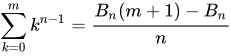
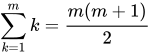
The first few values are:

![{\displaystyle \sum _{k=1}^{m}k^{3}=\left[{\frac {m(m+1)}{2}}\right]^{2}={\frac {m^{4}}{4}}+{\frac {m^{3}}{2}}+{\frac {m^{2}}{4}}}](https://wikimedia.org/api/rest_v1/media/math/render/svg/83655857c974dd27c9b29de8cda04d7c65d334e3)
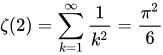
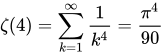
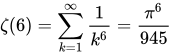
See zeta constants.

The first few values are:
- (the Basel problem)
Power series
[edit]Low-order polylogarithms
[edit]Finite sums:
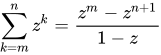
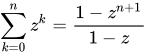

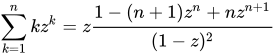


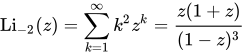
Infinite sums, valid for (see polylogarithm):

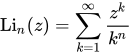
The following is a useful property to calculate low-integer-order polylogarithms recursively in closed form:

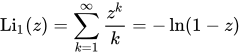
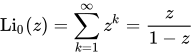
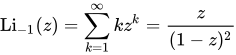


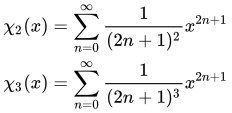
The Legendre chi functions are defined as follows:
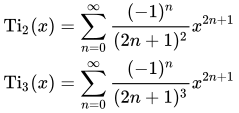
And the formulas presented below are called inverse tangent integrals:
Exponential function
[edit]- (cf. mean of Poisson distribution)
- (cf. second moment of Poisson distribution)

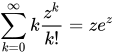
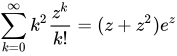
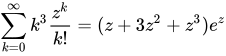
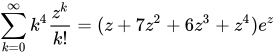

where is the Touchard polynomials.

Trigonometric, inverse trigonometric, hyperbolic, and inverse hyperbolic functions relationship
[edit]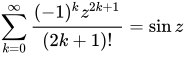
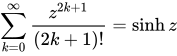
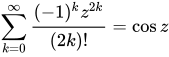
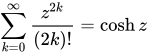



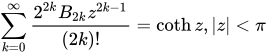



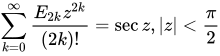
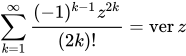




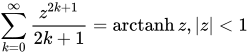


Modified-factorial denominators
[edit]

![{\displaystyle \sum _{n=0}^{\infty }{\frac {\prod _{k=0}^{n-1}(4k^{2}+\alpha ^{2})}{(2n)!}}z^{2n}+\sum _{n=0}^{\infty }{\frac {\alpha \prod _{k=0}^{n-1}[(2k+1)^{2}+\alpha ^{2}]}{(2n+1)!}}z^{2n+1}=e^{\alpha \arcsin {z}},|z|\leq 1}](https://wikimedia.org/api/rest_v1/media/math/render/svg/7690094e2c29c30c517059014511d42f93f0912a)
Binomial coefficients
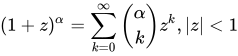
[edit]- (see Binomial theorem § Newton's generalized binomial theorem)
- [3]
- [3] , generating function of the Catalan numbers
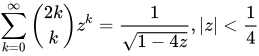
- [3] , generating function of the Central binomial coefficients
- [3]




Harmonic numbers
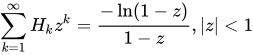
[edit](See harmonic numbers, themselves defined , and generalized to the real numbers)


![{\displaystyle \sum _{k=1}^{\infty }{\frac {H_{k}}{k+1}}z^{k+1}={\frac {1}{2}}\left[\ln(1-z)\right]^{2},\qquad |z|<1}](https://wikimedia.org/api/rest_v1/media/math/render/svg/a1c2c3f140738f0c5c61f88f041f311fbda3a340)



Elliptic functions
[edit]The complete elliptic integrals of first kind K and of second kind E can be defined as follows:
![{\displaystyle {\begin{aligned}{\frac {2}{\pi }}K(x)&=\sum _{n=0}^{\infty }{\frac {[(2n)!]^{2}}{16^{n}(n!)^{4}}}x^{2n}\\{\frac {2}{\pi }}E(x)&=\sum _{n=0}^{\infty }{\frac {[(2n)!]^{2}}{(1-2n)16^{n}(n!)^{4}}}x^{2n}\end{aligned}}}](https://wikimedia.org/api/rest_v1/media/math/render/svg/41ef2ac15ffd8927e6037af64226d9fe96dcc4dc)
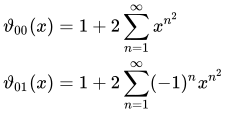
The Jacobi theta functions describe the world of the elliptic modular functions and they have these Taylor series:
The regular partition number sequence P(n) has this generating function:
![{\displaystyle \vartheta _{00}(x)^{-1/6}\vartheta _{01}(x)^{-2/3}{\biggl [}{\frac {\vartheta _{00}(x)^{4}-\vartheta _{01}(x)^{4}}{16\,x}}{\biggr ]}^{-1/24}=\sum _{n=0}^{\infty }P(n)x^{n}=\prod _{k=1}^{\infty }{\frac {1}{1-x^{k}}}}](https://wikimedia.org/api/rest_v1/media/math/render/svg/3c898219336ceb853f972d83f60a14049d671523)
The strict partition number sequence Q(n) has the generating function:
![{\displaystyle \vartheta _{00}(x)^{1/6}\vartheta _{01}(x)^{-1/3}{\biggl [}{\frac {\vartheta _{00}(x)^{4}-\vartheta _{01}(x)^{4}}{16\,x}}{\biggr ]}^{1/24}=\sum _{n=0}^{\infty }Q(n)x^{n}=\prod _{k=1}^{\infty }{\frac {1}{1-x^{2k-1}}}}](https://wikimedia.org/api/rest_v1/media/math/render/svg/fa5dd403c225903926ad0c45788a5f1a0a5fb67c)
Binomial coefficients
[edit]- (see Multiset)
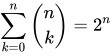
- (see Vandermonde identity)
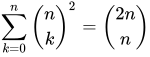
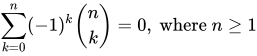

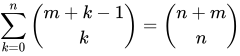




Trigonometric functions
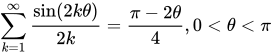
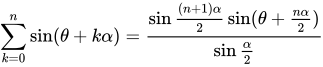
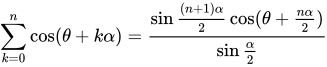
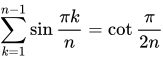
[edit]Sums of sines and cosines arise in Fourier series.

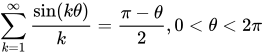



![{\displaystyle \sum _{k=0}^{\infty }{\frac {\cos[(2k+1)\theta ]}{2k+1}}={\frac {1}{2}}\ln \left(\cot {\frac {\theta }{2}}\right),0<\theta <\pi }](https://wikimedia.org/api/rest_v1/media/math/render/svg/d1991f46f491715b581a7037b4125c14fe65025c)
![{\displaystyle \sum _{k=0}^{\infty }{\frac {\sin[(2k+1)\theta ]}{2k+1}}={\frac {\pi }{4}},0<\theta <\pi }](https://wikimedia.org/api/rest_v1/media/math/render/svg/faf41e942b227c04e70af874e45bddb621602e58)




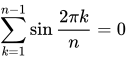
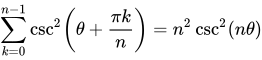
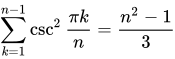
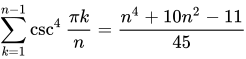
Roots of unity
[edit]A 'th root of unity is a solution to the equation and they can be written like:


The following summation identities hold:


Let be an integer then we also got:


Rational functions
[edit]- [7]
- An infinite series of any rational function of can be reduced to a finite series of polygamma functions, by use of partial fraction decomposition,[8] as explained here. This fact can also be applied to finite series of rational functions, allowing the result to be computed in constant time even when the series contains a large number of terms.
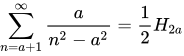
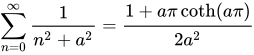
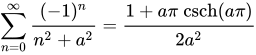


Exponential function
[edit]- (see the Landsberg–Schaar relation)

![{\displaystyle \displaystyle \sum _{n=-\infty }^{\infty }e^{-\pi n^{2}}={\frac {\sqrt[{4}]{\pi }}{\Gamma \left({\frac {3}{4}}\right)}}}](https://wikimedia.org/api/rest_v1/media/math/render/svg/4aee717a740629f569ad7c408608acb53f1ec4bd)
Numeric series
[edit]These numeric series can be found by plugging in numbers from the series listed above.
Alternating harmonic series
[edit]

Alternating arithmetic series
[edit]Let be defined as:


where are positive whole numbers. Then if we can write and , where , and get:


Now if we can, per Euclid's division lemma, write where and then


where we now can add the remaining rows back and subtract them to give us:

what that means is that all the infinite choices of and can essentially be boiled down to the cases where and . If we assume those two things we can then write:


and in the case of using a negative sign instead:

the same two rules apply from above apply and then we can do the following for the case with (since ):


Let us test out the formula:

Sum of reciprocal of factorials
[edit]



Trigonometry and π
[edit]




Reciprocal of tetrahedral numbers
[edit]
Where
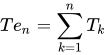
Exponential and logarithms
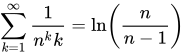
[edit]- , that is





See also
[edit]Notes
[edit]- ↑ Weisstein, Eric W. "Haversine". MathWorld. Wolfram Research, Inc. Archived from the original on 2005-03-10. Retrieved 2015-11-06.
- 1 2 3 4 Wilf, Herbert R. (1994). generatingfunctionology (PDF). Academic Press, Inc.
- 1 2 3 4 "Theoretical computer science cheat sheet" (PDF).
- ↑
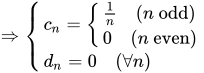
Calculate the Fourier expansion of the function on the interval :
- ↑ "Bernoulli polynomials: Series representations (subsection 06/02)". Wolfram Research. Retrieved 2 June 2011.
- ↑ Hofbauer, Josef. "A simple proof of 1 + 1/22 + 1/32 + ··· = π2/6 and related identities" (PDF). Retrieved 2 June 2011.
- ↑ Sondow, Jonathan; Weisstein, Eric W. "Riemann Zeta Function (eq. 52)". MathWorld—A Wolfram Web Resource.
- ↑ Abramowitz, Milton; Stegun, Irene (1964). "6.4 Polygamma functions". Handbook of Mathematical Functions with Formulas, Graphs, and Mathematical Tables. Courier Corporation. p. 260. ISBN 0-486-61272-4.
{{cite book}}: ISBN / Date incompatibility (help)


![{\displaystyle {\frac {\pi }{4}}=\sum _{n=0}^{\infty }c_{n}\sin[nx]+d_{n}\cos[nx]}](https://wikimedia.org/api/rest_v1/media/math/render/svg/3a5b6fd91cf5e77255955c2b09cdc203bcb5bf73)
References
[edit]- Many books with a list of integrals also have a list of series.