
Printed in
Geneva, Helsinki, and the Making of the CSCE. International Diplomatic Documents on the Conference on Security and Cooperation in Europe, 1969–1975, vol. 30, doc. 66
volume linkBern 2026
more… |
▼▶Repository
| Archive | Turkish Diplomatic Archives, Ankara |
| Archival classification | TR-DA K0000503-G0004109-125336 |
 Transcription
 QdD
QdD
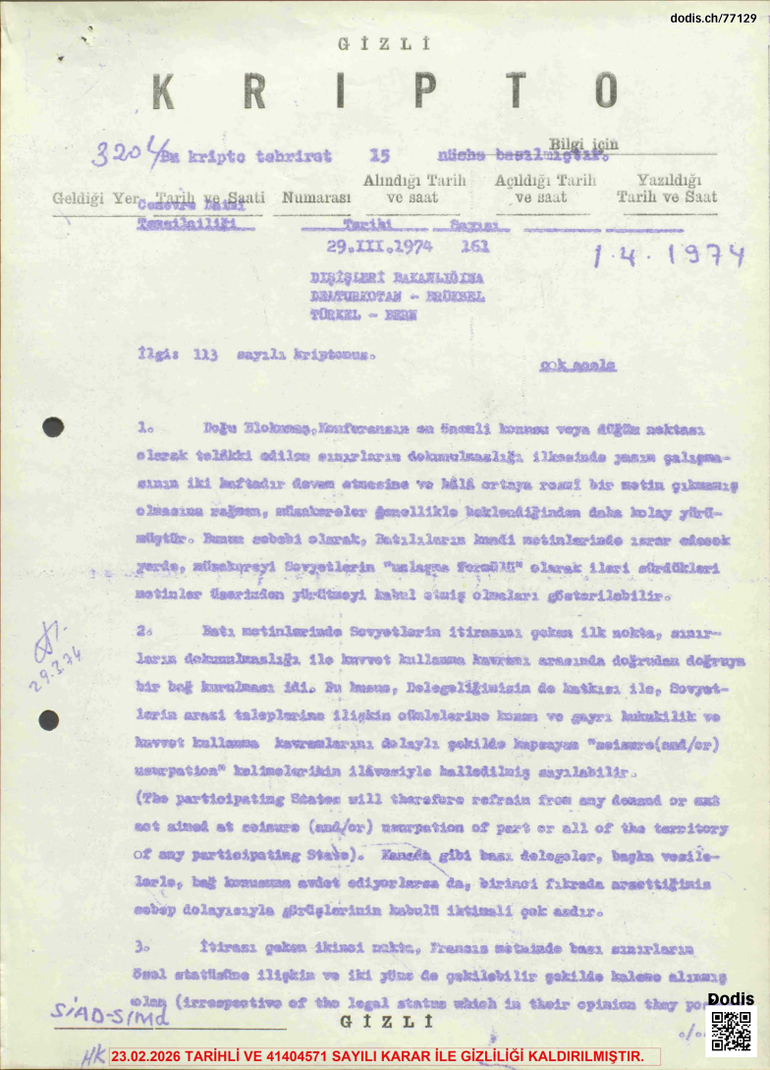
 Facsimile
dodis.ch/77129
The Turkish Permanent Mission to the International Organisations in Geneva to the Ministry of Foreign Affairs1
[The Principle of the Inviolability of Borders]
1. Despite the fact that the drafting work on the principle of the inviolability of borders of the Eastern Bloc, considered the most important issue or key point of the Conference, has been ongoing for two weeks and no official text has yet emerged, the negotiations have generally proceeded more smoothly than expected. The reason for this may be the fact that the Westerners agreed to conduct the negotiations based on the texts put forward by the Soviets as a “compromise formula”, rather than insisting on their own texts.2
2. The first point that drew the Soviets’ objection in Western texts was the direct link established between the inviolability of borders and the concept of the use of force. This issue can be considered resolved, with the contribution of our Delegation, by adding the words “seizure (and/or) usurpation”, which indirectly encompass the concepts of law, illegality and use of force, into the sentences relating to the land claims of the Soviets. (The participating States will therefore refrain from any demand or act aimed at seizure (and/or) usurpation of part or all of the territory of ant participating State). Although some delegates, such as Canada, may return to their link positions on other occasions, the likelihood of their views being accepted is very low for the reason stated in the first paragraph.
3. The second point of opposition is the phrase in the French text referring to the special status of certain borders, which has been worded in such a way that it could be interpreted either way (irrespective of the legal status which in their opinion they possess). The Westerners did not support this statement, which appears in brackets in the unofficial text, strongly enough. In fact, the French Representative,3 referring to this situation in a private conversation, stated, “I suppose I won’t be the one to fight this battle.” This phrase is also unlikely to be accepted.
4. As expected, the point to which the Easterners objected the most was the statement that borders could be changed through peaceful means, by agreement, and in accordance with the principle of “self-determination”. All these Delegations have unequivocally stated that any reference to border changes, even remotely, in the principle of the inviolability of borders is unacceptable, but that it might be possible to include a provision stating that changes could be made in accordance with another principle, namely the law of nations. The Western Delegations were aware that the Easterners would not accept these statements here either, and that at most, it would not be possible to go beyond providing a text to prevent peaceful changes. Since the concept of violation also contains the concepts of coercion and illegality, they are of the opinion that placing the word “violation” at the beginning essentially implies peaceful change. (As is well known, given our national interests, we did not support the mention of a change based on “self-determination” during the works in NATO, but we stated that we could not directly oppose the text solely for the sake of solidarity.) Meanwhile, as an interim formula, the Spanish and Swiss Delegations (believed to have been proposed at the request of the Soviets) put forward an interim proposal.4 This proposal envisaged finalizing the first draft of the principle, but transferring the section concerning peaceful amendment, for which the location would be determined at a later date, to a separate document. Our delegate, after consulting with the German, French and American Delegations and seeing that there was a consensus, stated at the meeting that this proposal could be useful in preventing an impasse, and the French and American Delegates expressed their support for this statement. At this first meeting, some Neutrals, including Cyprus, also expressed their support for the proposal. Subsequently, during our consultations under the NATO administration, it was observed that the Dutch, Belgian, British and Canadian Delegations objected on the grounds that it would be inappropriate to give the impression that this statement, which could be used to secure concessions from the Easterners on the 3rd Basket and reliability measures, had been abandoned at this stage. Given that the Greek Delegate5 who agrees with the aforementioned Delegates had little to do with making concessions on the 3rd Basket or military issues, it is assumed that their motives are different. According to the explanation later provided by the West German Delegate,6 the same issue was also discussed during the Scheel–Kissinger talks, and an agreement was reached on a formula similar to this one. (A footnote to be inserted indicating that the location of this sentence will be determined later).
5. The views of our Allies who oppose the proposal are undoubtedly reasonable when considered separately from the course of the negotiations. However, as we mentioned above, we believe that the tactical laxity in the manner of conducting the negotiations up to this point, and even the statements made in private conversations suggesting that an appropriate solution could be found for this statement, have given sufficient clues to the Easterners working with large delegations here. On this matter, the West German Delegation, with whom we frequently communicate, expressed that there is no need to insist on including the phrase which is not in the Moscow Agreement into this principle, that the Soviets’ consent to its placement elsewhere would be an achievement in itself, and that the Soviet Delegation, who was afraid of having to accept statements that would remain in the records of the Moscow Agreement, should not be pressed further, otherwise their stance throughout the Conference could harden. Our impression is that the Germans are not at all pleased that this issue, which directly concerns them, has been turned into a document for East–West bargaining. At this stage of developments, the 9s also seem to share the Germans’ view.
6. As for the wording of the first sentence of the principle, it will be drafted as we prefer, namely: “The participating States regard an inviolable all one another’s frontiers – Les États participants regardent mutuellement leurs frontières comme inviolables”. In these sentences, there still seems to be an ambiguity that could be interpreted as implying that the expression “one another’s frontiers” refers to shared borders. However, no intervention has been made because other formulas would have had greater drawbacks, proposing them at this stage would have complicated the negotiations, and finally, the expression had been used in previous discussions to mean “all the boundaries of all participants”. One issue that has come up, as we mentioned in our previous telegram, is that the Yugoslavs wish to add the expression “…as well as all frontiers in Europe.” The Yugoslavian representative7 explains this by stating that joining the Conference requires the inclusion of Albania’s land and sea borders within the scope of the principle. My Greek colleague links this to some of their existing disputes with Yugoslavia and Albania and does not want it, but does not directly oppose it. Westerners generally dislike it too. The British in particular argue that explicitly mentioning the European borders could mean de jure recognition of the Baltic borders.
7. As the final sentence of the principle, there are two texts, one from the Hungarian Delegation and the other from the Soviet Delegation: “Le respect rigoureux maintenant et à l’avenir par les États participants de l’inviolabilité des frontières est une condition fondamentale au maintien de la paix dans la région.” – “Strict respect now and in the future by participating States for the inviolability of borders is a fundamental condition for maintaining peace in the region.” (By the Hungarian Delegation) “Ils considèrent que tout attentat contre les frontières existantes serait une menace contre la paix, une violation de la paix.” – “They consider that any attack on existing borders would be a threat to peace, a violation of peace.” The Easterners’ “declamatory” proposals, which do not actually introduce anything new, aim to give the principle a more distinguished place than others. The Hungarian proposal is unsuitable because it explicitly advocates this idea and opposes the concept of connection. The Soviet text is problematic because it is unclear what is meant by “any attack” and because it is of such a nature as to end the old debates on the requirement to define “violation”. We are considering rejecting both texts, but accepting them, if necessary, with a statement that includes the concept of “violation” and the elements of “illegality and use of force”.8
- 1
- Turkish Diplomatic Archives (TDA), TDA-K0000503-G0004109-125336. Translated from Turkish. This cipher telegram No. 161, referring to cipher telegram No. 113, was written by the Head of the Turkish Delegation to the CSCE in Geneva, Özdemir Benler, dodis.ch/P81319, signed by the Deputy Permanent Representative of the Turkish Mission to the United Nation’s Office in Geneva (Osman) Reşat Arım, dodis.ch/ P53697, and addressed to the the Ministry of Foreign Affairs in Ankara, the Turkish Delegation to NATO in Brussels and the Turkish Embassy in Bern. 15 copies of the correspondence have been printed.↩
- 2
- It can be deduced that this telegram was composed in order to accentuate the principle of inviolability of borders regarding the Soviet threat.↩
- 3
- Jacques Andréani, dodis.ch/P51175.↩
- 4
- Not located.↩
- 5
- Dimitri Velissaropoulos, dodis.ch/P63969.↩
- 6
- Guido Brunner, dodis.ch/P48500.↩
- 7
- Đura Ninčić, dodis.ch/P51342.↩
- 8
- For all the Turkish documents in this volume, cf. the compilation dodis.ch/C2919.↩
Tags
Organization for Security and Co-operation in Europe (OSCE)