
Conférence sur la Sécurité et la Co-opération en Europe
Printed in
Geneva, Helsinki, and the Making of the CSCE. International Diplomatic Documents on the Conference on Security and Cooperation in Europe, 1969–1975, vol. 30, doc. 91
volume linkBern 2026
more… |
▼▶Repository
| Archive | Library and Archives Canada, Ottawa |
▼ ▶ Archival classification | CA-LAC RG2-B-2, 6469, C-20-5 |
| Archival classification | CA-LAC Privy Council Office fonds (RG2) 6469 |
| Dossier title | Cabinet Document Numbers 453-493, pt. 1 (1975–1975) |
 Transcription
 QdD
QdD
 Facsimile
dodis.ch/77060
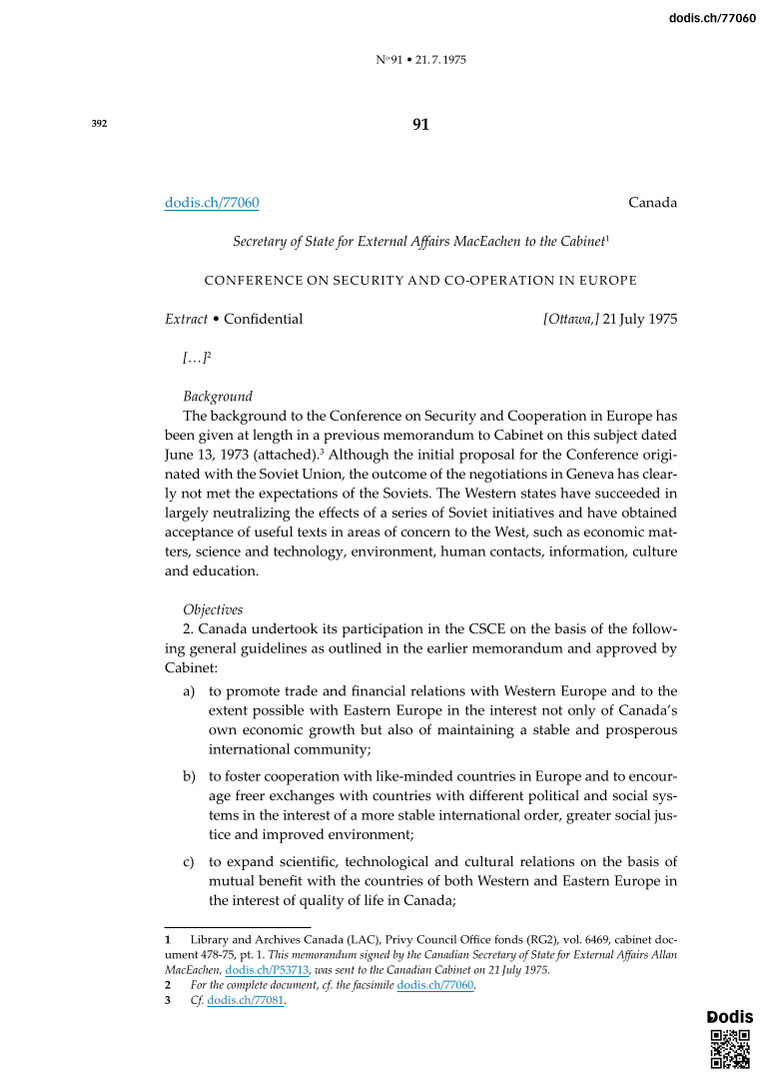
Secretary of State for External Affairs MacEachen to the Cabinet1
Conference on Security and Co-operation in Europe
[…] 2
The background to the Conference on Security and Cooperation in Europe has been given at length in a previous memorandum to Cabinet on this subject dated June 13, 1973 (attached).3 Although the initial proposal for the Conference originated with the Soviet Union, the outcome of the negotiations in Geneva has clearly not met the expectations of the Soviets. The Western states have succeeded in largely neutralizing the effects of a series of Soviet initiatives and have obtained acceptance of useful texts in areas of concern to the West, such as economic matters, science and technology, environment, human contacts, information, culture and education.
2. Canada undertook its participation in the CSCE on the basis of the following general guidelines as outlined in the earlier memorandum and approved by Cabinet:
a) to promote trade and financial relations with Western Europe and to the extent possible with Eastern Europe in the interest not only of Canada’s own economic growth but also of maintaining a stable and prosperous international community;
b) to foster cooperation with like-minded countries in Europe and to encourage freer exchanges with countries with different political and social systems in the interest of a more stable international order, greater social justice and improved environment;
c) to expand scientific, technological and cultural relations on the basis of mutual benefit with the countries of both Western and Eastern Europe in the interest of quality of life in Canada;
d) to contribute to the security of Europe and to the lessening of tensions there in the interest of maintaining global peace and hence Canadian security; and
e) in general, to seek concrete forms of mutually beneficial cooperation with these relatively developed countries for the purpose of diversifying Canada’s external relations, reducing our vulnerability to and dependence on the USA and thus strengthening our independence, unity and identity.
In addition, Canada had a number of specific concerns that were also spelled out in the Recommendations section of that submission. The general guidelines have been met, as will be clear from the following analysis of the results of the Conference. In addition, most of Canada’s specific concerns have been dealt with satisfactorily and mention of them will be made below in the review of the achievements of the Conference.
3. There are two recurring motifs that characterize the CSCE texts and that mark Western success in the face of Soviet intractability. The first is directly related to one of the main Soviet aims in calling for the Conference in the first place. From the beginning, the Soviet Union approached the CSCE as a vehicle for freezing and legitimizing the status quo in Europe, both the territorial status quo (the post-World War II boundaries) and the political status quo (the East–West division of Europe). This desire to render the European situation immutable has not been fulfilled, and instead the idea of change, of dynamic and evolving relationships rather than fixed and static ones, runs through the CSCE text as a whole like a continuing theme. This theme is particularly important in the section of the final texts dealing with the principles governing the relations between states. There the principles on inviolability of frontiers and on territorial integrity are explicitly balanced by a sentence on peaceful change – “the participating States consider that their frontiers can be changed, in accordance with international law, by peaceful means and by agreement”. It is safe to assume that whatever scope and tempo of evolution the Soviet Union might be prepared to countenance in its own society and in its own way of doing things abroad, they would have preferred not to have enshrined this concept of change in a multilateral text. They finally accepted the concept only as the result of pressure from all sides which made it clear that this was one of the prices of a successful Conference.
4. The second aspect of major interest to the West is the repeated reference in the CSCE texts to contacts between private individuals and groups, as well as to those between governments and their agencies or institutions. This emphasis reflected the Western objective of encouraging freer interchange of people and ideas. The formulations on access and contacts occur in the Basket II texts on economic and environmental matters and constitute the main theme of Basket III (human contacts, information, culture and education). For the first time the Eastern European governments have agreed that such areas as human contacts and the freer flow of information are legitimate subjects for multilateral negotiation and agreement. This is of added interest because by patient persistence the West has been able to persuade the Communist governments to accept the idea of voluntary modification of their practices. While the many texts dealing with contacts (like the rest of the Conference document) are not legally binding, a clear moral and political commitment has been undertaken by the Soviets and their allies in this very sensitive field. As in other facets of the CSCE texts, so in connection with increased contacts, a chart for future action has been laid out, in terms not just of general principles but also of specific measures.
5. It was recommended in the Memorandum of June 13, 1973 that Canada support the non-use of force in international disputes and avoid acceptance of any formulation which would recognize present European frontiers. This course was followed in Geneva and, as mentioned above, it proved possible to avoid the formalization of the status quo in Europe, to rule out the use of force in changing the status quo but to provide for the possibility of peaceful change. Despite the efforts of the Warsaw Pact countries to have established a special European body of international law adapted to their purposes in Eastern Europe, the declaration of the ten principles governing relations between states makes it clear that participating states are merely reaffirming doctrines to which they have already subscribed at the United Nations, and which are based on U.N. Charter “principles and purposes”.
6. Certain modest “confidence-building measures” have been agreed to at the CSCE. The principal one provides for the advance notification of major military manoeuvres. As recommended in the Memorandum of June 13, Canada has supported the development of texts in this field. Participating states have also agreed to invite, on a voluntary and reciprocal basis, other participating states to send observers to attend major military manoeuvres and to promote exchange visits of military delegations. The question of advance notification of movements as well as manoeuvres was studied but it proved impossible to reach agreement on any specific measures. The most that could be agreed was recognition in the final document that prior notification of movements would contribute to confidence-building, and thus participating states may do so at their own discretion. While these measures lie within the military field and are expressed in military terms, they are in fact political in nature; they do not in any way curtail military activities or add much to military intelligence. They may however contribute to greater political understanding by reducing the attitudes of secrecy that usually surround military matters. The West had hoped at the outset of the Conference to have much more substantial results in this area than in the event proved possible, but the call to all states henceforth to make some contribution to increasing mutual confidence is in itself a worthwhile if limited step in the process of furthering détente.
7. The economic aspects of the Conference have presented some problems because many of the subjects raised are more properly dealt with in other multilateral forums such as GATT, or in bilateral negotiations. Some important advances have, however, been made while, in accordance with the recommendations of the Memorandum to Cabinet of June 13, the Canadian interests in such matters as Most-Favoured-Nation status have been protected (specifically the agreed text does not contain any commitment to grant or exchange MFN treatment). In the area of commercial exchanges provisions have been agreed to which should lead to the facilitation of business contacts between East and West as well as to a significant increase in the interchange of business information (e.g., production and trade statistics, marketing information, information on national planning procedures). The texts on industrial cooperation also emphasize the importance of increased contacts and information exchange while stating that such cooperation is “motivated by economic considerations” rather than for political ends. Moving to the other aspects of Basket II, provisions directed towards facilitating direct and individual contacts between scientists and technologists have been achieved and maintained despite considerable opposition from the East. In the relatively new field of environmental cooperation, a Canadian proposal resulted in the adoption of a text aimed at “promoting the progressive development, codification and implementation of international law…” in this area.
8. The texts that have emerged from these two sub-committees are obviously less ambitious and more qualified than the West had, for negotiating purposes, originally demanded. The Canadian concern has been to encourage the progressive reduction of barriers to freer movement of ideas and people, with an emphasis on individual initiative rather than government control. Despite the inevitable compromises resulting from difficult negotiations, the agreed texts on human contacts and information constitute a breakthrough, since it is the first occasion when the Soviet Union has allowed such matters to be discussed and agreed on multilaterally. The very fact that these texts will make up a very significant proportion of the final document will tend to undermine the Eastern argument that such questions as family reunification are of secondary importance and are attendant on politico-military developments. Of special interest to Canadians are the Canadian-sponsored text on family reunification and the text on the working conditions of journalists.
9. The West has succeeded in obtaining not only specific provisions for more direct contacts in these two fields between persons and between institutions, but also broader declarations of intent relating to access to, and dissemination of, information in culture and education. An innovative text on the subject of cultural diversity has been included as a result of a Canadian initiative. Taken together, the culture and education texts will be a useful instrument in the development of wider relations with Eastern European countries.
10. This has been one of the most vexed questions at the CSCE, not least among our own allies. A decision on the modalities of follow-up was among the last taken at Geneva. The outcome was an agreement to hold a review meeting late in 1977, preceded by several lower level technical and preparatory meetings. This goes a fair way toward providing for a meaningful and thorough follow-up to the Conference, something which Canada has consistently favoured as part of our policy of drawing closer to Europe in the interests of diversifying Canada’s external relations.
[…] 4
14. Canadian policy towards the CSCE, particularly with respect to peaceful change and freedom of movement, reflects the concerns of interested sectors of the Canadian public. This policy was comprehensively set out by the Secretary of State for External Affairs at the Banff ’74 International Conference on Slavic Studies on September 6, 1974.5[…]6
15. […]7 It can be expected that some Canadians may voice disappointment that greater concessions were not obtained from the Warsaw Pact countries, especially in relation to Basket III items. In reply to such criticism, the point to be stressed is that the final document does not signal the achievement of détente, but rather establishes a solid and realistic basis for future steps in the process of furthering détente. CSCE was the first time that many issues, traditionally considered to be internal matters of states, were discussed multilaterally, and as such represents a notable departure from past practice.
16. The Canadian contribution to the Conference on Security and Cooperation in Europe can be counted a success. Canadian interests were served and Canadian objectives largely met. Going beyond the expectations of many, a document has emerged from the Conference that can truly be said to meet the criterion long set by the Western participants, Canada among them – it contains balanced and substantial results.
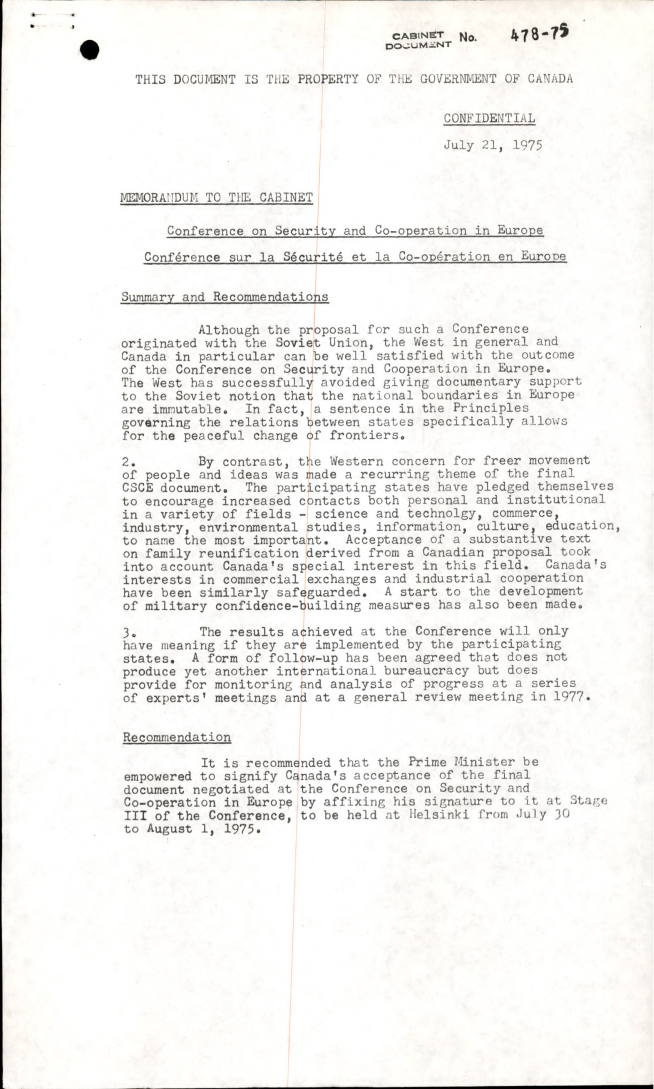
17. It is recommended that the Prime Minister8 be empowered to signify Canada’s acceptance of the final document negotiated at the Conference on Security and Cooperation in Europe by affixing his signature to it at Stage III of the Conference, to be held at Helsinki from July 30–August 1st, 1975. […]9
- 1
- Library and Archives Canada (LAC), Privy Council Office fonds (RG2), vol. 6469, cabinet document 478-75, pt. 1. This memorandum signed by the Canadian Secretary of State for External Affairs Allan MacEachen, dodis.ch/P53713, was sent to the Canadian Cabinet on 21 July 1975.↩
- 2
- For the complete document, cf. the facsimile dodis.ch/77060.↩
- 3
- Cf. dodis.ch/77081.↩
- 4
- For the complete document, cf. the facsimile dodis.ch/77060.↩
- 5
- Allan J. MacEachen, “Conference on Security and Co-operation in Europe at a Decisive Stage,” Statements and Speeches, No. 74/10.↩
- 6
- For the complete document, cf. the facsimile dodis.ch/77060.↩
- 7
- For the complete document, cf. the facsimile dodis.ch/77060.↩
- 8
- Canadian Prime Minister Pierre Trudeau, dodis.ch/P43403.↩
- 9
- For the complete document, cf. the facsimile dodis.ch/77060. For all Canadian documents in this volume, cf. the compilation dodis.ch/C2913.↩
Relations to other documents
| http://dodis.ch/77060 | refers to | http://dodis.ch/77081 |
Tags
Organization for Security and Co-operation in Europe (OSCE) Final CSCE conference in Helsinki (30.7.1975–2.8.1975)