
Printed in
Geneva, Helsinki, and the Making of the CSCE. International Diplomatic Documents on the Conference on Security and Cooperation in Europe, 1969–1975, vol. 30, doc. 87
volume linkBern 2026
more… |
▼▶Repository
| Archive | Library and Archives Canada, Ottawa |
▼ ▶ Archival classification | CA-LAC RG25-A-3-c, 9093, 20-4-CSCE, pt. 56 |
| Archival classification | CA-LAC Department of External Affairs fonds, RG25 9093 |
| (1975/07/01–1975/07/15) |
 Transcription
 QdD
QdD
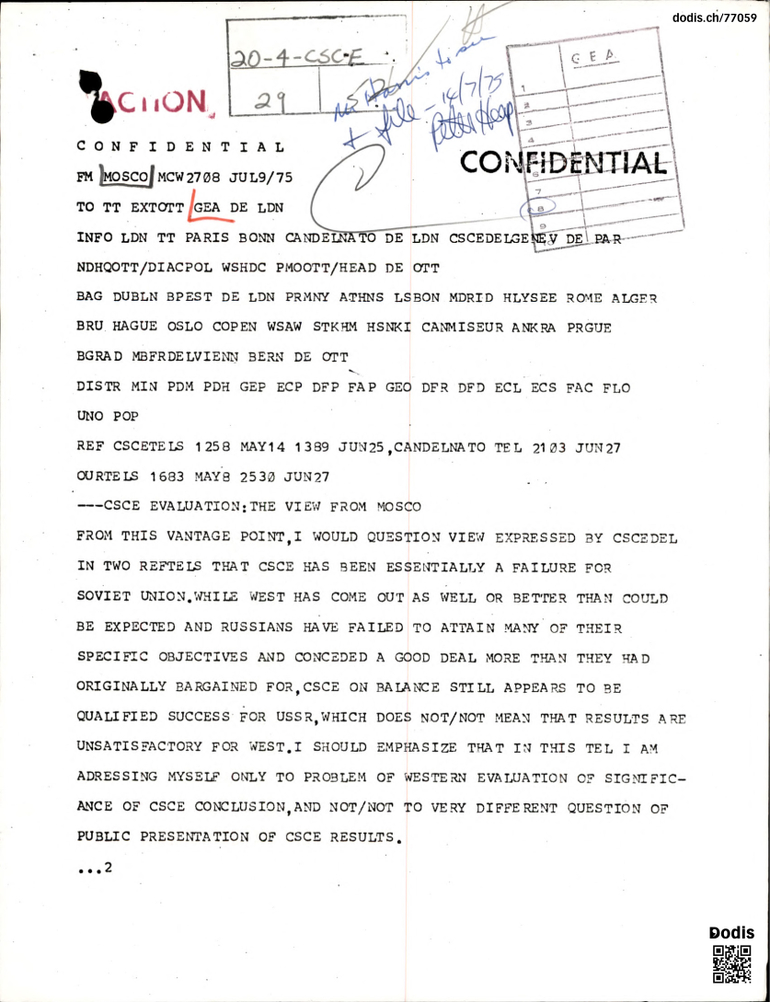
 Facsimile
dodis.ch/77059
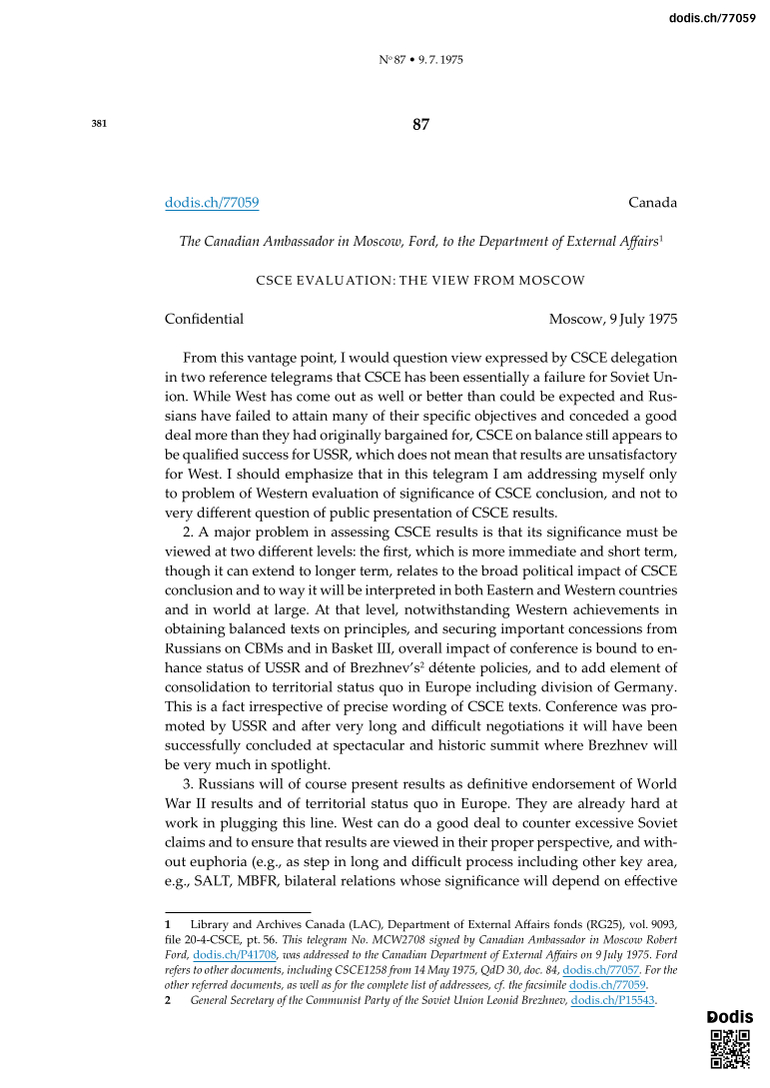
The Canadian Ambassador in Moscow, Ford, to the Department of External Affairs1
CSCE Evaluation: The View from Moscow
From this vantage point, I would question view expressed by CSCE delegation in two reference telegrams that CSCE has been essentially a failure for Soviet Union. While West has come out as well or better than could be expected and Russians have failed to attain many of their specific objectives and conceded a good deal more than they had originally bargained for, CSCE on balance still appears to be qualified success for USSR, which does not mean that results are unsatisfactory for West. I should emphasize that in this telegram I am addressing myself only to problem of Western evaluation of significance of CSCE conclusion, and not to very different question of public presentation of CSCE results.
2. A major problem in assessing CSCE results is that its significance must be viewed at two different levels: the first, which is more immediate and short term, though it can extend to longer term, relates to the broad political impact of CSCE conclusion and to way it will be interpreted in both Eastern and Western countries and in world at large. At that level, notwithstanding Western achievements in obtaining balanced texts on principles, and securing important concessions from Russians on CBMs and in Basket III, overall impact of conference is bound to enhance status of USSR and of Brezhnev’s2 détente policies, and to add element of consolidation to territorial status quo in Europe including division of Germany. This is a fact irrespective of precise wording of CSCE texts. Conference was promoted by USSR and after very long and difficult negotiations it will have been successfully concluded at spectacular and historic summit where Brezhnev will be very much in spotlight.
3. Russians will of course present results as definitive endorsement of World War II results and of territorial status quo in Europe. They are already hard at work in plugging this line. West can do a good deal to counter excessive Soviet claims and to ensure that results are viewed in their proper perspective, and without euphoria (e.g., as step in long and difficult process including other key area, e.g., SALT, MBFR, bilateral relations whose significance will depend on effective implementation). But at broad political level CSCE is still bound to be viewed widely as significant success for USSR though perhaps also as a successful exercise for both sides.
4. With CSCE out of way, and no institutional follow-up, Russians will be free to turn their attention to other areas including Far East communist party relations and Soviet-American relations, including SALT. European agenda will not be exhausted, with focus shifting to MBFR, but they will have some flexibility and time to determine best course for them and to ponder desirability at some later stage of a new initiative towards some kind of all-European security system with disarmament campaign meanwhile serving to maintain momentum and to encourage mood of military relaxation in West.
5. There is also second level for assessing CSCE results, namely impact over time of CSCE texts themselves. It is in this longer term perspective that results appear much less satisfactory for Russians and more favourable to West. Viewing results in this context, I would not quarrel with the analysis of CSCE delegation. Many of specific Soviet objectives have indeed been thwarted – they have failed to get kind of endorsement they wanted on inviolability of frontiers, subscribed to language on peaceful change and national self-determination which may in fact weaken their position on territorial status quo and Brezhnev doctrine, and accepted general undertakings on human contacts and flow of info which West can seek to use to good effect in years ahead in expanding exchanges with USSR and Eastern European countries. Latter may as a result feel a little freer to develop their relations with West, though conference has also served to bring about greater degree of multilateral coordination (and Soviet control) among WPO countries.
6. While implementation will be key issue for West, it is clear from speeches of Soviet leaders, notably Brezhnev, and from Soviet press articles, that Russians have no intention to be bound by CSCE texts which they regard as entirely subject to principle of non-interference and to their own interpretation of the requirements of their internal laws and regulations. Progress in implementation is thus likely to be slow and to take place essentially in framework of bilateral agreements and programs. While balance sheet on CSCE texts is satisfactory for West, and probably best that could have been hoped for, potential benefits are longer term and assessment of their real value must await test of time.
7. In sum, having in mind broad political impact of CSCE and significance of CSCE texts themselves, our tentative conclusions from Moscow vantage point may be stated as follows:
1) Conclusion of conference substantially enhances prestige of USSR and position of Brezhnev.
2) It entails some further political consolidation of European status quo.
3) It will free USSR from restraints imposed by conference and more fundamentally for some time from concern with defence of its interests in Europe, and enable it to concentrate on other areas, notably Far East and relations among communist parties. In particular one of main political aims of USSR will have been achieved by establishing at least appearance of stability in its relations with Europe thus permitting it to devote greater energy and attention to problem of Sino-Soviet relations.
4) Conference will appear as vindication of détente and will make it more difficult for West to maintain its military posture. It will increase pressure on West for concessions in MBFR. Russians will also be under pressure, but West has more difficult position to uphold, the more so because of differences in Western camp on substance of what negotiations should accomplish.
5) Conference has witnessed a high degree of cooperation and unity among Western countries and induced greater cohesion rather than divisiveness. This is a definite plus though it may be difficult to maintain in future notably in MBFR.
6) Russians have made important concessions in texts and this could serve to expand scope of East–West cooperation and exchanges. It has also potential to generate conflict in future, as Russians are unlikely to move quickly to implement CSCE provisions in Basket III especially.
7) CSCE results will lack essential element of balance for West if they are not complemented by meaningful commitments to limit or reduce defense expenditures and size of military forces.3
- 1
- Library and Archives Canada (LAC), Department of External Affairs fonds (RG25), vol. 9093, file 20-4-CSCE, pt. 56. This telegram No. MCW2708 signed by Canadian Ambassador in Moscow Robert Ford, dodis.ch/P41708, was addressed to the Canadian Department of External Affairs on 9 July 1975. Ford refers to other documents, including CSCE1258 from 14 May 1975, QdD 30, doc. 84, dodis.ch/77057. For the other referred documents, as well as for the complete list of addressees, cf. the facsimile dodis.ch/77059.↩
- 2
- General Secretary of the Communist Party of the Soviet Union Leonid Brezhnev, dodis.ch/P15543.↩
- 3
- For all Canadian documents in this volume, cf. the compilation dodis.ch/C2913.↩
Relations to other documents
| http://dodis.ch/77059 | refers to | http://dodis.ch/77057 |
Tags
Organization for Security and Co-operation in Europe (OSCE) Disarmament Final CSCE conference in Helsinki (30.7.1975–2.8.1975)