
Printed in
Geneva, Helsinki, and the Making of the CSCE. International Diplomatic Documents on the Conference on Security and Cooperation in Europe, 1969–1975, vol. 30, doc. 75
volume linkBern 2026
more… |
▼▶Repository
| Archive | Library and Archives Canada, Ottawa |
▼ ▶ Archival classification | CA-LAC RG25-A-3-c, 9092, 20-4-CSCE, pt. 49 |
| Archival classification | CA-LAC Department of External Affairs fonds, RG25 9092 |
| (1974/12/01–1974/12/31) |
 Transcription
 QdD
QdD
 Facsimile
dodis.ch/77054
The Head of the Canadian Delegation to the CSCE Delworth to the Department of External Affairs1
CSCE: General Assessment
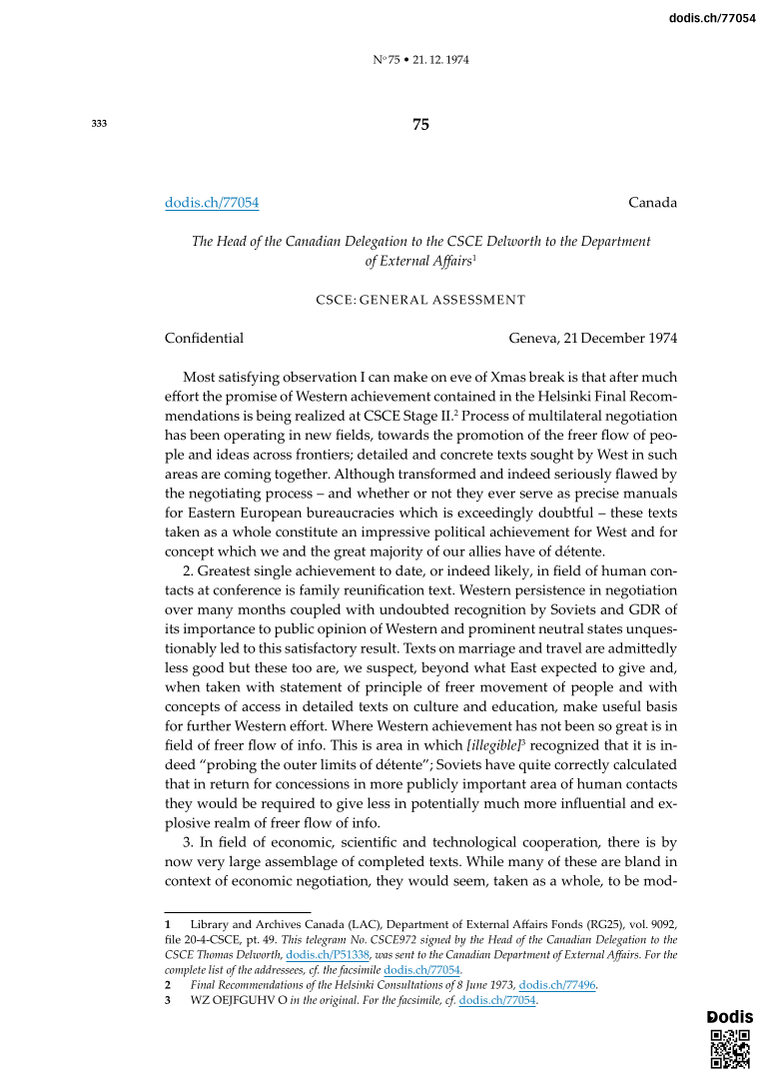
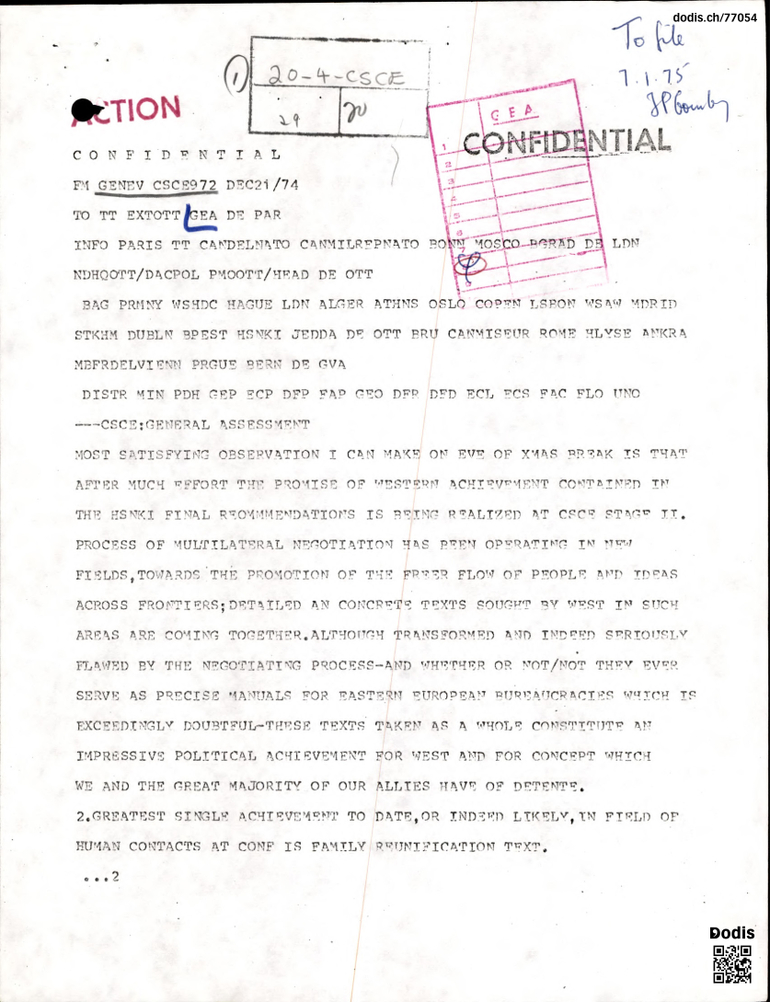
Most satisfying observation I can make on eve of Xmas break is that after much effort the promise of Western achievement contained in the Helsinki Final Recommendations is being realized at CSCE Stage II.2 Process of multilateral negotiation has been operating in new fields, towards the promotion of the freer flow of people and ideas across frontiers; detailed and concrete texts sought by West in such areas are coming together. Although transformed and indeed seriously flawed by the negotiating process – and whether or not they ever serve as precise manuals for Eastern European bureaucracies which is exceedingly doubtful – these texts taken as a whole constitute an impressive political achievement for West and for concept which we and the great majority of our allies have of détente.
2. Greatest single achievement to date, or indeed likely, in field of human contacts at conference is family reunification text. Western persistence in negotiation over many months coupled with undoubted recognition by Soviets and GDR of its importance to public opinion of Western and prominent neutral states unquestionably led to this satisfactory result. Texts on marriage and travel are admittedly less good but these too are, we suspect, beyond what East expected to give and, when taken with statement of principle of freer movement of people and with concepts of access in detailed texts on culture and education, make useful basis for further Western effort. Where Western achievement has not been so great is in field of freer flow of info. This is area in which [illegible]3 recognized that it is indeed “probing the outer limits of détente”; Soviets have quite correctly calculated that in return for concessions in more publicly important area of human contacts they would be required to give less in potentially much more influential and explosive realm of freer flow of info.
3. In field of economic, scientific and technological cooperation, there is by now very large assemblage of completed texts. While many of these are bland in context of economic negotiation, they would seem, taken as a whole, to be moderately useful from Western point of view; in some respects they could prove to be of considerable importance. East has neither sought nor obtained important commercial nor technological advantage at CSCE, leaving this for bilateral deals with major Western states or other more specific multilateral fora. On other hand, West has achieved good number of texts aimed at promoting freer contact between individual scientists and businessmen, better business conditions, etc., all with a distinctly freer movement of people flavour. Key problems such as MFN stubbornly remain to be solved but all indications are that result will not be unsatisfactory from Western point of view.
4. If Western patience in negotiating in human contacts has at last resulted in relatively sudden pre-Xmas (1974) completion or near-completion of texts, same approach has produced much more steady build-up of useful text in declaration on principles. With eight of ten principles now completed (seven registered and the eighth on the verge of registration), there still remains a number of difficult issues – peaceful change of frontiers, the inter-relationship of the principles and a means of safeguarding quadripartite rights in Berlin in the principle on fulfilment of obligations under international law – which will probably require considerable negotiating time. Although some allies are concerned that work in this area is lagging as a result of more dramatic moves in human contacts, we have been advocating continuation of careful and measured approach. It was this approach on Western side, with some considerable help from neutrals, which added satisfactorily full text of principle on human rights to growing decalogue.
5. There is of course significant area where progress is not being made, on CBMs. Adamant refusal of Soviets to enter into real negotiation is causing increasing consternation among Western and neutral delegations who are of firm view that military aspects of building security must be treated in serious way at CSCE. Danger of arriving at eleventh-hour cul de sac has led number of Western delegations to call for a rethinking of approach to CBMs early in New Year; our suggestions have been set out in separate message. Other area where positions remain far apart and almost no progress has been made is on the follow-up to the conference. Although West has quite rightly maintained that need for measures of organizational nature to follow conference could only be gauged on basis of conference results and has usefully gained time to this end, fact is that results are now being produced and Western position will have to move after Xmas. Value of continuing multilateral negotiating process in areas concerning freer flow of people, info and ideas and of continuing to involve USSR and its Eastern European allies in this process is perhaps more evident now. We have suggested rethinking of reserved Canadian position and expect that other Western delegations too may now be looking more seriously at positive aspects of follow-up prior to concerted analysis of Western position after Xmas.
6. Most marked feature of past session has been change of pace. From very static and discouraging beginning in early autumn, conference moved into gear with indication by Soviets some weeks ago of series of concessions in key human contacts area. In retrospect, this move seems almost certainly to have been designed to prepare way for Brezhnev meetings with Ford and Giscard although it may also be result of increased firmness, publicly announced in conference, of USA position. After Rambouillet summit, events have moved even faster; while it is possible that considerable progress now being achieved is simply traditional end of term acceleration, it seems more likely that Stage II of the conference is indeed moving towards completion, perhaps by late spring. Completion of third stage at highest level before meeting of European communist parties mid-year seems to be immediate Soviet goal. In broader perspective, it is probable that Soviets have at last recognized that conference will have to produce results across board of Final Recommendations4 and are moving to cut off a long negotiating process which had turned out to be rather different from the one they expected, of their envisaged pan-European security conference.
7. Acceleration of progress and of concessions this undeniably requires from Western side is causing predictable strains among allies. Particular FRG concerns in principles area, and French, USA, British concern for safeguarding of quadripartite rights in Berlin (apparently “settled” between French and Soviets at Rambouillet) are not easy for other allies to deal with. Greatest strain of all however has been caused by Rambouillet summit itself; whatever French may argue after fact about continuity in allied approach to completion of second stage and holding of third, operative impression throughout conference is of a “deal” – or possibly a series of deals. This impression has been reinforced by growing tendency of French to negotiate human contacts and cultural issues directly with Soviets and then to exert pressure on rest of Nine and 15 and neutrals to fall into line. Some have speculated this is not unrelated to French wish to complete much of sensitive, important negotiating before Irish take over presidency of Nine at New Year. Whatever the motive, this tactic backfired rather spectacularly in last hours of conference when several allies refused to bow to heavy French pressure and accept French-Soviet text on intro to human contacts and MAC.5 Undoubtedly some such effort at some point is required and French as long time leader of Western side at conference are in best position to make it and to respond to present Soviet concessions. This fact, however much recognized, does not make process easy one with regard to alliance solidarity so remarkably consistent and productive in conference to date. Our emphasis on necessity to preserve this solidarity and on a measured careful approach to obtain satisfactory results, when taken with similar attitudes on part of most of our other allies, will hopefully help to counter-balance undoubted need to “move” in conference.
8. As footnote I would add the obvious. Whether tied to the Vladivostok communique formula or the “bonnes prémisses” of Rambouillet, pass has been effectively sold by West on meeting at third stage at highest level. It has been clear for some time that this bargaining counter fell in a political domain outside conference negotiations so that its abrupt loss is not unexpected and should not seriously upset Western position in remainder of second stage negotiations. In any case in light of recent progress in conference, and from vantage point of Xmas break, it is our expectation that such a meeting will be warranted on basis of fairly satisfactory results.6
- 1
- Library and Archives Canada (LAC), Department of External Affairs Fonds (RG25), vol. 9092, file 20-4-CSCE, pt. 49. This telegram No. CSCE972 signed by the Head of the Canadian Delegation to the CSCE Thomas Delworth, dodis.ch/P51338, was sent to the Canadian Department of External Affairs. For the complete list of the addressees, cf. the facsimile dodis.ch/77054.↩
- 2
- Final Recommendations of the Helsinki Consultations of 8 June 1973, dodis.ch/77496.↩
- 3
- WZ OEJFGUHV O in the original. For the facsimile, cf. dodis.ch/77054.↩
- 4
- Final Recommendations of the Helsinki Consultations of 8 June 1973, dodis.ch/77496.↩
- 5
- Mutually acceptable conditions.↩
- 6
- For all Canadian documents in this volume, cf. the compilation dodis.ch/C2913.↩
Relations to other documents
| http://dodis.ch/77496 | is quoted in | http://dodis.ch/77054 |
Tags
Organization for Security and Co-operation in Europe (OSCE) CSCE negotiations in Helsinki and Geneva (1972–1975)