
Printed in
Geneva, Helsinki, and the Making of the CSCE. International Diplomatic Documents on the Conference on Security and Cooperation in Europe, 1969–1975, vol. 30, doc. 63
volume linkBern 2026
more… |
▼▶Repository
| Archive | Library and Archives Canada, Ottawa |
▼ ▶ Archival classification | CA-LAC RG25-A-3-c, 9091, 20-4-CSCE, pt. 42 |
| Archival classification | CA-LAC Department of External Affairs fonds, RG25 9091 |
| (1973/12/01–1974/01/31) |
 Transcription
 QdD
QdD
 Facsimile
dodis.ch/77052
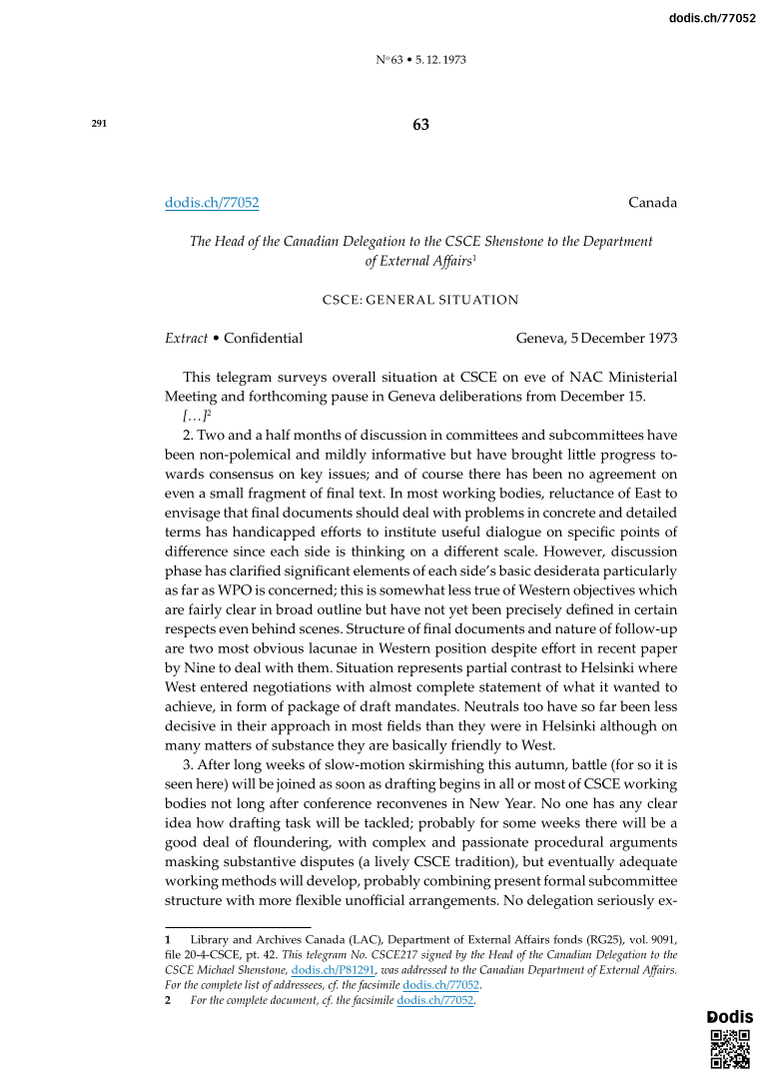
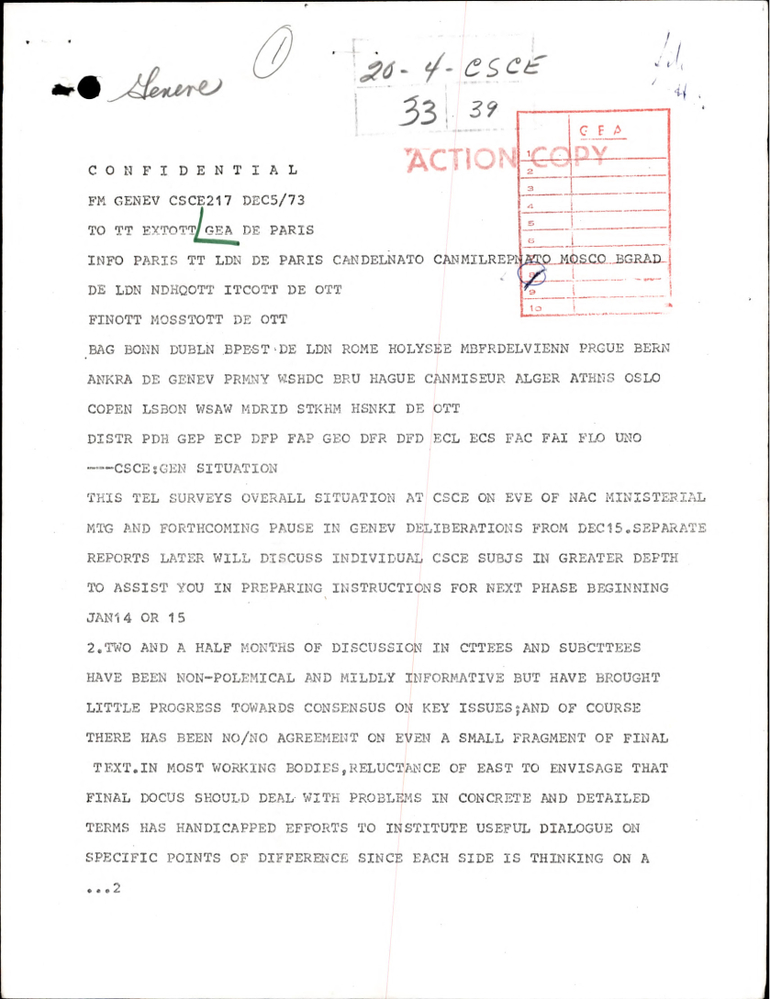
The Head of the Canadian Delegation to the CSCE Shenstone to the Department of External Affairs1
CSCE: General Situation
This telegram surveys overall situation at CSCE on eve of NAC Ministerial Meeting and forthcoming pause in Geneva deliberations from December 15.
[…] 2
2. Two and a half months of discussion in committees and subcommittees have been non-polemical and mildly informative but have brought little progress towards consensus on key issues; and of course there has been no agreement on even a small fragment of final text. In most working bodies, reluctance of East to envisage that final documents should deal with problems in concrete and detailed terms has handicapped efforts to institute useful dialogue on specific points of difference since each side is thinking on a different scale. However, discussion phase has clarified significant elements of each side’s basic desiderata particularly as far as WPO is concerned; this is somewhat less true of Western objectives which are fairly clear in broad outline but have not yet been precisely defined in certain respects even behind scenes. Structure of final documents and nature of follow-up are two most obvious lacunae in Western position despite effort in recent paper by Nine to deal with them. Situation represents partial contrast to Helsinki where West entered negotiations with almost complete statement of what it wanted to achieve, in form of package of draft mandates. Neutrals too have so far been less decisive in their approach in most fields than they were in Helsinki although on many matters of substance they are basically friendly to West.
3. After long weeks of slow-motion skirmishing this autumn, battle (for so it is seen here) will be joined as soon as drafting begins in all or most of CSCE working bodies not long after conference reconvenes in New Year. No one has any clear idea how drafting task will be tackled; probably for some weeks there will be a good deal of floundering, with complex and passionate procedural arguments masking substantive disputes (a lively CSCE tradition), but eventually adequate working methods will develop, probably combining present formal subcommittee structure with more flexible unofficial arrangements. No delegation seriously expects completion of agreement till at least Easter; and many, including Canadian delegation and at least some WPO reps, estimate that task will probably take until about mid-May, with most of major issues being settled almost simultaneously near end of process. However, degree of commitment to completion of CSCE among most participants is such that there is little detectable disposition here to doubt likelihood of eventually achieving agreement. Refusal of third phase is of course an option which West must clearly keep open for bargaining purposes, but it is envisaged seriously by very few, e.g., Dutch (quite gladly) and Finns (quite sadly). This general mood is factor we shall have to reckon with in determining our own tactics during crucial phases of bargaining process.
4. A striking fact testifying to momentum of conference is extent to which convulsions of Mideast war, nuclear alerts and energy crisis have so far left CSCE unaffected in its stately onward progress apart from fact that Swiss oil shortage has lowered temperature in conference building and further numbed debate. Delegations now display slightly more polite interest in contributions by non-participating Mediterranean states but few delegations are genuinely willing to shift balance of this basically East–West conference southward.
5. Following survey of state of play in main working bodies will demonstrate difficulty of estimating how fast events will move after Xmas or precisely what bargains will emerge.
6. Subcommittee 1 on principles guiding relations between states […]3 During discussion USSR and WPO (minus Romania) have supported Soviet declaration and its sparse definitions but have received practically no support from Romania, neutrals and NATO who have insisted on inclusion of essential details concerning each principle. It has not been possible to contest fact embodied in Helsinki recommendations that there will be separate listing of principles of non-use of force, inviolability and territorial integrity. Outside of WPO, however, there is no support for wording these three principles in way which could lead to interpretation that peaceful changes in frontiers are excluded. Although it is still difficult to predict precise course of events, it seems likely that when Soviet text is rejected USSR will press for minimal definition of “respect for inviolability of frontiers” which WPO can interpret one way and neutrals and NATO another way. Touchy issue of rights of national minorities (raised recently in Committee 1 by Yugoslavs) may be included in principle on human rights.
7. Special Working Body (SWB) has reached impasse over Swiss proposed system for peaceful settlement of disputes. Swiss, other neutrals and NATO insist that in order to be improvement on existing systems, new system must provide for compulsory jurisdiction in advance of particular future disputes; WPO rejects this and says any system must embody free choice of parties. They have so far refused to budge on Canadian compromise formula (backed by Swiss) for selecting for compulsory jurisdiction a few specific subjects, perhaps linked with CSCE results. We wonder if Swiss will hold to compulsory jurisdiction indefinitely; if not, West may have problems. Other topics before SWB are (a) basically meaningless Soviet draft on application of principles, which has virtually no non-WPO support; (b) Romanian draft on implementation of non-use of force. Call in latter for future drafting (e.g., by follow-up body) of European non-use of force treaty is regarded by NATO countries as one of most dangerous ideas floating at conference since, although Romanians claim proposal is aimed at USSR, Soviets might try to use treaty to score points they fail to achieve at CSCE on inviolability and territorial integrity. Hope is that a few innocuous details from Romanian text may be selected for incorporation in final documents.
8. In Subcommittee 2, discussion of military confidence-building measures has been marked by (a) divergent positions on notification of manoeuvres, WPO being ultra conservative; (b) only few problems regarding exchange of observers as all delegations agree on fundamentals, i.e., purely voluntary, reciprocal conditions, bilateral initiatives; (c) limited debate on notification of movements because neither Soviet nor USA delegations in favour and NATO tactic is to conceal divergent positions among 15 by discussing manoeuvres and movements as single concept. Some other CBMs, e.g., Spanish exchange of visits and Swedish budget disclosure, receiving cautious encouragement but prospects uncertain. Debate on other military measures is strongly pushed by neutrals and has focused on MBFR info link, principle of undiminished security for all European states not merely MBFR participants, and indivisibility of political and military détente (meaning need for realistic advances in both areas). CSCE results in military area will clearly be minimal but some acceptable means should be found of at least appearing to meet some neutral concerns in this area.
[…] 4
14. Problems here as expected seem more intractable than elsewhere, and differences are particularly acute on issue mentioned above in paragraph 2, i.e., extent to which final results should contain provisions couched in concrete and specific terms. In various subcommittees Soviet delegation recently put cards on table concerning final form of results of work in this basket. They said that as directed by Helsinki paragraph 435 there should be one final document encompassing all results of negotiations (in contrast to Western inclination towards numerous loosely associated texts); it should be of average length in terms of precedents (meaning quite short, like Helsinki text); it should be precise and intelligible to man in street and phrased in respectable terms (meaning non-controversial and without anti-curtain overtones); and it should be headed by preamble reiterating elements of paragraphs 42–44, i.e., aims stated therein and principles of relations between states, with particular emphasis on sovereignty, non-interference and respect for laws and customs. In prolonged and difficult Committee III debates, West including Canada has strenuously resisted idea of such a preamble because of its restrictive connotations but Soviets keep insisting this is price for acceptance of detailed measures in subcommittees. Meanwhile, long overdue work is starting among Nine (with strong encouragement from Canada and others) to draft texts embodying general objectives or principles of freer movement of people and dissemination of info to introduce specific Western measures.
15. In Subcommittee 8 (human contacts) WPO and Western positions remain far apart; it is still almost impossible to see shape of any final common ground in conference document form. Essentially WPO have shown no sign of accepting anything more than statement of good intent in human contacts area, well hedged by respect for restrictive principles (see above), to be followed up by bilateral agreements. Their idea of negotiating fat appears to be concessions to return to Helsinki texts but certainly not to go beyond them. They have almost completely avoided trying to come to terms with detailed and concrete multilateral proposals with political and moral binding force put forward by Western delegations, although they seem slightly more resigned to eventual paper concessions in family problems than in equally important general travel area. Fact that except for Canadian proposal on reunification of families there are still no major final proposals from Western delegations on table has probably made WPO, who are treating human contacts as inconvenient drafting exercise, even less willing to engage in any real discussion. Therefore even second round of discussion based on French-inspired catalogue has not been particularly productive. Drafting phase will be severe test of Western determination.
16. Info (Subcommittee 9) seems as sensitive for WPO as human contacts, or more so. Here they appear to be thinking in terms of (a) statement such as that in Helsinki mandate advocating greater (but not free) dissemination of info, and (b) elaboration of a few simple concrete measures towards this aim, but not of type which would result in circulation of info beyond control of authorities. Where concessions will be hardest to obtain are precisely where they would be most useful: i.e., improved circulation of printed info, guaranteed unhindered access to direct broadcasts, and better conditions for journalists in contacting unofficial sources, travel, etc. Unless West adopts very tough stance during drafting, there is risk of securing only marginal improvements (like magazine or Irish proposal on oral info), prefaced by statement urging only relatively greater flow of info, to which it will be difficult to pin WPO countries in future.
[…] 6
19. In summary, we see long and difficult drafting phase ahead. Final outcome will almost certainly constitute, on balance, something that can be depicted as modest advance on present situation in Europe in terms of Canadian objectives but every inch of real progress beyond minimal level will be hard-fought and will require stubborn and united efforts of allies combined with as much influential neutral support as can be rallied. We cannot yet estimate chances of such progress being attained.7
- 1
- Library and Archives Canada (LAC), Department of External Affairs fonds (RG25), vol. 9091, file 20-4-CSCE, pt. 42. This telegram No. CSCE217 signed by the Head of the Canadian Delegation to the CSCE Michael Shenstone, dodis.ch/P81291, was addressed to the Canadian Department of External Affairs. For the complete list of addressees, cf. the facsimile dodis.ch/77052.↩
- 2
- For the complete document, cf. the facsimile dodis.ch/77052.↩
- 3
- For the complete document, cf. the facsimile dodis.ch/77052.↩
- 4
- For the complete document, cf. the facsimile dodis.ch/77052.↩
- 5
- This reference and the following one refer to the Final Recommendations of the Helsinki Consultations of 8 June 1973, dodis.ch/77496.↩
- 6
- For the complete document, cf. the facsimile dodis.ch/77052.↩
- 7
- For all Canadian documents in this volume, cf. the compilation dodis.ch/C2913.↩
Tags
Organization for Security and Co-operation in Europe (OSCE) CSCE negotiations in Helsinki and Geneva (1972–1975)