dodis.ch/77047
The Department of External Affairs to the Canadian Delegation to NATO
1
CSCE Agenda: Freer Movement
We agree with general line you propose in your reference telegram for use in discussion in senior PAC2 meeting. You should also draw as appropriate on this telegram.
2. We remain convinced of the correctness of Canadian position on this subject and unconvinced by any argument so far made for acceptance of human contacts formula for initial presentation in Helsinki. We hope you will repeat to our allies how strongly we feel on this subject as demonstrated once more by reference in yesterday’s Throne Speech3 (PST-27 January 4 refers). We wish record to show when these exercises are complete that we consistently and firmly opposed watering-down of established NATO position before negotiation of CSCE agenda and mandates had begun. It has never been satisfactorily explained to us why EEC countries are so insistent on human contacts wording. Your approach in senior PAC and subsequently in NAC should be to meet so-called arguments of EEC countries and ask key questions which will expose logical inconsistencies and bring to light real motives.
3. Some EEC countries have asked that we should agree to EEC formula for sake of maintaining NATO solidarity. It is legitimate to ask whether they put more stock in NATO or in EEC solidarity. NATO solidarity must be created before it can be maintained and we are being asked to accept a wording which was formulated without consulting us or asking for input. It seems to us that this way of proceeding is anything but conducive to solidarity of NATO.
4. While there is talk of maintaining NATO solidarity there is also objection to use of wording appearing in NATO communique4 on grounds it has overtones of bloc to bloc approach. This seems to us contradiction in logic. If there is to be NATO solidarity NATO ministerial language should be used. If there is objection in principle to use of such language one cannot talk about NATO solidarity and each NATO member will be free to table own wording.
5. Argument that wording suggested by us would be regarded as provocative by USSR is supported by no evidence that we have been able to obtain either privately or publicly. Indeed there is evidence from Helsinki to contrary. It greatly underestimates intelligence of Russians to argue that it will be easier for them to accept one wording rather than another. They are fully aware of what words are intended to convey and, whatever agenda item may be, they will assume that West intends it to cover same content.
6. We certainly cannot accept tactical argument that more direct wording we propose would be less likely to achieve our objectives. This approach is inconsistent with tactics being employed with respect to many other aspects of CSCE. Anyone with experience of negotiating with USSR is aware that concessions are not extracted by unilateral softening of positions. If we wish to achieve balanced result, it must be bargained for and concessions must not be made until there is indication that other side is also prepared to make deal. We cannot accept argument that although title of agenda item may be weak, points we wish to achieve are included in mandate. The mandate has yet to be negotiated. If we do not table agenda item covering all we wish committee to discuss, other side will be justified in demanding elimination from mandate of those aspects they can claim are not in agenda item. This strengthens argument for starting with comprehensive title and mandates. Title could then be watered down by agreement provided mandate was retained without deletions.
7. You should draw attention of senior PAC to Brezhnev statement on December 21 to 50th celebration meeting in Moscow where he indicated acceptance of some of position in draft mandate. (See Moscow telegram 5253 [sic] of December 22/72).5 It would be too bad if we did not take advantage of this to obtain broadest possible agenda item. Brezhnev’s use of words “contacts between peoples” indicates we are in good bargaining position to obtain satisfactory mandate provided we do not compromise “freer movement” wording gratuitously.6

 Transcription
 QdD
QdD
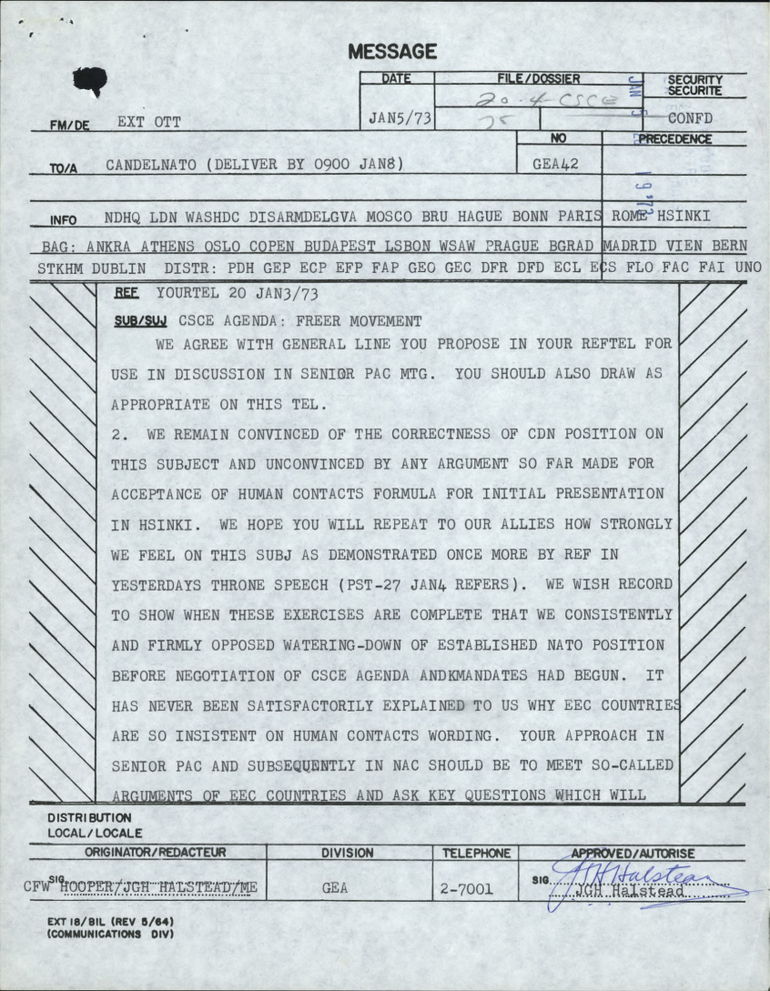
 Facsimile