
Printed in
Geneva, Helsinki, and the Making of the CSCE. International Diplomatic Documents on the Conference on Security and Cooperation in Europe, 1969–1975, vol. 30, doc. 26
volume linkBern 2026
more… |
▼▶Repository
| Archive | Library and Archives Canada, Ottawa |
▼ ▶ Archival classification | CA-LAC RG25-A-3-c, 9088, 20-4-CSCE, pt. 22 |
| Archival classification | CA-LAC Department of External Affairs fonds, RG25 9088 |
| (1972/08/01–1972/08/31) |
 Transcription
 QdD
QdD
 Facsimile
dodis.ch/77046
Assistant Under-Secretary of State for External Affairs Halstead to Under-Secretary of State for External Affairs Ritchie1
Conference on Security and Cooperation in Europe
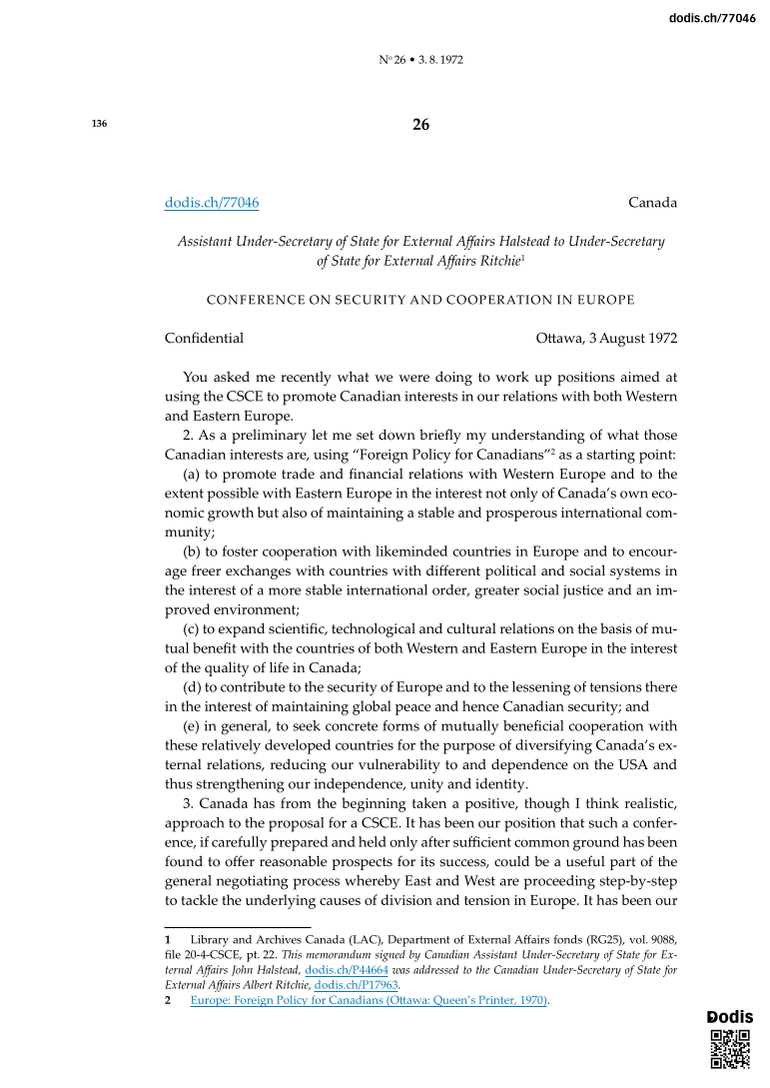
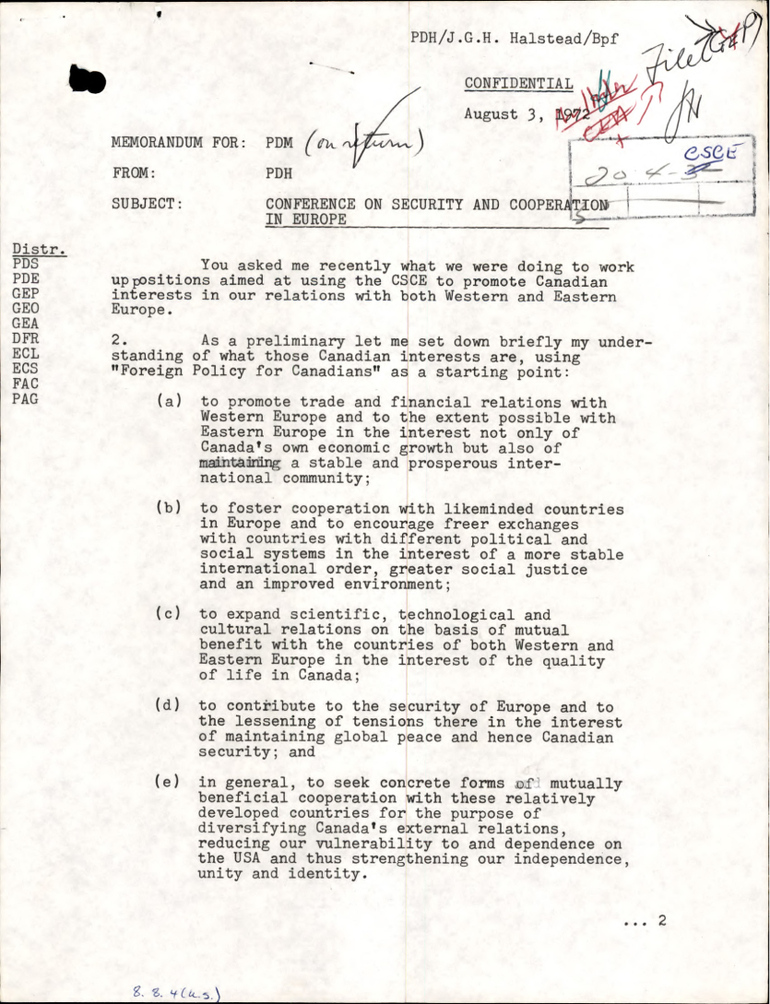
You asked me recently what we were doing to work up positions aimed at using the CSCE to promote Canadian interests in our relations with both Western and Eastern Europe.
2. As a preliminary let me set down briefly my understanding of what those Canadian interests are, using “Foreign Policy for Canadians”2 as a starting point:
(a) to promote trade and financial relations with Western Europe and to the extent possible with Eastern Europe in the interest not only of Canada’s own economic growth but also of maintaining a stable and prosperous international community;
(b) to foster cooperation with likeminded countries in Europe and to encourage freer exchanges with countries with different political and social systems in the interest of a more stable international order, greater social justice and an improved environment;
(c) to expand scientific, technological and cultural relations on the basis of mutual benefit with the countries of both Western and Eastern Europe in the interest of the quality of life in Canada;
(d) to contribute to the security of Europe and to the lessening of tensions there in the interest of maintaining global peace and hence Canadian security; and
(e) in general, to seek concrete forms of mutually beneficial cooperation with these relatively developed countries for the purpose of diversifying Canada’s external relations, reducing our vulnerability to and dependence on the USA and thus strengthening our independence, unity and identity.
3. Canada has from the beginning taken a positive, though I think realistic, approach to the proposal for a CSCE. It has been our position that such a conference, if carefully prepared and held only after sufficient common ground has been found to offer reasonable prospects for its success, could be a useful part of the general negotiating process whereby East and West are proceeding step-by-step to tackle the underlying causes of division and tension in Europe. It has been our calculation that this process is itself of benefit to Canada because it tends to lower international tensions, to strengthen international peace and security, and in the process to allow a country like Canada greater freedom for international manoeuvre. It has also been part of our calculation that, in fostering this process, Canada should seek out and exploit opportunities for promoting our particular interests in Europe. That is why we have insisted on the right to participate just as fully in the “cooperation” as in the “security” dimension of CSCE. The particular way in which we pursue Canadian interests in the conference will of course depend on the opportunities which we find.
4. Considerable work has already been done to translate these interests into Canadian positions with respect to a wide range of issues raised by CSCE. The results of this work so far are summarized in the attached collection of position papers.3 However it might be useful if I indicated briefly what I think some of the main problems and opportunities are and how we might deal with them from now on.
5. It seems likely that the subject matter of the conference deliberations will be divided into three groups: security questions; economic questions; and cultural, scientific and other forms of cooperation.
6. Under the heading of security questions the main matters for consideration will probably be:
(a) some form of declaration of the non-use of force;
(b) some form of ratification of the post-war European boundaries (including the FRG/GDR boundary and the western boundaries of the USSR);
(c) some code of conduct or declaration of principles governing relations between States; and
(d) some confidence building measures and some reference to MBFR.
7. Concerning the non-use of force, the main Canadian purpose will be to ensure that whatever is adopted is as realistic as possible, of general application and not capable of being used in a one-sided way against us. Concerning the ratification of the post-war European boundaries, the main question it will raise for Canada will probably be the implication of recognition of the Soviet annexation of the Baltic States. Concerning the declaration of principles, Canada may have a particular problem if others (e.g., the FRG) press to include the principle of self-determination. Concerning confidence building measures and the relationship of CSCE with MBFR, we are prepared to go along with whatever formula commands general NATO support. In fact there seems to be wide agreement that it would be useful to discuss at CSCE a limited number of practical measures (such as the reciprocal notification of military manoeuvres) which would build mutual confidence but that it would be unwise with respect to MBFR to go farther than to give a general blessing from the CSCE to the idea of roughly parallel negotiations elsewhere on force reductions.
8. While NATO background studies have been dealing with a broad range of questions such as hindrances and aids to East–West trade, industrial cooperation, financial cooperation and the problem of development aid, it is still too early to say just what the economic aspects of the CSCE will comprise. It is already clear, however, that there will be two orders of problems of general interest to all NATO countries. The first is the question of how the group of ten countries comprising the enlarged European Community will handle their dealings with Canada and other non-EEC members of NATO. So far the tendency of the EC has been to formulate their own positions before being prepared to consult with others. This has proved to be a time-consuming procedure which may be too unwieldy for the faster moving pace of the CSCE.
9. The second and related problem is the question of what the Western strategy should or could be. At an earlier stage it was thought that the conference would be an inappropriate forum for the negotiation of economic matters but more recently the EC seems to have come round to the view that the conference may indeed provide a useful opportunity for serious economic negotiations. The EC members have belatedly begun preparing position papers which contemplate bargaining with the Communist countries for mutual concessions in the economic field rather than merely preparing defences against their economic demands. In fact however, it seems most unlikely that anything like a common NATO position will be formulated on these matters, if only because EC interests are not the same as USA interests; and of course Canadian interests are something else again.
10. As for specific Canadian interests, it is planned to undertake between now and the middle of September an intensive analysis of the issues identified in the background papers prepared in NATO, with a view to recommending policies and tactics best designed to achieve our purposes. This work will be undertaken by PAG4 in consultation with ECL5 and other divisions concerned.
11. Under the third heading it is expected that the CSCE may deal with such matters as:
(a) cooperation in pure and applied science and technology;
(b) cultural exchanges; and
(c) cooperation to improve the environment.
12. In this context Canadian efforts will in general be employed to promote the following objectives:
(a) to remove obstacles to the freer movement of people, ideas and information;
(b) to adopt a problem-oriented approach, making use as appropriate of existing international organizations;
(c) to avoid bloc-to-bloc arrangements and to preserve the opportunity to deal bilaterally with individual countries of Eastern Europe; and
(d) to respect the principles of reciprocity and mutual benefit.
13. It seems likely that one of the main issues in this area of the conference’s deliberations will be the question of freer movement of people, ideas and information. It is an issue to which Canada attaches great importance, not for propaganda reasons but because we believe this opportunity should not be missed to obtain some real improvements in the situation by means of concrete measures of liberalization, for example by reducing obstacles to leaving one’s country, lifting restrictions on marriage and re-uniting families, removing radio jamming, freeing the circulation of publications and relaxing the censorship of foreign films. Our tactics will be to use low-key persuasion in favour of a gradual process leading toward generally accepted international behaviour rather than a frontal attack against the repressive practices of the Communist regimes.6
- 1
- Library and Archives Canada (LAC), Department of External Affairs fonds (RG25), vol. 9088, file 20-4-CSCE, pt. 22. This memorandum signed by Canadian Assistant Under-Secretary of State for External Affairs John Halstead, dodis.ch/P44664 was addressed to the Canadian Under-Secretary of State for External Affairs Albert Ritchie, dodis.ch/P17963.↩
- 3
- Cf. LAC, RG25, vol. 9088, file 20-4-CSCE, pt. 21.↩
- 4
- The Policy Analysis Group in the Canadian Department of External Affairs.↩
- 5
- The Commercial Policy Division in the Canadian Department of External Affairs.↩
- 6
- For all Canadian documents in this volume, cf. the compilation dodis.ch/C2913.↩
Tags
Organization for Security and Co-operation in Europe (OSCE) Disarmament East-West-Trade (1945–1990) CSCE negotiations in Helsinki and Geneva (1972–1975)