
Darin: Aufzeichnung vom 13.11.1976 (Beilage).
Darin: Vorschlag der sowjetischen Delegation vom 19.9.1973 (Beilage).
Darin: Vorschlag der deutschen Delegation vom 24.9.1973 (Beilage).
Darin: Vorschlag der französischen Delegation vom 19.10.1973, am 22.10.1973 per Telex ans Auswärtige Amt übermittelt (Beilage).
Darin: Vertrag zwischen der UdSSR und Bundesrepublik Deutschland vom 12.8.1970 (Beilage).
Printed in
Akten zur Auswärtigen Politik der Bundesrepublik Deutschland, vol. 1973, doc. 375
volume linkMünchen 2004
more… |
Geneva, Helsinki, and the Making of the CSCE. International Diplomatic Documents on the Conference on Security and Cooperation in Europe, 1969–1975, vol. 30, doc. 61
volume linkBern 2026
more… |
▼▶Repository
| Archive | Political Archives of the German Federal Foreign Office, Berlin |
| Archival classification | DE-PA/AA B 130, Bd. 9073 (212) |
 Transcription
 QdD
QdD
 Facsimile
dodis.ch/77019
The Political Director of the Federal Foreign Office, van Well, to State Secretary Frank1
CSCE; Here: Soviet Criticism of our Wording Regarding the “Inviolability of Frontiers”• Talks Between the Federal Chancellor and Ambassador Falin on 24 October 19732
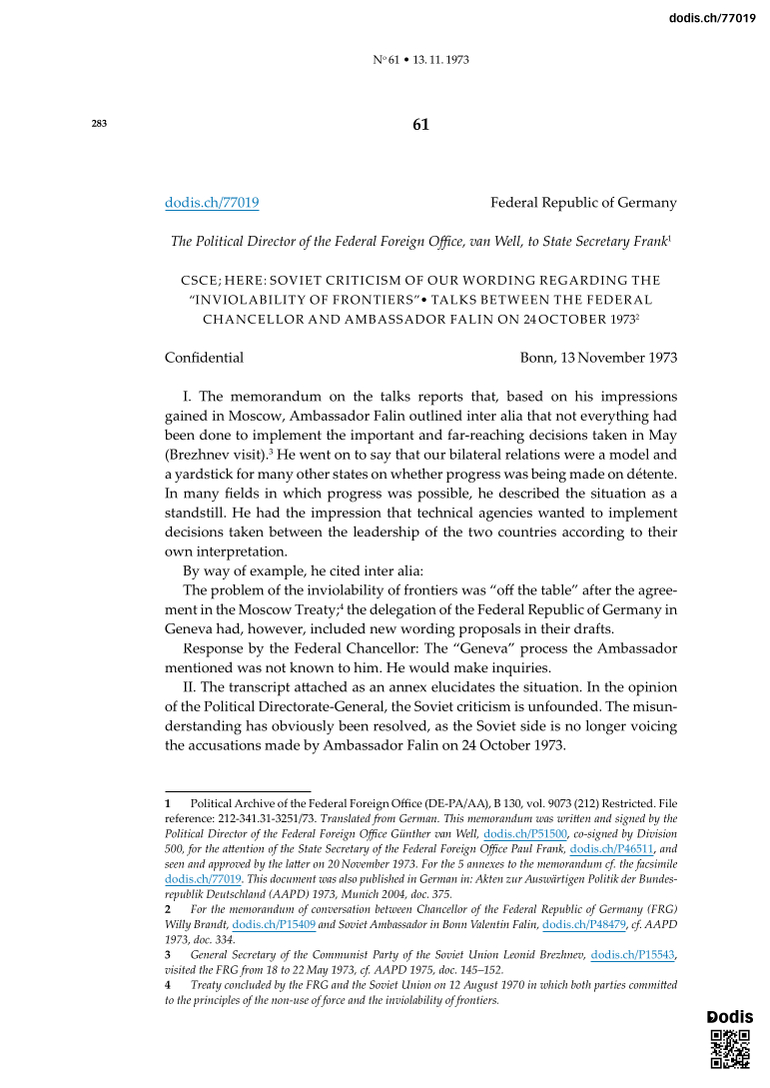
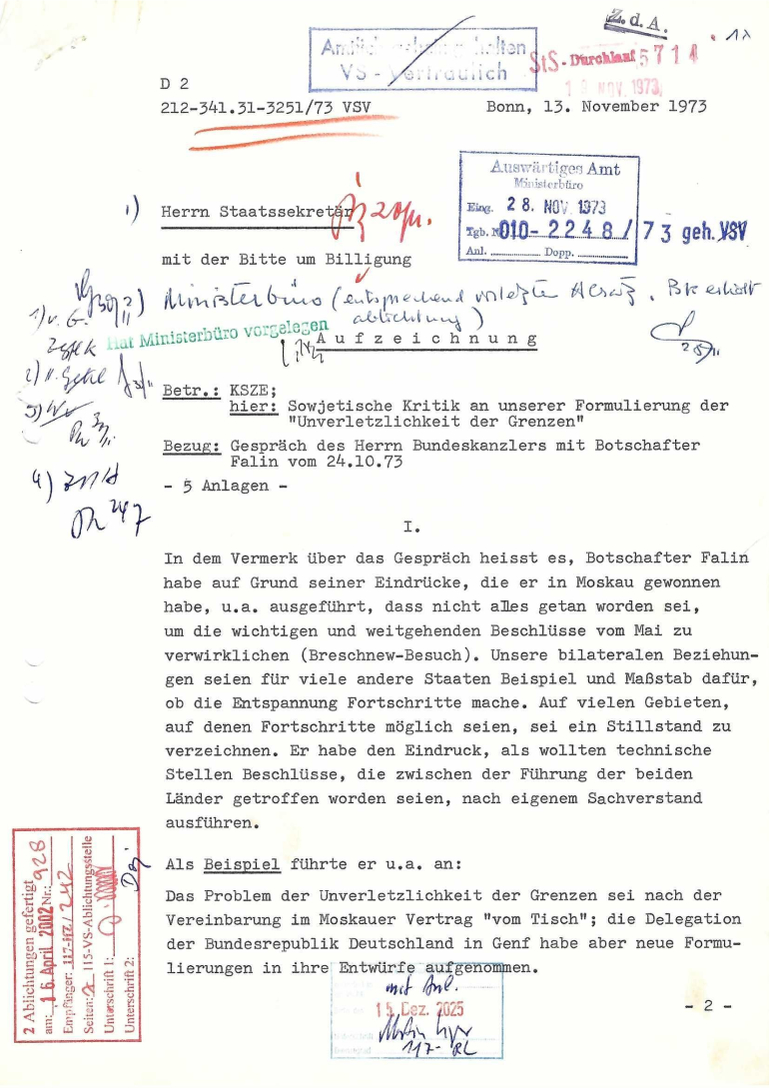
I. The memorandum on the talks reports that, based on his impressions gained in Moscow, Ambassador Falin outlined inter alia that not everything had been done to implement the important and far-reaching decisions taken in May (Brezhnev visit).3 He went on to say that our bilateral relations were a model and a yardstick for many other states on whether progress was being made on détente. In many fields in which progress was possible, he described the situation as a standstill. He had the impression that technical agencies wanted to implement decisions taken between the leadership of the two countries according to their own interpretation.
By way of example, he cited inter alia:
The problem of the inviolability of frontiers was “off the table” after the agreement in the Moscow Treaty;4 the delegation of the Federal Republic of Germany in Geneva had, however, included new wording proposals in their drafts.
Response by the Federal Chancellor: The “Geneva” process the Ambassador mentioned was not known to him. He would make inquiries.
II. The transcript attached as an annex elucidates the situation. In the opinion of the Political Directorate-General, the Soviet criticism is unfounded. The misunderstanding has obviously been resolved, as the Soviet side is no longer voicing the accusations made by Ambassador Falin on 24 October 1973.
Our delegation in Geneva tells us that this delegation had confirmed prior to the visit of the Federal Foreign Minister to Moscow that there were no difficulties at all between the two delegations and that the topic no longer played a significant role in Moscow. The Soviet side instead attached particular importance to the good cooperation between the two delegations in Geneva being praised in the statement on the Moscow visit.5
I propose bringing the attached transcript to the attention of the Federal Chancellor and the Federal Minister.
The discussion on the principle of the inviolability of frontiers in Geneva is being conducted primarily on the basis of the following documents:
1. Helsinki Final Recommendations: 7
In accordance, a document is to be drawn up in Geneva precisely formulating the principles “with such clarifications and additions as may be deemed desirable” and “in conformity with the purposes and principles of the United Nations”; in the list of ten principles, “inviolability of frontiers” comes directly after “refraining from the threat or use of force”.
2. Soviet draft of a General Declaration on the principles of Security in Europe and on the Principles Guiding Relations between States in Europe (Annex 1).8 In this Declaration, the participating States solemnly declare that they will respect and apply the following principles without restriction:
“… the inviolability of frontiers, whereby the participating States consider the existing frontiers in Europe to be inviolable today and in the future, do not make territorial claims against one another and recognise that peace in this area can only be upheld if no-one attempts to challenge the inviolability of current frontiers.”
The Soviet Union concedes that this principle is connected to other principles in the catalogue, however, rejects subordinating this principle to the principle of refraining from the use of force. According to the Soviet Union, frontier changes are not completely excluded in the future, in the form of
– frontier changes based on a treaty between sovereign states;
– frontier changes through integration processes;
– frontier corrections, including negotiations on the demarcation of frontiers.
They are not, however, to be explicitly mentioned in the catalogue of principles in the CSCE Declaration because the Soviet Union considers these obvious; the principle of the inviolability of frontiers is not to be “restricted” in any way.
3. On 26 September, we presented an explanatory document on the principles of refraining from the use of force, the inviolability of frontiers and territorial integrity in Geneva (Annex 2).9 Other allies also presented explanatory documents on other key principles. The tactics agreed in the Alliance and the Community were not to take up the wording of the principles requested by the Soviet Union based on its draft until a sufficient basis for drafting texts had been created after thorough discussion of the individual principles (inductive method). Our wording regarding the principle of the inviolability of frontiers reads:
“Every participating State has the duty to refrain from the threat or use of force to violate the existing international boundaries of another participating State or as a means of solving territorial disputes and issues concerning frontiers of States. The participating States consider their frontiers, as they exist today and regardless of the legal status they have in their view, to be inviolable. The participating States are of the opinion that their frontiers can only be changed in accordance with international law, using peaceful means and by means of an agreement which takes due account of the right to self-determination of peoples.”
The first sentence is based on the Declaration on Principles of International Law concerning Friendly Relations and Co-operation among States,10 which is quoted as a source in the Helsinki Final Act.11 The two subsequent sentences are identical to those in the French draft (see figure 4).
4. French draft of a declaration on principles (Annex 3).12 This draft has been discussed at length in the Alliance and the Community. The French have largely taken account of the amendments we requested. In its definition of inviolability in number 3, the French draft refrains from making express reference to the non-use of force. In number 2, however, it prohibits the “threat and use of force … to violate territorial integrity” which amounts to the same thing. The rest of the wording matches ours in terms of content, that is, the right to peaceful and consensual frontier changes is connected to the right of self-determination of peoples. This clarifies that frontiers cannot be changed using violent means.
5. The Political Committee of the “Nine” has just agreed in Copenhagen that when formulating international law principles on territorial issues our main goal is to uphold the possibility of peaceful frontier changes13 (number 7 of the Political Committee report to the ministers RM (73) 20 of 13 November 1973).
1. The explanatory documents presented in Geneva, as well as our paper on the principles of refraining from the use of force, the inviolability of frontiers and territorial integrity, are intended as a “position de départ”. They serve to examine the subject at a deeper level. In this discussion, our aim was to make plain our understanding of the nature of the inherent connection between the principle of the inviolability of frontiers and the non-use of force.
2. The discussions in Helsinki and Geneva have resulted in agreement that the principle of the inviolability of frontiers should be listed separately in the CSCE catalogue of principles alongside the prohibition of the use of force as laid down in international law. This agreement does not, however, imply acceptance of the Soviet thinking that the principle of the inviolability of frontiers is independent from the prohibition of the use of force in terms of content or that it is even some kind of overarching principle. We want to uphold the connection between the principle of the inviolability of frontiers and the prohibition of the use of force and other principles under international law, as expressed in the introductory sentence of Article 3 of the Treaty of Moscow. We need to do so in order to protect our policy on Germany as outlined in the Letter on German Unity of 12 August 1970.14 At the same time we also need to do this with a view to the “European option”. With regard to the creation of a European Union, all EC countries absolutely insist that peaceful and consensual frontier changes have to remain possible and that the catalogue of principles must be absolutely clear here.
Although it is notable that the Soviet Union only addresses frontier changes and not in parallel the elimination of frontiers, the focus ultimately is not so much on the subordination of inviolability to the non-use of force that the Soviet Union accuses us of which is allegedly in contradiction of the Moscow Treaty (Annex 4)15 but on the endeavours of the Soviet Union to ensure the wording does not include “peaceful change”. However, it meets with the collective resistance of the West and of most non-aligned countries, which like for example Spain have unresolved frontier issues that they want to resolve peacefully.
3. Recently we have not re-introduced our wording in Geneva, wording which is supported by many countries, including the United States and Canada, and have ourselves voiced our support for the document presented by France. Nevertheless, we should not withdraw our paper until wording is agreed with which we are absolutely content. We thus allow ourselves the option of potentially coming back to our paper if, for example, the French vote in favour of wording that we cannot accept. As a country which proposed wording, we are in the “inner circle” when the drafting begins. We also need to ensure we can continue to interpret the Moscow Treaty as we have been doing thus far in case the principle of the inviolability of frontiers ends up being worded ambiguously. However, this option may vanish if we were to withdraw our proposals before knowing the final outcome.
This will not result in a bilateral controversy with the Soviet Union.16
- 1
- Political Archive of the Federal Foreign Office (DE-PA/AA), B 130, vol. 9073 (212) Restricted. File reference: 212-341.31-3251/73. Translated from German. This memorandum was written and signed by the Political Director of the Federal Foreign Office Günther van Well, dodis.ch/P51500, co-signed by Division 500, for the attention of the State Secretary of the Federal Foreign Office Paul Frank, dodis.ch/P46511, and seen and approved by the latter on 20 November 1973. For the 5 annexes to the memorandum cf. the facsimile dodis.ch/77019. This document was also published in German in: Akten zur Auswärtigen Politik der Bundesrepublik Deutschland (AAPD) 1973, Munich 2004, doc. 375.↩
- 2
- For the memorandum of conversation between Chancellor of the Federal Republic of Germany (FRG) Willy Brandt, dodis.ch/P15409 and Soviet Ambassador in Bonn Valentin Falin, dodis.ch/P48479, cf. AAPD 1973, doc. 334.↩
- 3
- General Secretary of the Communist Party of the Soviet Union Leonid Brezhnev, dodis.ch/P15543, visited the FRG from 18 to 22 May 1973, cf. AAPD 1975, doc. 145–152.↩
- 4
- Treaty concluded by the FRG and the Soviet Union on 12 August 1970 in which both parties committed to the principles of the non-use of force and the inviolability of frontiers.↩
- 5
- For the statement of the Federal Foreign Office on the visit of Foreign Minister Walter Scheel, dodis.ch/P15413, to the USSR from 31 October to 3 November 1973, cf. Bulletin of the Press and Information Office of the Federal Government, Bonn 1973, pp. 1405 f.↩
- 6
- DE-PA/AA, B 130, vol. 9073 (212). Translated from German. This annex dates from 6 November 1973.↩
- 7
- Final Recommendations of the Helsinki Consultations of 8 June 1973, cf. dodis.ch/77496.↩
- 8
- For Annex 1 cf. the facsimile dodis.ch/77019.↩
- 9
- For Annex 2 cf. the facsimile dodis.ch/77019.↩
- 10
- Resolution No. 2625 of the United Nations General Assembly of 24 October 1970, UN doc. A/RES/2625(XXV).↩
- 11
- For the Final Act in all CSCE languages, cf. dodis.ch/58821.↩
- 12
- For Annex 3 cf. the facsimile dodis.ch/77019.↩
- 13
- Cf. the document “Conference goals and Strategy of the Nine at the CSCE” of 13 November 1973, dodis.ch/77021, that was supplemented to the “Blauer Dienst” (Blue Service) vol. 33 of 10 December 1973. The Blue Service, which was printed on blue paper, was a compilation of selected information from the headquarters of the Federal Foreign Office for the missions abroad.↩
- 14
- In the Letter on German Unity presented in the Soviet Foreign Ministry on the occasion of the signing of the Moscow Treaty on 12 August 1970, the Federal Government underscored that “this Treaty does not stand in contradiction to the political aim of the Federal Republic of Germany to work toward a state of peace in Europe, in which the German people regain their unity in free self-determination”.↩
- 15
- For Annex 4 cf. the facsimile dodis.ch/77019.↩
- 16
- For all documents of the FRG in this volume, cf. the compilation dodis.ch/C2909.↩
Relations to other documents
| http://dodis.ch/77019 | is quoted in | http://dodis.ch/77018 |
| http://dodis.ch/77019 | is quoted in | http://dodis.ch/77012 |
| http://dodis.ch/77019 | is quoted in | http://dodis.ch/76991 |
Tags
Federal Republic of Germany (Politics)
Organization for Security and Co-operation in Europe (OSCE) France (Politics) Russia (Politics) CSCE negotiations in Helsinki and Geneva (1972–1975)