
Printed in
Geneva, Helsinki, and the Making of the CSCE. International Diplomatic Documents on the Conference on Security and Cooperation in Europe, 1969–1975, vol. 30, doc. 101
volume linkBern 2026
more… |
▼▶Repository
| Archive | Political Archives of the German Federal Foreign Office, Berlin |
| Archival classification | DE-PA/AA B 28-ZA/111659 |
 Transcription
 QdD
QdD
 Facsimile
dodis.ch/77014
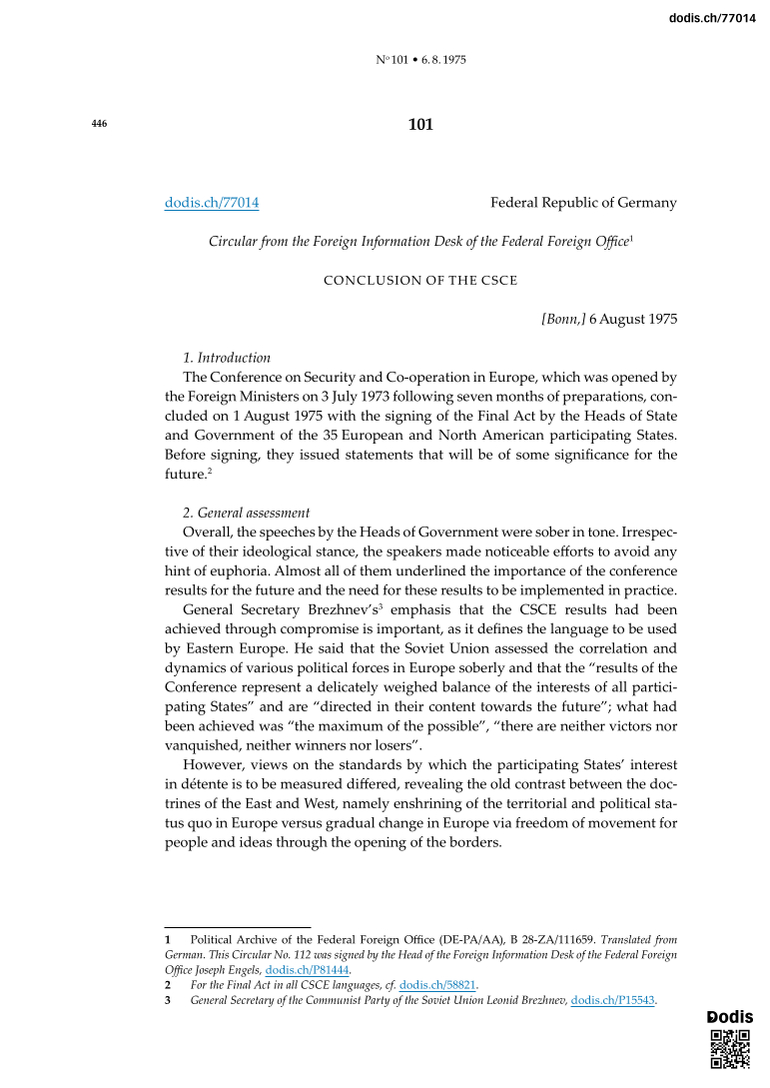
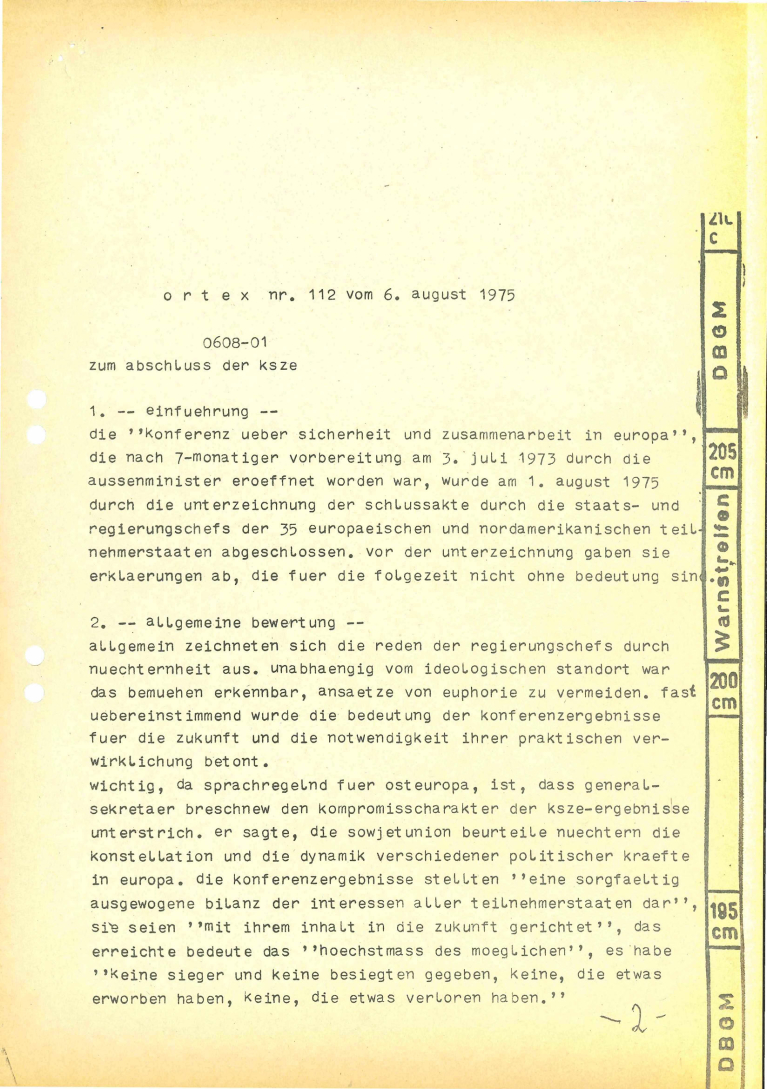
Circular from the Foreign Information Desk of the Federal Foreign Office1
Conclusion of the CSCE
The Conference on Security and Co-operation in Europe, which was opened by the Foreign Ministers on 3 July 1973 following seven months of preparations, concluded on 1 August 1975 with the signing of the Final Act by the Heads of State and Government of the 35 European and North American participating States. Before signing, they issued statements that will be of some significance for the future.2
Overall, the speeches by the Heads of Government were sober in tone. Irrespective of their ideological stance, the speakers made noticeable efforts to avoid any hint of euphoria. Almost all of them underlined the importance of the conference results for the future and the need for these results to be implemented in practice.
General Secretary Brezhnev’s3 emphasis that the CSCE results had been achieved through compromise is important, as it defines the language to be used by Eastern Europe. He said that the Soviet Union assessed the correlation and dynamics of various political forces in Europe soberly and that the “results of the Conference represent a delicately weighed balance of the interests of all participating States” and are “directed in their content towards the future”; what had been achieved was “the maximum of the possible”, “there are neither victors nor vanquished, neither winners nor losers”.
However, views on the standards by which the participating States’ interest in détente is to be measured differed, revealing the old contrast between the doctrines of the East and West, namely enshrining of the territorial and political status quo in Europe versus gradual change in Europe via freedom of movement for people and ideas through the opening of the borders.
However, it was also striking here that Brezhnev refrained from interpreting the conference results from the standpoint of the East, leaving this to his counterparts. The speeches by the Eastern heads of party or government largely followed a set structure.
They mentioned the thirtieth anniversary of the end of the war, the suffering during the Second World War, the liberation of Europe by the Soviet Union and the anti-Hitler coalition states (Honecker,4 Gierek5), the CSCE as the realisation of the principles of peaceful coexistence, with an emphasis on the Principles Declaration (Gierek: “the great charter of peace in Europe”); Zhivkov:6 “heart of the Final Act”), selectively mentioned the principles of the inviolability of frontiers, territorial integrity and non-interference (particularly by Honecker and Gierek) and described the CSCE as a first step towards a pan-European security system (Gierek, Zhivkov, Honecker).
Kádár7 commented positively on the results of Basket III, while Brezhnev mentioned them in general terms, but did not give an opinion on them. The other Eastern European Heads of Government either did not mention the results at all or did so merely by referring to rights and laws, or to the laws, traditions and habits of the participating States (Zhivkov) – the very language that was not included in CSCE documents because of resistance from the West. Kádár stated that Hungary was willing to follow the recommendations on expanding information and human relations and solving humanitarian issues, as well as to expand existing relations.
How soberly the East assesses the outcome of the Conference is shown by the fact that it has abandoned its original main idea for the post-conference period – the creation of a permanent body – and, with the exception of Romania, which calls for the creation of a permanent body to be the main topic at the Senior Officials Meeting planned for 1977 in order to ensure the continuity of the multilateral détente process, no longer mentioned this idea.
For their part, the Western leaders, irrespective of whether their countries are NATO members or neutral, emphasised the Western concept of détente expressed in the CSCE documents, that is, the need for peaceful change in Europe, including the possibility of peaceful and consensual border changes; freedom of movement in the humanitarian field and in the exchange of ideas; and the realisation of human rights.
The fact that in addition to the Federal Chancellor,8 and as prepared in the Group of Four, Prime Minister Wilson,9 President Giscard d’Estaing10 and President Ford11 explicitly emphasised Berlin’s special role as a touchstone and test case for détente, as well as the applicability of the CSCE documents to Berlin, is particularly important for us. The fact that EC acting President, Italian Prime Minister Moro,12 issued a declaration on behalf of the Community and signed the Final Act in both his roles is of importance for recognition of the EC.
Nuances could be heard in the speeches by Western leaders. President Ford passionately defended the ideals of the Western democracies. After initially sounding like an apology for his participation in the Helsinki Summit, his cleverly structured speech became a clear statement of support for the goals of the CSCE and for the United States’ engagement in Europe. Giscard d’Estaing focused on Europe’s role in global politics and conveyed the impression the superpowers were lateral powers who would be well advised to allow the interests of the “actual” Europeans in Europe to take precedence.
5. The speeches were held without any particular drama, and only interrupted by the largely unnoticed departure of the Turkish delegation during the speech by President Makarios13 and by the vehemency of his speech. Turkey submitted a written caveat by which the CSCE Final Act will not have any impact on Turkey’s relations with Cyprus, so long as a legitimate government has not been formed by both parts of the population; the Cypriot delegation rightfully rejected this protest as incompatible with the conference’s rules of procedure. During the signing ceremony, Makarios and Demirel14 sat together harmoniously at the same table.15
- 1
- Political Archive of the Federal Foreign Office (DE-PA/AA), B 28-ZA/111659. Translated from German. This Circular No. 112 was signed by the Head of the Foreign Information Desk of the Federal Foreign Office Joseph Engels, dodis.ch/P81444.↩
- 2
- For the Final Act in all CSCE languages, cf. dodis.ch/58821.↩
- 3
- General Secretary of the Communist Party of the Soviet Union Leonid Brezhnev, dodis.ch/P15543.↩
- 4
- General Secretary of the Socialist Unity Party of Germany Erich Honecker, dodis.ch/P46563.↩
- 5
- First Secretary of the Polish United Workers’ Party Edward Gierek, dodis.ch/P46565.↩
- 6
- General Secretary of the Bulgarian Communist Party Todor Zhivkov, dodis.ch/P15343.↩
- 7
- General Secretary of the Hungarian Socialist Workers’ Party János Kádár, dodis.ch/P11430.↩
- 8
- Chancellor of the Federal Republic of Germany (FRG) Helmut Schmidt, dodis.ch/P15416.↩
- 9
- British Prime Minister Harold Wilson, dodis.ch/P13688.↩
- 10
- French President Valéry Giscard d’Estaing, dodis.ch/P13791.↩
- 11
- United States President Gerald Ford, dodis.ch/P47012.↩
- 12
- Italian Prime Minister Aldo Moro, dodis.ch/P13878.↩
- 13
- Cypriot President Archbishop Myriarthes Makarios III, dodis.ch/P16540.↩
- 14
- Turkish Prime Minister Süleyman Demirel, dodis.ch/P44321.↩
- 15
- For all documents of the FRG in this volume, cf. the compilation dodis.ch/C2909.↩
Relations to other documents
| http://dodis.ch/58821 | is quoted in | http://dodis.ch/77014 |
Tags
Federal Republic of Germany (Politics)
Organization for Security and Co-operation in Europe (OSCE) Final CSCE conference in Helsinki (30.7.1975–2.8.1975)