
Printed in
Geneva, Helsinki, and the Making of the CSCE. International Diplomatic Documents on the Conference on Security and Cooperation in Europe, 1969–1975, vol. 30, doc. 68
volume linkBern 2026
more… |
▼▶Repository
| Archive | Israel State Archives, Jerusalem |
| Archival classification | IL MFA8530/2 |
| Archival classification | IL Ministry of Foreign Affairs |
| Dossier title | אירופה - ובש"א (הועדה לבטחון אירופה). (3.5.1974–30.6.1975) |
 Transcription
 QdD
QdD
 Facsimile
dodis.ch/76983
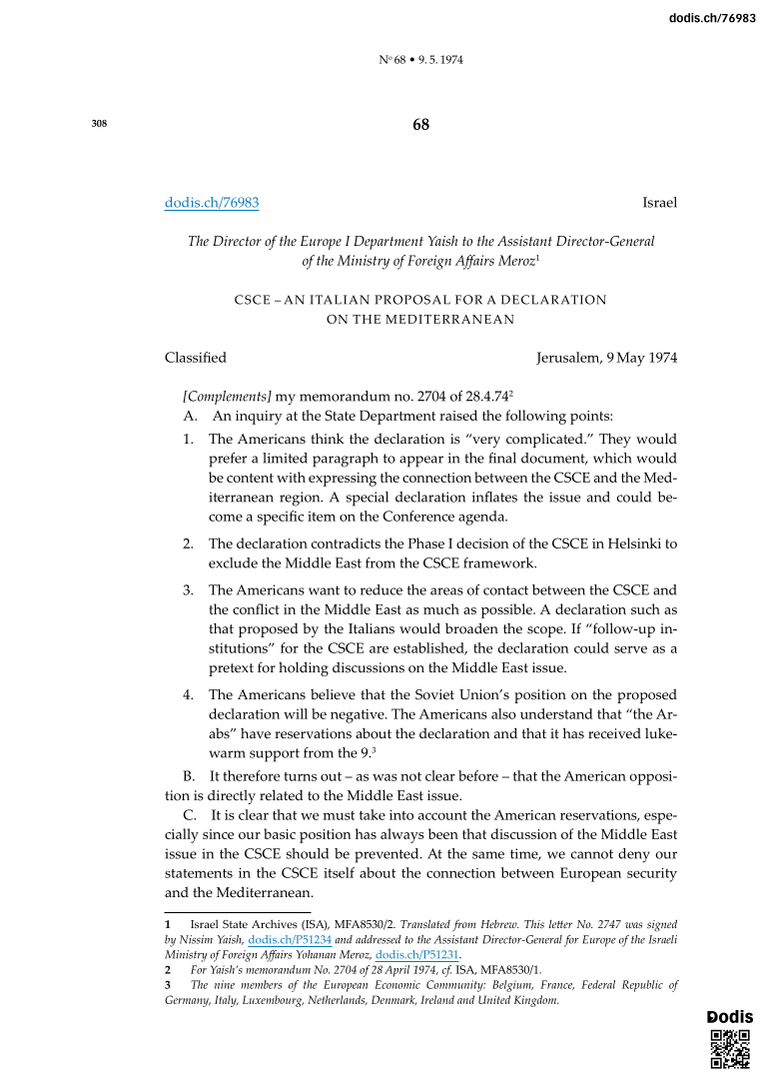
The Director of the Europe I Department Yaish to the Assistant Director-General of the Ministry of Foreign Affairs Meroz1
CSCE – An Italian Proposal for a Declaration on the Mediterranean
[Complements] my memorandum no. 2704 of 28.4.742
A. An inquiry at the State Department raised the following points:
1. The Americans think the declaration is “very complicated.” They would prefer a limited paragraph to appear in the final document, which would be content with expressing the connection between the CSCE and the Mediterranean region. A special declaration inflates the issue and could become a specific item on the Conference agenda.
2. The declaration contradicts the Phase I decision of the CSCE in Helsinki to exclude the Middle East from the CSCE framework.
3. The Americans want to reduce the areas of contact between the CSCE and the conflict in the Middle East as much as possible. A declaration such as that proposed by the Italians would broaden the scope. If “follow-up institutions” for the CSCE are established, the declaration could serve as a pretext for holding discussions on the Middle East issue.
4. The Americans believe that the Soviet Union’s position on the proposed declaration will be negative. The Americans also understand that “the Arabs” have reservations about the declaration and that it has received lukewarm support from the 9.3
B. It therefore turns out – as was not clear before – that the American opposition is directly related to the Middle East issue.
C. It is clear that we must take into account the American reservations, especially since our basic position has always been that discussion of the Middle East issue in the CSCE should be prevented. At the same time, we cannot deny our statements in the CSCE itself about the connection between European security and the Mediterranean.
D. The Italian chargé4 contacted me yesterday on instructions from Rome and asked for our position on their proposal. He added that it was urgent because they had heard that another Mediterranean country was preparing to submit a proposal on the same subject (The hint was: a country unfriendly to Israel).
In light of the above, I suggest that we respond to the Italians roughly in the following general terms:
1. As we declared in our appearances before the CSCE, Israel willingly accepted the Conference’s recommendation that, in its discussions on security and cooperation in Europe, it would take into account the existing connection between the above and the Mediterranean region. In principle, Israel therefore regards the mention of the subject in the final document positively.
2. However, Israel wishes to note that in Helsinki it was explicitly decided not to address or discuss the issue of the Middle East at the Conference and in its committees. Israel has noticed that despite the above decision, all five Arab countries that appeared before the CSCE5 raised the issue of the conflict in the Middle East in an explicit and controversial manner and in extreme language that is offensive to Israel. Israel also noted with regret that no country, including Italy, had found it necessary to call the above speakers to order, or to ask them to remove from their statements and memoranda the sections referring to an issue that had been explicitly removed from the conference’s agenda.
3. This being so, Israel fears that those sections in the declaration that refer, in the form of direct or indirect implications, to tensions in the Middle East will serve as a pretext for the Arabs to renew and establish their previous demands for a discussion of the conflict at the current Conference or even in frameworks that may be decided upon later in the Conference.
4. Without entering into a discussion of the details of the wording of the Italian proposal, Israel requests that its concerns be taken into account in order to prevent a move that could lead, with a high degree of probability, to developments that would undermine the justified and wise decision made in Helsinki not to discuss Middle East affairs within the framework of the CSCE.
5. I propose to inform the Americans of our position and our response to the Italians.
At this point, I would not suggest embarking on a campaign against the Italian initiative, as American opposition is enough to clip its wings.6
- 1
- Israel State Archives (ISA), MFA8530/2. Translated from Hebrew. This letter No. 2747 was signed by Nissim Yaish, dodis.ch/P51234 and addressed to the Assistant Director-General for Europe of the Israeli Ministry of Foreign Affairs Yohanan Meroz, dodis.ch/P51231.↩
- 2
- For Yaish’s memorandum No. 2704 of 28 April 1974, cf. ISA, MFA8530/1.↩
- 3
- The nine members of the European Economic Community: Belgium, France, Federal Republic of Germany, Italy, Luxembourg, Netherlands, Denmark, Ireland and United Kingdom.↩
- 4
- Refers to the Italian chargé d’affaires in Tel Aviv. Not identified.↩
- 5
- Algeria, Tunisia, Morocco, Egypt and Syria.↩
- 6
- For all Israeli documents in this volume, cf. the compilation dodis.ch/C2908.↩
Tags
Organization for Security and Co-operation in Europe (OSCE) Italy (Politics) CSCE negotiations in Helsinki and Geneva (1972–1975)