
Printed in
Geneva, Helsinki, and the Making of the CSCE. International Diplomatic Documents on the Conference on Security and Cooperation in Europe, 1969–1975, vol. 30, doc. 67
volume linkBern 2026
more… |
▼▶Repository
| Archive | Archives diplomatiques du Ministère de l’Europe et des Affaires étrangères, La Courneuve |
| Archival classification | FR-AMAE 178QO/2125 |
| Archival classification | FR-AMAE France. Ministère des Affaires étrangères. Direction de l'Europe |
| Dossier title | Europe, Allemagne, République fédérale d’Allemagne, 1974–1978 (1974–1978) |
 Transcription
 QdD
QdD
 Facsimile
dodis.ch/76978
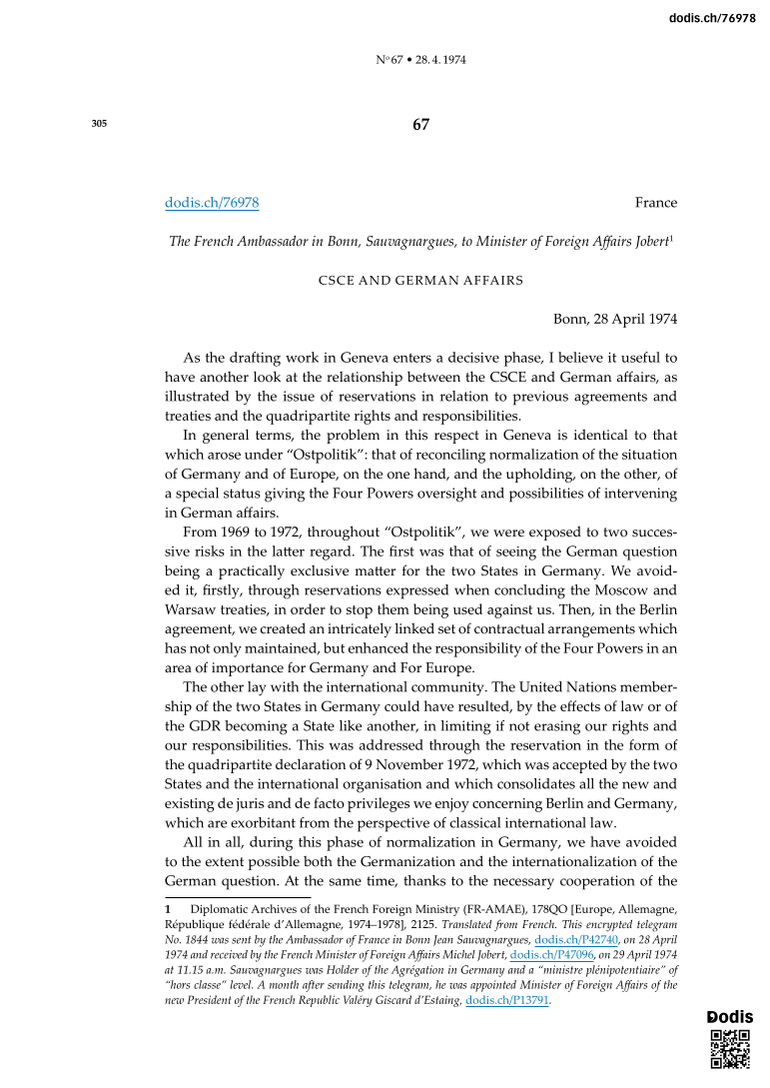
The French Ambassador in Bonn, Sauvagnargues, to Minister of Foreign Affairs Jobert1
CSCE and German Affairs
As the drafting work in Geneva enters a decisive phase, I believe it useful to have another look at the relationship between the CSCE and German affairs, as illustrated by the issue of reservations in relation to previous agreements and treaties and the quadripartite rights and responsibilities.
In general terms, the problem in this respect in Geneva is identical to that which arose under “Ostpolitik”: that of reconciling normalization of the situation of Germany and of Europe, on the one hand, and the upholding, on the other, of a special status giving the Four Powers oversight and possibilities of intervening in German affairs.
From 1969 to 1972, throughout “Ostpolitik”, we were exposed to two successive risks in the latter regard. The first was that of seeing the German question being a practically exclusive matter for the two States in Germany. We avoided it, firstly, through reservations expressed when concluding the Moscow and Warsaw treaties, in order to stop them being used against us. Then, in the Berlin agreement, we created an intricately linked set of contractual arrangements which has not only maintained, but enhanced the responsibility of the Four Powers in an area of importance for Germany and for Europe.
The other lay with the international community. The United Nations membership of the two States in Germany could have resulted, by the effects of law or of the GDR becoming a State like another, in limiting if not erasing our rights and our responsibilities. This was addressed through the reservation in the form of the quadripartite declaration of 9 November 1972, which was accepted by the two States and the international organisation and which consolidates all the new and existing de juris and de facto privileges we enjoy concerning Berlin and Germany, which are exorbitant from the perspective of classical international law.
All in all, during this phase of normalization in Germany, we have avoided to the extent possible both the Germanization and the internationalization of the German question. At the same time, thanks to the necessary cooperation of the Four Powers and the two Germanies that the Berlin agreement required, we have given the former a living right and concrete grounds for intervention. The importance of this result becomes clear when you remember that in 1961 and 1962, the United States were considering the internationalization of access routes to the old capital, and that at the beginning of the Berlin talks they were still inclined to entrust to the Germans alone the task of agreeing on the arrangements for traffic on these same routes.
The risk emerging now in Geneva is that of a dilution – at European level this time – of the specific situation of Germany, and, therefore, of our position in this region. That was no doubt one of the fundamental aims of the USSR, for which the next stage in normalization launched in Helsinki and continued in Geneva was to lead to an arrangement concluded in lieu of an undesirable or impossible peace treaty concerning Germany.
Of course, in the last two years or so, the agenda of the CSCE has broadened. Security is no longer one single subject, and cooperation problems account for two baskets of work. But progress in these two fields is slow and difficult, and is primarily being made on the first dimension, the only one, moreover, that the Soviets have the intention of signing. Germany is not its subject. However, it must be recognised that, notwithstanding the assurances that Yugoslavia and Romania wanted, faced with the USSR, and above all if the fact that military issues are more or less absent from the talks in Geneva is taken into account, that the ulterior motives of many, if not all of the participants often appear to be focused on the major political security problem that persists in Europe: that of the status and the evolution of Germany – or the Germanies.
The problem can be apprehended from two angles.
The first is primarily legal. If we are not careful, the CSCE will place above quadripartism a sediment of texts that may mitigate or even erase it, as both the Federal and the Democratic Republics will, for the first time, have the same standing as the Four Powers, signing a common document of such scope. This risk must be avoided, thanks to a satisfactory reservation in relation to prior treaties and agreements inserted into the very documents of the CSCE. This reserve must be worded so as to cover agreements “concerning” the two Germanies – to which the latter are not “parties”.
In this respect, I noted during recent talks in Bonn on this subject with members of our delegation to Geneva, that the Germans have agreed that the passage in question of the declaration on principles (paragraph 10) expresses reservations, not only concerning prior agreements and treaties to which the participating States have signed up to, but also those to which they are committed. Such a wording seems to me to be acceptable if it must, as it safeguards the quadripartite agreement and declaration and everything covered by the latter, but it is the absolute minimum.
The second aspect is more political. The very existence of a body of rules applicable to Europe and to all European States, in addition to the United States, another quadripartite power – regardless of the precautions taken to mitigate its binding nature – may seem to empower this Europe to meddle in German affairs. This risk would of course be heightened, should the conference be followed by further steps or even lead to the creation of a more or less permanent body. In the most favourable scenario, with a good clause expressing reservations in relation to prior agreements and treaties, we will have to prove, when difficulties emerge concerning Germany, that this is the prerogative of the Four Powers and, if applicable, the two German States. In the less favourable scenario, we will be at risk of interferences that could only complicate the exercise of our right of oversight of German affairs.
To cover ourselves in this respect also, the ideal solution would of course be a reservation concerning the quadripartite rights and responsibilities in general, worded in light of the outcomes of Geneva and outside of those outcomes. We have expressed two “objections” as to the CSCE as a whole. The first was in response to Finland’s invitation in autumn 1972 and had the primary effect of protecting us from the consequences that could have arisen at that time, from the fact that the GDR, with which neither the three allies, nor the Federal Republic, had established relations at that point, participated alongside us in the preparatory work. The second was made orally by our delegation, on behalf of the three Western powers alone, at the start of the talks in Geneva. Neither seems to me to have the significance that a reservation expressed in due form by the Four Powers, during the adoption of the final text or texts of the CSCE, would have.
The task would no doubt be tricky. On the Russian side, their reluctance would no doubt be even greater than that shown by Mr Gromyko in June 1972 as to the idea of a quadripartite declaration. And we perhaps now have fewer means of pressure over them than at a time when the GDR was waiting to be recognised by the three Western powers and sought, moreover, United Nations admittance. The Americans, meanwhile, may be tempted to reach the end of the work in Geneva with as few difficulties and, above all, clashes as possible. That said, if they have not forged relations with the GDR by then, they may still have some interest in a reservation. Lastly, the Germans, while they say the see no problem with a repetition of the content of the quadripartite declaration, may be less in need of such a precaution as in the past, tempted as they seem to be by the prospect of humanitarian facilities on top of what “Ostpolitik” has brought them.
The British, meanwhile, have just informed us in the quadripartite group that they had come, both in London and here, to the conclusion that a general objection appeared necessary to them. The Embassy of the United States considers that the problem as a whole should be examined by the Bonn group.
The matter does indeed seem to me to need detailed study as quickly as possible.
I would appreciate instructions from the Ministry.2
- 1
- Diplomatic Archives of the French Foreign Ministry (FR-AMAE), 178QO [Europe, Allemagne, République fédérale d’Allemagne, 1974–1978], 2125. Translated from French. This encrypted telegram No. 1844 was sent by the Ambassador of France in Bonn Jean Sauvagnargues, dodis.ch/P42740, on 28 April 1974 and received by the French Minister of Foreign Affairs Michel Jobert, dodis.ch/P47096, on 29 April 1974 at 11.15 a.m. Sauvagnargues was Holder of the Agrégation in Germany and a “ministre plénipotentiaire” of “hors classe” level. A month after sending this telegram, he was appointed Minister of Foreign Affairs of the new President of the French Republic Valéry Giscard d’Estaing, dodis.ch/P13791.↩
- 2
- For all the French documents in this volume, cf. the compilation dodis.ch/C2906.↩
Tags
Organization for Security and Co-operation in Europe (OSCE) German Democratic Republic (Politics)