
Printed in
Geneva, Helsinki, and the Making of the CSCE. International Diplomatic Documents on the Conference on Security and Cooperation in Europe, 1969–1975, vol. 30, doc. 34
volume linkBern 2026
more… |
▼▶Repository
| Archive | Archives diplomatiques du Ministère de l’Europe et des Affaires étrangères, La Courneuve |
| Archival classification | FR-AMAE 436QO/214 |
| Dossier title | CSCE (Conférence pour la sécurité et la coopération en Europe), processus d'acceptation et processus de négociation, pourparlers, position des Etats, travaux de l'OTAN et du Comité Politique des Six, accords d'Helsinki (juillet 1973) et acte final (août 1975) . (15.10.1972–15.11.1972) |
 Transcription
 QdD
QdD
 Facsimile
dodis.ch/76975
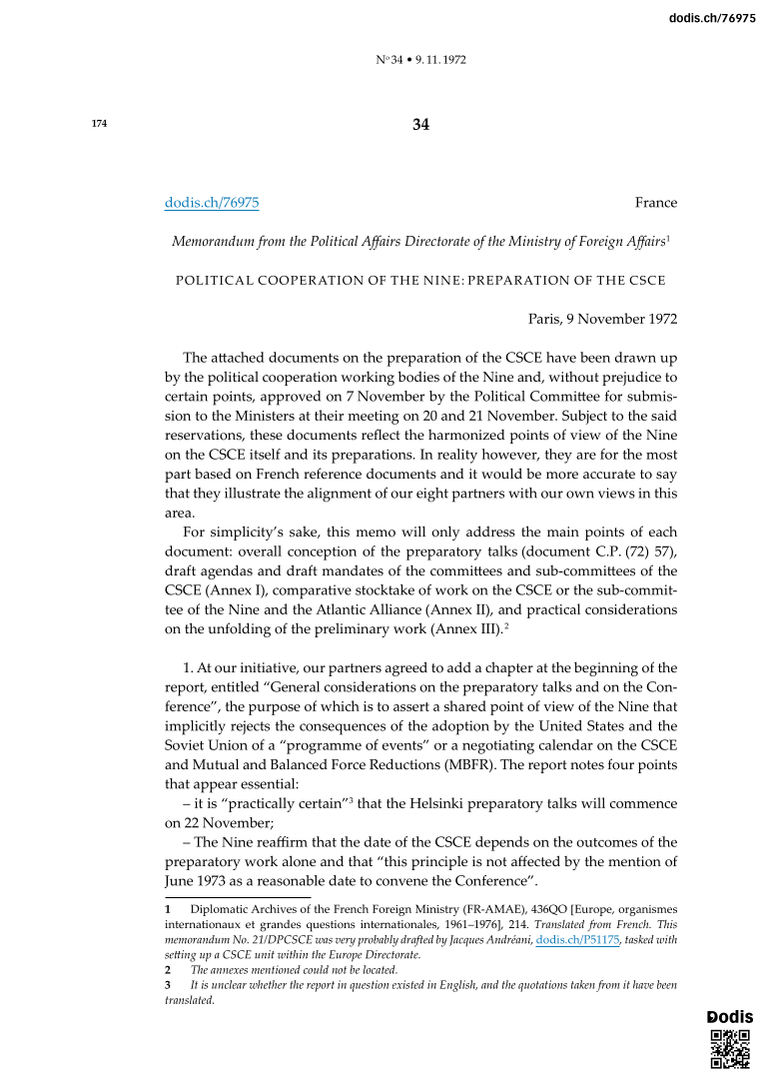
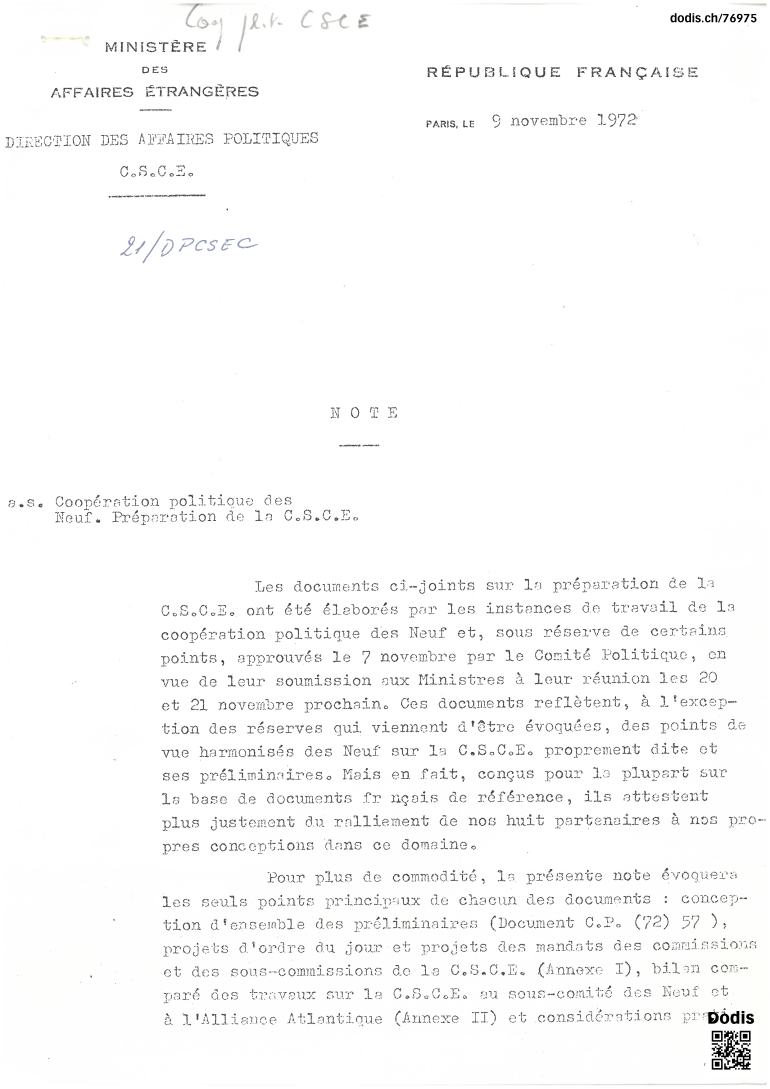
Memorandum from the Political Affairs Directorate of the Ministry of Foreign Affairs1
Political Cooperation of the Nine: Preparation of the CSCE
The attached documents on the preparation of the CSCE have been drawn up by the political cooperation working bodies of the Nine and, without prejudice to certain points, approved on 7 November by the Political Committee for submission to the Ministers at their meeting on 20 and 21 November. Subject to the said reservations, these documents reflect the harmonized points of view of the Nine on the CSCE itself and its preparations. In reality however, they are for the most part based on French reference documents and it would be more accurate to say that they illustrate the alignment of our eight partners with our own views in this area.
For simplicity’s sake, this memo will only address the main points of each document: overall conception of the preparatory talks (document C.P. (72) 57), draft agendas and draft mandates of the committees and sub-committees of the CSCE (Annex I), comparative stocktake of work on the CSCE or the sub-committee of the Nine and the Atlantic Alliance (Annex II), and practical considerations on the unfolding of the preliminary work (Annex III).2
1. At our initiative, our partners agreed to add a chapter at the beginning of the report, entitled “General considerations on the preparatory talks and on the Conference”, the purpose of which is to assert a shared point of view of the Nine that implicitly rejects the consequences of the adoption by the United States and the Soviet Union of a “programme of events” or a negotiating calendar on the CSCE and Mutual and Balanced Force Reductions (MBFR). The report notes four points that appear essential:
– it is “practically certain”3 that the Helsinki preparatory talks will commence on 22 November;
– The Nine reaffirm that the date of the CSCE depends on the outcomes of the preparatory work alone and that “this principle is not affected by the mention of June 1973 as a reasonable date to convene the Conference”.
– The Nine note that it is “necessary that no prior calendar can be invoked in order to apply a time limit to the Conference other than that resulting from the normal completion of the tasks it has set itself”, which means that they do not accept the idea that the CSCE should end before September 1973 to enable MBFR negotiations to commence on that date.
– The Nine advocate for the possibility of overlapping, both of the Helsinki preparatory talks and exploratory talks on force reductions and of the CSCE and the MBFR negotiations.
Lastly, again at our initiative, our partners have decided to set out these considerations to the countries taking part in the CSCE preparatory talks by 22 November.
2. A satisfactory compromise has been reached between our views and those of the Netherlands concerning the organisation of the CSCE in three stages and at two levels. The agreed text notes that “it is now recommended that this hypothesis be confirmed by the governments before the beginning of the preparatory talks”, i.e. at the meeting of the Ministers on 20 and 21 November. Moreover, we could mention this organisation in Helsinki at the time that appears most appropriate, probably at the beginning of the preparatory talks and without waiting, as the Netherlands would prefer, to have sufficient assurances as to the readiness of some of our interlocutors to discuss our proposals relating to the agenda of the CSCE.
3. Our partners, including the Netherlands, have come around to our views on the practical unfolding of the preparatory talks, including their informal nature, the choice of consensus for decision-making rather than a voting system, and not using working committees for detailed study of this and that point on the agenda.
4. Concerning the draft mandates of the committees and sub-committees, all our proposals have been accepted, apart from two.
a) Firstly, the mandate of the sub-committee on “collateral” or “stabilization” measures, for which we accepted only a literal reproduction of article 11 of the Bonn communiqué, while the Netherlands, Belgium and Germany wanted to extend it to a list of effective measures that could be envisaged to this effect and add the drafting of a “joint statement on problems concerning the level and activity of armed forces in Europe”.
b) Following difficult discussions with the Netherlands and Italy on the mandate of the committee addressing cultural and human aspects and that of the sub-committee on developing human contacts, our partners agreed to adopt our title (“Development of human contacts, broadening of cultural exchanges and wider flow of information”) rather than “free movement of persons, ideas and information and strengthening of cultural relations” in return for the following wording of the mandate of the committee: “The committee is tasked with examining all possibilities that could foster the development of human contacts, with increasing cultural exchanges and with widening the flow of information. Its task includes drawing up mutually approved procedures that can foster “greater freedom of movement and exchanges” between persons and drafting a long-term programme widening the flow of information and increasing cultural exchanges, including those in the field of pure science”.
The French delegation expressed a reservation concerning the inclusion of the underlined words which figured, along with the same reservation, in the mandate of the sub-committee on developing human contacts. The delegations from Italy and the Netherlands, meanwhile, accepted this wording with a counter-reservation and intend, should this compromise wording not be approved, return to a wording of the mandates using the words “free movement of persons”.
That said, our partners’ acceptance of our title and our beginning of the mandate of the committee on the human dimension of the CSCE, is for us a major source of satisfaction that should taken into account before we make a final decision on the proposed compromise wording. Similarly, it is important to underline that we have been able to exclude from these mandates, despite the favour they enjoyed from some of our partners, a series of proposals submitted to the political committee by the Netherlands and Italy, such as the suppression of exclusion zones, the issue of passports, and the scrambling of radio programmes. Only a proposal concerning “the access of the nationals of a State to the diplomatic missions located in the territory of that State” remains, concerning which we have expressed a reservation of opposition.4
- 1
- Diplomatic Archives of the French Foreign Ministry (FR-AMAE), 436QO [Europe, organismes internationaux et grandes questions internationales, 1961–1976], 214. Translated from French. This memorandum No. 21/DPCSCE was very probably drafted by Jacques Andréani, dodis.ch/P51175, tasked with setting up a CSCE unit within the Europe Directorate.↩
- 2
- The annexes mentioned could not be located.↩
- 3
- It is unclear whether the report in question existed in English, and the quotations taken from it have been translated.↩
- 4
- For all the French documents in this volume, cf. the compilation dodis.ch/C2906.↩
Tags
Organization for Security and Co-operation in Europe (OSCE) European Union (EEC–EC–EU) CSCE negotiations in Helsinki and Geneva (1972–1975)