
Printed in
Geneva, Helsinki, and the Making of the CSCE. International Diplomatic Documents on the Conference on Security and Cooperation in Europe, 1969–1975, vol. 30, doc. 51
volume linkBern 2026
more… |
▼▶Repository
| Archive | Richard Nixon Presidential Library and Museum, Yorba Linda |
| Archival classification | US-RMNPL National Security Council Files, Country Files – Europe 673 |
| Dossier title | Finland Vol. I [May 1969–February 1974] (5.1969–2.1974) |
 Transcription
 QdD
QdD
 Facsimile
dodis.ch/76944
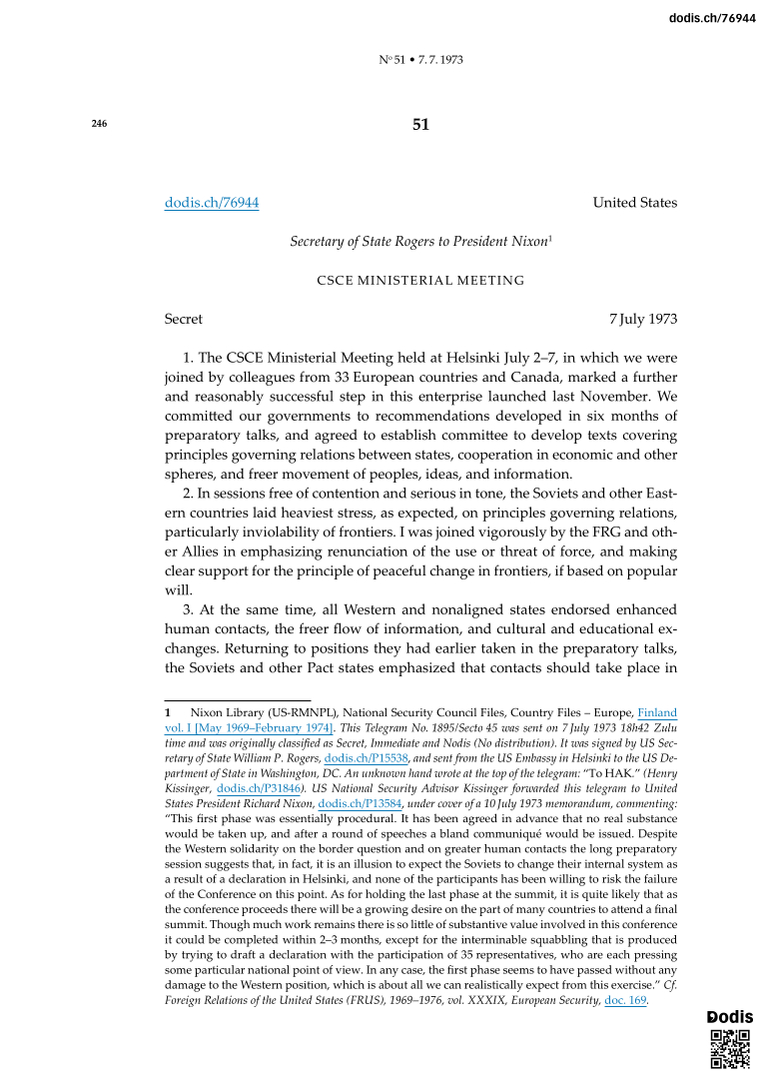
Secretary of State Rogers to President Nixon1
CSCE Ministerial Meeting
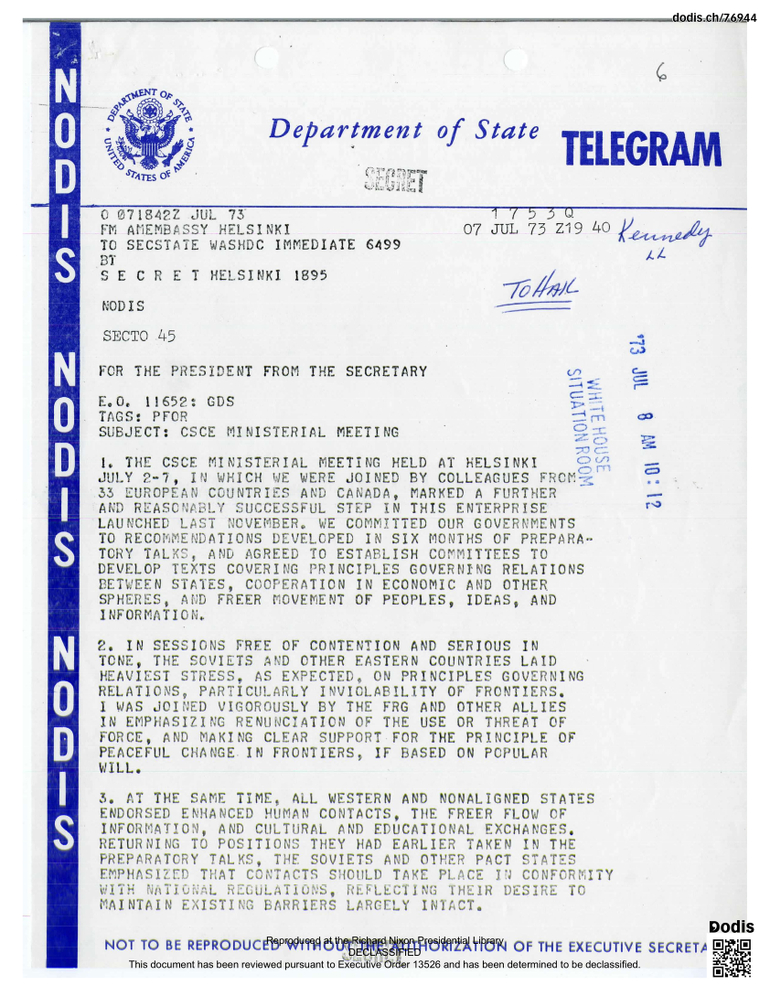
1. The CSCE Ministerial Meeting held at Helsinki July 2–7, in which we were joined by colleagues from 33 European countries and Canada, marked a further and reasonably successful step in this enterprise launched last November. We committed our governments to recommendations developed in six months of preparatory talks, and agreed to establish committee to develop texts covering principles governing relations between states, cooperation in economic and other spheres, and freer movement of peoples, ideas, and information.
2. In sessions free of contention and serious in tone, the Soviets and other Eastern countries laid heaviest stress, as expected, on principles governing relations, particularly inviolability of frontiers. I was joined vigorously by the FRG and other Allies in emphasizing renunciation of the use or threat of force, and making clear support for the principle of peaceful change in frontiers, if based on popular will.
3. At the same time, all Western and nonaligned states endorsed enhanced human contacts, the freer flow of information, and cultural and educational exchanges. Returning to positions they had earlier taken in the preparatory talks, the Soviets and other Pact states emphasized that contacts should take place in conformity with national regulations, reflecting their desire to maintain existing barriers largely intact.
4. The united front of our Allies on both of the foregoing issues will make it difficult for the Soviets to achieve without real challenge their paramount objective of affirming through CSCE the immutability of present boundaries in Europe; they will be under considerable pressure to modify their present restrictive practices in the areas of human contact and the flow of information and ideas.
5. I have been struck, too, by the realistic attitude of our Allies, especially as reflected in the comments of Douglas-Home, Scheel, and Jobert.2 While all share hope for some progress, it is clear that none believes CSCE will be a panacea. Nor are our Allies feeding euphoric public expectation. On the contrary, their cautious comments suggest they are trying to convey to public opinion in their countries that CSCE is only a limited step and that NATO’s defenses must be maintained.
6. The reactions to the US position were favorable. The restatement of your position concerning the US commitment to Europe was especially welcomed by our Allies.
7. The next stage of the Conference will begin at committee level in September. The Soviets continued to press for concluding the Conference at a meeting at highest level toward the end of this year, but these points were not really debated. There continues to be substantial reserve about the level and the work remaining makes a considerably later date a more realistic prospect for the final phase.3
- 1
- Nixon Library (US-RMNPL), National Security Council Files, Country Files – Europe, Finland vol. I [May 1969–February 1974]. This Telegram No. 1895/Secto 45 was sent on 7 July 1973 18h42 Zulu time and was originally classified as Secret, Immediate and Nodis (No distribution). It was signed by US Secretary of State William P. Rogers, dodis.ch/P15538, and sent from the US Embassy in Helsinki to the US Department of State in Washington, DC. An unknown hand wrote at the top of the telegram: “To HAK.” (Henry Kissinger, dodis.ch/P31846). US National Security Advisor Kissinger forwarded this telegram to United States President Richard Nixon, dodis.ch/P13584, under cover of a 10 July 1973 memorandum, commenting: “This first phase was essentially procedural. It has been agreed in advance that no real substance would be taken up, and after a round of speeches a bland communiqué would be issued. Despite the Western solidarity on the border question and on greater human contacts the long preparatory session suggests that, in fact, it is an illusion to expect the Soviets to change their internal system as a result of a declaration in Helsinki, and none of the participants has been willing to risk the failure of the Conference on this point. As for holding the last phase at the summit, it is quite likely that as the conference proceeds there will be a growing desire on the part of many countries to attend a final summit. Though much work remains there is so little of substantive value involved in this conference it could be completed within 2–3 months, except for the interminable squabbling that is produced by trying to draft a declaration with the participation of 35 representatives, who are each pressing some particular national point of view. In any case, the first phase seems to have passed without any damage to the Western position, which is about all we can realistically expect from this exercise.” Cf. Foreign Relations of the United States (FRUS), 1969–1976, vol. XXXIX, European Security, doc. 169.↩
- 2
- British Secretary of State for Foreign and Commonwealth Affairs Alec Douglas-Home, dodis.ch/P13965, Vice Chancellor and Foreign Minister of the Federal Republic of Germany Walter Scheel, dodis.ch/P15413, and French Minister of Foreign Affairs Michel Jobert, dodis.ch/P47096.↩
- 3
- For all documents of the United States in this volume, cf. the compilation dodis.ch/C2904.↩
Tags
United States of America (USA) (Politics)
Organization for Security and Co-operation in Europe (OSCE) CSCE negotiations in Helsinki and Geneva (1972–1975)