dodis.ch/76941
National Security Advisor Kissinger to President Nixon
1
Soviet Initiative for a European Security Conference
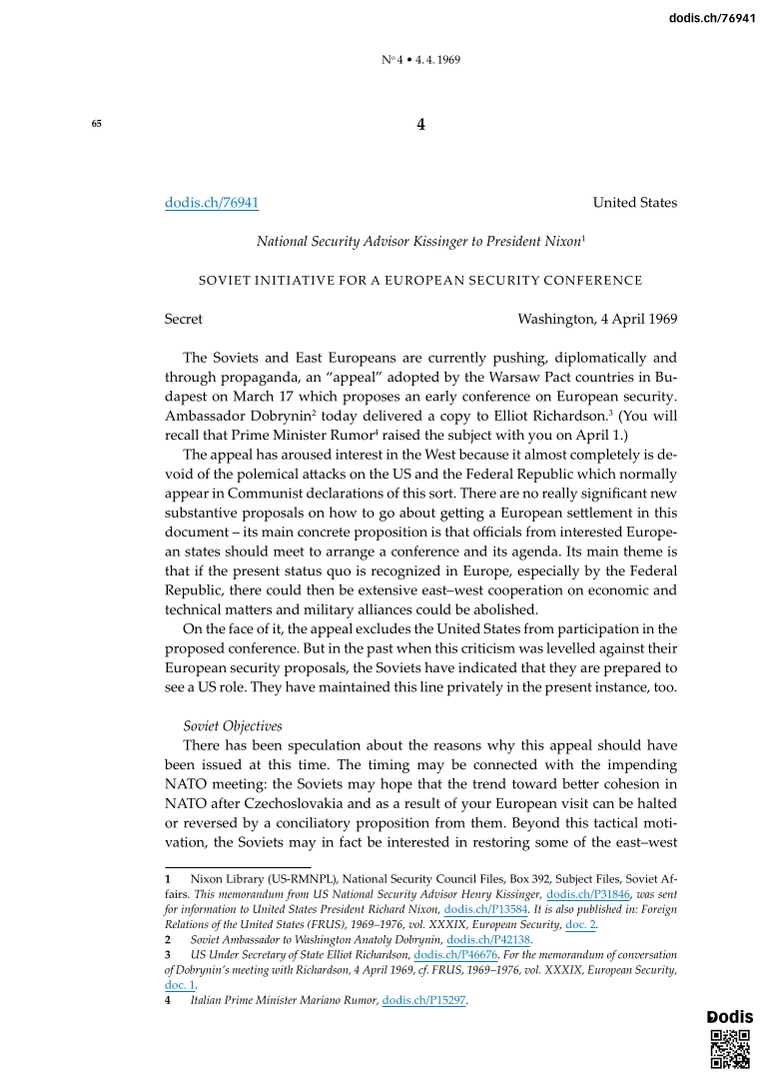
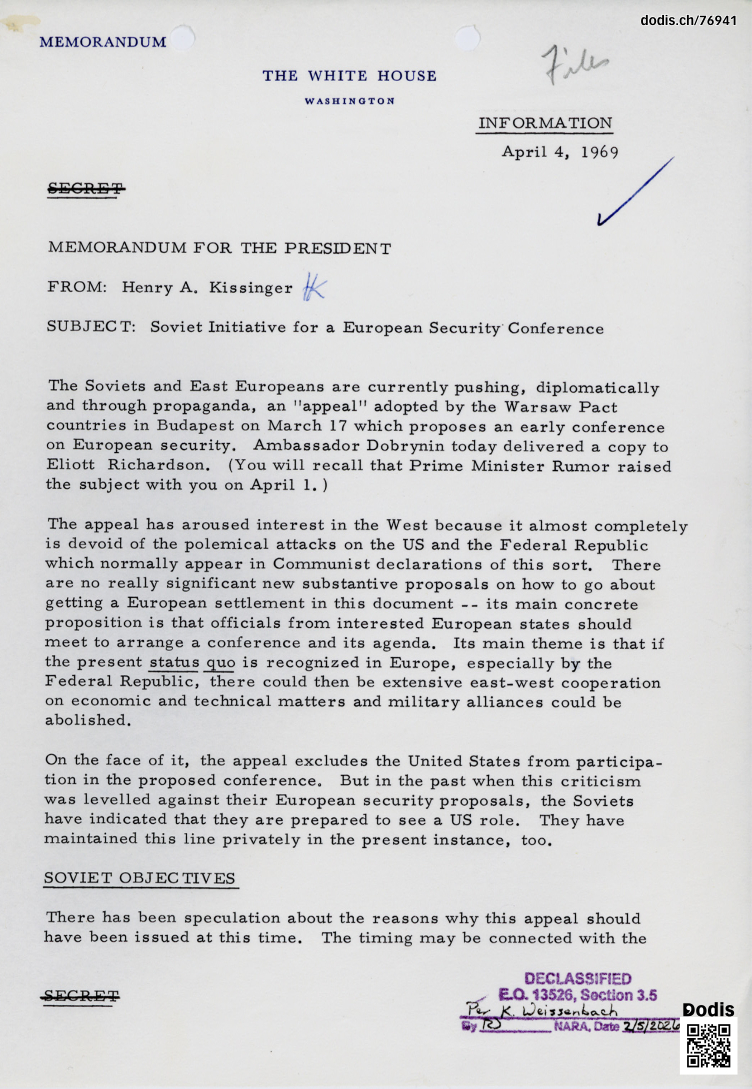
The Soviets and East Europeans are currently pushing, diplomatically and through propaganda, an “appeal” adopted by the Warsaw Pact countries in Budapest on March 17 which proposes an early conference on European security. Ambassador Dobrynin2 today delivered a copy to Elliot Richardson.3 (You will recall that Prime Minister Rumor4 raised the subject with you on April 1.)
The appeal has aroused interest in the West because it almost completely is devoid of the polemical attacks on the US and the Federal Republic which normally appear in Communist declarations of this sort. There are no really significant new substantive proposals on how to go about getting a European settlement in this document – its main concrete proposition is that officials from interested European states should meet to arrange a conference and its agenda. Its main theme is that if the present status quo is recognized in Europe, especially by the Federal Republic, there could then be extensive east–west cooperation on economic and technical matters and military alliances could be abolished.
On the face of it, the appeal excludes the United States from participation in the proposed conference. But in the past when this criticism was levelled against their European security proposals, the Soviets have indicated that they are prepared to see a US role. They have maintained this line privately in the present instance, too.
Soviet Objectives
There has been speculation about the reasons why this appeal should have been issued at this time. The timing may be connected with the impending NATO meeting: the Soviets may hope that the trend toward better cohesion in NATO after Czechoslovakia and as a result of your European visit can be halted or reversed by a conciliatory proposition from them. Beyond this tactical motivation, the Soviets may in fact be interested in restoring some of the east–west contacts, including economic ones, that were disrupted by their invasion of Czechoslovakia. Since the document makes a number of demands on the FRG – including recognition of East Germany, the Oder-Neisse Line and the “special status” of West Berlin, as well as renunciation of nuclear weapons – the Soviets may have wanted to lay the groundwork for renewed political contacts with Bonn. The obverse side of that coin is, as it always has been, an effort to isolate the Federal Republic by picturing it as the main obstacle to a European settlement if it fails to meet Communist demands.
Another motivation that may have played a role relates to Soviet efforts to consolidate the Warsaw Pact: this is the first major document in some time that all the East Europeans, including Romania, have been willing to sign.
Our Attitude
Although I do not believe that in and of itself this “appeal” does anything to advance the prospects of a European settlement, I believe we should not give it a negative response. Rather, we might use it in our effort to impress on the Soviets the need to talk concretely about the issues that exist between us.
What we have said about the inutility and, indeed, dangers of holding grandiose conferences at this stage should hold true in this case also; but we need not rule out eventual meetings, after the necessary spadework has been done to ensure that they get somewhere.
I do not believe that we should make an issue of our attendance at such meetings. Anyone who is serious about making progress on European problems knows that we must be a party; we should not make the Soviets think that they are doing us a favor if they agree to such an obvious fact of life.
I do believe that in the context of a constructive response we should make clear that
(1) in our view a real settlement in Europe is incompatible with gross intervention in the domestic affairs of other countries, and
(2) cannot be based on discrimination against Germany, since this would undermine any settlement from the beginning. All of this, of course, looks very far into the future. But I think it would be desirable for us to be in a positive if cautious posture on this range of issues. This, judging from discussions at NATO, is also the position of our allies in Europe.5


 Transcription
 QdD
QdD
 Facsimile