
Printed in
Polskie Dokumenty Dyplomatyczne, vol. 1972, doc. 127
volume linkWarsaw 2005
more… |
Geneva, Helsinki, and the Making of the CSCE. International Diplomatic Documents on the Conference on Security and Cooperation in Europe, 1969–1975, vol. 30, doc. 21
volume linkBern 2026
more… |
▼▶Repository
| Archive | Archives of the Ministry of Foreign Affairs of the Republic of Poland, Warsaw |
| Archival classification | PL-AMSZ DSiP 63/77, w. 1 |
| Archival classification | PL-AMSZ Departament Studiów i Programowania (DSiP) |
 Transcription
 QdD
QdD
 Facsimile
dodis.ch/76897
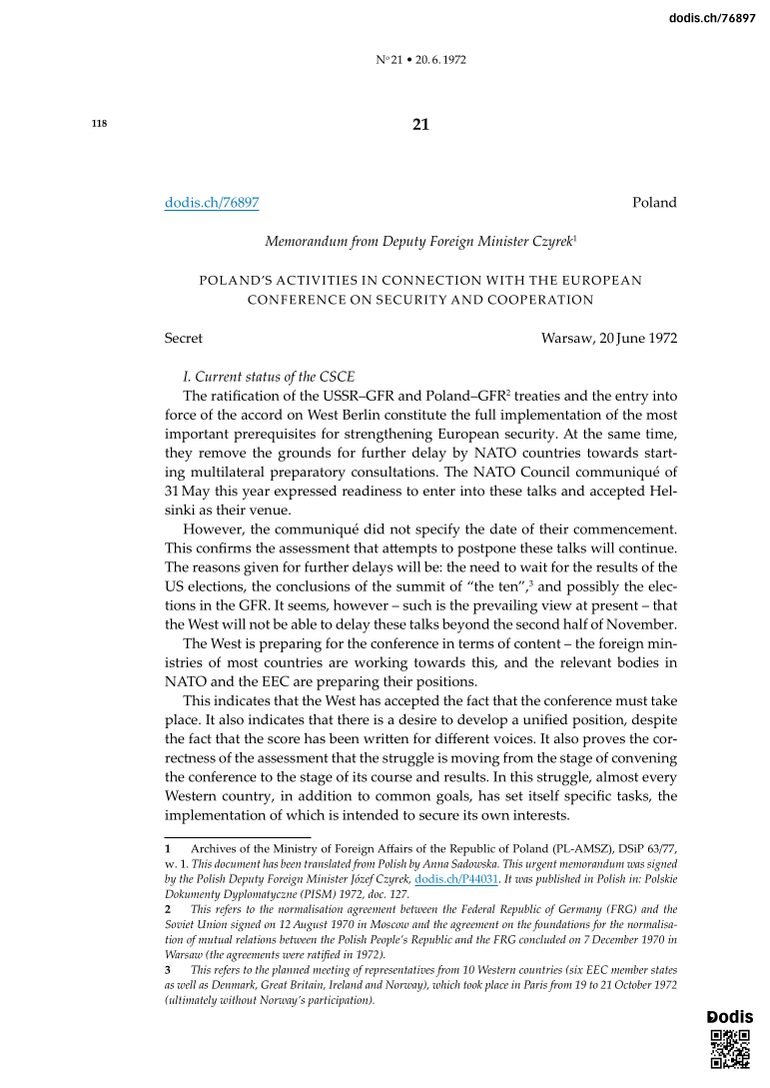
Memorandum from Deputy Foreign Minister Czyrek1
Poland’s Activities in Connection with the European Conference on Security and Cooperation
The ratification of the USSR–GFR and Poland–GFR2 treaties and the entry into force of the accord on West Berlin constitute the full implementation of the most important prerequisites for strengthening European security. At the same time, they remove the grounds for further delay by NATO countries towards starting multilateral preparatory consultations. The NATO Council communiqué of 31 May this year expressed readiness to enter into these talks and accepted Helsinki as their venue.
However, the communiqué did not specify the date of their commencement. This confirms the assessment that attempts to postpone these talks will continue. The reasons given for further delays will be: the need to wait for the results of the US elections, the conclusions of the summit of “the ten”,3 and possibly the elections in the GFR. It seems, however – such is the prevailing view at present – that the West will not be able to delay these talks beyond the second half of November.
The West is preparing for the conference in terms of content – the foreign ministries of most countries are working towards this, and the relevant bodies in NATO and the EEC are preparing their positions.
This indicates that the West has accepted the fact that the conference must take place. It also indicates that there is a desire to develop a unified position, despite the fact that the score has been written for different voices. It also proves the correctness of the assessment that the struggle is moving from the stage of convening the conference to the stage of its course and results. In this struggle, almost every Western country, in addition to common goals, has set itself specific tasks, the implementation of which is intended to secure its own interests.
The coming months, until the start of multilateral preparatory talks, will be filled with bilateral dialogue between individual European countries and another round of bilateral talks conducted by the Finnish Ministry for Foreign Affairs with interested countries. These will provide more insight into the intentions of individual countries in relation to the conference and the multilateral phase of preparations.
An analysis of the NATO Council communiqué of 31 May 1972 and the positions taken by Western countries in the course of the consultations which we have conducted allows us to identify two groups of difficulties and dangers:
1) difficulties still related to the convening of the conference itself,
2) dangers resulting from the substantive positions of some Western countries being prepared for the conference.
The NATO countries have effectively created a new condition for the conference, in the form of making their participation dependent on “good preparation” and obtaining confidence during the multilateral preparatory phase that the conference will yield positive results. Therefore, it should be expected that the West will seek to prolong the multilateral talks under the pretext of the need for substantive discussion of the issues on the conference agenda. It must be assumed that we will not avoid a substantive exchange of views in Helsinki, as many issues are controversial, starting from the composition of the conference (not only the equal participation of the two German states, but also the issue of observers from non-European countries and international organisations), through the venue of the conference, and, above all, the conference agenda. The danger lies in the fact that it is difficult to determine at all whether the conference has been sufficiently prepared. There is also no reason for NATO to be the evaluator. There are also no measurable evaluation criteria.
The second potential obstacle in the hands of the West is the issue of parallelism in the disarmament negotiations. Although NATO has abandoned its demand to include arms reduction (MBFR) on the agenda, which happened under the influence of the Brezhnev4 –Nixon5 talks, there remains the demand for discussion of “certain military aspects of security” at the conference. The SC6 position that talks on arms reduction should be conducted separately from the CSCE is accepted, but there is a tendency (especially in the GFR) to precede the start of the conference with the initiation of multilateral disarmament negotiations. This is to be a “test” of the intentions of the USSR and other SC; just as the West Berlin issue was a “test” before.
Another difficulty concerns ensuring the full and equal participation of the GDR in all stages of the conference. There is still a significant divergence in positions. NATO maintains its position that multilateral preparatory talks should be conducted at the level of heads of mission in Helsinki. This puts the GDR at a disadvantage compared to other countries, as the GDR has a trade representation in Helsinki (the same applies to the GFR, but its international position and influence are greater than those of the GDR). It is doubtful whether before the beginning of the multilateral talks Finland will succeed in simultaneously raising the level of its relations with two German states to the rank of embassies. The GFR has – so far successfully – opposed this. Our formula for conducting multilateral talks in Helsinki at the level of heads of mission or other government representatives rules out the possibility of discriminatory treatment of the GDR.
A number of difficulties may also arise in relation to various procedural matters (e.g. the language of the conference and preparatory talks), reflecting differences in political positions.
The main dangers stem from the fact that the CSCE will be a platform for the struggle between two socio-political systems, exacerbated by the fact that each country will seek to secure its place and interests in the future Europe.
There is no doubt that the West as a whole will seek to weaken the unity of the socialist community. This goal will be served by tendencies to emphasise certain principles (sovereignty, non-interference in internal affairs) at the expense of other principles (respect for integrity and borders), certain projects of pan-European economic, scientific, technological and cultural cooperation.
It is no coincidence that the “freer exchange of ideas, people and information” is being promoted by the West as one of the main tasks in relation to the CSCE. The initiators of this proposal would like to gain greater opportunities for ideological infiltration, undermining the foundations of the socialist system and loosening the cohesion of the socialist community by exploiting the positive phenomenon of increased interpersonal contacts resulting from easing of tensions and the development of cooperation.
It is now clear that the West (with the exception of France and some smaller NATO and neutral countries) would prefer to limit itself to a single conference that would settle certain political and economic matters on the basis of a modus vivendi and would not allow the process of building a new security and cooperation system to begin. Hence the reluctance to accept the proposal to establish a permanent security and cooperation body. It must also be taken into account that the West will want to compensate for any issue that is beneficial to the SC with appropriate concessions on our part. This applies, for example, to the abolition of trade discrimination or the liquidation of Radio Free Europe.
Another kind of danger is the attempt to link to the CSCE the problem of security in the Mediterranean, which is connected with the conflict in the Middle East. The possible connection of these issues would make the resolution of security and cooperation problems dependent on the resolution of the complex Middle East matter.
It also seems that it will be impossible to completely avoid discussing certain disarmament questions at the conference. While the disarmament negotiations themselves will probably take place separately, certain general principles of these negotiations and confidence-building measures will certainly be found among the topics of discussion at the CSCE.
A particular and major danger arises from the GFR’s concept of subordinating the CSCE to the national interests of the GFR. The GFR has the most advanced conference model among Western countries, as we have learned from recent consultations with the Bonn Foreign Ministry.7 Its danger lies in skilfully combining the class interests of Western Europe with the national interests of the GFR. The GFR strives to make its goals the goals of NATO and the whole Western Europe. These goals include:
– recognition of the status quo in Europe as a form of “modus vivendi”,
– confirmation of the right to reunify the German nation on the basis of the right to self-determination (recognition of the status quo in order to change it in the future – as Bahr8 recently said),
– developing pan-European cooperation, especially cooperation between the two German states,
– a “freer” exchange of ideas, people and information, especially with regard to the GDR.
A warning sign that this position is gaining NATO support is the NATO Council communiqué of 31 May 1972 and the support expressed there for the Bundestag resolution. The GFR is already formulating reservations that the CSCE cannot change the legal status of the countries participating in the conference, and that the CSCE itself cannot replace or pre-empt a peace conference.
In this situation, the struggle for full international recognition of the GDR has particular importance. This is becoming the main task of our foreign policy, resulting from Poland’s raison d’état. From our point of view, the outcome of this struggle will determine the significance of the CSCE.
Our goals related to the CSCE stem from Poland’s national interests as a member of the socialist community. We are pursuing them and will continue to pursue them in the following areas:
1. bilateral cooperation with the USSR and development of a consultation system,
2. participation in working out the community’s position (in bilateral and multilateral forms),
3. bilateral dialogues with Western countries,
4. bilateral contact with the Finnish Ministry for Foreign Affairs (in July, we will hold another consultation within the framework of the second round of talks to be conducted by the Finnish Ministry for Foreign Affairs),
5. multilateral preparatory talks in Helsinki, which will most likely begin in November this year.
Our general objectives connected with the conference are fully expressed in the joint documents (in particular the Prague Declaration of January 1972) of the Warsaw Pact states.9 These are:
1. Ensuring further easing of tensions and normalisation of relations in Europe based on the peaceful coexistence of states with different political systems and respect for the territorial integrity of states. We have treated and continue to treat the CSCE as the most effective instrument for developing positive processes in Europe. From our point of view, the most important thing would be to achieve confirmation at the conference by all European states of the principles of security and relations between states as formulated in the Prague Declaration, with particular emphasis on the principle of territorial integrity and the inviolability of existing borders. For this confirmation to be of value to Poland, it cannot be temporary or limited in time.
2. Further strengthening of the international position of the GDR. The fundamental results of the conference will depend on progress in this matter. Even if we succeed in completely resolving the issue of international legal recognition of the GDR before or during the conference, we must nevertheless ensure the GDR’s full participation in the conference and its resolutions. At the same time, we must prevent attempts by the GFR to steer the conference in such a way as to emphasise the “unity of the German nation” or to create conditions that would facilitate the implementation of long-term policy of German unification, pursued by Bonn and signalled in relation to the CSCE by putting forward, among other principles, the “right to self-determination”.
3. The conference should begin the process of building a new system of security and cooperation. For this reason, we should strive not only to have the relevant documents adopted by the first conference (e.g. a system of mutual commitments excluding the use of violence or the threat of its use), but also to ensure the continuity of this process by establishing a permanent security and cooperation body. The goal of ending the division of Europe into blocs should be put forward, and the readiness should be indicated to dissolve the Warsaw Pact (in accordance with its Article 11) after the entry into force of the collective security system.
4. The conference should remove obstacles to the development of economic and scientific-technical cooperation. Poland has particularly much to gain in this area, given the structure of our trade turnover, geographical location and dynamic programme of socio-economic development. This applies to the development of trade, industrial cooperation, scientific and technical exchange and the protection of the human environment. The conference should establish the principles of cooperation based on equal rights and benefits, as well as the directions for its development. We must be vigilant in this area so that the conference agreements do not lead to a weakening of the socialist integration of the CMEA and, in particular, do not facilitate the GFR’s policy of attracting the GDR.
5. In the ideological sphere, the conference should bring about better positions to continue the offensive by the SC. We must counter Western concepts with a constructive programme, which, by preventing the West from conducting ideological diversion, would serve to further ease tensions and gain increasing support from the societies of Western Europe for our vision of Europe. In this context, we will seek to liquidate “Free Europe” and Radio “Svoboda”. The aim is therefore to seize the proposal for “freer exchange” and give it the direction we desire.
6. Our general approach to the problems of the CSCE should promote the emancipation of Western Europe from the USA, while at the same time diversifying the countries of Western Europe. This goal would be served by the establishment of diplomatic relations between all European countries, which could be taken care of on the occasion of the CSCE . (With the exception of the special case of diplomatic relations between Poland and the GFR, which cannot wait until the conference).10
Taking the above objectives and tasks as a starting point, we have developed proposals for our position on specific issues of the CSCE, which are enclosed.
The tasks listed in Part III will be implemented in stages, some of them only at the conference. Currently, the following tasks may be considered as the most urgent:
1. improving the system for working out a common position of the SC on substantive and procedural issues regarding the CSCE; our proposals are intended as a contribution to the process of developing this position,
2. bringing about the setting of a precise date for the start of multilateral preparatory consultations in Helsinki; this seems to be more important than the start of the consultations itself,
3. conducting a second round of talks with the Finnish Ministry for Foreign Affairs in accordance with the enclosed instructions, emphasising the need for the Finns to propose a date for the start of multilateral consultations and to present suggestions for the procedure of these consultations, ensuring as far as possible their efficient and not too long course,
4. continuing the dialogue on the CSCE with the main Western European countries and countries working constructively towards the conference, while delving deeper and deeper into the substance of the issue,
5. attempting to persuade the USA and Canada to hold preparatory talks with Finland on the CSCE, conducting consultations with these countries i.a. for this purpose,
6. further exploring of the subject matter of CSCE by the Ministry of Foreign Affairs and other institutions, especially the issues of economic, scientific-technical, cultural and environmental cooperation; this task will be carried out with the help of the Interministerial Commission for Security and Cooperation in Europe, established by order of the Prime Minister of the Polish People’s Republic,
7. From our findings, it appears that we will not be able to avoid raising certain disarmament issues or issues closely related to disarmament at the conference. Therefore, we have prepared theses for our position on these issues in the context of the needs resulting from the CSCE. The concept of our position on arms reduction in Central Europe will be the subject of a separate memo and will be presented separately.
V. In connection with the anticipated start of multilateral preparatory talks for the CSCE in Helsinki this autumn, there is a necessity to determine the composition of the Polish delegation to these talks.
We propose that Comrade Adam Willmann,11 Ambassador of the Polish People’s Republic to Finland, be the Plenipotentiary Representative of the Polish People’s Republic and head of the Polish delegation to these talks, and that Comrade Józef Wiejacz,12 Deputy Director of the Department of Studies and Programming of the Ministry of Foreign Affairs, be his deputy.
We also envisage the participation of Comrade Andrzej Skowroński,13 Counsellor of the Embassy of the Polish People’s Republic in Helsinki, and a group of experts from the Ministry of Foreign Affairs on the principle of interchangeability, comprising: Comrades T. Biegański,14 A. Szyc,15 Pastecka-Neneman,16 Woźnowski,17 Freyberg.18
Enclosures: 19
1) Legal and political aspects of European security.
2) Pan-European economic and scientific cooperation.
3) Cooperation in the field of culture and information.
4) Cooperation in the protection of the natural environment.
5) Institutional problems of the CSCE.
6) Conference model and concept of multilateral preparations.
7) Instructions for Ambassador Willmann for conducting the second round of talks with the Finnish Ministry for Foreign Affairs.
8) The issue of disarmament in the context of the CSCE.20
- 1
- Archives of the Ministry of Foreign Affairs of the Republic of Poland (PL-AMSZ), DSiP 63/77, w. 1. This document has been translated from Polish by Anna Sadowska. This urgent memorandum was signed by the Polish Deputy Foreign Minister Józef Czyrek, dodis.ch/P44031. It was published in Polish in: Polskie Dokumenty Dyplomatyczne (PISM) 1972, doc. 127.↩
- 2
- This refers to the normalisation agreement between the Federal Republic of Germany (FRG) and the Soviet Union signed on 12 August 1970 in Moscow and the agreement on the foundations for the normalisation of mutual relations between the Polish People’s Republic and the FRG concluded on 7 December 1970 in Warsaw (the agreements were ratified in 1972).↩
- 3
- This refers to the planned meeting of representatives from 10 Western countries (six EEC member states as well as Denmark, Great Britain, Ireland and Norway), which took place in Paris from 19 to 21 October 1972 (ultimately without Norway’s participation).↩
- 4
- General Secretary of the Communist Party of the Soviet Union Leonid Brezhnev, dodis.ch/P15543.↩
- 5
- United States President Richard Nixon, dodis.ch/P13584.↩
- 6
- Socialist countries.↩
- 7
- This probably refers to the visit of Deputy Minister Czyrek to the FRG, which took place from 3 to 5 June 1972.↩
- 8
- State Secretary in the Chancellor’s Office and Minister for Special Tasks of the FRG Egon Bahr, dodis.ch/P39530.↩
- 9
- This refers to the declaration adopted at the conclusion of the meeting of the Consultative Political Committee of the Warsaw Pact countries, which took place in Prague from 25 to 26 January 1972.↩
- 10
- Diplomatic relations between the Polish People’s Republic and the FRG were established on 14 September 1972.↩
- 11
- Polish Ambassador in Helsinki Adam Willmann, dodis.ch/P44778.↩
- 12
- Polish Deputy Director of the Department of Studies and Programming at the Ministry of Foreign Affairs Józef Wiejacz, dodis.ch/P48184.↩
- 13
- Counsellor at the Polish Embassy in Helsinki Andrzej Skowroński, dodis.ch/P81415.↩
- 14
- Polish expert appraiser in the Department of Studies and Programming of the Ministry of Foreign Affairs Tadeusz Biegański, dodis.ch/P81416.↩
- 15
- Polish expert at the Ministry of Foreign Affairs Andrzej Szyc, dodis.ch/P81417.↩
- 16
- Polish expert at the Ministry of Foreign Affairs Jadwiga Pastecka-Neneman, dodis.ch/P81418.↩
- 17
- Polish scientific consultant in the Department of Studies and Programming of the Ministry of Foreign Affairs Jan Woźnowski, dodis.ch/P81419.↩
- 18
- Polish Minister Counsellor in the Department of Studies and Programming of the Ministry of Foreign Affairs Piotr Freyberg, dodis.ch/P81420.↩
- 19
- Enclosures are not published; for the enclosures, cf. PL-AMSZ, DSiP 63/77, w. 1.↩
- 20
- For all Polish documents in this volume, cf. the compilation dodis.ch/C2901.↩

Tags
Organization for Security and Co-operation in Europe (OSCE) CSCE negotiations in Helsinki and Geneva (1972–1975)