dodis.ch/76896
Memorandum from Deputy Minister of Foreign Affairs Trepczyński
1
[The USSR’s Position on Taking Further Steps Towards Convening a European Conference]
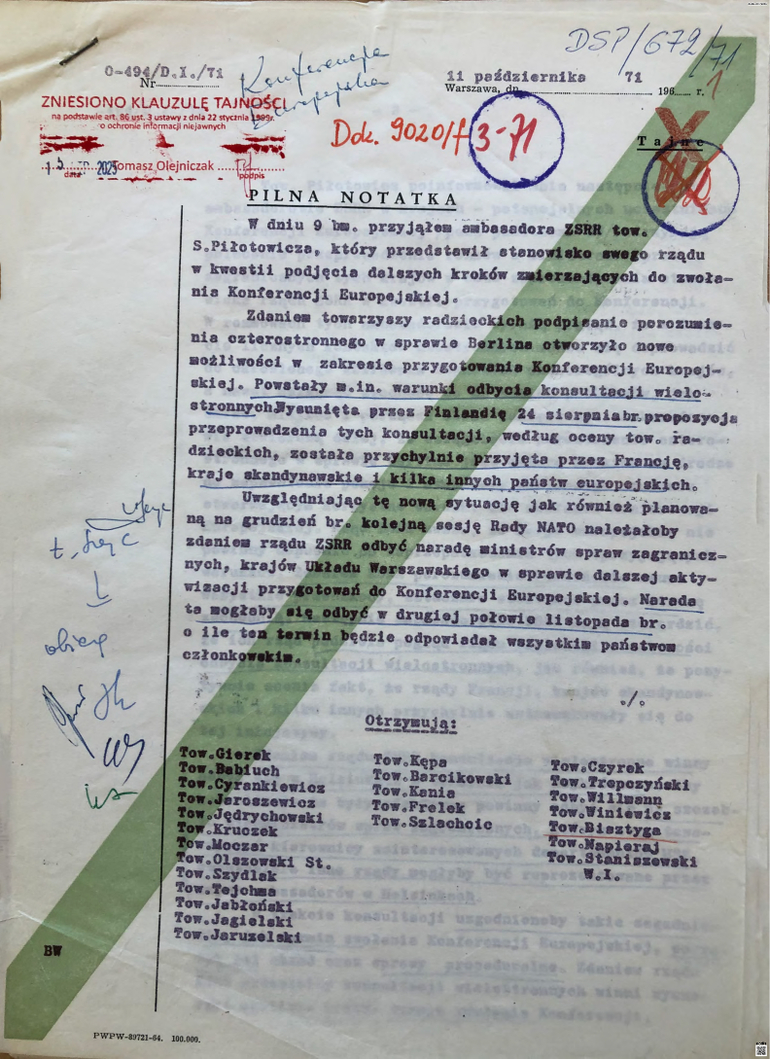
On the 9th of this month, I received the Ambassador of the USSR, Comrade S. Pilotovich,2 who presented his government’s position on taking further steps towards convening a European Conference.
According to the Soviet comrades, the signing of the four-party agreement on Berlin3 has opened up new possibilities for the preparation of the European Conference. Among other things, conditions have arose for multilateral consultations. In the opinion of the Soviet comrades, the proposal to hold these consultations, put forward by Finland on 24 August this year, was favourably received by France, the Scandinavian countries and several other European states.
Taking into account this new situation, as well as the next session of the NATO Council4 planned for December this year, the USSR government believes that a meeting of the foreign ministers of the Warsaw Pact countries should be held to further activate preparations for the European Conference. This meeting could take place in the second half of November this year, provided that this date suits all member states.5
Comrade Pilotovich then informed me that the Soviet ambassadors to countries – potential participants in the European Conference (apart from the Warsaw Pact countries) – will be instructed to hold talks with the foreign ministers of those countries in order to present the Soviet government’s position on the preparations for the Conference. During these talks, the ambassadors will express the view that during numerous bilateral contacts, it was made possible to achieve a certain convergence of positions between individual countries and even to achieve consensus on issues such as the composition, venue and agenda of the Conference. The ambassadors further state that the achievement of a four-party agreement on Berlin is an important step towards ensuring peace and an atmosphere of mutual trust, creating favourable conditions for the convening of the European Conference. The USSR government believes that European countries should not allow these favourable conditions to be wasted. According to the USSR, the Berlin agreement removes all obstacles artificially created by the Western side. The USSR ambassadors are then to state that their government shares the Finnish government’s view on the advisability of holding multilateral consultations and that it welcomes the fact that the governments of France, the Scandinavian countries and several others have responded favourably to this initiative.
According to the USSR government, multilateral consultations should take place in Helsinki as soon as possible. In order for these consultations to be effective, they should be held at the level of deputy foreign ministers, who may be accompanied by heads of relevant departments of the Ministries of Foreign Affairs; alternatively, other governments could be represented by their ambassadors in Helsinki.
During the consultations, issues such as the date of the European Conference, its agenda and procedural matters would be agreed upon. According to the USSR government, the participants in the multilateral consultations should set the shortest possible time for convening the Conference.
If Western interlocutors raise the question of whether the issue of arms reduction in Europe will be included in the agenda of the European Conference, the USSR ambassadors should reply that, in their government’s opinion, this would not be expedient, as this issue should be considered separately, since there is a possibility of addressing it even before the Conference is convened.
If the interlocutors express the opinion that multilateral consultations will only be possible after the Berlin issue has been completely resolved, the USSR ambassadors will vigorously oppose this view. They will express their hope that, given the favourable situation in Europe, the December session of the NATO Council will remove all existing conditions and agree to hold the Conference in the near future.6

 Transcription
 QdD
QdD
 Facsimile