
Printed in
Geneva, Helsinki, and the Making of the CSCE. International Diplomatic Documents on the Conference on Security and Cooperation in Europe, 1969–1975, vol. 30, doc. 14
volume linkBern 2026
more… |
▼▶Repository
| Archive | Archives of the Ministry of Foreign Affairs of the Republic of Poland, Warsaw |
| Archival classification | PL-AMSZ DSiP 61/77, w. 1 |
| Archival classification | PL-AMSZ Departament Studiów i Programowania (DSiP) |
 Transcription
 QdD
QdD
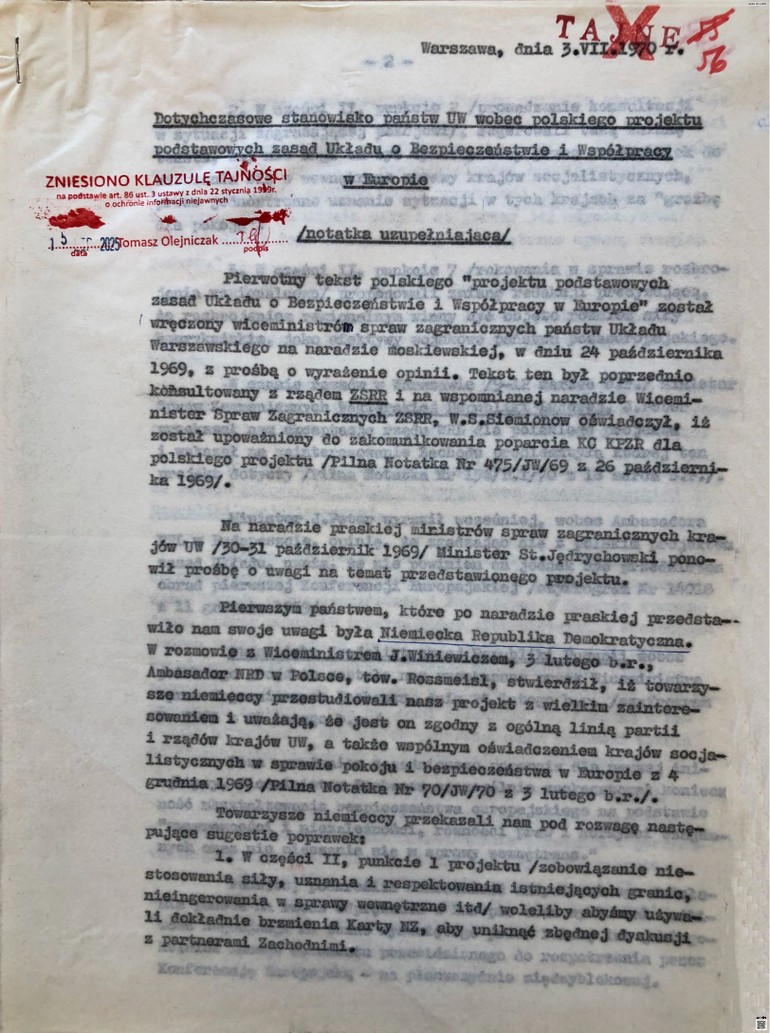
 Facsimile
dodis.ch/76895
The Department of Studies and Programming to Deputy Ministers of Foreign Affairs Winiewicz, Wolniak and Willmann1
The Hitherto Position of the Warsaw Pact Countries on the Polish Draft of the Basic Principles of the Treaty on Security and Cooperation in Europe
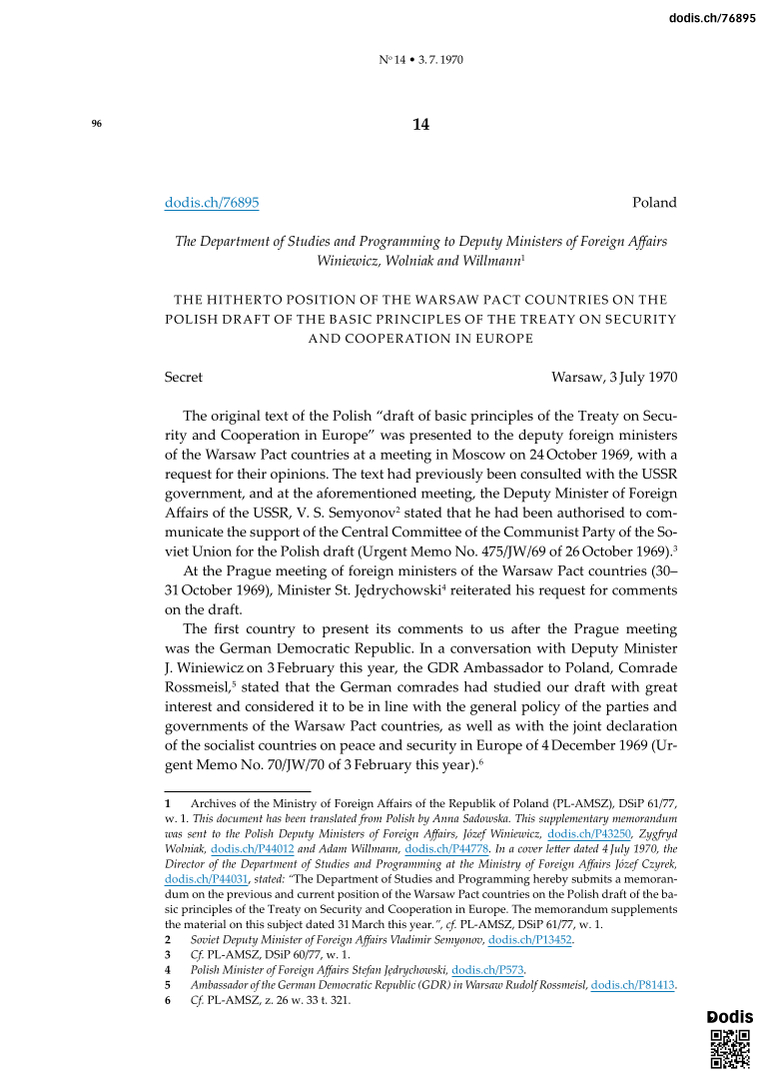
The original text of the Polish “draft of basic principles of the Treaty on Security and Cooperation in Europe” was presented to the deputy foreign ministers of the Warsaw Pact countries at a meeting in Moscow on 24 October 1969, with a request for their opinions. The text had previously been consulted with the USSR government, and at the aforementioned meeting, the Deputy Minister of Foreign Affairs of the USSR, V. S. Semyonov2 stated that he had been authorised to communicate the support of the Central Committee of the Communist Party of the Soviet Union for the Polish draft (Urgent Memo No. 475/JW/69 of 26 October 1969).3
At the Prague meeting of foreign ministers of the Warsaw Pact countries (30–31 October 1969), Minister St. Jędrychowski4 reiterated his request for comments on the draft.
The first country to present its comments to us after the Prague meeting was the German Democratic Republic. In a conversation with Deputy Minister J. Winiewicz on 3 February this year, the GDR Ambassador to Poland, Comrade Rossmeisl,5 stated that the German comrades had studied our draft with great interest and considered it to be in line with the general policy of the parties and governments of the Warsaw Pact countries, as well as with the joint declaration of the socialist countries on peace and security in Europe of 4 December 1969 (Urgent Memo No. 70/JW/70 of 3 February this year).6
The German comrades have conveyed for our consideration the following suggestions of amendments:
1. In Part II, point 1 of the draft (commitment not to use force, to recognise and respect existing borders, not to interfere in internal affairs, etc.), they would prefer us to use the exact wording of the UN Charter in order to avoid unnecessary discussion with our Western partners.
2. In Part II, point 2 (holding consultations in the event of a threat to peace), they suggested changing the text so that it could not be used by anyone to interfere in the internal affairs of socialist countries by unilaterally recognising the situation in those countries as a “threat to peace”.
3. In Part II, point 7 (negotiations on regional disarmament), they proposed a change in the wording to specify that regional disarmament should also cover American forces, as the military forces of a non-European state.
During talks in Warsaw (9–12 March this year), the Minister of Foreign Affairs of the Hungarian People’s Republic, J. Peter,7 informed us of the HPR government’s acceptance of the Polish draft and pointed to the West’s interest in the issues covered by the draft (Urgent Memo No. 156/D.I/70 of 18 March this year).8
Minister J. Peter had previously expressed his opinion to the Ambassador of the Polish People’s Republic in Budapest that, while he agreed with the Polish draft of the Agreement, he believed that it should not be the object of discussion at the first European Conference (ciphergram No. 14018 of 11 December 1969).9
The position of the Socialist Republic of Romania on the Polish draft was communicated to us by Deputy Minister of Foreign Affairs Ecobescu10 on 24 February this year (ciphergram No. 2085 of 25 February this year).11
In addition to expressing fundamental support for our initiative, Deputy Minister Ecobescu particularly emphasised the need to shape European security on the basis of “sovereignty and independence, equality of rights and mutual benefits, and non-interference in internal affairs.”
Moreover, he stressed the need for individual countries to take action to promote easing of tensions in Europe and ruled out the possibility of negotiations concerning the document proposed by Poland – or any other document stipulated for consideration by European Conference – at the inter-bloc level.
The Romanian side suggested that the draft presented by Poland should include clear wording on the link between security and cooperation based on “fundamental generally recognised principles… the indivisibility of security and peace, the condemnation of both aggressive war and the use or threat of force in general, and any form of interference in the internal affairs of other states.”
The Romanian side also expressed:
– its desire to receive the full text of the Polish draft (we had only provided the countries of the Warsaw Pact with a draft of the basic principles of the Agreement),
– willingness to hold consultations with the Polish side (whenever it is considered useful) on the initiative to conclude the Treaty on Security and Cooperation in Europe.
To date, we have not received any comments on our draft from the governments of the People’s Republic of Bulgaria and the Czechoslovak Socialist Republic.
Taking into account the comments made by some Warsaw Pact countries, a number of amendments have been made to the original text of the draft of basic principles of the Treaty on Security and Cooperation in Europe, clarifying the wording and adapting the text – wherever we considered it possible – to the wishes expressed by our Warsaw Pact partners. Some amendments were made on the basis of conclusions from consultations with non-Warsaw Pact countries, although in principle they are limited to adapting the wording of the text to the formulations used in international documents.
Based on comments submitted by the GDR government:
– we have brought the text of Part II, point 1 closer to the wording of the UN Charter, while retaining the phrase on the recognition and respect of borders, which is not explicitly included in the UN Charter,
– we have reworded Part II, point 2 with the objective of limiting the possibility of interference in the internal affairs of socialist countries.
We consider concerns that the wording of Part II, point 7 does not state precisely enough that any reduction in armed forces would also apply to American forces stationed in Europe as unfounded, particularly in the light of the disarmament proposals contained in the memorandum adopted by the Budapest Conference.
The opinion expressed by the HPR government that the draft of the Treaty should not be a subject of the first European Conference is in line with our earlier position on this matter. As a result of the Prague Conference arrangements, we treated the draft as a platform for discussion on broader, forward-looking solutions, following the possible pan-European acceptance of the documents put forward by that conference.
We have taken into account, as far as we deemed possible, the proposals put forward by the SRR government, in particular those concerning the introduction of expressions referring to the link between security and cooperation and the shaping of the European security system on the basis of state sovereignty.
They have been included in both the draft of the preamble and the operative part of the Treaty.
At the meeting of deputy ministers in Budapest and the consultation of foreign ministers of the Warsaw Pact countries (19–20 and 21–22 June this year), we reiterated the proposal to present a draft of the basic principles of the Treaty on Security and Cooperation in Europe. Declaring that this draft was in line with the agreed position expressed in the Bucharest Declaration, the resolutions of the Karlovy Vary Conference12 and the Budapest Appeal, we suggested that it be presented at the first European Conference as a programme for building a collective security system in Europe, following the adoption of proposals on the renunciation of force and the expansion of pan-European cooperation. At the same time, we suggested that the presented draft be discussed at subsequent meetings of European states.
The countries represented at the Budapest meeting, with the exception of Romania to a certain extent, stated, however, that multilateral and individual efforts should now focus on convening a European Conference with the agenda proposed in the memorandum of the Warsaw Pact countries and that, in the immediate phase of dialogue with the West, they should not go beyond the theses contained in the memorandum.
Taking this position into account, we believe that in further campaign for the adoption of the Budapest memorandum proposal by other interested countries, the presentation of ideas contained in the draft Agreement on Security and Cooperation in Europe should not be abandoned. Participating in the dialogue as a signatory to the memorandum provides a convenient platform for promoting the ideas contained in our draft of the Treaty.
For tactical reasons, however, it would be unreasonable at this stage to continue further action on the draft principles of the Treaty as a formulated document, delaying the return to it – after certain modifications – to one of the next phases of the dialogue.
Enclosures:13
1. Original text of the draft of basic principles of the Treaty.
2. Revised text of the above-mentioned draft (red underlining indicates newly introduced text or editorial changes).14
- 1
- Archives of the Ministry of Foreign Affairs of the Republik of Poland (PL-AMSZ), DSiP 61/77, w. 1. This document has been translated from Polish by Anna Sadowska. This supplementary memorandum was sent to the Polish Deputy Ministers of Foreign Affairs, Józef Winiewicz, dodis.ch/P43250, Zygfryd Wolniak, dodis.ch/P44012 and Adam Willmann, dodis.ch/P44778. In a cover letter dated 4 July 1970, the Director of the Department of Studies and Programming at the Ministry of Foreign Affairs Józef Czyrek, dodis.ch/P44031, stated: “The Department of Studies and Programming hereby submits a memorandum on the previous and current position of the Warsaw Pact countries on the Polish draft of the basic principles of the Treaty on Security and Cooperation in Europe. The memorandum supplements the material on this subject dated 31 March this year.”, cf. PL-AMSZ, DSiP 61/77, w. 1.↩
- 2
- Soviet Deputy Minister of Foreign Affairs Vladimir Semyonov, dodis.ch/P13452.↩
- 3
- Cf. PL-AMSZ, DSiP 60/77, w. 1.↩
- 4
- Polish Minister of Foreign Affairs Stefan Jędrychowski, dodis.ch/P573.↩
- 5
- Ambassador of the German Democratic Republic (GDR) in Warsaw Rudolf Rossmeisl, dodis.ch/P81413.↩
- 6
- Cf. PL-AMSZ, z. 26 w. 33 t. 321.↩
- 7
- Hungarian Minister of Foreign Affairs János Péter, dodis.ch/P15513.↩
- 8
- Cf. PL-AMSZ, DSiP 23/78 w. 1.↩
- 9
- Cf. PL-AMSZ, ZD 6/77.↩
- 10
- Romanian Deputy Minister of Foreign Affairs Nicolae Ecobescu, dodis.ch/P81414.↩
- 11
- Cf. PL-AMSZ, ZD 6/77.↩
- 12
- This refers to the conference of communist parties in Karlovy Vary (24–26 April 1967), during which a decision was made not to establish relations with the Federal Republic of Germany until it recognised the GDR and the existing borders.↩
- 13
- Enclosures are not published in this volume. For the enclosures, cf. PL-AMSZ, DSiP 61/77, w. 1.↩
- 14
- For all Polish documents in this volume, cf. the compilation dodis.ch/C2901.↩
Tags
Organization for Security and Co-operation in Europe (OSCE)