
Printed in
Geneva, Helsinki, and the Making of the CSCE. International Diplomatic Documents on the Conference on Security and Cooperation in Europe, 1969–1975, vol. 30, doc. 10
volume linkBern 2026
more… |
▼▶Repository
| Archive | Archives of the Ministry of Foreign Affairs of the Republic of Poland, Warsaw |
| Archival classification | PL-AMSZ z. 26, w. 33, t. 32 |
| Archival classification | PL-AMSZ Gabinet Ministra 1961–1977 |
 Transcription
 QdD
QdD
 Facsimile
dodis.ch/76894
Memorandum from Foreign Minister Jędrychowski1
[Position of the Soviet Union Concerning the European Conference on Security and Cooperation]
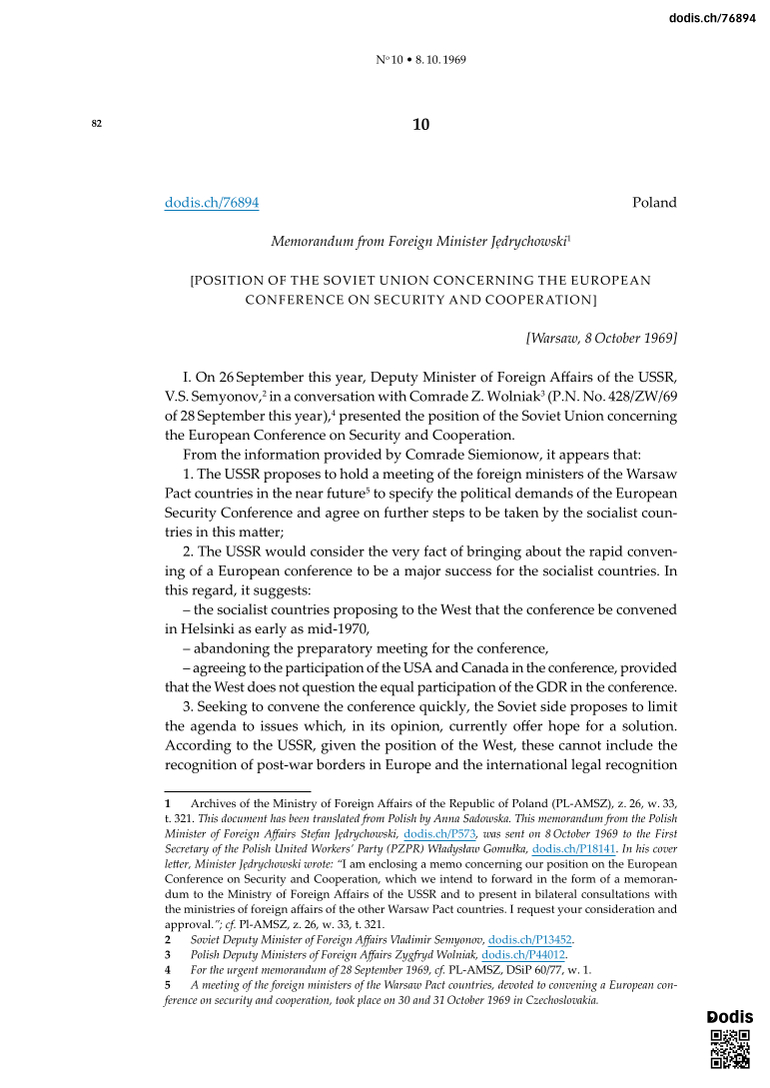
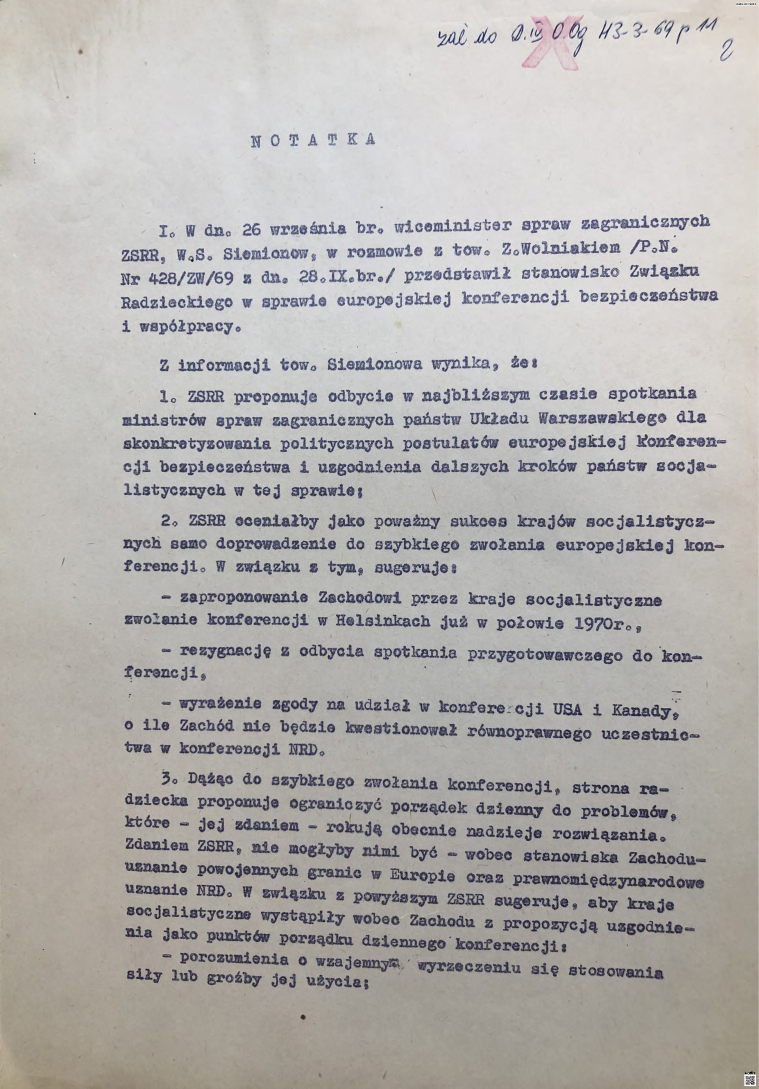
I. On 26 September this year, Deputy Minister of Foreign Affairs of the USSR, V.S. Semyonov,2 in a conversation with Comrade Z. Wolniak3 (P.N. No. 428/ZW/69 of 28 September this year),4 presented the position of the Soviet Union concerning the European Conference on Security and Cooperation.
From the information provided by Comrade Siemionow, it appears that:
1. The USSR proposes to hold a meeting of the foreign ministers of the Warsaw Pact countries in the near future5 to specify the political demands of the European Security Conference and agree on further steps to be taken by the socialist countries in this matter;
2. The USSR would consider the very fact of bringing about the rapid convening of a European conference to be a major success for the socialist countries. In this regard, it suggests:
– the socialist countries proposing to the West that the conference be convened in Helsinki as early as mid-1970,
– abandoning the preparatory meeting for the conference,
– agreeing to the participation of the USA and Canada in the conference, provided that the West does not question the equal participation of the GDR in the conference.
3. Seeking to convene the conference quickly, the Soviet side proposes to limit the agenda to issues which, in its opinion, currently offer hope for a solution. According to the USSR, given the position of the West, these cannot include the recognition of post-war borders in Europe and the international legal recognition of the GDR. In view of the above, the USSR suggests that the socialist countries propose to the West that the following be agreed upon as items on the conference agenda:
– an accord on the mutual renunciation of the use or threat of force;
– an accord on the development of economic and scientific-technical cooperation.
The draft agreement on the renunciation of the use of force presented by the USSR does not contain a requirement to recognise the existing borders in Europe or to respect the territorial integrity of states.
The essence of the Soviet proposal would therefore be achieving a general improvement in the political climate in Europe. This means accepting a minimum programme in advance without attempting to achieve the fundamental premises of European security, both through bilateral talks with Western countries, including the GFR, and through multilateral talks. This puts us in an incontinent position due to our fundamental interest in the recognition of the border on the Oder and Neisse rivers and our commitment to promoting the idea of a security and cooperation agreement in Europe.
Should the issue of recognition and respect for borders in Europe be dropped from the conference agenda – even if it is intended as a first step towards further meetings – it would adversely affect the prospects of achieving progress on the recognition of our border, both at the pan-European level and in bilateral talks with the GFR.
In view of the above, in response to the position presented to us by the USSR, we propose to send a memorandum to the Soviet side in which:
– we express our support for the proposal to hold a meeting of foreign ministers of socialist countries in order to agree on a common position on the main issues related to the European conference, as well as for the suggestions regarding the date of the conference and its makeup;
– we express once again the view that the conference should focus on key issues of European security and cooperation, and that its outcome should be progress based on recognition of the existing territorial and political status quo; to this end, we propose that the basic principles of a security and cooperation agreement be considered and agreed upon at the meeting of foreign ministers in preparation. Dialogue on the draft of such an agreement – even if not all of the objectives outlined in it could be achieved immediately – would play a major role in moving forward the realization of European security premises;
– we declare that the issue of recognising the territorial status quo has not been addressed in the Soviet draft of the accord on the renunciation of the use of force or the threat of force which has been submitted to us; we therefore present a counter-draft of the “Basic Principles of an Accord on the Renunciation of the Use of Force or Threat of Force in Mutual Relations between European States”, which provides for the explicit recognition of “existing state borders in Europe and respecting them”;
– we emphasise the need to clarify the principles of European cooperation in the economic and scientific-technical fields and propose, to this end, the establishment of a special working group of the signatory states of the Budapest Appeal and the supplementation of the draft of the document on economic and scientific-technical cooperation presented by the USSR.
It should also be considered whether, regardless of the presentation of our position in writing to the USSR and the already scheduled consultation with the GDR, it would be appropriate to hold consultations with other Warsaw Pact countries at the level of deputy ministers or department directors even before the meeting of foreign ministers concerning the European conference and German affairs.
II. It should be assumed that during the meeting of the foreign ministers of the Warsaw Pact countries, there will arise the issue of these countries’ policy towards GFR. The formal basis for raising this issue is provided by the protocol of the Warsaw meeting of the Warsaw Pact countries in February 1967.6 Such an initiative may be taken in particular by the GDR, which, as we know from unofficial statements by the Deputy Minister of Foreign Affairs of the USSR, Comrade W.S. Semyonov, raised this issue in connection with Comrade Gomułka’s proposal7 of 17 May this year.8 (During the last consultations with the USSR, the GDR side did not return to this issue). Regardless of this, there is a need on our part to consult on further proceedings regarding talks with the GFR. However, the matter is not suitable for discussion among the foreign ministers of all seven countries of the Warsaw Pact, as Romania is not a signatory to the February 1967 protocol.
Thus, two options suggest themselves:
1) to hold a meeting of the foreign ministers of the six countries which signed the February 1967 protocol: the meeting could take place on the eve of or the day after the meeting of the seven countries;
2) to hold bilateral consultations on this matter with the other five countries which signed the February 1967 protocol.
The bilateral form of consultation is supported by the fact that a premature revision of the 1967 agreements on the full normalisation of relations with the GFR (both in the case of a relaxation of the conditions for this normalisation and their possible tightening) would not be in our interest.
We will submit the theses for consultation with socialist countries on German matters in a separate memo.
We enclose:
1) Draft of Polish memorandum to the USSR government,
2) Polish draft of principles of an agreement on collective security and cooperation in Europe,
3) Polish draft of principles of an agreement on the renunciation of the use of force,
4) Completed draft of communiqué from the meeting of foreign ministers of the Warsaw Pact member states.9
- 1
- Archives of the Ministry of Foreign Affairs of the Republic of Poland (PL-AMSZ), z. 26, w. 33, t. 321. This document has been translated from Polish by Anna Sadowska. This memorandum from the Polish Minister of Foreign Affairs Stefan Jędrychowski, dodis.ch/P573, was sent on 8 October 1969 to the First Secretary of the Polish United Workers’ Party (PZPR) Władysław Gomułka, dodis.ch/P18141. In his cover letter, Minister Jędrychowski wrote: “I am enclosing a memo concerning our position on the European Conference on Security and Cooperation, which we intend to forward in the form of a memorandum to the Ministry of Foreign Affairs of the USSR and to present in bilateral consultations with the ministries of foreign affairs of the other Warsaw Pact countries. I request your consideration and approval.”; cf. Pl-AMSZ, z. 26, w. 33, t. 321. ↩
- 2
- Soviet Deputy Minister of Foreign Affairs Vladimir Semyonov, dodis.ch/P13452.↩
- 3
- Polish Deputy Ministers of Foreign Affairs Zygfryd Wolniak, dodis.ch/P44012.↩
- 4
- For the urgent memorandum of 28 September 1969, cf. PL-AMSZ, DSiP 60/77, w. 1.↩
- 5
- A meeting of the foreign ministers of the Warsaw Pact countries, devoted to convening a European conference on security and cooperation, took place on 30 and 31 October 1969 in Czechoslovakia.↩
- 6
- This refers to the protocol signed at the conclusion of the meeting of foreign ministers of the Warsaw Pact countries in Warsaw on 9 February 1967, which was devoted to the policy of socialist countries towards the Federal Republic of Germany (FRG).↩
- 7
- First Secretary of the PZPR Władysław Gomułka, dodis.ch/P18141.↩
- 8
- On 17 May 1969, First Secretary Gomułka proposed that the Polish People’s Republic and the FRG begin talks on normalising mutual relations.↩
- 9
- The enclosed drafts are not published in the present volume. For the drafts, cf. PL-AMSZ, z. 26, w. 33, t. 321. For all Polish documents in this volume, cf. the compilation dodis.ch/C2901.↩
Tags
Organization for Security and Co-operation in Europe (OSCE)