
Printed in
Geneva, Helsinki, and the Making of the CSCE. International Diplomatic Documents on the Conference on Security and Cooperation in Europe, 1969–1975, vol. 30, doc. 83
volume linkBern 2026
more… |
▼▶Repository
| Archive | Arquivo Histórico Diplomático do Ministério dos Negócios Estrangeiros, Lisbon |
| Archival classification | PT-AHD PT/AHD/3/MNE-SE-DNPEC/DGNP-PEA/142/DC000001 |
| Archival classification | PT-AHD Direcção Geral dos Negócios Políticos |
| Dossier title | Processos 309 - Notas internas das diferentes repartições (1975–1975) |
 Transcription
 QdD
QdD
 Facsimile
dodis.ch/76761
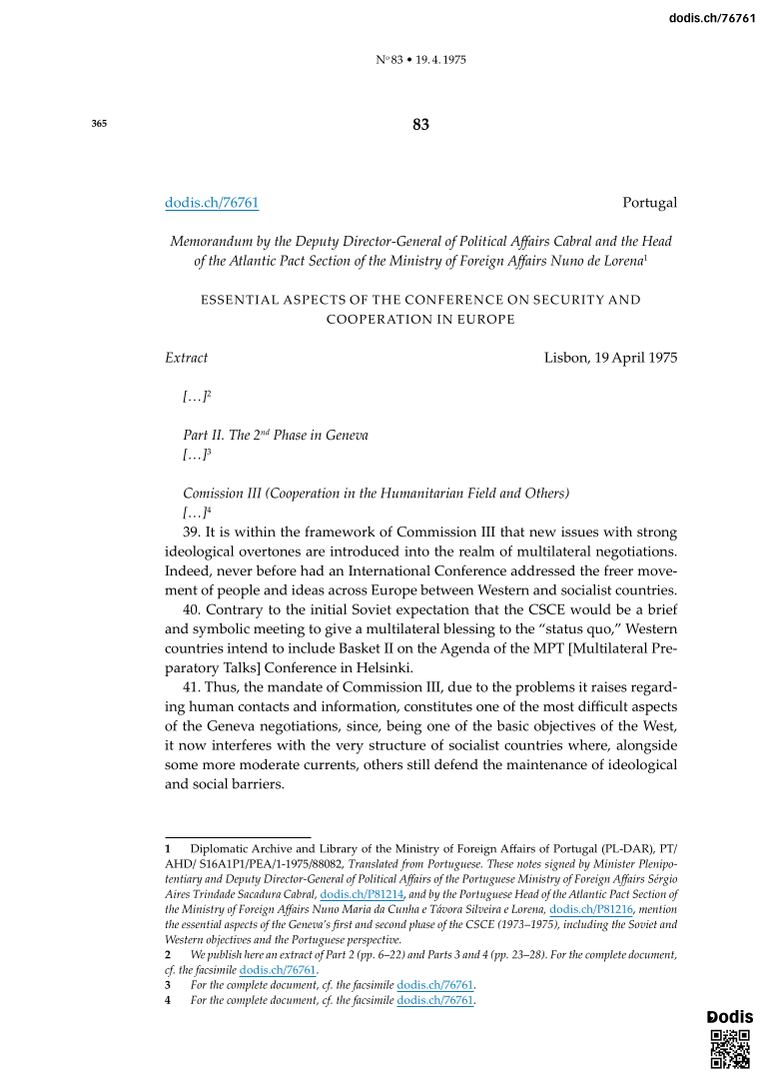
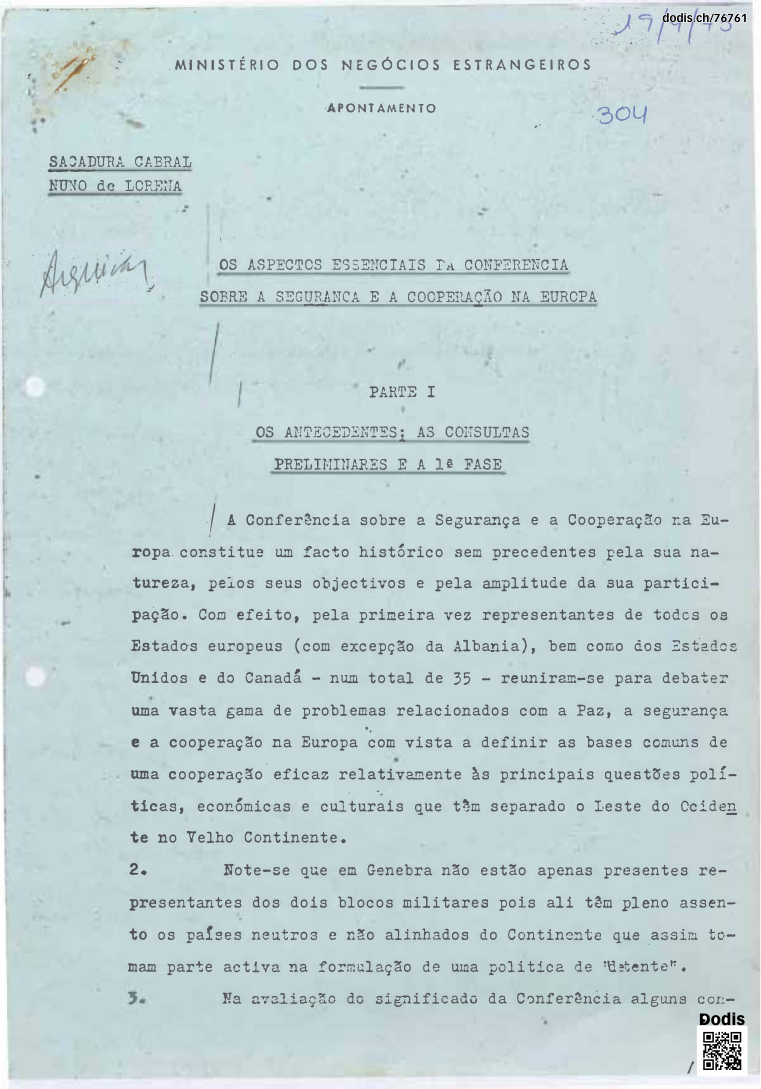
Memorandum by the Deputy Director-General of Political Affairs Cabral and the Head of the Atlantic Pact Section of the Ministry of Foreign Affairs Nuno de Lorena1
Essential Aspects of the Conference on Security and Cooperation in Europe
[…] 2
[…] 3
[…] 4
39. It is within the framework of Commission III that new issues with strong ideological overtones are introduced into the realm of multilateral negotiations. Indeed, never before had an International Conference addressed the freer movement of people and ideas across Europe between Western and socialist countries.
40. Contrary to the initial Soviet expectation that the CSCE would be a brief and symbolic meeting to give a multilateral blessing to the “status quo,” Western countries intend to include Basket II on the Agenda of the MPT [Multilateral Preparatory Talks] Conference in Helsinki.
41. Thus, the mandate of Commission III, due to the problems it raises regarding human contacts and information, constitutes one of the most difficult aspects of the Geneva negotiations, since, being one of the basic objectives of the West, it now interferes with the very structure of socialist countries where, alongside some more moderate currents, others still defend the maintenance of ideological and social barriers.
42. In this context, the question of the “preamble” to the texts of the Third Commission arose: the socialist countries wanted it to be restrictive, invoking the principles of non-interference and respect for domestic law, which would subsequently allow the authorities of those states to prevent the application of decisions taken within the framework of the Third Commission. Obviously, the Western countries opposed this.
43. The “preamble question” was only resolved through a general compromise (“package deal”)5 that included a final proposal acceptable to the West, since it referred to the Principles only in general terms, and two texts to be inserted into Principles 1 and 10, which established the right of participating States to choose and develop their respective political, economic and cultural systems and to determine their laws and regulations, but in accordance with international law and the final documents of the CSCE.
[…] 6
64. Having described, albeit very briefly, the nature and results of the work of the various committees and subcommittees, it is now important to provide a more complete overview of the Conference, outlining the objectives pursued in Geneva by the Soviet and Western parties.
65. Fundamentally, the USSR aims to achieve, within the CSCE, the enshrinement of the status quo resulting from the Second World War in Eastern Europe, the establishment (albeit in the long term) of a collective security system in Europe, and the strengthening of its position through a “droit de regard” in all European affairs.
66. More specifically, the USSR would have in mind: a) Western recognition of the existing borders on the continent, particularly those of the GDR and the territories acquired by the Soviets as a result of the 1939–45 war (namely Estonia, Latvia, Lithuania, part of Finland, Poland and Romania, i.e. a total of 500 000 km² with over 23 million inhabitants; b) Western acceptance of the political status quo in Central and Eastern Europe, which would imply tacit recognition of the Soviet sphere of influence in the Warsaw Pact countries; c) rapprochement with the West on terms more favourable to the preservation of the Soviet political, economic and social system and an increase in its political influence in Western Europe; Western Europe; d) the creation of a climate of détente likely to lead to a gradual weakening of the West’s determination to maintain appropriate defence mechanisms; e) the weakening of the transatlantic link, particularly in view of the gradual withdrawal of American forces; f) the weakening the Atlantic Alliance, calling into question the belief in its usefulness, pressing for the abolition of blocs and advocating a new security system; broader access to Western financial, scientific and technological resources; h) to influence political leaders in Western countries, primarily with a view to preventing progress in their economic and political integration, by insisting on the idea of cooperation at European level.
67. For their part, Western countries want the CSCE to play a key role in reducing tensions by achieving concrete results in relations between the two blocs in the political, economic and security fields.
68. More specifically, the Western countries want: a) the CSCE not to serve to perpetuate the division in Europe, but rather to contribute to reconciliation and cooperation, initiating a process aimed at reducing existing barriers; b) the creation of an atmosphere of trust by promoting freer movement of people, information and ideas; the definition of principles governing relations between participating States and the adoption of measures (including military measures) aimed at strengthening trust and stability in order to reduce the dangers of military confrontation; c) that the “Brezhnev doctrine” of limited sovereignty be challenged by insisting on the application of the principles governing relations between participants, regardless of their respective political, economic and social systems.
69. Regarding the Portuguese position, arguments were invoked from the outset pointing out the drawbacks of our presence in the CSCE, fundamentally related to aspects, now outdated, of our country’s foreign policy.7 But not only that. Arguments were also put forward to highlight the advantages of this presence, namely the possibility of Portugal having an active voice in continental affairs, not distancing itself from Europe and keeping all doors open, contributing to the formulation of a European policy, strengthening contacts with Eastern European countries and taking advantage of the benefits that might result from a permanent body that could eventually emerge from the conference as part of the “follow-up”.
70. In the course of the negotiations, the Portuguese position has been, as mentioned above, the following: a) in Commission I,8 a general alignment with the Allied position regarding principles, support for the Swiss project of peaceful dispute resolution, and, with respect to the CBM opposition to the notification of air and naval manoeuvres and the notification of movements, and support for the notification, on a voluntary basis, of land manoeuvres with forces smaller than a Division or equivalent; in Commission II,9 a very discreet attitude, given the difficulties we have had in ensuring an effective presence in that Commission. However, we particularly supported the reference to developing European countries; in Commission III,10 a position of balance and conciliation, the only one that, in the face of the divergences between the two camps, seems able to safeguard solidarity with the Atlantic allies while still establishing good ties with the socialist countries, particularly with Romania;11 on point IV (follow-up), where there are also marked divergences, we adopted an intermediate position based on the Danish ideas supplemented by the British memorandum of January 30th, thus favouring a certain institutionalization of the “follow-up”. Our position is set out in the instructions recently sent to Delse [Portuguese Delegation to CSCE] by telegram No. 48 of the 18th of this month, a copy of which is attached for better clarification.12
71. From what has been said above, it follows that the CSCE has already achieved appreciable results, although important points of the Helsinki Agenda, regarding which there are still disagreements among the participants in the Conference, must still be discussed at the negotiating table.
72. Thus, Commission I still needs to resolve the issue of the peaceful alteration of borders as well as the safeguarding of the rights of the four Powers with respect to Germany. Agreement must also be reached on the wording of the preamble to the “Declaration of Principles”, including the question of its equivalence. Furthermore, no agreement has yet been reached on confidence-building measures (CBMs).
73. In Committee II, where the atmosphere has been less tense from a political point of view, given that many of the issues discussed there are being negotiated within the GATT or through direct negotiations, there are matters that require agreement. This is the case with reciprocity and most-favoured-nation treatment.
74. In Committee III, discussions are continuing on issues relating to journalists’ working conditions, travel and certain aspects of the cultural sector.
75. As for the “Follow-up,” the crux of the matter is currently being negotiated.
76. The Conference therefore marks the beginning of the process of thawing relations between East and West, and for this reason its limitations—which cannot be overcome at this stage—must be viewed realistically. It is understood that, with regard to issues being addressed for the first time at the multilateral level (such as those in Basket III), it is not possible, for the time being, to reach definitive solutions.
77. On the other hand, the scope and significance of the results achieved depend not so much on the signing (albeit at the highest level) of the CSCE’s final documents, but rather on how the Conference’s recommendations—the implementation of which is primarily the responsibility of the participating States—are put into practice. Furthermore, to assess the CSCE’s results in their proper perspective, it is important to bear in mind that they must be viewed within the broader context of East–West relations, which includes other ongoing negotiations.
78. Western countries do not expect the CSCE to bring about a sudden, radical change in the European landscape. They believe that it should have a dynamic, far-reaching effect, and thus do not accept the permanent entrenchment of the “status quo” in Europe.
79. The valid criterion for assessing the CSCE will therefore be the extent to which it effectively contributes to East–West cooperation and to overcoming the division of Europe into blocs.13
- 1
- Diplomatic Archive and Library of the Ministry of Foreign Affairs of Portugal (PT-AHD), PT/AHD/ S16A1P1/PEA/1-1975/88082. Translated from Portuguese. These notes signed by Minister Plenipotentiary and Deputy Director-General of Political Affairs of the Portuguese Ministry of Foreign Affairs Sérgio Aires Trindade Sacadura Cabral, dodis.ch/P81214, and by the Portuguese Head of the Atlantic Pact Section of the Ministry of Foreign Affairs Nuno Maria da Cunha e Távora Silveira e Lorena, dodis.ch/P81216, mention the essential aspects of the Geneva’s first and second phase of the CSCE (1973–1975), including the Soviet and Western objectives and the Portuguese perspective.↩
- 2
- We publish here an extract of Part 2 (pp. 6–22) and Parts 3 and 4 (pp. 23–28). For the complete document, cf. the facsimile dodis.ch/76761.↩
- 3
- For the complete document, cf. the facsimile dodis.ch/76761.↩
- 4
- For the complete document, cf. the facsimile dodis.ch/76761.↩
- 5
- English in the original. For the “package deal” cf. QdD 30, doc. 69, dodis.ch/38858.↩
- 6
- For the complete document, cf. the facsimile dodis.ch/76761.↩
- 7
- For the Portuguese position towards the CSCE in the final stage of the dictatorship, cf. QdD 30, doc 27, dodis.ch/76736 and QdD 30, doc. 36, dodis.ch/76737.↩
- 8
- On security.↩
- 9
- On cooperation in the fields of economics, science and technology, and the environment.↩
- 10
- On cooperation in the humanitarian field and others.↩
- 11
- Romania was the first East European country with which Portugal established diplomatic relations immediately after the 25 April 1974 revolution.↩
- 12
- For the telegram No. 48 from the Portuguese Ministry of Foreign Affairs to the Head of the Portuguese Delegation (Delse) in Geneva, dated 18 April 1975, cf. dodis.ch/78103.↩
- 13
- For all Portuguese documents in this volume, cf. the compilation dodis.ch/C2897.↩
Relations to other documents
| http://dodis.ch/76736 | is quoted in | http://dodis.ch/76761 |
| http://dodis.ch/76737 | is quoted in | http://dodis.ch/76761 |
| http://dodis.ch/38858 | is quoted in | http://dodis.ch/76761 |
| http://dodis.ch/78103 | is quoted in | http://dodis.ch/76761 |
Tags
Organization for Security and Co-operation in Europe (OSCE) CSCE negotiations in Helsinki and Geneva (1972–1975)