dodis.ch/75731
The Director of the North American Department of the Ministry of Foreign Affairs Elizur to the Israeli Ambassador in Ottawa, Meron
1
The Conference on Security and Cooperation in Europe
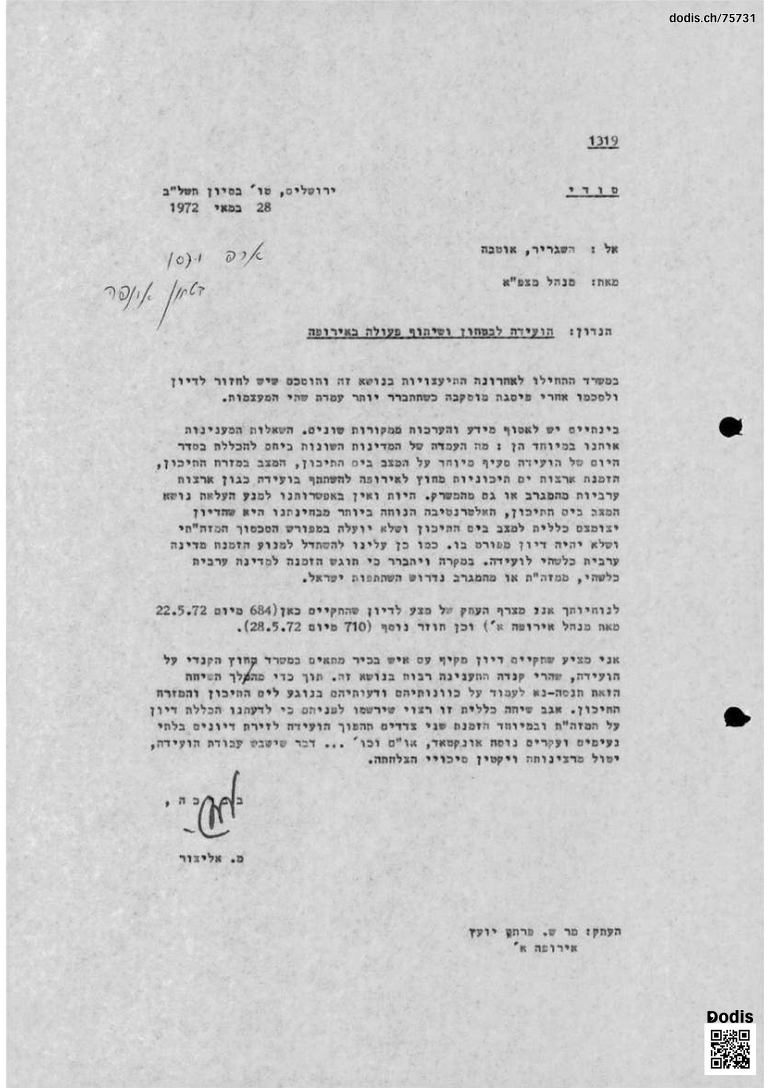
Consultations on this issue have recently begun in the Ministry,2 and it was agreed that we should return to the discussion and sum it up after the Moscow summit,3 when the position of the two Great Powers becomes clearer.
In the meantime, information and assessments should be gathered from various sources. The questions that interest us in particular are: what is the position of the various countries regarding the inclusion in the Conference agenda of a special item on the situation in the Mediterranean, the situation in the Middle East, and inviting Mediterranean countries outside of Europe to participate in the Conference, such as Arab countries from the Maghreb or also from the Mashreq.4 Since we cannot prevent the issue of the situation in the Mediterranean from being raised, the most convenient alternative from our perspective is that the discussion be limited to the situation in the Mediterranean in general, and that the Middle East conflict should not be explicitly raised or discussed in detail. We must also try to prevent the invitation of any Arab country to the conference. In the event that an invitation is extended to any Arab country, from the Middle East or the Maghreb, we will demand Israel’s participation.
For your convenience, we are enclosing a copy of the basis for the discussion that took place here (684 dated 22.5.72 from the Director of Europe A [Department])5 as well as another circular (710 dated 28.5.72).6
I propose that you hold a comprehensive discussion with an appropriate senior official in the Canadian Foreign Ministry about the Conference, since Canada has taken a great interest in this subject. During the course of this conversation, please try to establish their intentions and opinions regarding the Mediterranean and the Middle East. Incidental to this general conversation, it is advisable to put it on record to them that in our opinion, including a discussion on the Middle East, and especially inviting the two parties, will turn the conference into an arena for unpleasant and fruitless discussions, in the style of UNCTAD, the UN, etc. …which will disrupt the work of the Conference, detract from its seriousness, and reduce its chances of success.7

 Transcription
 QdD
QdD
 Facsimile