
Printed in
Geneva, Helsinki, and the Making of the CSCE. International Diplomatic Documents on the Conference on Security and Cooperation in Europe, 1969–1975, vol. 30, doc. 97
volume linkBern 2026
more… |
▼▶Repository
| Archive | Austrian State Archive, Vienna |
| Archival classification | AT-OeStA Zl. 808/123-II-7/75 |
| Archival classification | AT-OeStA Bundesministerium für auswärtige Angelegenheiten |
| (1975–1975) |
 Transcription
 QdD
QdD
 Facsimile
dodis.ch/75720
Speech by Federal Chancellor Kreisky at the CSCE Summit in Helsinki1
CSCE
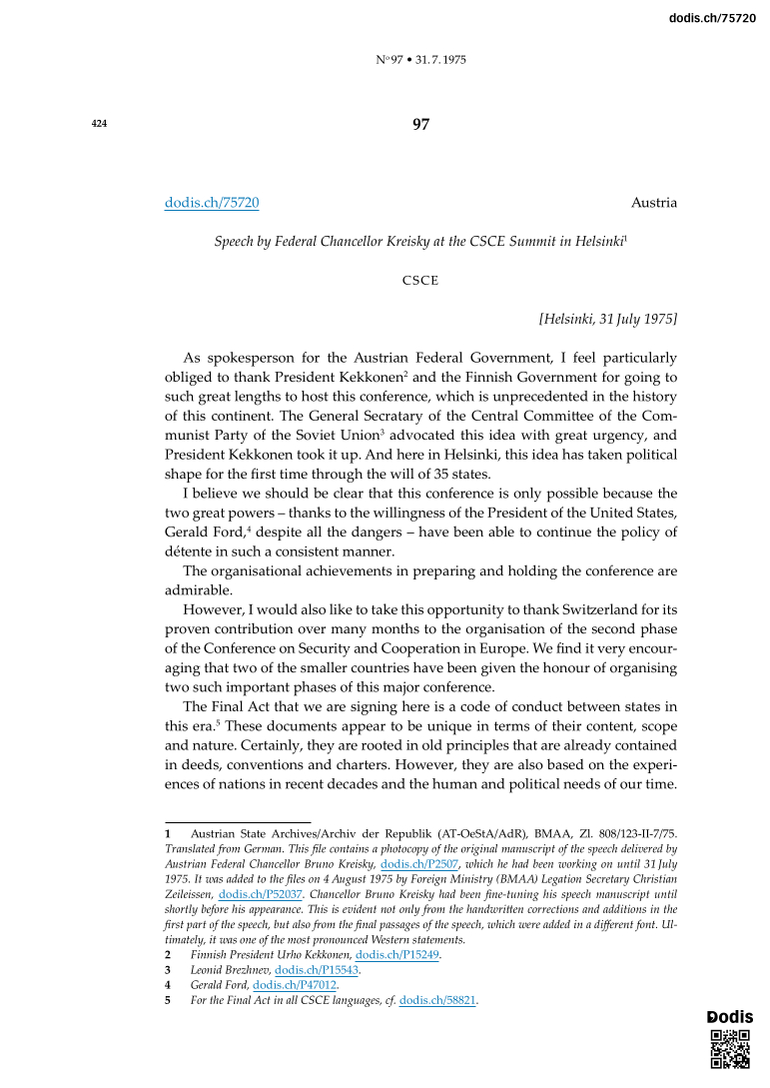
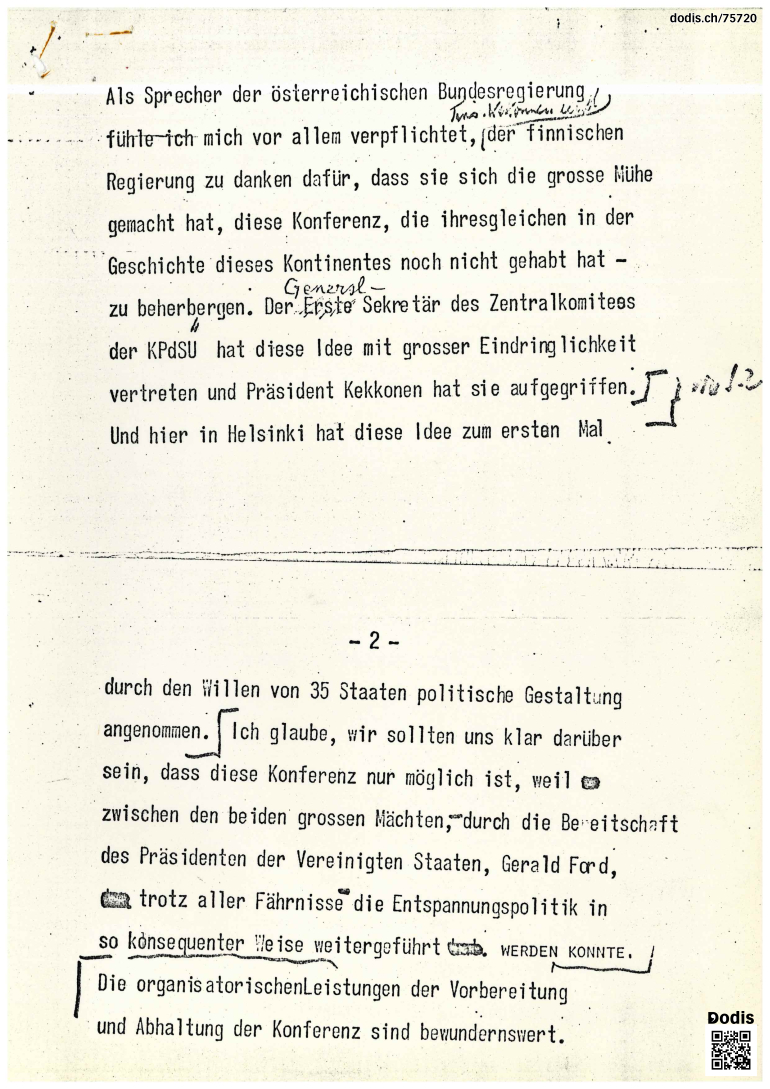
As spokesperson for the Austrian Federal Government, I feel particularly obliged to thank President Kekkonen2 and the Finnish Government for going to such great lengths to host this conference, which is unprecedented in the history of this continent. The General Secratary of the Central Committee of the Communist Party of the Soviet Union3 advocated this idea with great urgency, and President Kekkonen took it up. And here in Helsinki, this idea has taken political shape for the first time through the will of 35 states.
I believe we should be clear that this conference is only possible because the two great powers – thanks to the willingness of the President of the United States, Gerald Ford,4 despite all the dangers – have been able to continue the policy of détente in such a consistent manner.
The organisational achievements in preparing and holding the conference are admirable.
However, I would also like to take this opportunity to thank Switzerland for its proven contribution over many months to the organisation of the second phase of the Conference on Security and Cooperation in Europe. We find it very encouraging that two of the smaller countries have been given the honour of organising two such important phases of this major conference.
The Final Act that we are signing here is a code of conduct between states in this era.5 These documents appear to be unique in terms of their content, scope and nature. Certainly, they are rooted in old principles that are already contained in deeds, conventions and charters. However, they are also based on the experiences of nations in recent decades and the human and political needs of our time. As extensive and magnificent as this work might be, it will depend6 on how much reality we are able to give to it all.
This conference, however, is the result of a process of détente that has already taken place, which – we are so immodest as to claim – began with the conclusion of the Austrian State Treaty.7 For beyond its significance for the Austrian people, the Austrian State Treaty was a signal visible far and wide that it is once again possible to achieve substantial and lasting results at the negotiating table between the powers.
It has taken a long time from then to now, but we nevertheless find it remarkable that this continent has rarely known a quarter of a century without war in its history.8
And that is why we regard this conference as the conclusion of a first, but very decisive phase.9 From this conference onwards, the policy of détente must begin; it must now show visible and substantial results. And here, a number of questions seem to us to be of particular importance.
Firstly, in the world in which we live, space and time seem to have been overcome to an unprecedented extent. This also applies to the lives of peoples and thus to world politics – there can therefore be no theatres of war far from Europe, no centres of tension in which Europe could remain uninvolved.
The policy of détente has thus become indivisible. And so I believe that we who are gathered here have a duty to do everything in our power to help calm a dangerous area of tension that is close to Europe.
In many respects, the Middle East has been the cradle of our culture. The mere fact that the great religions originated there and that much of our civilisation was adopted from there establishes a close relationship that is binding. And that is why10 to the governments of the Arab states and Israel, a call on them to do everything in their power to resolve their conflicts peacefully, although we are well aware of the difficulty of the problems. There must be a way that respects the rights of both the Israeli and Palestinian peoples equally.
Closely related to this is a problem that is particularly relevant to Europe. A large group of European industrialised countries that feel they belong to the Western world are still 98% dependent on oil supplies, mainly from the Middle East, and since oil is a special kind of raw material, we must very quickly find a way to establish constructive cooperation between Europe and the oil-producing countries of the Middle East. This cooperation must involve more than just buying and selling. A special kind of cooperation needs to be established.
Given that the energy problem is now a pressing issue and that Eastern Europe still produces more energy resources than Western Europe, at least for the time being, it seems reasonable to us that European cooperation should focus in particular on preparing the concept of a pan-European energy industry.
Another problem of current importance – one that I have spoken about many times – is the expansion of the European waterway system. Here, it will be important in the coming years to find solutions, particularly with regard to the European Canal, which is important for nine European countries.11
The European economy is characterised by integration efforts on a scale never seen before. These efforts reflect the current state of development of our productive forces and means of production. An important test of our efforts12 will be how quickly we can achieve a genuine and constructive rapprochement between the two European integration systems.
I would therefore like to briefly outline an area of cooperation that is particularly important to me. The aid provided by industrialised countries to 130 countries in 1974 is estimated at approximately 38 billion dollars. As considerable as this sum is, it clearly does not seem to be sufficient to provide the development aid that is needed. The industrialised countries must be prepared to make a much greater effort here and must set themselves the goal of creating an infrastructure in the developing countries that will protect the people of these countries from falling into hunger and misery. I know that my country has not yet fulfilled these obligations to the extent that it should, but I have come to the conclusion that we could all fulfil these obligations more easily if they were part of a large-scale, concerted continental effort. Only in this way will we strengthen the developing countries economically and bring them up to a level that will allow them to enter into a genuine partnership with the industrialised world. Only in this way will we create a system of economic interdependence, which alone is the surest guarantee of peaceful development.
I am talking about a European plan for cooperation with other parts of the world.
And so I would like to turn finally to a political and psychological question of the utmost importance. The greatest difficulties in preparing for this conference lay in the deep mistrust that people feel towards power and its brutal manifestations. And that is why there have been such lengthy discussions about the humanitarian sphere.
The success of our efforts will depend above all on whether we succeed in eliminating this mistrust, if not completely, then at least to a minimum. Not that we want to harbour the illusion that there will be no disputes in the future about what we agree here. However, it seems crucial that we always find a way to resolve any disputes that may arise about this or that.
We do not have much time before the next conference in 1977: time passes quickly, and so we must set to work the day after this conference to do what we need to do if this conference is to have any meaning.
The documents presented to us for signature repeatedly refer to our desire to cooperate despite the diversity of social systems that exist in Europe. What are these different systems we are talking about? Here, too, a word of clarification from my side is necessary. Hundreds of millions of people live in countries that are deeply committed to the idea of political democracy, and hundreds of millions more live in countries where the political ideas of communist parties have been realised, whereas the autonomous developments in some states are highly remarkable. It would make little sense to downplay or even ignore the fundamental differences between these various political systems and social orders. It is therefore very welcome that it is repeatedly clarified that coexistence – by which we mean the form of peaceful relations that is possible today – cannot be regarded as valid in the ideological sphere. I welcome this clarification, because the democratic states are also determined to promote the idea of democracy more and more, and we believe that democracy is in itself such a creative form of government that, within its framework and in strict accordance with its principles, major social reforms have taken place and will continue to take place in the future.
We are therefore prepared for this controversy and we welcome the Conference on Security and Cooperation in Europe, not least because the principles that have been developed should allow this global debate to take place in a peaceful manner. In any case, this is how we understand the passage in the Declaration of Principles that refers to the right of each participating state to freely choose and develop its political, social, economic and cultural system.
From the very beginning, Austria has been committed to a Conference on Security and Cooperation in Europe. For we know from our own experience how important it is to have a relaxed continent.
If it exists, then we lie at the heart of this continent as a flourishing community and a safe home for its people; if it does not exist, then we lie in the gloomy shadow of a military and political demarcation line, we lie in the shadow of a demarcation line that runs through the whole of Europe and becomes the dividing line between its military and political systems. You will therefore understand why Austria wants to contribute everything it can, why, despite being free of illusions, we are so positive about the idea of détente: an important first phase has been completed, and a new, even more fruitful one must begin after Helsinki.13
- 1
- Austrian State Archives/Archiv der Republik (AT-OeStA/AdR), BMAA, Zl. 808/123-II-7/75. Translated from German. This file contains a photocopy of the original manuscript of the speech delivered by Austrian Federal Chancellor Bruno Kreisky, dodis.ch/P2507, which he had been working on until 31 July 1975. It was added to the files on 4 August 1975 by Foreign Ministry (BMAA) Legation Secretary Christian Zeileissen, dodis.ch/P52037. Chancellor Bruno Kreisky had been fine-tuning his speech manuscript until shortly before his appearance. This is evident not only from the handwritten corrections and additions in the first part of the speech, but also from the final passages of the speech, which were added in a different font. Ultimately, it was one of the most pronounced Western statements.↩
- 2
- Finnish President Urho Kekkonen, dodis.ch/P15249.↩
- 3
- Leonid Brezhnev, dodis.ch/P15543.↩
- 4
- Gerald Ford, dodis.ch/P47012.↩
- 5
- For the Final Act in all CSCE languages, cf. dodis.ch/58821.↩
- 6
- Handwritten addition by Chancellor Kreisky: – and this has been repeatedly said yesterday and today –.↩
- 7
- The Treaty for the Re-establishment of an Independent and Democratic Austria was signed in Vienna during a brief phase of East–West détente on 15 May 1955 after almost nine years of negotiations and, mostly Soviet, foot-dragging. It stipulated the withdrawal of Soviet and Western forces from Austria.↩
- 8
- This formulation allowed to omit Soviet military intervention in Hungary 1956 and invasion in Czechoslovakia 1968.↩
- 9
- Handwritten addition by Chancellor Kreisky: namely the introduction and preparation of the policy of détente in Europe.↩
- 10
- Handwritten addition by Chancellor Kreisky: this conference shall be a reminder.↩
- 11
- Handwritten addition by Chancellor Kreisky: in the West, in the middle and in the East of Europe.↩
- 12
- Handwritten addition by Chancellor Kreisky: for cooperation.↩
- 13
- For all the Austrian documents in this volume, cf. dodis.ch/C2929.↩
Relations to other documents
| http://dodis.ch/75720 | is quoted in | http://dodis.ch/75726 |
| http://dodis.ch/58821 | is quoted in | http://dodis.ch/75720 |
Tags
Final CSCE conference in Helsinki (30.7.1975–2.8.1975)