
Printed in
Geneva, Helsinki, and the Making of the CSCE. International Diplomatic Documents on the Conference on Security and Cooperation in Europe, 1969–1975, vol. 30, doc. 72
volume linkBern 2026
more… |
▼▶Repository
| Archive | Austrian State Archive, Vienna |
| Archival classification | AT-OeStA Zl.800-887-6a-74 |
| Archival classification | AT-OeStA Bundesministerium für auswärtige Angelegenheiten |
| (1974–1974) |
 Transcription
 QdD
QdD
 Facsimile
dodis.ch/75715
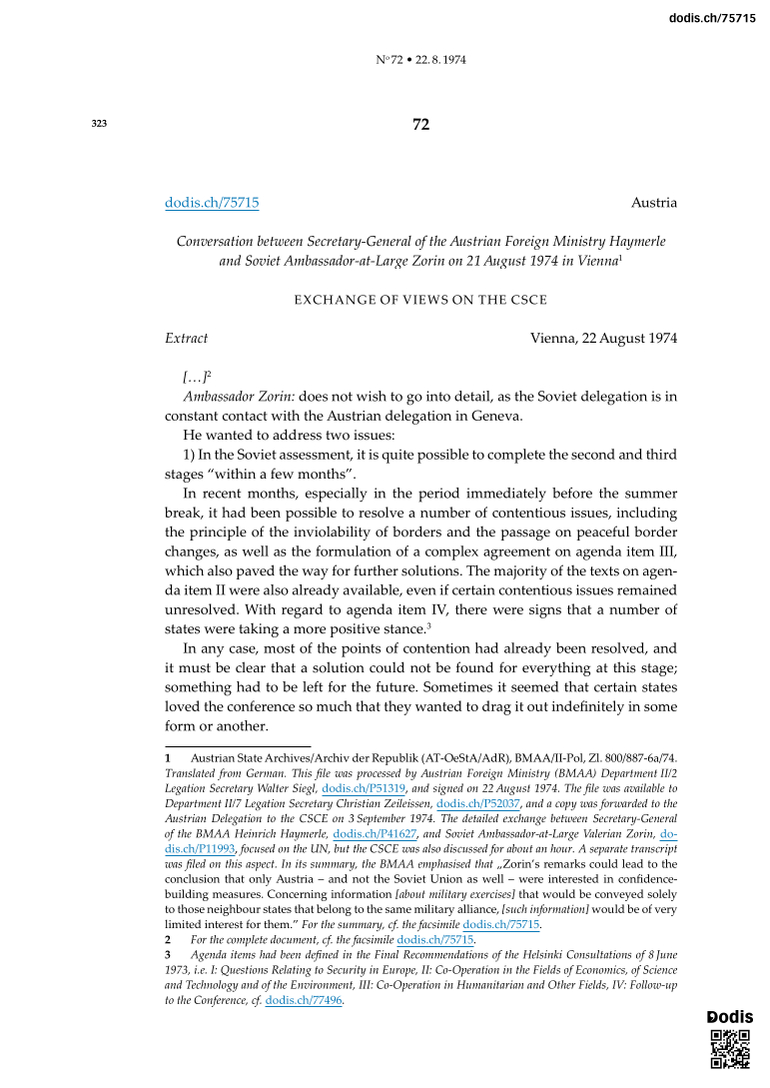
Conversation between Secretary-General of the Austrian Foreign Ministry Haymerle and Soviet Ambassador-at-Large Zorin on 21 August 1974 in Vienna1
Exchange of Views on the CSCE
[…] 2
Ambassador Zorin: does not wish to go into detail, as the Soviet delegation is in constant contact with the Austrian delegation in Geneva.
He wanted to address two issues:
1) In the Soviet assessment, it is quite possible to complete the second and third stages “within a few months”.
In recent months, especially in the period immediately before the summer break, it had been possible to resolve a number of contentious issues, including the principle of the inviolability of borders and the passage on peaceful border changes, as well as the formulation of a complex agreement on agenda item III, which also paved the way for further solutions. The majority of the texts on agenda item II were also already available, even if certain contentious issues remained unresolved. With regard to agenda item IV, there were signs that a number of states were taking a more positive stance.3
In any case, most of the points of contention had already been resolved, and it must be clear that a solution could not be found for everything at this stage; something had to be left for the future. Sometimes it seemed that certain states loved the conference so much that they wanted to drag it out indefinitely in some form or another.
The results available made it seem appropriate to plan for the third phase to be convened at the highest level. This did not mean that every country was obliged to send its head of state. Secretary-General Haymerle interjected that this also depended on the respective constitutions; Zorin nodded in agreement.
Zorin concluded by saying that Austria was participating very actively in the work in Geneva and expressed the hope that Austria would contribute to bringing the conference to a conclusion “soon”.
2) He then turned to the “confidence-building measures,” in which Austria, he said, was developing a special activity.
The Soviet Union did not want Austria to get the impression that pressure on the Soviet Union could be used to get it to go further than was possible. The Soviet Union was no less interested in matters of national security than other states.
As the entire post-war policy shows, the Soviet Union has no aggressive intentions.4 Therefore, the far-reaching proposals put forward by some states – including Austria – cannot be described as realistic. Zorin said he could understand that individual NATO states were interested in placing the Soviet Union under military control. However, he found Austria’s position in this regard incomprehensible. “Why does Austria need information about all military manoeuvres held throughout the European [part of the] Soviet Union? Austria has managed without this information until now.”
Zorin then addressed specific issues relating to confidence-building measures, in particular the announcement of military manoeuvres:
Scale: In the Soviet Union, the proposal by the West (including the neutral countries) is laughed at; a regulation requiring the announcement of manoeuvres at division level would mean a continuous flow of information, as manoeuvres are constantly taking place within a division. Such communications could therefore only create a distorted picture and would arouse mistrust instead of trust.
The Soviet Union, on the other hand, proposes such information at army level, as such manoeuvres are of a special and not a routine nature.
Addressees: The Soviet proposal to notify neighbours in the case of national manoeuvres is entirely sufficient. Zorin listed the following neighbours: Poland, Romania, Hungary, Bulgaria, Czechoslovakia, as well as Finland, Norway and Turkey. In the case of international manoeuvres, information could be provided to all CSCE states.
Notice period: The Soviet Union offered 10 days. If the West demanded 60 days, it was perhaps to engage in espionage.
Zorin summed up that the Soviet Union saw no basis for the Western proposals on any of these issues, as each state had a special responsibility in matters of national security.
It must also be recognised that, given the current state of international relations, it is not possible to go any further. Austria must proceed “sensibly” and not allow itself to be influenced “emotionally”. Later, there may be more to be done on these issues, which concern a completely new area of international agreements.
If some Western states – not Austria – assume that the Soviet Union absolutely wants to end the conference and must therefore meet maximum demands, this is an illusion. Small states need the CSCE more than the Soviet Union.
As Zorin concludes, he has addressed this aspect in a particularly open manner, as Austria is by no means taking a passive stance here.
Secretary-General Haymerle: We know that the Soviet Union does not need the CSCE – just as Austria does not need it, since we too have lived without the CSCE until now. But we want to arrive at a new, more secure form of coexistence. Every country raises the issues that are important to it at the CSCE.
Austria’s concern is that the CSCE should lay the foundations for a process of détente that cannot be reversed.
So much for the basics.
Haymerle then addresses some of Zorin’s general questions, but emphasises that he does not wish to comment on technical aspects here.
1) Zorin’s remarks suggest that only Austria – and not the Soviet Union – is interested in confidence-building measures. Information in this context that only concerns neighbours belonging to the same military alliance can only be of very limited interest.
2) The basic idea behind confidence-building is not “control” or espionage, but the hope that such measures will create trust – as the word suggests – which will lead to a lasting deepening of the détente process.
3) There is a connection between political and military détente, which is reflected in the idea of confidence-building measures. This is the purpose of Austria’s efforts, but it is also actively involved in all other issues at the conference. For Austria, which is located in the middle of Europe and is practically disarmed,5 the issue of confidence-building is understandably of particular and great importance. It is therefore also important that the negotiations in Geneva go hand in hand with those in Vienna.
Austria is in favour of developing forward-looking principles for issues on which no concrete arrangements are yet possible. In this regard, Austria put forward ideas before the summer recess that envisage the implementation of confidence-building measures in two phases; these ideas have aroused interest in both pact systems. There has not yet been a formal response from the Soviet Union.
Haymerle refers to the CSCE passage in the communiqué following Chancellor’s6 state visit to Moscow and mentions that the Chancellor also had a lengthy private discussion with Prime Minister Kosygin.7
Austria would, of course, be in favour of the final phase taking place at the highest level. However, the Federal Chancellor had said that this was on one condition: it must be a success. Only then would people appreciate the significance of a summit meeting; otherwise, it would mean a devaluation of the work of the leading statesmen. Some concrete results had been achieved before the summer break. With regard to agenda item I, one of the Soviet Union’s main concerns had already been satisfactorily addressed earlier (Zorin nods in agreement). If there were still contentious issues with regard to agenda item II, the conference would certainly not fail because of them (Zorin nods in agreement again).
Austria has particular concerns regarding item III. Austria has no intention of undermining or questioning the social order of other states. We are living in a time of transition, and if we want to lay the foundations for further détente, we have to slowly move towards bringing the people of different states into closer contact with one another. We do not want to demand anything impossible here; we want the same thing as with the confidence-building measures – a long-term goal and concrete results where this is already possible today. A number of principles would have to be worked out that would slowly and automatically lead to a genuine cooperation between the European states. (Zorin reveals his reservations by laughing.)
Zorin: thanks him for explaining the Austrian position and addresses the issue of confidence-building measures.
We must proceed step by step. This does not contradict Austria’s ideas about parallel political and military détente.
It is a question of degree – what is possible today and what is not yet possible.
Haymerle: It is true that this is a question of degree, but Austria already wants to establish certain principles today, as the Austrian delegation explained to the Soviet representative in the relevant working body in Geneva shortly before the summer break.
Zorin: confirmed that Ambassador Mendelevich8 had told him about these statements, which he (Mendelevich) was “considering”. However, as Mendelevich had added, the new Austrian approach did not differ significantly from the previous proposal and was therefore not realistic in all respects. Mendelevich would, however, consider the idea of two phases.
If we want to establish certain principles now, we must bear in mind that everyone understands these principles in their own way; we cannot determine today what is not yet clear.
Haymerle: The term “principles” is perhaps misleading; it would be better to speak of “perspectives”. Austria does not want the conference to simply decide that the essential issues should be settled later. Things must be steered in the right direction.
Zorin: Some countries give the impression that they want to go beyond the Helsinki mandate. Significant steps have been taken since then, but “appetite comes with eating”.
Zorin urges Austria “not to rush things” and not to try to achieve too much at this stage. That could only damage trust.
Haymerle: For the time being, trust has undoubtedly not been lost. Difficulties in overcoming different negotiating positions are part and parcel of any conference.
Zorin: There is a minimum and a maximum of what is possible.
Haymerle: Let us strive to turn the minimum of what is possible into the maximum of what is possible.
Zorin: concludes by saying that this has been a very useful exchange of views.9
- 1
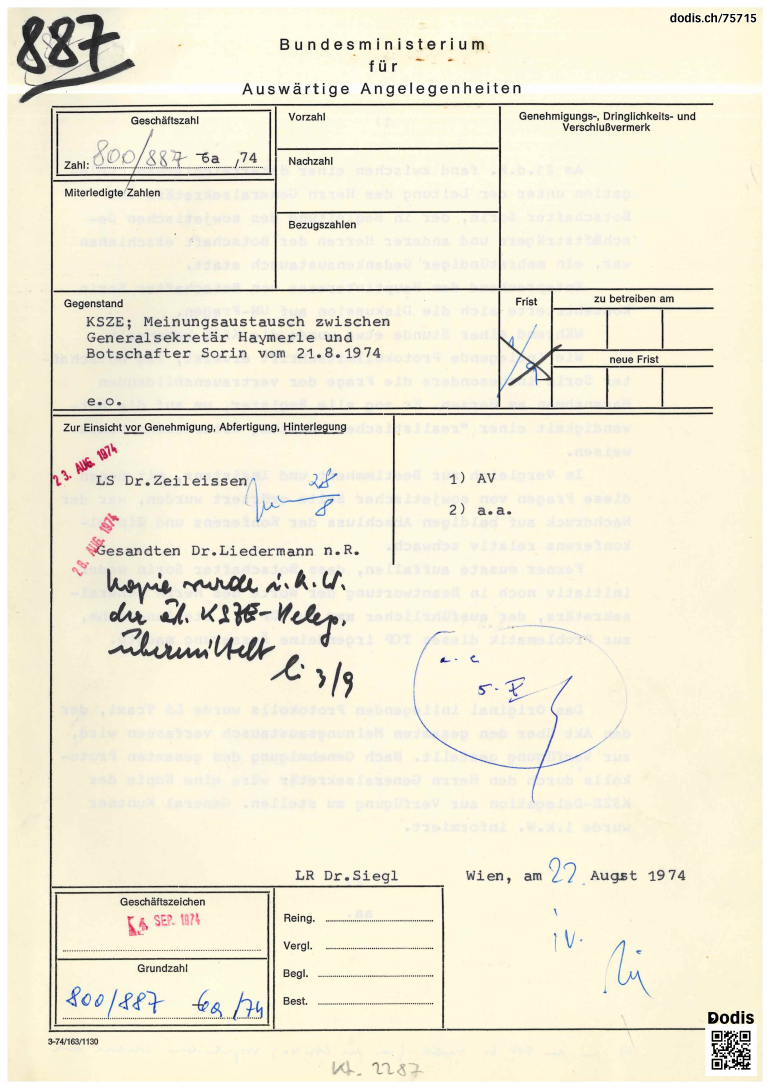
- Austrian State Archives/Archiv der Republik (AT-OeStA/AdR), BMAA/II-Pol, Zl. 800/887-6a/74. Translated from German. This file was processed by Austrian Foreign Ministry (BMAA) Department II/2 Legation Secretary Walter Siegl, dodis.ch/P51319, and signed on 22 August 1974. The file was available to Department II/7 Legation Secretary Christian Zeileissen, dodis.ch/P52037, and a copy was forwarded to the Austrian Delegation to the CSCE on 3 September 1974. The detailed exchange between Secretary-General of the BMAA Heinrich Haymerle, dodis.ch/P41627, and Soviet Ambassador-at-Large Valerian Zorin, dodis.ch/P11993, focused on the UN, but the CSCE was also discussed for about an hour. A separate transcript was filed on this aspect. In its summary, the BMAA emphasised that „Zorin’s remarks could lead to the conclusion that only Austria – and not the Soviet Union as well – were interested in confidence-building measures. Concerning information [about military exercises] that would be conveyed solely to those neighbour states that belong to the same military alliance, [such information] would be of very limited interest for them.” For the summary, cf. the facsimile dodis.ch/75715.↩
- 2
- For the complete document, cf. the facsimile dodis.ch/75715.↩
- 3
- Agenda items had been defined in the Final Recommendations of the Helsinki Consultations of 8 June 1973, i.e. I: Questions Relating to Security in Europe, II: Co-Operation in the Fields of Economics, of Science and Technology and of the Environment, III: Co-Operation in Humanitarian and Other Fields, IV: Follow-up to the Conference, cf. dodis.ch/77496.↩
- 4
- Zorin omitted Soviet military interventions and invasions in Hungary 1956 and Czechoslovakia 1968.↩
- 5
- While reflecting the small size of Austria’s defence budget, armed forces and weapons arsenal, this statement was in contradiction of the Neutrality Law of 1955 stipulating Austria’s will to defend its neutrality with all available means, cf. Bundesgesetzblatt für die Republik Österreich No. 211 of 4 November 1955, p. 1151.↩
- 6
- Austrian Federal Chancellor Bruno Kreisky, dodis.ch/P2507. Kreisky’s visit to the USSR took place from 28 May until 1 June 1974. For the Soviet-Austrian Communiqué, cf. dodis.ch/75195.↩
- 7
- Soviet Prime Minister Alexei Kosygin, dodis.ch/P15549.↩
- 8
- Soviet Ambassador-at-Large Lev Mendelevich, dodis.ch/P54642.↩
- 9
- For all the Austrian documents in this volume, cf. dodis.ch/C2929.↩
Tags
Human Rights Russia (Politics) CSCE negotiations in Helsinki and Geneva (1972–1975)