
Printed in
Building an Oecumene of Historians. Documents on the History of the Comité International des Sciences Historiques 1926–2026, vol. 29, doc. 30
volume linkBern 2026
more… |
▼▶Repository
| Archive | Publication |
| Archival classification | Pub p. 73–78 |
| Dossier title | Proceedings of the XIV International Congress Of The Historical Sciences, New York, Arno Press (1976–1976) |
 Transcription
 QdD
QdD
 Facsimile
dodis.ch/75261
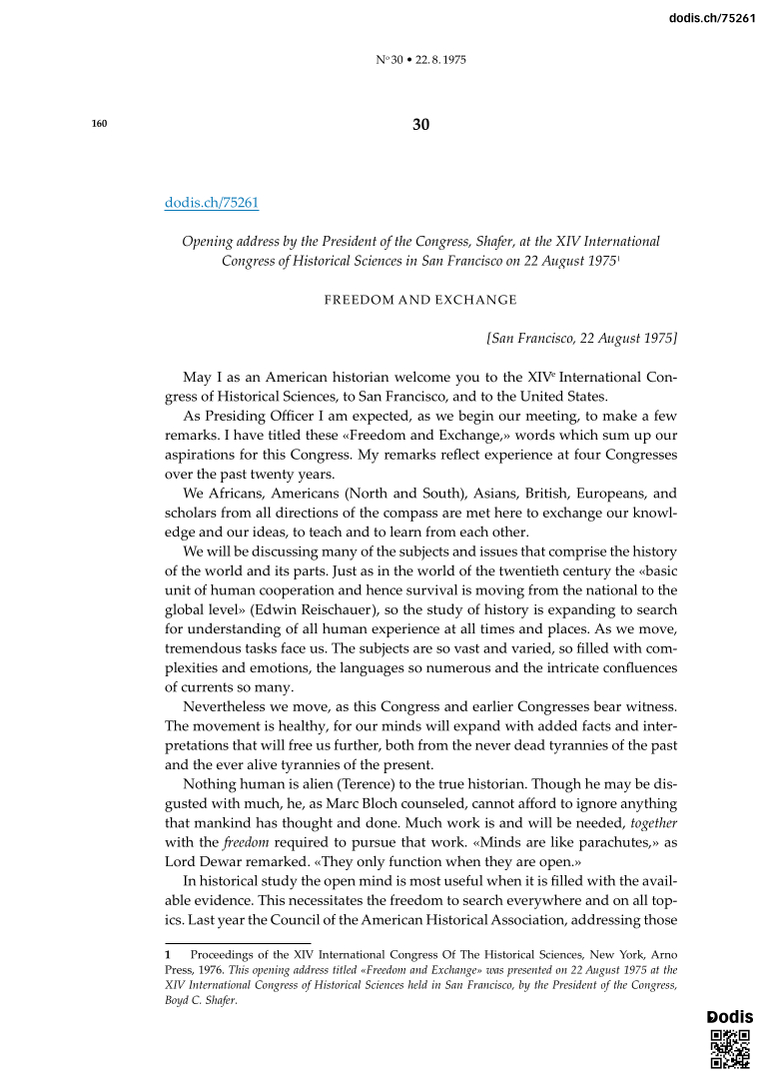
Opening address by the President of the Congress, Shafer, at the XIV International Congress of Historical Sciences in San Francisco on 22 August 19751
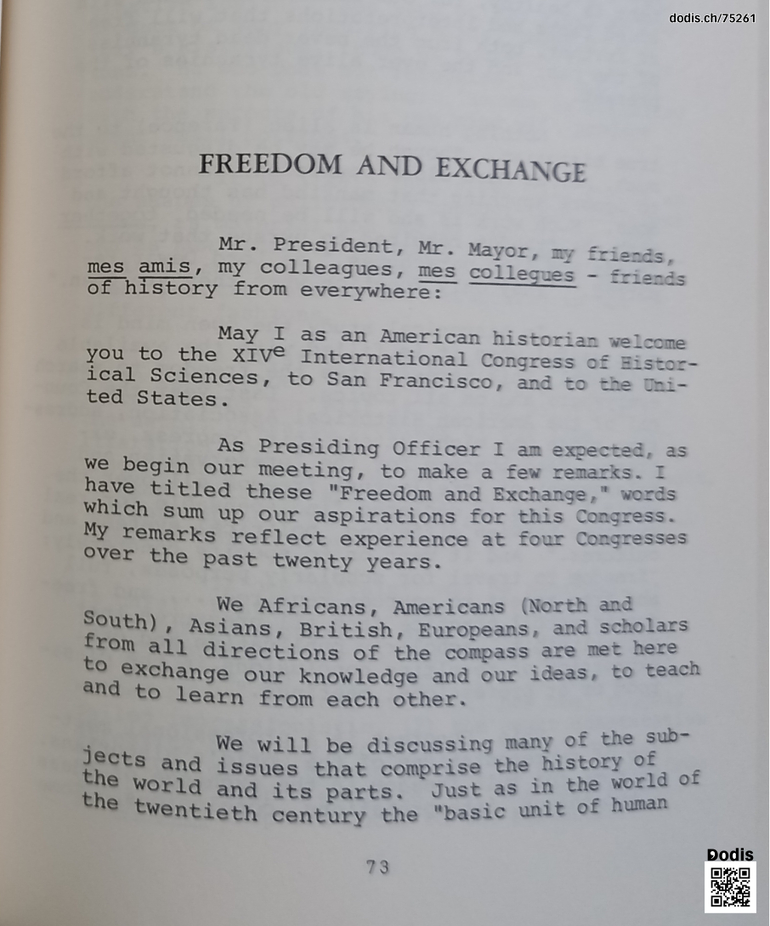
Freedom and Exchange
May I as an American historian welcome you to the XIVe International Congress of Historical Sciences, to San Francisco, and to the United States.
As Presiding Officer I am expected, as we begin our meeting, to make a few remarks. I have titled these «Freedom and Exchange,» words which sum up our aspirations for this Congress. My remarks reflect experience at four Congresses over the past twenty years.
We Africans, Americans (North and South), Asians, British, Europeans, and scholars from all directions of the compass are met here to exchange our knowledge and our ideas, to teach and to learn from each other.
We will be discussing many of the subjects and issues that comprise the history of the world and its parts. Just as in the world of the twentieth century the «basic unit of human cooperation and hence survival is moving from the national to the global level» (Edwin Reischauer), so the study of history is expanding to search for understanding of all human experience at all times and places. As we move, tremendous tasks face us. The subjects are so vast and varied, so filled with complexities and emotions, the languages so numerous and the intricate confluences of currents so many.
Nevertheless we move, as this Congress and earlier Congresses bear witness. The movement is healthy, for our minds will expand with added facts and interpretations that will free us further, both from the never dead tyrannies of the past and the ever alive tyrannies of the present.
Nothing human is alien (Terence) to the true historian. Though he may be disgusted with much, he, as Marc Bloch counseled, cannot afford to ignore anything that mankind has thought and done. Much work is and will be needed, together with the freedom required to pursue that work. «Minds are like parachutes,» as Lord Dewar remarked. «They only function when they are open.»
In historical study the open mind is most useful when it is filled with the available evidence. This necessitates the freedom to search everywhere and on all topics. Last year the Council of the American Historical Association, addressing those who might attend this Congress, expressed deep concern for the «preservation and enlargement of intellectual freedom all over the world.» This is declared «indispensable for real exchange between differing political systems and cultures.» And it went on to specify concretely: «freedom to travel for scholarly purposes, full and free access to sources required…, and freedom in actual practice from all pressures that might inhibit… scholarly publication and oral expression of resulting conclusions in the classroom or at professional meetings.»
This Congress is a professional meeting of representatives of the world’s historians. We hope for full freedom in the exchange of ideas – hypotheses, interpretations, conclusions. Some of us do not believe such a conception of history is possible but rather that several more-or-less reasonable views have been developed, are developing, or will develop and that, whatever they are, the pathways to truth, whatever it is, are many and varied. The frontiers of knowledge always beckon.
The quality and the usefulness of the varying views depend on how they are evolved: upon the use of reliable evidence, precision in thought, comparative analysis, and – yes – imaginative insight. And each of the views is the product of many inquiring minds, those of history’s historians, those of contemporary historians. He who does not recognize this does not understand the old saying: «He who is satisfied with the sprouts of his own mind will produce might small potatoes.»
It is likely that views will change as the shapes of philosophic thought take different forms, as material and social conditions vary, and as new evidence is found – in short, as historians, reflecting their ever changing societies, perceive events and structures in new or different fashions.
A first goal is always understanding of human experience. This may not afford us definitive lessons nor will it provide solutions for the awful, pressing problems of our time: proliferation, population, and pollution. It will, nonetheless, offer, as Friedrich Meinecke thought, «content, wisdom, and signposts» for our lives and thus enhance our chances of coping with these problems before they eliminate us.
If one certainty may be hazarded, it is this: Whatever the method or philosophy, a first aim of historical study will likely remain understanding of how men and women have thought and acted in the past. This is true whether the method be (1) the old but still new one, roughly called impressionistic, (2) the newer quantitative stressing counting and computer techniques, (3) the study of the masses as well as the elites from yet barely tapped evidence, (4) the Marx as well as Annales inspired focus on the structural organizations of societies as well as on events, (5) psychoanalytic observation arising out of the work of Freud, his successors and his competitors, or (6) several other approaches.
During the next eight days we will read, hear, and discuss papers based on many methodological and philosophic approaches. Each approach has its possibilities, each its limitations, and its direction will depend in considerable degree on the value judgments of the historians, a subject to which we will devote significant time.
No one this side of heaven or an earthly utopia can know which of the now-prominent value systems will prove itself most satisfying for an era. Most of us will agree that scholarly discussion of all serious philosophic approaches is both desirable and fruitful, for as fallible mortals we may benefit by trying to understand the values that all men and women have evolved and that have moved them to action. We but blind ourselves and impoverish both ourselves and our students by suppressing any opinion. As John Stuart Mill put it, «the peculiar evil of silencing the expression of an opinion is that it is robbing the human race» by depriving it of «the opportunity of exchanging error for truth…»
In all probability we will always fall short of perfectibility. Someone of the Annales school once observed, a historian must try to know everything in order to know anything. This is impossible, but it is always a desirable dream and should make us wary of suppressing any interpretations.
If we desire to be the most socially responsible historians we are capable of being, we should encourage full freedom to agree and disagree and never attempt to impose our views on anyone. Though we may in good faith attempt to persuade others, Burke’s admonition is wise: «Intemperate minds cannot be free.»
Many of us assembled here are considered intellectual leaders; yet our intelligence and our knowledge are limited. Our lives are so short and the time given us to think and work even shorter. We sorely need all the intelligence, all the insights, all the knowledge of all men and women regardless of sex, race, nationality, or ideology. And therefore the more free exchange of facts and ideas the better, for us as individuals and for our social existence.
It is obvious that all the members of the Bureau, Assembly, national committees, and international commissions did not always agree on what should be included in our program. Yet we did in amity agree to cover six major historical themes and six methodological problems as well as all chronological eras. And we did, here in the United States, for this Congress make a truly extraordinary effort to include representatives not only from the European and American but from major cultures of the world. Our American Committee considered it an opportunity and privilege to bring to the Congress over thirty historians from Asia, Africa, and Latin America.
I cannot end my brief remarks without reference to the place in which we are meeting – San Francisco, one of the truly beautiful and cosmopolitan cities of the contemporary world. But we must not forget that the area was once a western frontier where Spanish, Russian, British, American (red and white), and later other peoples as the Chinese and Japanese, have met and mingled. It is fitting that we meet here.
We meet as a result of the efforts of many people and groups, many more than the Program mentions. It would be invidious to single out any, but I must mention the American Organizing Committee and particularly Richard Schlatter, the Executive Director, and Joseph Illick, Chairman of the Local Arrangements Committee. Many of you may not know of the immense work of the International Commissions of the International Committee, and we are happy that so many have organized meetings and programs for this Congress.2 I cannot without undue modesty fail to mention, finally, the contribution of the University of Arizona – the many hours and days of the presiding officer and his secretary, and the costly burden of voluminous and time-consuming correspondence.
We in the United States, perhaps the first new nation, are about to celebrate our bicentennial year and to become an old nation still dedicated in the main, though with regrettable deviations, to life, liberty, and the pursuit of happiness.
When this nation was young, one of its founders, Thomas Jefferson, as he dedicated his University of Virginia, asked that it «be based on the illimitable freedom of the human mind,» for, he said, «we are not afraid to follow truth wherever it may lead nor to tolerate error so long as reason is left free to combat it.» I would be quite willing to have Jefferson’s dedication be the motto of this Congress.
If this International Congress follows Jefferson, it may not find truth, but it may come a little closer than we have to sharp hypotheses and reasonable interpretations. At least, at meetings like this one men may realize, to paraphrase a great American judge, Oliver Wendell Holmes, that the study of history does lead to one conclusion: «Time has upset many fighting faiths,» and whatever the ultimate good may be, it will best be «reached by the free trade of ideas» from everywhere. May we also remember with Henri Marrou and Raymond Aron that however humble history’s role, it does afford «feeling, thinking, acting men» «an abundance of facts and ideas on which to base their judgments and their will.»
- 1
- Proceedings of the XIV International Congress Of The Historical Sciences, New York, Arno Press, 1976. This opening address titled «Freedom and Exchange» was presented on 22 August 1975 at the XIV International Congress of Historical Sciences held in San Francisco, by the President of the Congress, Boyd C. Shafer.↩
- 2
- For the programme of the San Francisco Congress held in 1975, cf. dodis.ch/75851.↩
Tags