Printed in
Building an Oecumene of Historians. Documents on the History of the Comité International des Sciences Historiques 1926–2026, vol. 29, doc. 29
volume linkBern 2026
more… |
▼▶Repository
| Archive | National Archives of France, Saint-Denis |
| Archival classification | FR-ANF 105AS/163 |
| Dossier title | Assemblée générale et Bureau de Herceg-Novi 1 (21-22 et 24 juillet 1972). - Ordre du jour et comptes rendus [1972] ; choix des délégués des Comités nationaux et des Organismes internationaux affiliés participant à l'Assemblée générale (1972) ; listes d'émargement (1972) ; notes manuscrites de Michel François [1972] ; vœux (1972) ; transformation des Commissions internes en Organismes internationaux affiliés (1970-1971) ; situation financière (1972) ; préparation du congrès de San Francisco prévu en 1975 : organisation et choix des thèmes (1971-1972) ; publication, bulletin d'Informationn° 9 et activités des membres du CISH (1971-1972) ; succession du président A.A. Gouber : correspondance (1971-1972) ; rapports entre le CIPSH et l'UNESCO (1971-1972) ; correspondance reçue et envoyée de Michel François avant et après l'Assemblée générale (1971-1972). (1971–1972) |
 Transcription
 QdD
QdD
 Facsimile
dodis.ch/75260
The CISH Vice-President, Shafer, to the Secretary General, François1
[Concerns over Presidential Succession]
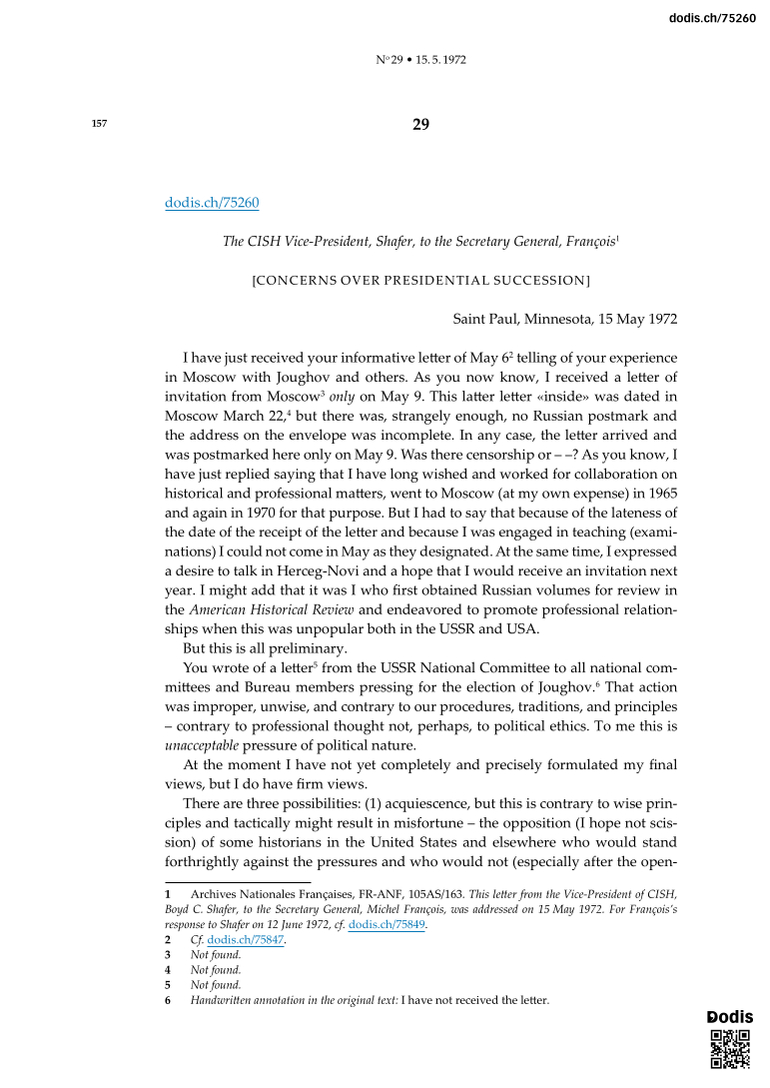
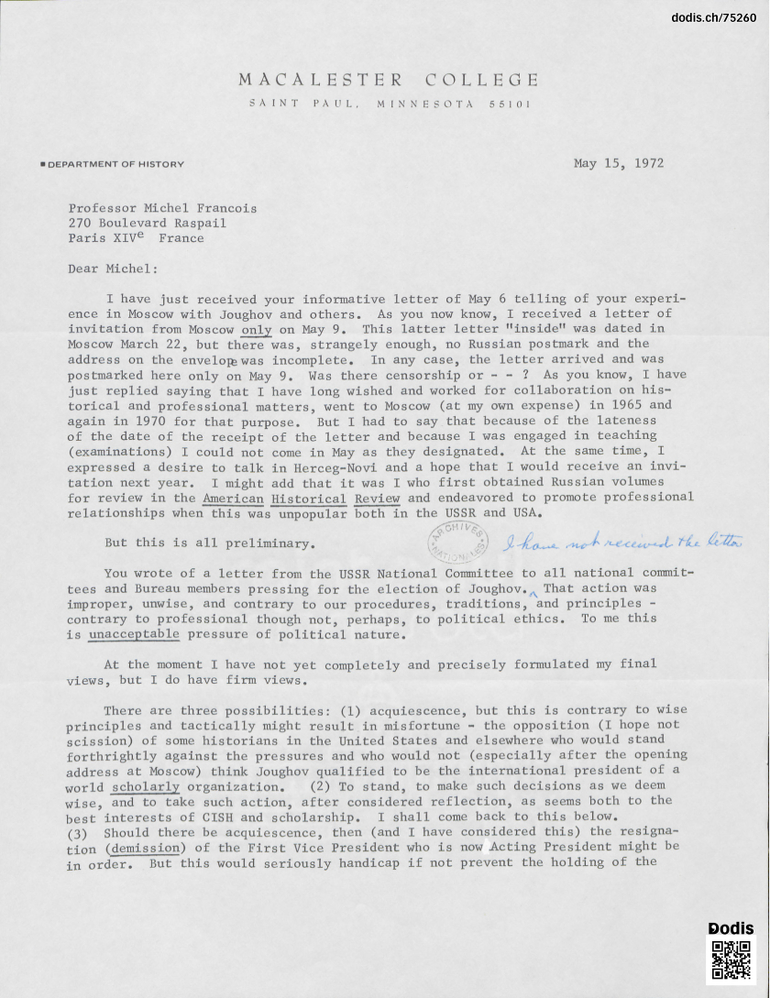
I have just received your informative letter of May 62 telling of your experience in Moscow with Joughov and others. As you now know, I received a letter of invitation from Moscow3 only on May 9. This latter letter «inside» was dated in Moscow March 22,4 but there was, strangely enough, no Russian postmark and the address on the envelope was incomplete. In any case, the letter arrived and was postmarked here only on May 9. Was there censorship or – –? As you know, I have just replied saying that I have long wished and worked for collaboration on historical and professional matters, went to Moscow (at my own expense) in 1965 and again in 1970 for that purpose. But I had to say that because of the lateness of the date of the receipt of the letter and because I was engaged in teaching (examinations) I could not come in May as they designated. At the same time, I expressed a desire to talk in Herceg-Novi and a hope that I would receive an invitation next year. I might add that it was I who first obtained Russian volumes for review in the American Historical Review and endeavored to promote professional relationships when this was unpopular both in the USSR and USA.
But this is all preliminary.
You wrote of a letter5 from the USSR National Committee to all national committees and Bureau members pressing for the election of Joughov.6 That action was improper, unwise, and contrary to our procedures, traditions, and principles – contrary to professional thought not, perhaps, to political ethics. To me this is unacceptable pressure of political nature.
At the moment I have not yet completely and precisely formulated my final views, but I do have firm views.
There are three possibilities: (1) acquiescence, but this is contrary to wise principles and tactically might result in misfortune – the opposition (I hope not scission) of some historians in the United States and elsewhere who would stand forthrightly against the pressures and who would not (especially after the opening address at Moscow) think Joughov qualified to be the international president of a world scholarly organization. (2) To stand, to make such decisions as we deem wise, and to take such action, after considered reflection, as seems both to the best interests of CISH and scholarship. I shall come back to this below. (3) Should there be acquiescence, then (and I have considered this) the resignation (demission) of the First Vice President who is now Acting President might be in order. But this would seriously handicap if not prevent the holding of the Congress in 1975, and I shall not think more about it at this time.
Let me now return to point two.
The Bureau in Dublin decided to keep in close «contact» with the USSR National Committee and that is all. We have kept in contact. We did not promise to elect a Russian to any office, though all of us, apparently, believed Russian representation on the Bureau both necessary and desirable. This could be as an Assessor or Vice President. I believe a nomination of a Russian to one or the other of these two offices should be presented at Herceg-Novi and I would hope he would then be elected as Assessor or Vice President.
Professor Gouber, whom we all respected and admired, did serve as President for four years. The ICHS Constitution does not require that if a President dies his successor shall be from the same country.7 The custom is quite to the contrary. Gouber as First Vice President succeeded Schmitt, Sir Charles Webster as First Vice President succeeded Chabod.
Professor Joughov would not be acceptable, I believe, to many historians. He apparently is at present in control of the USSR National Committee (why, really, was Troukhanovsky in the country when you, an important world leader, were in Moscow?). But Joughov’s elementary and polemical speech in Moscow offended many of us who well knew the Lenin «line» and were eager to know more about the historical Lenin. Joughov is unacceptable not only for this reason but for others.8 He has not been a member of the Bureau, does not (obviously) know of its procedures or how CISH is conducted.
The next Congress is in San Francisco and I much need not only the wise direction of the Bureau but the collaboration of historians here in the United States and elsewhere to try to make the Congress successful. We are not sure, as yet, about the financing of the Congress. I hope, for this and other reasons, to encounter as little opposition in the United States as possible. I cannot command American historians as historians are sometimes commanded in other countries.
I cannot, then, agree to the nomination of Joughov. I wish that I personally were not involved, but I am. (You will remember that I left the Bureau meeting in Dublin, taking Troukhanovsky with me, during the particular discussion of the problem.) Many historians will not understand if a man like Joughov is elected, or if what we here consider customary procedures are not followed. Or perhaps they would understand only too well that we bow to pressure.
I am sending a copy of this letter to Professors Harsin and Erdmann. I believe we should all exchange views before any decision. I write, of course, in what I believe to be the best interests of CISH and scholarship.
P. S. Michel: Your tulips are in bloom in our garden. We plan to come to Paris around July 13 and will, I think, be at the Regent Hotel as usual. We move to Arizona in early August. We are very busy.
- 1
- Archives Nationales Françaises, FR-ANF, 105AS/163. This letter from the Vice-President of CISH, Boyd C. Shafer, to the Secretary General, Michel François, was addressed on 15 May 1972. For François’s response to Shafer on 12 June 1972, cf. dodis.ch/75849.↩
- 2
- Cf. dodis.ch/75847.↩
- 3
- Not found.↩
- 4
- Not found.↩
- 5
- Not found.↩
- 6
- Handwritten annotation in the original text: I have not received the letter.↩
- 7
- Cf. the Statutes of the International Committee of Historical Sciences (CISH), 1960, dodis.ch/75816.↩
- 8
- Concerning the election of Evgenij Mikhaïlovitch Joukov in 1972, cf. the minutes of the General Assembly in Herceg-Novi in 1972, dodis.ch/75846.↩