
Printed in
Diplomatic Documents of Switzerland, vol. 24, doc. 188
volume linkZürich/Locarno/Genève 2012
more… |
Geneva, Helsinki, and the Making of the CSCE. International Diplomatic Documents on the Conference on Security and Cooperation in Europe, 1969–1975, vol. 30, doc. 13
volume linkBern 2026
more… |
Sicherheit und Zusammenarbeit in Europa. Diplomatische Dokumente der Schweiz von den Anfängen des KSZE-Prozesses bis zur ersten Schweizer OSZE-Präsidentschaft 1969–1996, vol. 31, doc. 1
volume linkBern 2026
more… |
▼▶Repository
| Archive | Swiss Federal Archives, Bern | |
▼ ▶ Archival classification | CH-BAR#E2001E#1980/83#540* | |
| Old classification | CH-BAR E 2001(E)1980/83 136 | |
| Dossier title | Europäische Sicherheitskonferenz (1969–1970) | |
| File reference archive | B.72.09.15.1 |
 Transcription
 QdD
QdD
 Facsimile
dodis.ch/32405
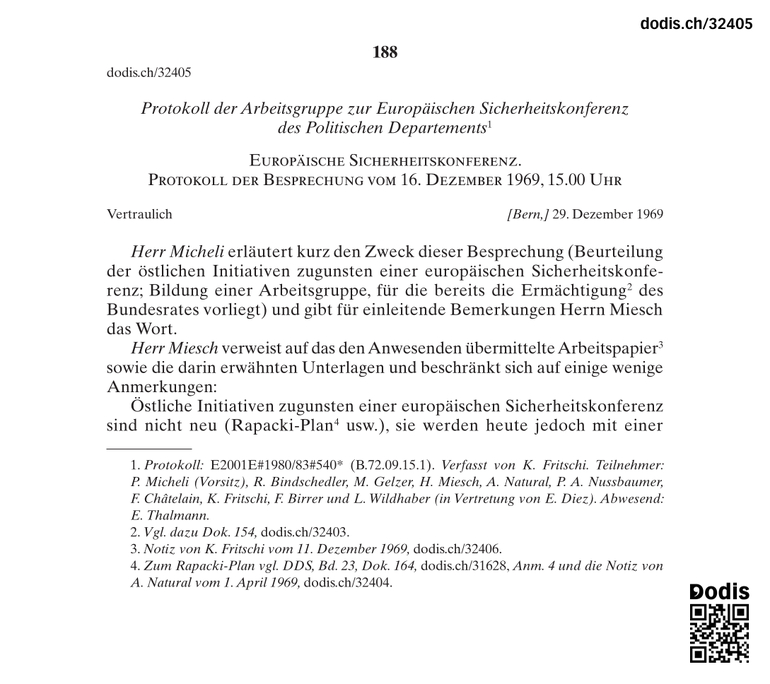
Protokoll der Arbeitsgruppe zur Europäischen Sicherheitskonferenz des Politischen Departements1
Europäische Sicherheitskonferenz. Protokoll der Besprechung vom 16. Dezember 1969, 15.00 Uhr
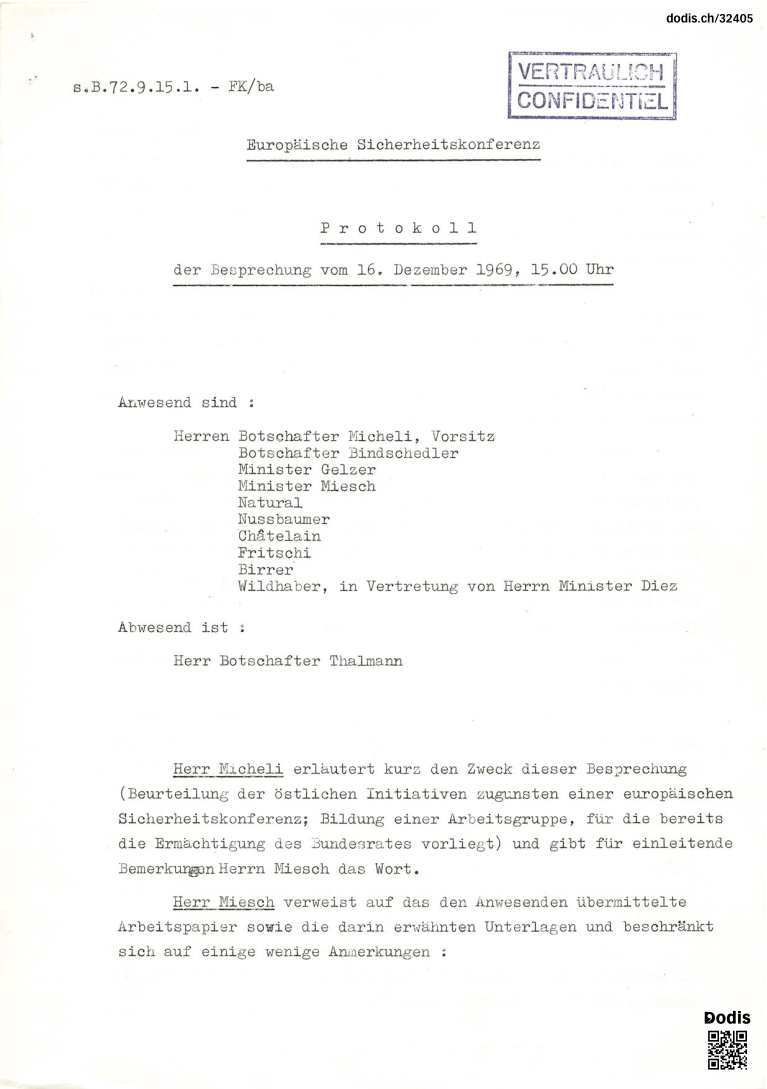
Herr Michelierläutert kurz den Zweck dieser Besprechung (Beurteilung der östlichen Initiativen zugunsten einer europäischen Sicherheitskonferenz; Bildung einer Arbeitsgruppe, für die bereits die Ermächtigung2 des Bundesrates vorliegt) und gibt für einleitende Bemerkungen Herrn Miesch das Wort.
Herr Mieschverweist auf das den Anwesenden übermittelte Arbeitspapier3 sowie die darin erwähnten Unterlagen und beschränkt sich auf einige wenige Anmerkungen:
Östliche Initiativen zugunsten einer europäischen Sicherheitskonferenz sind nicht neu (Rapacki-Plan4 usw.), sie werden heute jedoch mit einer gewissen Insistenz vorgetragen. Auch die NATO hat bekanntlich schon in Reykjavik5 Vorschläge auf militärischem Gebiet unterbreitet, die soeben in Brüssel6 bekräftigt wurden (Abrüstung, Truppenverminderungen).
Interessant an den Appellen der Warschauer Pakt-Staaten ist die Tatsache, dass sich dahinter verschiedene Interessen einerseits der UdSSR, anderer seits ihrer Verbündeten geltend machen. Rumänien7 und Polen8 setzen in eine solche Konferenz Hoffnungen auf grössere aussenpolitische Bewegungsfreiheit, Hoffnungen, die wohl als Illusionen bezeichnet werden können.
Moskau9 zeigte sich zuerst zurückhaltend, hat jedoch inzwischen ein allgemeines Interesse für die Abhaltung einer solchen Konferenz festgestellt. Für den Kreml stellt sich das Problem, den Ostblock unter Kontrolle zu halten. Die sowjetische Haltung hat stark propagandistischen Charakter, der sich schon darin zeigt, dass für die Einberufung der Konferenz – ohne dass vorher die NATO-Länder dazu Stellung genommen hätten – ein sehr frühes Datum in Vorschlag gebracht wurde.
Die Sowjetunion lässt sich in dieser Sache wohl von folgenden Beweggründen leiten:
Die UdSSR will – übrigens nicht nur in Europa, sondern auch Ostasien – als Friedensstifter auftreten, eine Rolle, die sich namentlich im nächsten Jahr, dem 25jährigen Jubiläum der UNO, gut macht. Sie unternimmt Initiativen für Frieden und Sicherheit in Europa zu einem Zeitpunkt, da die CSSR-Krise10 kaum vorbei ist. Starkes Misstrauen ist deshalb berechtigt. Moskau will ferner den status quo in Europa festigen, ins westliche Lager Zwiespalt bringen und einer zu grossen Konzentration wirtschaftlicher Macht im Westen entgegenwirken.
Den Neutralen möchte die UdSSR offenbar eine aktive Rolle unterschieben und diese Länder für eine Sicherheitskonferenz als Aushängeschild in Dienst nehmen11.
Die beiden östlichen Diskussionsvorschläge betreffend Gewaltverzicht und Zusammenarbeit12 sind wenig präzis und beinhalten namentlich Schlagworte. Im Textentwurf über den Gewaltverzicht sollen wichtige Aspekte des Deutschlandproblems geregelt und die Breschnew-Doktrin sanktioniert werden; in jenem über die Zusammenarbeit fehlen die kulturellen Beziehungen. Für Abrüstungsfragen scheint die Sowjetunion – im Gegensatz zu Polen – keinerlei Interesse zu zeigen.
Die NATO-Mitglieder sind gegenüber den Initiativen und Vorschlägen der Warschauer Pakt-Staaten skeptisch. In ihrer jüngsten Erklärung13 wird besonderes Gewicht auf Abrüstungsmassnahmen gelegt und für vorherige bilaterale Gespräche (z. B. der Bundesrepublik mit der UdSSR und anderen osteuropäischen Ländern) eingetreten. Erwartet werden zunächst östliche Zeichen des guten Willens. Die NATO äussert sich nicht zur Frage des Datums, lässt aber durchblicken, dass vor einer Konferenz gewisse Regelungen gefunden werden müssen und dass das für ein solches gesamteuropäisches Treffen günstige Klima noch nicht gegeben ist.
Für die Schweiz steht zwar im vorneherein fest, dass sie an der Regelung jener Fragen, die ihren Ursprung im Zweiten Weltkrieg haben, nicht teilnehmen kann. Unser Land kann jedoch nicht völlig abseits stehen, dies schon deshalb nicht, weil die Lösung der europäischen Friedens- und Sicherheitsprobleme nicht ganz den Grossmächten überlassen werden sollte.
Der Bundesrat hat seine allgemeine grundsätzliche Haltung gegenüber dem Konferenzprojekt vorläufig festgelegt14. Der Departementschef15 hat in letzter Zeit namentlich auch auf die Atmosphäre gegenseitigen Vertrauens hingewiesen, welche vor einer Konferenz geschaffen werden müsse. Er hat zudem auf die Feststellung Wert gelegt, dass an einer solchen Konferenz die nationale Souveränität aller Staaten, d. h. das Prinzip der Nichteinmischung in die inneren Angelegenheiten eines jeden Staates, Anerkennung finden muss16.
Es stellt sich nun die Frage der Bildung einer Arbeitsgruppe, welche die Probleme prüft, die sich der Schweiz im Zusammenhang mit einer euro päischen Sicherheitskonferenz ergeben. Soll diese Gruppe jetzt geschaffen und soll sie departementsintern oder zwischendepartemental gebildet werden? Im erwähnten Arbeitspapier sind einige jener Fragen aufgezählt, mit denen sich diese Arbeitsgruppe zu befassen hätte.
Herr Micheli: Unsere Vorbereitung auf eine mögliche Konferenz kann auf zwei Arten geschehen: – extern aufgrund von bilateralen Kontakten, die bereits bisher stattfanden
und die jedoch in Allgemeinheiten verblieben. So haben z. B. die Holländer
grosses Interesse daran gezeigt, auch diese Frage mit uns besprechen zu
können (Anfang Februar wird uns der Generaldirektor der Politischen
Angelegenheiten des niederländischen Aussenministeriums, de Ranitz,
einen Besuch17 abstatten); – intern unter den Departementen.
Bei der Frage, ob die zu bildende Arbeitsgruppe lediglich innerhalb des EPD zu schaffen ist oder ob noch Vertreter anderer Departemente zugezogen werden sollen, ist davon auszugehen, dass sich diesem Gremium eine doppelte Aufgabe stellt. Die Arbeitsgruppe wird sich mit zwei Problemkreisen zu beschäftigen haben, die einerseits die politischen Aspekte der Vorschläge von Warschauer Pakt und NATO betreffen und die andererseits Fragen der Zusammenarbeit auf allen möglichen Gebieten zum Gegenstand haben. Da in letzterer Gruppe von Fragen die Gebiete der Wirtschaft, des Handels, der Wissenschaft und Kultur zur Diskussion stehen, wären hier gegebenenfalls Kontakte mit anderen Departementen zu suchen.
Zu den politischen Fragen hat der Bundesrat insofern bereits Stellung genommen, als er erklärte18, dass die Schweiz sich nicht an der Lösung von Problemen beteiligen könne, die ihren Grund im letzten Weltkonflikt haben. Eine Unterscheidung zwischen diesen Problemen und solchen, die nicht im Zweiten Weltkrieg entstanden sind, ist jedoch keineswegs leicht, weil sie untereinander verzahnt sind.
Darüber hinaus stellt sich für die Arbeitsgruppe die Frage, welche Haltung unser Land zum Problem des Gewaltverzichts einnehmen soll. Ist es angezeigt, dass die neutralen Staaten sich am Austausch von Gewaltverzichtserklärungen beteiligen? Sollen sie hiefür Initiativen ergreifen oder eher Zurückhaltung an den Tag legen?
Auf den Gebieten der wirtschaftlichen, wissenschaftlichen, technischen und kulturellen Zusammenarbeit stellt sich die Frage, ob die Neutralen, also auch die Schweiz, eine spezifische Rolle spielen können, was französischen Vorstellungen zu entsprechen scheint. Hinzu kommt die Frage, ob diese Zusammenarbeit überhaupt im Rahmen einer europäischen Sicherheitskonferenz diskutiert und vereinbart werden soll oder ob es nicht angezeigt ist, diese Zusammenarbeit zuerst in anderem multilateralem Rahmen oder auf bilateraler Ebene zu suchen und zu verbessern.
Herr Bindschedlerteilt grundsätzlich die eingangs gegebene Beurtei lung der Situation in Sachen europäische Sicherheitskonferenz. Zu ergänzen wäre lediglich noch ein Hinweis auf die sowjetischen Stabilisierungswünsche in Europa, weil die UdSSR wegen China19 im Osten grössere Handlungsfreiheit anstrebt. Ferner: die zwei östlichen Dokumente über Gewaltverzicht und Zusammenarbeit sind keine Vertragsentwürfe, sondern blosse Deklarationen, d. h. Verbalmanifestationen.
Bei der Frage, was eine solche Konferenz anstreben und erzielen kann, kommt man nicht um die Feststellung herum, dass nichts dahinter steckt. In ihrer gegenwärtigen Form sind die Vorschläge eine Täuschung, weil keine Grundprobleme gelöst werden sollen. Im Gegenteil, diese Probleme werden zugedeckt, um darauf ein Verbalgebäude zu errichten. Gewaltverzicht ist lediglich ein neues Wort für Nichtangriffspakt. Bekanntlich waren Nichtangriffspakte schon früher nichts wert. Das Prinzip des Gewaltverzichts ist im übrigen in der UNO-Charta20 verankert und gilt heute im allgemeinen Völkerrecht als Gewohnheitsrecht. Sowohl die Bundesrepublik wie die DDR haben die Prinzipien der UNO-Charta anerkannt. Ein Austausch von Gewaltverzichtserklärungen ist somit überflüssig, weil blosse Wiederholung.
Ein System von kollektiver Sicherheit ist – wenn überhaupt – universell (UNO-Charta) wirksamer als auf regionaler Ebene (vgl. Vertrag von Locarno21, der nicht länger als sechs, sieben Jahre dauerte). Die notwendige Übermacht der Verteidiger des Rechts gegenüber dem Angreifer besteht regional noch weniger als universal; ebenso fehlt die Elastizität der Staatengruppierungen noch mehr. Zudem können wir uns den präsumtiven Angreifer – Mitglied des Systems – wohl vorstellen.
Was die Auflösung der Blöcke angeht, so hat die Schweiz daran kein Interesse, weil sie selbst vom Bestehen des NATO-Bündnisses profitiert. Länder wie Jugoslawien und Rumänien machen sich Illusionen, wenn sie an diese Auflösung glauben. Wo deren Limiten liegen, haben die Ereignisse in der Tschechoslowakei deutlich gezeigt.
An Abrüstungsmassnahmen wie Räumung der ausländischen Stützpunkte und gegenseitige Truppenverminderung ist die Sowjetunion nicht interessiert, weil sie ihre Satelliten an der Kandare halten muss. Aber selbst wenn sich Amerikaner und Russen zurückzögen, entstünde für Europa wegen der Distanzen eine gefährliche Situation, an der auch amerikanische Vorkehren wie big lift22 nicht viel ändern würden. Eine solche Situation ist für uns keineswegs wünschenswert.
Abrüstung ist in erster Linie Sache der Supermächte. Sie ist deshalb im Rahmen einer europäischen Sicherheitskonferenz ein irreales Postulat.
Zu einer Erklärung zugunsten von Unabhängigkeit und Nichteinmischung wäre der Osten bereit. Wir wissen jedoch was diese wert ist. Hiefür liefert die Breschnew-Doktrin das jüngste Beispiel. Der Westen müsste darauf beharren, dass diese Prinzipien auch unter den jeweiligen Verbündeten gelten: gerade dies kann aber vom Osten kaum erreicht werden.
Bleibt so hinter den politisch-militärischen Postulaten nichts übrig, so ist in Sachen Zusammenarbeit die Verschiedenheit der Wirtschaftssysteme zwischen Ost und West23 das Hindernis. Hier spielen nämlich z. B. nicht handelstechnische (Zölle usw.), sondern politische Gründe eine Rolle.
Für die Verbesserung der gegenseitigen Handelsbeziehungen ist keine Konferenz notwendig. Handel kann bilateral stattfinden; in multilateralem Rahmen könnte sich die Europäische Wirtschaftskommission in Genf mit diesen Fragen befassen. Alles andere ist östliches window-dressing. Ein Gleiches gilt für die Wissenschaft24. Und normale kulturelle Beziehungen will der Osten nicht, weil er sich vor westlicher Beeinflussung fürchtet.
Alles in allem genommen, es bleiben viele leere Worte und – etwas Gefährliches – die Schaffung von Illusionen, die wir aus den 20er und 30er Jahren kennen.
Es fragt sich nun, was die Schweiz tun soll.
Wollen wir die Zementierung des status quo, die Teilung Deutschlands, die vielleicht machtpolitisch auch für uns erwünscht, aber etwas Künstliches ist, und die Sanktionierung der Verhältnisse im Ostblock? Es ergeben sich auch Probleme der Neutralitätspolitik, weil die Fragen, die der Friedenskonferenz vorbehalten sein sollten, nur schwer abzugrenzen sind. Dies zeigt sich auch in der Gewaltverzichtsfrage. Es wäre vernünftig, zuerst eine Friedenskonferenz abzuhalten und dann erst die übrigen Probleme zu lösen.
Zu befürchten ist, dass schweizerische Initiativen zugunsten der einen und zulasten der anderen Partei gehen würden. Es ist schwierig, einen Mittelweg zu finden. Somit wirken sich Initiativen einseitig aus. Auf jeden Fall wird deren Wirkung gering sein.
Ein Postulat bleibt von Interesse: eine Sicherheitskonferenz böte Gelegenheit, die Neutralität anerkennen zu lassen. Die Frage der Anerkennung der Neutralität ist namentlich mit Bezug auf die Sowjetunion, die Vereinigten Staaten und die UNO nicht oder nicht eindeutig geregelt.
Wir könnten uns dabei an Staaten halten, die ein gleiches Interesse haben oder die uns unterstützen. Mit Bezug auf die Neutralen bleibt allerdings zu bemerken, dass Österreich eine Anerkennung seiner Neutralität nicht nötig hat, Schweden sie wegen seiner spezifischen Neutralitätspolitik wohl nicht wünscht und Finnland in dieser Beziehung eine besondere Politik verfolgen muss.
Zudem bestehen die Risiken, dass – die UdSSR die Frage der Anerkennung der Neutralität für ihre eigenen
Ziele nützen möchte (vgl. sowjetische Initiativen vom Anfang der 50er Jahre:
Schaffung einer «Neutralen Zone»25 einseitig zulasten des Westens); – die Anerkennung der Neutralität mit Bedingungen verknüpft würde; – unsere Stellung schwächer würde, sollte es zu dieser Anerkennung nicht kommen.
Es ist deshalb Skepsis am Platz, auch wenn die Anerkennungsfrage nicht im vorneherein von unserer Diskussion ausgeschlossen werden sollte.
Die Schlussfolgerung drängt sich auf, dass es für die Schweiz vor allem darum geht, an einer solchen Konferenz, wenn sie zustande kommen sollte, präsent zu sein.
Für die Arbeitsgruppe stellt sich die Frage, wie sie zusammengesetzt werden soll. Dabei ist davon auszugehen, dass es bei der Diskussion über eine europäische Sicherheitskonferenz ausschliesslich um ein aussenpolitisches Problem geht; alles andere ist Dekoration. Die Arbeitsgruppe ist deshalb aus Vertretern des EPD zusammenzusetzen; hinzugezogen werden kann darüber hinaus ein Vertreter der Handelsabteilung.
Herr Miesch: Über die Beteiligung der Schweiz an einer europäischen Sicher heitskonferenz hat der Bundesrat noch nicht entschieden. Gegenüber den Appellen der Warschauer Pakt-Staaten wurde eine zu positive Haltung vermieden. Auch die finnische Initiative war ja keine Einladung, sondern lediglich eine Konsultation. Der Departementschef26 hat gegenüber diesen Vorstössen und Vorschlägen auf eine realistische Haltung Wert gelegt. Aufgabe der Arbeits gruppe wird es sein, dem Bundesrat die schweizerische Stellungnahme vorzuschlagen und namentlich auch den neuen Departementschef27 über das Konferenzprojekt zu orientieren.
Herr Micheli: Die Arbeitsgruppe wird tatsächlich die beiden Hauptfragen abzuklären haben: 1. Beteiligung oder nicht, 2. wenn ja, Vorbereitung dieser Beteiligung.
Herr Nussbaumeräussert sich zu Herrn Bindschedlers Bemerkungen über die vom Osten vorgeschlagene Zusammenarbeit auf dem Gebiete des Handels. Hier geht es zum Teil um die Frage der Meistbegünstigung, die schon Gegenstand von Diskussionen im Rahmen des GATT und der OECD ist. Darüber herrscht im Westen zwischen Europa und den Vereinigten Staaten keine Einigkeit. Die USA gewähren die Meistbegünstigung gegenüber Polen und sind im Prinzip bereit, sie – wenn Europa ein Gleiches tut – auf andere Länder Osteuropas auszudehnen. Die wichtigsten westeuropäischen Länder haben dem Osten keine Meistbegünstigung zugestanden, vorwiegend um für Verhandlungen etwas in der Hand zu haben. Es ist kaum anzunehmen, dass auf diesem Gebiet an einer europäischen Sicherheitskonferenz eine Lösung gefunden werden könnte.
Die Schweiz hat den Oststaaten die Meistbegünstigung zuerkannt, wenn man von vier Restriktionen absieht, die nicht schwer ins Gewicht fallen: – Strategische Güter28, für die wir das Prinzip des «courant normal»
beobachten; – Preisüberwachung bei Textileinfuhren; – Eiereinfuhren; – Clearing29.
Da diese Restriktionen unseren Handel mit dem Osten praktisch nicht beeinträchtigen, liegt die Schweiz in dieser Frage ausserhalb der Schusslinie. Unser Land ist eher daran interessiert, diese Probleme bilateral zu lösen. So sind wir bereit, die einzelnen Clearings aufzugeben; bei dieser Gelegenheit wäre zu versuchen, dafür etwas einzuhandeln. Somit ist, alles in allem genommen, kein unmittelbares schweizerisches Wirtschaftsinteresse an einer grossen Konferenz vorhanden.
In politischer Sicht ist immerhin von Bedeutung, dass im Osten gewisse Reformtendenzen auf dem Wirtschaftssektor zu verzeichnen sind. So wird in Ungarn30 der Versuch unternommen, langfristig und schrittweise vom Zwangsplan auf einen Indikativplan überzugehen, dies allerdings mit Absicherungsmassnahmen für den Fall, dass es in dieser Richtung zu weit gehen sollte. Die Bedürfnisse des Marktes sollen in vermehrtem Masse Berücksichtigung finden. Ähnliche Tendenzen sind auch anderswo festzustellen. Von solchen Reformbestrebungen könnten politische Rückwirkungen ausgehen, die es auch im Zusammenhang mit der Sicherheitskonferenz zu berücksichtigen gilt.
Herr Natural: Es besteht für die Schweiz, wenn die Konferenz zustande kommt, kein Grund, nicht daran teilzunehmen, weil unser Land seine Interessen wahren muss.
Wohl ist Skepsis am Platz, aber es ist auch möglich, dass mit einer europäischen Sicherheitskonferenz ein Anfang gemacht würde, der zu einem Friedensvertrag führen könnte. Wenn die Schweiz nicht von Anfang an dabei ist, könnten ihr Schwierigkeiten entstehen, später «einzusteigen» (vgl. die Situation in den westeuropäischen Einigungsbestrebungen31). Unser Interesse für die Konferenz ist somit sicher angezeigt.
Im Ostblock sehen wir zwei Tendenzen: die UdSSR will die Zementierung des status quo, währenddem Rumänien mit der gleichen Konferenz die Auflösung der Blöcke anstrebt. Die Frage verdient deshalb eine Prüfung, ob eine europäische Sicherheitskonferenz in der einen oder in der anderen Richtung gehen wird. Eine europäische Sicherheitskonferenz setzt Entspannung zwischen Ost und West voraus. Die Geschichte lehrt uns aber, dass Entspannung der Sowjetunion Schwierigkeiten bereitet (vgl. Beria32, Chruschtschew33; Budapest34, Prag).
Auch wenn die Schweiz für die Konferenz grosses Interesse zeigen soll, so wird sie doch hiefür keine eigenen Initiativen ergreifen wollen.
Herr Gelzerist ebenfalls der Auffassung, dass der Konferenzvorschlag grosse Skepsis verdient. Die Öffentlichkeit hat jedoch – bedingt durch Erklärungen von Regierungsseite35 – das Bild von einer durchaus positiven schweizerischen Haltung. Es fragt sich deshalb, ob angesichts der herrschenden Skepsis nicht eine gewisse Zurückhaltung von offizieller Seite angebracht wäre.
Herr Miesch: Die Beantwortung der Interpellationen Renschler im Nationalrat und Hefti36 im Ständerat wird Gelegenheit geben, die Haltung des Bundesrats zu präzisieren.
Herr Michelifasst die Diskussion zusammen und schlägt aufgrund des Meinungsaustauschs vor, dass zunächst eine Arbeitsgruppe innerhalb des EPD unter Beizug eines Vertreters der Handelsabteilung37 gebildet wird. Sollte es sich später als notwendig erweisen, könnten auch Vertreter der EDI, des EMD und eventuell des EVED zugezogen werden.
Die Arbeitsgruppe setzt sich auf folgenden Herren zusammen:
Botschafter Bindschedler, Vorsitz; Minister Miesch; Minister Gelzer; Minister Diez; Natural; Nussbaumer; Fritschi; ein Vertreter der IO38; ein Vertreter der Handelsabteilung.
Die erste Sitzung der Arbeitsgruppe wird Ende Januar stattfinden.
- 1
- Protokoll: E2001E#1980/83#540* (B.72.09.15.1). Verfasst von K. Fritschi. Teilnehmer: P. Micheli (Vorsitz), R. Bindschedler, M. Gelzer, H. Miesch, A. Natural, P. A. Nussbaumer, F. Châtelain, K. Fritschi, F. Birrer und L. Wildhaber (in Vertretung von E. Diez). Abwesend: E. Thalmann.↩
- 2
- Vgl. dazu DDS, Bd. 24, Dok. 154, dodis.ch/32403.↩
- 3
- Notiz von K. Fritschi vom 11. Dezember 1969, dodis.ch/32406.↩
- 4
- Zum Rapacki-Plan vgl. DDS, Bd. 23, Dok. 164, dodis.ch/31628, Anm. 4 und die Notiz von A. Natural vom 1. April 1969, dodis.ch/32404.↩
- 5
- Zur Tagung des NATO-Ministerrats am 24. und 25. Juni 1968 in Reykjavík vgl. Doss. E2200.209#1986/20#118* (742.0).↩
- 6
- Zur Déclaration du Conseil de l’Atlantique Nord vom 5. Dezember 1969 vgl. das Schreiben von Ph. Zutter an P. Micheli vom 11. Dezember 1969, Doss. wie Anm. 1.↩
- 7
- Zur Haltung Rumäniens gegenüber einer europäischen Sicherheitskonferenz vgl. DDS, Bd. 24, Dok. 140, dodis.ch/32536, bes. Anm. 9.↩
- 8
- Zur Haltung Polens gegenüber einer europäischen Sicherheitskonferenz vgl. DDS, Bd. 24, Dok. 154, dodis.ch/32403, Anm. 22; das Telegramm Nr. 184 von P. Frochaux an das Politische Departement vom 2. Dezember 1969, Doss. wie Anm. 1 sowie das Schreiben von R. Keller an P. Micheli vom 15. Dezember 1969, dodis.ch/33741.↩
- 9
- Zur sowjetischen Haltung gegenüber einer europäischen Sicherheitskonferenz vgl. DDS, Bd. 24, Dok. 154, dodis.ch/32403, Anm. 25; das Schreiben von J. de Stoutz an P. Micheli vom 19. November 1969, dodis.ch/32781 und die Notiz von A. Weitnauer an H. Schaffner vom 2. Dezember 1969, dodis.ch/32778.↩
- 10
- Zur Krise in der Tschechoslowakei vgl. DDS, Bd. 24, Dok. 100, dodis.ch/32192, bes. Anm. 3.↩
- 11
- Vgl. dazu das Schreiben von J. de Stoutz an das Politische Departement vom 1. Dezember 1969, Doss. wie Anm. 1.↩
- 12
- Zur Déclaration adoptée à la consultation des ministres des affaires étrangères des états-membres du Traité de Varsovie in Prag vom 31. Oktober 1969 vgl. die Notiz von P. Micheli an W. Spühler vom 31. Oktober 1969 und für die nachgereichten Dokumente über Vereinbarungen zu Gewaltverzicht und Zusammenarbeit vgl. die Notiz von H. Miesch an W. Spühler vom 10. November 1969, Doss. wie Anm. 1.↩
- 13
- Vgl. Anm. 6.↩
- 14
- Vgl. dazu DDS, Bd. 24, Dok. 154, dodis.ch/32403 und die Pressemitteilung des Politischen Departements vom 24. Juli 1969, Doss. wie Anm. 1.↩
- 15
- W. Spühler.↩
- 16
- Vgl. z. B. die Deklaration von W. Spühler am Treffen des Ministerkomitees des Europarats in Paris vom 12. Dezember 1969; die Notiz Projet de déclaration du Chef du département sur le sujet «relations avec les Etats tiers» von F. Pictet an W. Spühler vom 10. Dezember 1969 und das Protokoll Nr. 5 des Ministerkomitees des Europarates der Sitzung vom 12. Dezember 1969, E2003A#1980/85#332* (o.121.53)).↩
- 17
- Vgl. dazu das Telegramm Nr. 110 von C. Caillat an P. Micheli vom 24. November 1969, Doss. wie Anm. 1.↩
- 18
- Vgl. dazu DDS, Bd. 24, Dok. 154, dodis.ch/32403.↩
- 19
- Zum sino-sowjetischen Grenzkonflikt am Ussuri vgl. DDS, Bd. 24, Dok. 140, dodis.ch/32536, Anm. 7.↩
- 20
- Zur Charta der Vereinten Nationen vgl. DDS, Bd. 16, Dok. 48, dodis.ch/54.↩
- 21
- Zum Vertrag von Locarno vgl. DDS, Bd. 9, Dok. 122, dodis.ch/45139.↩
- 22
- Lufttransportmanöver der US-Streitkräfte im Herbst 1963.↩
- 23
- Zum Ost-West-Handel vgl. DDS, Bd. 24, Dok. 135, dodis.ch/33630.↩
- 24
- Zur möglichen Ernennung eines Wissenschaftsattachés in Moskau vgl. DDS, Bd. 24, Dok. 48, dodis.ch/32688, Anm. 5.↩
- 25
- Zur Note von J. W. Stalin vom 10. März 1952 vgl. DDS, Bd. 18, Dok. 138, dodis.ch/7700.↩
- 26
- W. Spühler.↩
- 28
- Vgl. dazu DDS, Bd. 24, Dok. 189, dodis.ch/33136.↩
- 29
- Vgl. dazu DDS, Bd. 24, Dok. 20, dodis.ch/32396.↩
- 30
- Vgl. z. B. das Exposé Quelques considérations sur le nouveau mécanisme économique hongrois à la lumière des expériences suisses von L. Mordasini, E2001E#1980/83#2685* (C.41.100.0).↩
- 31
- Vgl. dazu DDS, Bd. 24, Dok. 33, dodis.ch/33238; Dok. 68, dodis.ch/33241 und Dok. 180, dodis.ch/33243.↩
- 32
- Zur Entmachtung von L. P. Berija vgl. DDS, Bd. 19, Dok. 69, dodis.ch/9557.↩
- 33
- Zur Entmachtung von N. S. Chruschtschow, dem Initiator der sog. «Koexistenzpolitik», vgl. DDS, Bd. 23, Dok. 47, dodis.ch/31312, Anm. 2.↩
- 34
- Zur Krise in Ungarn vgl. DDS, Bd. 20, thematisches Verzeichnis: I.6. Die Krisen in Suez und Ungarn.↩
- 35
- Vgl. etwa die Pressemitteilung des Politischen Departements vom 24. Juli 1969, Doss. wie Anm. 1.↩
- 36
- Zur Interpellation von W. Renschler vom 2. Juni 1969 vgl. die Übersicht über die Verhandlungen der Bundesversammlung, Sommersession 1969, 2. bis 27. Juni 1969, S. 59; zur Interpellation von P. Hefti vom 26. November 1969 vgl. die Übersicht über die Verhandlungen der Bundesversammlung, Wintersession 1969, 24. November bis 19. Dezember 1969, S. 57.↩
- 37
- A. Weitnauer.↩
- 38
- E. Thalmann.↩
dodis.ch/32405
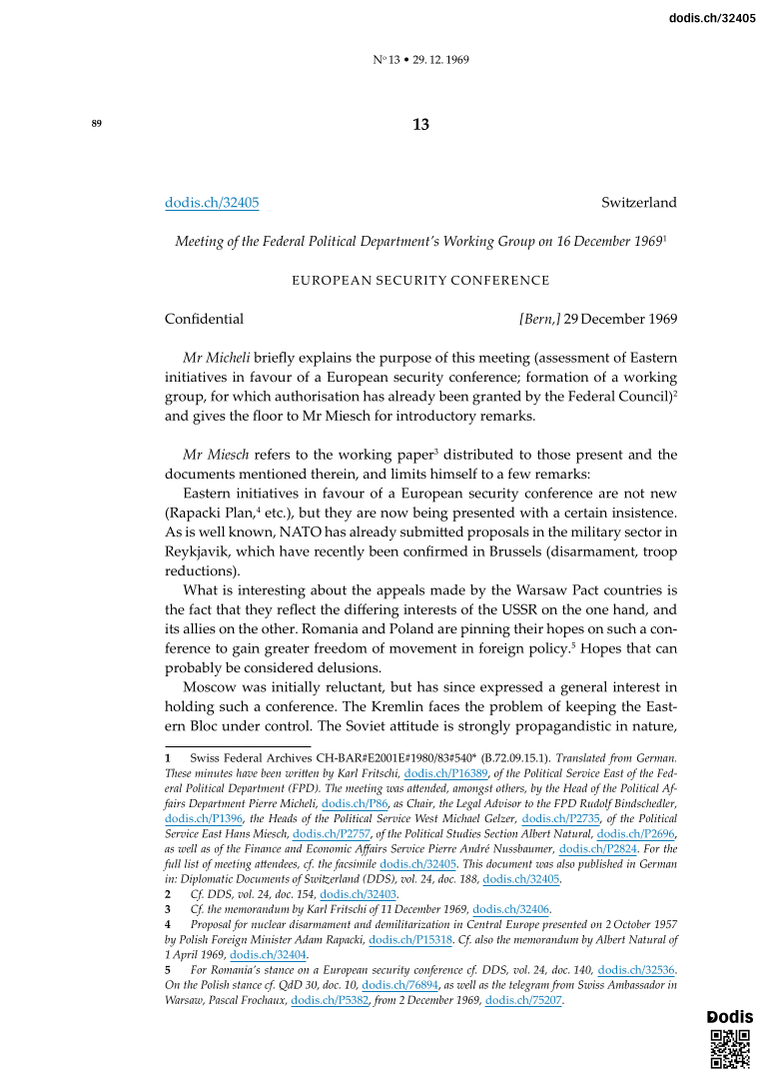
Meeting of the Federal Political Department’s Working Group on 16 December 19691
EUROPEAN SECURITY CONFERENCE
Mr Micheli briefly explains the purpose of this meeting (assessment of Eastern initiatives in favour of a European security conference; formation of a working group, for which authorisation has already been granted by the Federal Council)2 and gives the floor to Mr Miesch for introductory remarks.
Mr Miesch refers to the working paper3 distributed to those present and the documents mentioned therein, and limits himself to a few remarks:
Eastern initiatives in favour of a European security conference are not new (Rapacki Plan,4 etc.), but they are now being presented with a certain insistence. As is well known, NATO has already submitted proposals in the military sector in Reykjavik, which have recently been confirmed in Brussels (disarmament, troop reductions).
What is interesting about the appeals made by the Warsaw Pact countries is the fact that they reflect the differing interests of the USSR on the one hand, and its allies on the other. Romania and Poland are pinning their hopes on such a conference to gain greater freedom of movement in foreign policy.5 Hopes that can probably be considered delusions.
Moscow was initially reluctant, but has since expressed a general interest in holding such a conference. The Kremlin faces the problem of keeping the Eastern Bloc under control. The Soviet attitude is strongly propagandistic in nature, as evidenced by the very early date proposed for the conference leaving NATO countries no opportunity to take a position on it beforehand.
The Soviet Union is likely driven by the following motives in this matter:
The USSR wants to act as a peacemaker – not only in Europe, but also in East Asia – a role that will be particularly welcome next year, the 25th anniversary of the UN. It is undertaking peace and security initiatives in Europe at a time when the CSSR crisis is barely over. A deep mistrust is therefore justified. Moscow also wants to consolidate the status quo in Europe, sow discord in the Western camp and counteract an excessive concentration of economic power in the West.
The USSR apparently wants to assign an active role to the neutral countries and use them as figureheads for a security conference.6
The two Eastern proposals for discussion concerning the renunciation of violence and cooperation are vague and are mainly comprised of slogans. The draft text on the renunciation of violence aims to regulate important aspects of the German question and sanction the Brezhnev7 Doctrine; the text on cooperation fails to mention cultural relations. Unlike Poland, the Soviet Union appears to show no interest in disarmament issues.
NATO members are sceptical about the initiatives and proposals put forward by the Warsaw Pact countries. In their latest statement, they place particular emphasis on disarmament measures and advocate prior bilateral talks (e.g. between the Federal Republic of Germany and the USSR and other Eastern European countries). They expect the East to show signs of goodwill first. NATO has made no comment on the question of the date, but has indicated that certain arrangements must be made before a conference can be held and that the climate for such a pan-European meeting is not yet favourable.
For Switzerland, it is clear that it cannot participate in the resolution of issues that originated during the Second World War. However, our country cannot remain completely on the sidelines, because solving European peace and security problems should not be left entirely to the major powers.
The Federal Council has provisionally established its general position on the conference project.8 The head of the department has recently emphasised the importance of creating an atmosphere of mutual trust prior to the conference.9 He also stressed that such a conference must recognise the national sovereignty of all states, i.e. the principle of non-interference in the internal affairs of each state.
The question now arises as to whether a working group should be set up to examine the issues facing Switzerland in connection with a European security conference. Should this group be created now, and should it be formed within a single department or across departments? The working paper mentioned above lists some of the issues that this working group would have to deal with.
Mr Micheli: We can prepare for a possible conference in two ways:
– externally, on the basis of bilateral contacts that have already taken place but have remained at a general level. For example, the Dutch have shown great interest in discussing this issue with us (at the beginning of February, the Director-General for Political Affairs at the Dutch Foreign Ministry, Mr de Ranitz, will visit us);10
– internally among the departments.
When considering whether the working group to be formed should be created solely within the FPD or whether representatives from other departments should also be involved, it should be assumed that this body will have a dual role. The working group will have to deal with two sets of issues: on the one hand, the political aspects of the proposals put forward by the Warsaw Pact and NATO and, on the other, questions of cooperation in all possible areas. Since the latter group of issues covers the fields of economics, trade, science and culture, contacts with other departments may need to be sought here.
The Federal Council has already commented on the political issues, stating that Switzerland cannot participate in resolving problems that have their roots in the last world conflict.11 It is, nevertheless, far from easy to distinguish between these problems and those that did not arise during the Second World War, since they are interwoven.
Furthermore, the working group is considering what stance our country should take on the issue of renouncing violence. Is it appropriate for neutral states to participate in the exchange of declarations renouncing violence? Should they take the initiative in this regard or rather exercise restraint?
In the areas of economic, scientific, technical and cultural cooperation, there is a question around whether neutral countries, including Switzerland, can play a specific role, which would seem to accord with French ideas. In addition, there is the issue of whether this cooperation should be discussed and agreed upon within the framework of a European security conference at all, or whether it would be more appropriate to first seek and improve this cooperation in other multilateral frameworks or at the bilateral level.
Mr Bindschedler basically agrees with the assessment of the situation regarding the European security conference given at the outset. The only thing that needs to be added is a reference to the Soviet desire for stability in Europe, because the USSR is seeking greater freedom of action in the East due to China. Furthermore, the two Eastern documents on renunciation of violence and cooperation are not draft treaties, but mere declarations, i.e. verbal manifestations.12
When considering what such a conference should aim to achieve, it is impossible to avoid the conclusion that there is nothing behind it. In their current form, the proposals are a deception because they do not seek to resolve any fundamental problems. On the contrary, these problems are being covered up with a verbal edifice constructed in their place. Renunciation of violence is merely a new term for a non-aggression pact, and as is well known, non-aggression pacts have been worthless in the past. Incidentally, the principle of renunciation of violence is enshrined in the UN Charter and is now considered customary law in general international law. Both the Federal Republic of Germany and the GDR have recognised the principles of the UN Charter. An exchange of declarations on renunciation of violence is therefore superfluous since it is merely repetition.
A system of collective security is – if effective at all – more so universally (UN Charter) than at the regional level (cf. the Treaty of Locarno, which lasted no longer than six or seven years). The necessary superiority of the defenders of the law over the aggressor is even less evident at the regional level than it is at the universal level; likewise, the flexibility of groups of states is even more lacking. Moreover, we can well envisage who the presumptive aggressor might be – a member of the system.
As far as the dissolution of the blocs is concerned, Switzerland has no interest in this because it itself benefits from the existence of the NATO alliance. Countries such as Yugoslavia and Romania are deluding themselves if they believe in this dissolution. The events in Czechoslovakia have clearly shown where their limits lie.
The Soviet Union is not interested in disarmament measures such as clearing foreign bases and mutual troop reductions because it needs to keep its satellites in check. Yet even if the Americans and Russians withdrew, the distances involved would create a dangerous situation for Europe, which American precautions such as the Big Lift13 would do little to change. Such a situation is by no means desirable for us.
Disarmament is primarily a matter for the superpowers and is, therefore, an unrealistic postulate in the context of a European security conference.
The East would be prepared to make a declaration in favour of independence and non-interference. However, we know what that is worth. The Brezhnev Doctrine provides the most recent example of this. The West would have to insist that these principles also apply among its respective allies, but this is something that the East would keep hardly.
If nothing is left behind the political and military postulates, then the obstacle to cooperation is the difference between the economic systems of East and West. Here, it is not trade-related factors (customs duties, etc.) that play a role, but political factors.
No conference is necessary to improve mutual trade relations. Trade can take place bilaterally; in a multilateral framework, the European Economic Commission in Geneva could deal with these issues. Everything else is Eastern window dressing.14 The same applies to science. Furthermore, the East does not want normal cultural relations because it fears Western influence.
All things considered, what remains are many empty words and – somewhat dangerously – the creation of illusions that we recognise from the 1920s and 1930s.
The question now is what Switzerland should do.
Do we want to cement the status quo, the division of Germany, which may be desirable for us in terms of power politics, but is somewhat artificial, and the sanctioning of conditions in the Eastern Bloc? Problems also arise with regard to the policy of neutrality, because the issues that should be reserved for the peace conference are difficult to define. This is also evident in the question of renouncing violence. It would be sensible to hold a peace conference first, and only then resolve the remaining problems.
There is a fear that Swiss initiatives would favour one party at the expense of the other. It is difficult to find a middle ground. Initiatives thus have a one-sided effect. In any case, their impact will be minimal.
One postulate remains of interest: a security conference would provide an opportunity to have neutrality recognised. The issue of the recognition of neutrality has not been settled, or at least not clearly, with regard to the Soviet Union, the United States and the UN.
We could align ourselves with countries that have the same interests or that support us. With regard to the neutral countries, however, it should be noted that Austria does not need recognition of its neutrality, Sweden probably does not want it because of its specific neutrality policy, and Finland has to pursue a special policy in this regard.
There are also risks that
– the USSR would want to use the issue of recognition of neutrality for its own purposes (cf. Soviet initiatives in the early 1950s: creation of a one-sided “neutral zone” at the expense of the West);
– recognition of neutrality would be linked to conditions;
– our position would be weakened if this recognition did not come about.
Scepticism is therefore warranted, even if the question of recognition should not be excluded from our discussion from the outset.
The conclusion is that it is particularly important for Switzerland to be present at such a conference, should it take place.
The working group is faced with the question of its composition. It can be assumed that discussion about a European security conference will focus exclusively on foreign policy issues; everything else is window dressing. The working group should therefore be composed of representatives from the FPD; a representative from the Trade Division may also be consulted.
Mr Miesch: The Federal Council has not yet decided on Switzerland’s participation in a European security conference. In response to the appeals of the Warsaw Pact states, an overly positive stance has been avoided. The Finnish initiative was not an invitation, but merely a consultation.15 The head of department has emphasised the importance of taking a realistic stance on these initiatives and proposals. The task of the working group will be to make recommendations on Switzerland’s position to the Federal Council and, in particular, to inform the new head of department about the conference project.16
Mr Micheli: The working group will indeed have to clarify the two main issues: 1. Participation or not, 2. If so, preparation for this participation.
Mr Nussbaumer comments on Mr Bindschedler’s remarks about the cooperation proposed by the East in the field of trade. This partly concerns the question of most-favoured-nation treatment, which is already the subject of discussions within the GATT and the OECD. There is no agreement on this between Europe and the United States in the West. The US grants most-favoured-nation status to Poland and is, in principle, prepared to extend it to other Eastern European countries if Europe does the same. The most important Western European countries have not granted most-favoured-nation status to the East, mainly in order to have a bargaining chip in negotiations. It is unlikely that a solution in this area could be found at a European security conference.
Switzerland has granted most-favoured-nation status to the Eastern European countries, apart from four minor restrictions:
– strategic goods, for which we observe the principle of “courant normal”;17
– price monitoring for textile imports;
– egg imports;
– clearing.18
As these restrictions have virtually no impact on our trade with the East, Switzerland is not in the firing line on this issue. Our country is more interested in resolving these problems bilaterally. We are therefore prepared to abandon individual clearing arrangements; we should take this opportunity to try to negotiate something in return. All in all, therefore, Switzerland has no immediate economic interest in a major conference.
From a political standpoint, it is nevertheless significant that certain reform tendencies are evident in the economic sector in the East. In Hungary, for example, attempts are being made to move gradually and in the long term from a compulsory plan to an indicative plan, albeit with safeguards in place in case this goes too far. The needs of the market are to be taken into account to a greater extent. Similar trends can also be observed elsewhere. Such reform efforts could have political repercussions that must also be taken into account in connection with the security conference.
Mr Natural: If the conference goes ahead, there is no reason for Switzerland not to participate, because our country must protect its interests.
Scepticism is certainly warranted, but it is also possible that a European security conference could mark the beginning of a process that could lead to a peace treaty. If Switzerland is not involved from the outset, it would be difficult to “join in” later (cf. the situation in Western European unification efforts).19 Our interest in the conference is therefore certainly justified.
We see two trends in the Eastern Bloc: the USSR wants to cement the status quo, while Romania is seeking to dissolve the blocs with the same conference. The question as to whether a European security conference will go in one direction or the other therefore deserves consideration. A European security conference presupposes détente between East and West. However, history teaches us that détente causes difficulties for the Soviet Union (cf. Beria,20 Khrushchev,21 Budapest, Prague).
Even if Switzerland is to show great interest in the conference, it will not want to put forward any initiatives of its own in this regard.
Mr Gelzer also believes that the conference proposal warrants a great deal of scepticism. However, due to statements made by the government, the public has the impression that Switzerland’s attitude is entirely positive.22 The question therefore arises as to whether, in view of the prevailing scepticism, a certain degree of restraint on the part of the authorities would be appropriate.
Mr Miesch: Responding to the interpellations by Mr Renschler in the National Council and Mr Hefti in the Council of States will provide an opportunity to clarify the Federal Council’s position.23
Mr Micheli summarises the discussion and, based on the exchange of views, proposes that a working group be set up within the FPD, with the involvement of a representative from the Trade Division.24 Should it prove necessary at a later stage, representatives from the FDHA, the FMD and possibly the FDTE could also be involved.
The working group is composed of the following gentlemen:
Ambassador Bindschedler, Chair; Minister Miesch; Minister Gelzer; Minister Diez; Natural; Nussbaumer; Fritschi; a representative of the IO;25 a representative of the Trade Division.
The first meeting of the working group will take place at the end of January.26
- 1
- Swiss Federal Archives CH-BAR#E2001E#1980/83#540* (B.72.09.15.1). Translated from German. These minutes have been written by Karl Fritschi, dodis.ch/P16389, of the Political Service East of the Federal Political Department (FPD). The meeting was attended, amongst others, by the Head of the Political Affairs Department Pierre Micheli, dodis.ch/P86, as Chair, the Legal Advisor to the FPD Rudolf Bindschedler, dodis.ch/P1396, the Heads of the Political Service West Michael Gelzer, dodis.ch/P2735, of the Political Service East Hans Miesch, dodis.ch/P2757, of the Political Studies Section Albert Natural, dodis.ch/P2696, as well as of the Finance and Economic Affairs Service Pierre André Nussbaumer, dodis.ch/P2824. For the full list of meeting attendees, cf. the facsimile dodis.ch/32405. This document was also published in German in: Diplomatic Documents of Switzerland (DDS), vol. 24, doc. 188, dodis.ch/32405.↩
- 2
- Cf. DDS, vol. 24, doc. 154, dodis.ch/32403.↩
- 3
- Cf. the memorandum by Karl Fritschi of 11 December 1969, dodis.ch/32406.↩
- 4
- Proposal for nuclear disarmament and demilitarization in Central Europe presented on 2 October 1957 by Polish Foreign Minister Adam Rapacki, dodis.ch/P15318. Cf. also the memorandum by Albert Natural of 1 April 1969, dodis.ch/32404.↩
- 5
- For Romania’s stance on a European security conference cf. DDS, vol. 24, doc. 140, dodis.ch/32536. On the Polish stance cf. QdD 30, doc. 10, dodis.ch/76894, as well as the telegram from Swiss Ambassador in Warsaw, Pascal Frochaux, dodis.ch/P5382, from 2 December 1969, dodis.ch/75207.↩
- 6
- Cf. the letter of Swiss Ambassador in Moscow Jean de Stoutz, dodis.ch/P2695, to the FPD of 1 December 1969, dodis.ch/75208.↩
- 7
- General Secretary of the Communist Party of the Soviet Union (CPSU) Leonid Brezhnev, dodis.ch/P15543.↩
- 8
- Cf. DDS, vol. 24, doc. 154, dodis.ch/32403.↩
- 9
- This probably refers to the draft declaration by Federal Councillor Willy Spühler, dodis.ch/P2111, intended for the 45th Committee of Ministers of the Council of Europe in Paris on 12 December 1969, dodis.ch/77669. However, that part of the programme has been postponed, cf. dodis.ch/75205.↩
- 10
- On the visit of Jan de Ranitz, dodis.ch/P43901, on 19 and 20 February 1970, cf. dodis.ch/75216.↩
- 11
- Cf. DDS, vol. 24, doc. 154, dodis.ch/32403.↩
- 12
- Cf. the memorandum by Swiss Secretary-General of the FPD Micheli dated 31 October 1969, dodis.ch/75209, and the memorandum by the Head of the Political Service East Miesch dated 10 November 1969, dodis.ch/75210.↩
- 13
- Operation “Big Lift” was a US Armed Forces airlift exercise across the Atlantic in autumn 1963.↩
- 14
- English in the original.↩
- 15
- Cf. QdD 30, doc. 6, dodis.ch/76726.↩
- 16
- On 1 February 1970, Federal Councillor Pierre Graber, dodis.ch/P4171, replaced Federal Councillor Spühler as Head of the FPD.↩
- 17
- Cf. DDS, vol. 24, doc. 189, dodis.ch/33136.↩
- 18
- Cf. DDS, vol. 24, doc. 20, dodis.ch/32396.↩
- 19
- Cf. DDS, vol. 24, doc. 33, dodis.ch/33238; doc. 68, dodis.ch/33241, and doc. 180, dodis.ch/33243.↩
- 20
- On the removal from power of the Soviet Minister of the Interior Lavrentiy Beria, dodis.ch/P2163, in July 1953, cf. DDS, vol. 19, doc. 69, dodis.ch/9557.↩
- 21
- On the removal from power of Soviet Prime Minister and First Secretary of the CPSU Nikita Khrushchev, dodis.ch/P14485, in October 1964, cf. DDS, vol. 23, doc. 47, dodis.ch/31312.↩
- 22
- Press Release of the FPD of 24 July 1969, dodis.ch/77668.↩
- 23
- For Federal Councillor Graber’s response of 15 June 1970 to Interpellation 193/10282 European Security Conference tabled by National Councillor Walter Renschler, dodis.ch/P29759, on 2 June 1969, cf. dodis.ch/75124; for his response of 23 June 1970 to Interpellation 203/10430 European Security Conference tabled by Councillor of the States Peter Hefti, dodis.ch/P31801, on 26 November 1969, cf. dodis.ch/75126.↩
- 24
- The Delegate for Trade Agreements and Special Missions of the Federal Department of Economic Affairs Albert Weitnauer, dodis.ch/P2132.↩
- 25
- The Head of the Division for International Organisations of the FPD Ernesto Thalmann, dodis.ch/P997.↩
- 26
- For all Swiss documents in this volume, cf. dodis.ch/C2935.↩
Tags
Organization for Security and Co-operation in Europe (OSCE)
Disarmament Warsaw Pact NATO Collective security projects