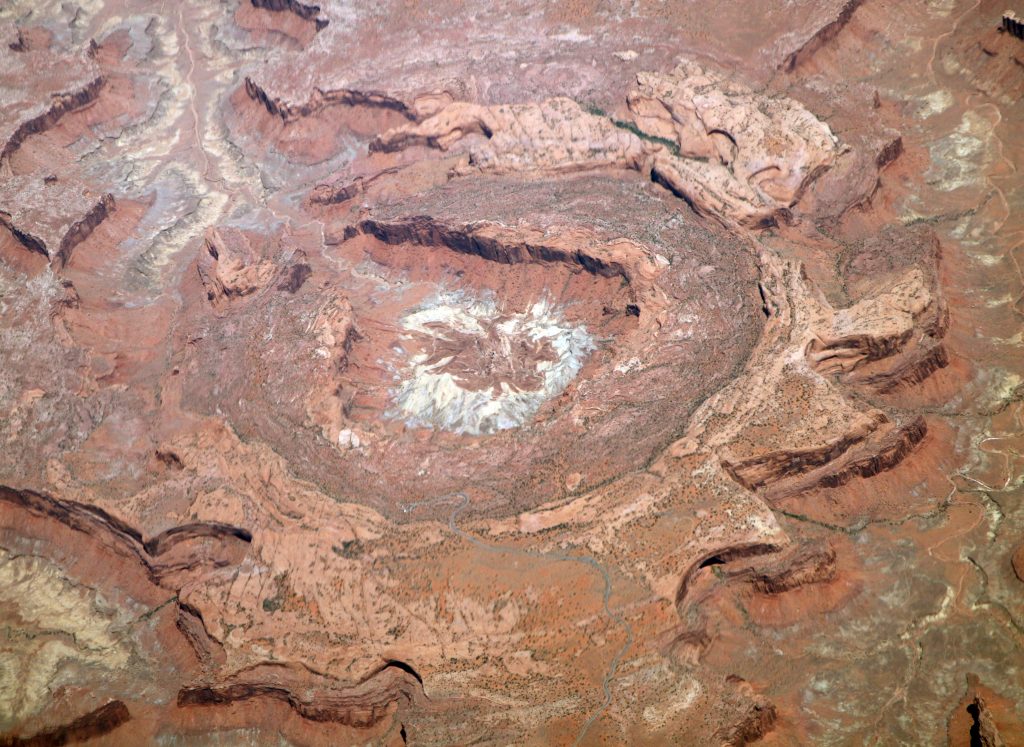
There is a meteor impact crater in Utah’s Canyonlands National Park. It’s called Upheaval Dome, because that’s what geologists thought it was before it became clear that it wasn’t.
When I visited the place with my teenage kids in the late ’80s, all the placards along the trail explained that the circular canyon was what remained of a giant blister of salt that heaved upward and collapsed beneath what became desert in recent eras. But it seemed obvious to me at the time that this was a crater, because it looked like one and was unlike all the other landforms around it.
I suspect the placards on that trail now harmonize with this paragraph from the Wikipedia page for the site:
The currently accepted theory is an interpretation of the dome as an eroded impact crater, like the much younger Meteor Crater near Winslow, Arizona. In the 1990s, a team of geologists and seismologists from NASA and the University of Nevada at Reno performed a detailed study that included seismic refraction and rock mapping. The results of this study support the meteorite theory.[2][3] In 2008, it was announced that shocked quartz was discovered in addition to the numerous impact-related features described by Kriens et al. in 1998.[4]
Anyway, in recent decades I’ve shot that crater, and countless other scenes visible from my window seat on passenger gets, and published them in my Flickr collection of permissively licensed photos, in faith that some will show up in Wikimedia Commons, the library of images used by Wikipedia. As a result of that that work, the photo above appears atop the Wikipedia page for the crater (still called a dome). I shot it through the window of a flight from Newark to Los Angeles in 2012. The whole collection from that flight is here. The person who uploaded the photo to Wikimedia Commons is the boundlessly useful Wikipedian called Tillman, to whom we all owe thanks.
My camera then was a 2005 Canon EOS 5D with a Canon EF28-105mm f/3.5-4.5 lens, neither of which is nearly as good as what I shoot with now. Since 2022, my main camera-lens pair has been a Sony a7iv and a Sony FE 24-105mm f/4 G OSS lens, which Ken Rockwell calls “the world’s best midrange zoom (with) spectacular optical performance as well as first-rate mechanical construction at half the price of similar lenses (while also) smaller, lighter and (with) better ergonomics than the more expensive lenses.” It’s almost perfect for shooting out plane windows, and is half the weight and bulk of my old Canon pair.
But it’s not perfect, because I can’t shoot from every angle, especially looking down. It’s just too big and cumbersome. But now I also have an Apple iPhone 16 Pro Max, which is the ideal way to shoot around smudges, scratches, and other flaws in airplane windows—and down toward what neither the Sony nor my own eyeballs can see.
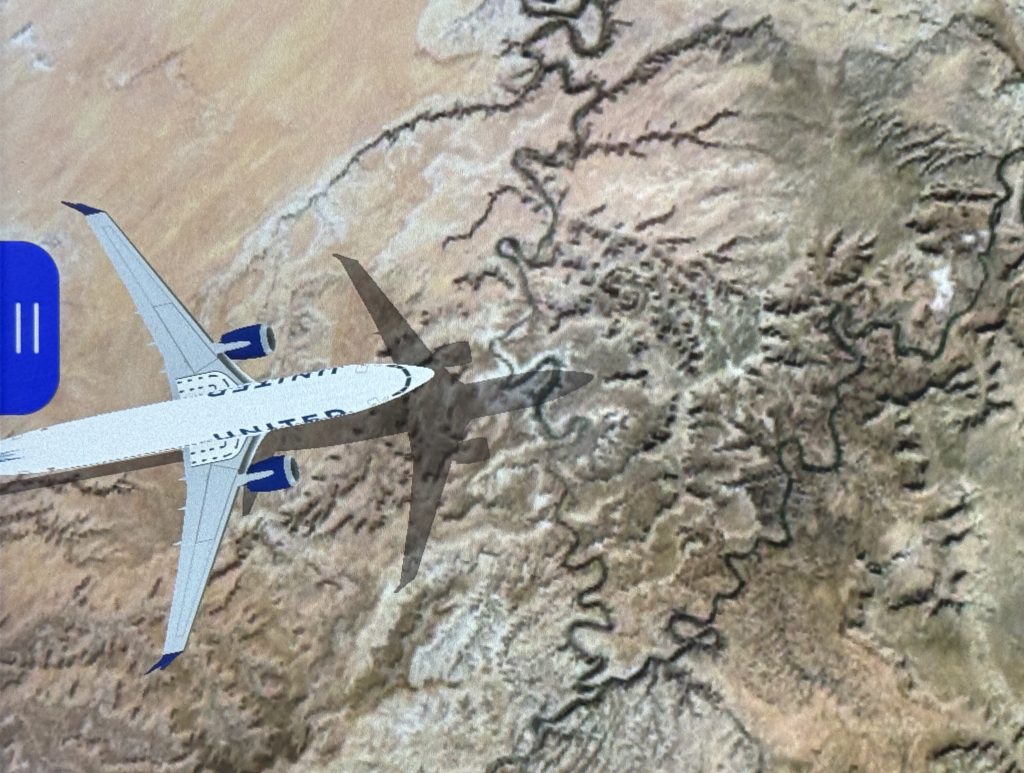
I bring this up because I have been hoping to give the world a better shot of the Upheaval Dome than that old one of mine in Wikipedia. My latest chance came yesterday, on a flight from Santa Barbara to Chicago. After our plane crossed the San Rafael Swell and approached the Green River and Canyonlands, I could see (from my hand-held GPS, my phone, and the plane’s seat-back map) that I might get a view of the crater. It’s the round-ish canyon above and to the right of the plane’s shadow in this view of the plane’s map:
While we flew just south of it (at 622 mph, my GPS said), my Sony and I couldn’t see it, but my iPhone could. Here’s the series I shot with it:
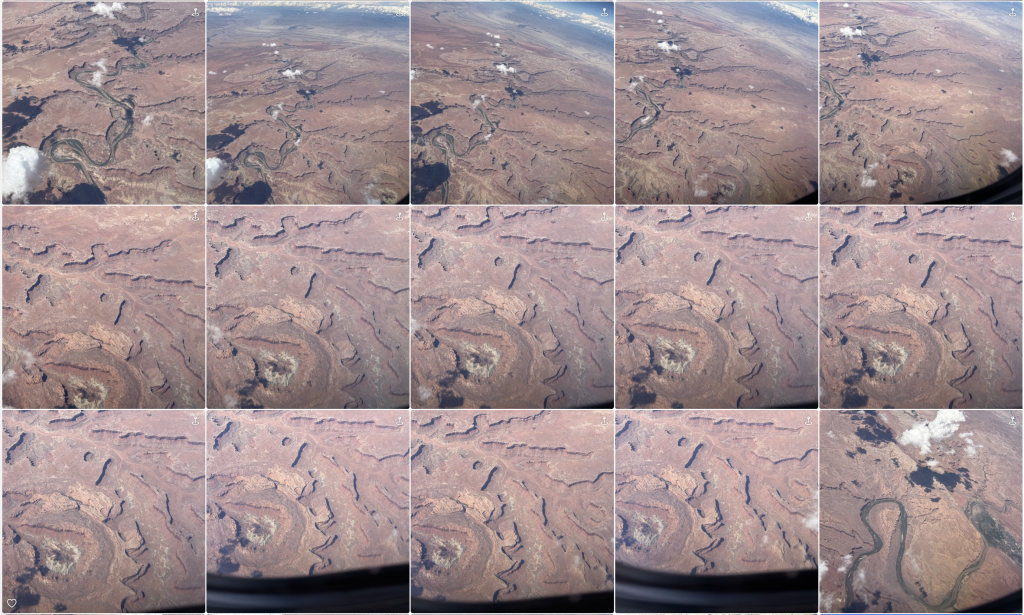
I couldn’t see what I was shooting, because my phone was looking down from the top of the window, and my view of the phone’s screen was edge-on. So I just guessed at where I was aiming. Alas, while my aim wasn’t bad, the angle was too steep.
But I still got hundreds of other nice shots on the trip, and I’ll put them up soon, annotated and licensed for easy re-use, adding to the aquifer of photos of whatever that anyone can tap for anything. For example, news stories. I mean it when I say You’re welcome.

Leave a Reply