
Also, it’s not podcasting if you can’t skip ads
Spotify is reportedly improving what we do anyway on podcast apps: hitting the 30-second skip-forward button when the host says “we’ll be back after a quick break.” (On Pivot, I might hit the +:30 button six or seven times, because that first “quick break” is up to three and a half minutes.)
I get why some podcasters and their networks are splitting a gut about this, and I know the lengths some hosts go to make the ads as low-pressure, personal, and appealing as possible. I did that when I hosted FLOSS Weekly on the TWiT network.
Still, that skip-forward button is a feature, not a bug. Get this straight: a podcast in its purest form is an audio or video file distributed—syndicated—by RSS, aka Really Simple Syndication.
The way I see it, podcasting starts here:
Anyone can publish
↓
recording / production
↓
any publishing system
↙ ↘
HTML RSS + enclosure
Below that, it looks something like this:
RSS + enclosure
/ | \ / | \
Any browser or podcast app
\ | / \ | /
Listeners
Then, modeled the way how Jonathan Zittrain illustrated the generativity of the Internet’s base protocol —
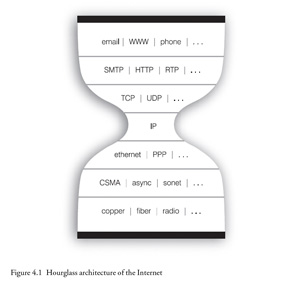
—in Chapter 4 of his book The Future of the Internet and How to Stop It, here is a less graphical way of showing how RSS, at the waist of the hourglass, is maximally generative for both the producers and consumers of podcasts:
AUTHORS / PUBLISHERS / PRODUCERS
blogs / CMSs / hosting audio / video / other media HTML / Web sites
\ | / \ | / \ | /
[ RSS ]
<enclosure>
/ | \ / | \ / | \
podcast apps / aggregators web / desktop / phone / car speakers / headphones / etc.
LISTENERS OR VIEWERS
Here is another virtue: nobody on the consumption side needs permissions or exclusive apps provided by the production side. That maximizes the width of populations on both the top and the bottom. (Though I hate putting people at the bottom, you do get the point.)
This is the reason why a search for podcasts brought up only 24 results when I wrote about it in 2004 (and resurfaced here in 2016), and now brings up (Gemini tells me, sourcing its mother) 10.2 billion results, and DemandSage says there were 4.6 million podcasts going in April of this year.
That’s why a podcast isn’t a podcast without the generative power of RSS enclosures in the middle. Nothing else is more generative or defining of what a podcast is and how it works.
And any podcast app provider should be free to make ad-skipping a feature. Going back to more minimal graphics,
OPEN
Publishers > > > RSS < < < Listeners
↑
nobody owns it
PLATFORM
Producers > > > [ PLATFORM ] < < < Customers
↑
somebody owns it
RSS is a requirement for interop, maximized generativity and maximized expansions of markets. A platform for captives is a system for controlling a closed market.
If Spotify (or Apple, Google, or anybody) owned podcasting right now, podcasting would be a bunch of small markets exclusively controlled by platforms—and publishers would be on solid ground when complaining about a new ad-skipping feature. But that’s not what we have, because RSS is a market-opening protocol (just like IP is for the Net and HTTP/S is for the Web). Celebrate that and make your ads as appealing as possible, if ads are your business model.
And face the simple fact that a large wedge of the market’s demand side wants to skip over ads. Spotify is responding to that simple fact. It’s the market at work, folks.
Lately I’ve noticed that some publishers are pushing back on ad-skipping by making some ads skip-proof. When I’ve found that happening on a podcast, I tend to leave and not come back. Two examples are The Old Man & the Three and The Athletic NBA Daily. They both lost me. If you’re with either one, tell me when that’s stopped and I’ll be back.
One final note: I am not a Spotify customer and don’t use their service. So I won’t be seeing the feature at issue here. I am, however, a Dish Network customer, and have been since it was Echostar, back in the last millennium. My set-top box (which dwells in a cabinet, since we don’t want to see it and TV sets now have edges, not tops) is called a “Hopper,” because it’s supposed to be able to hop forward across ads on the box’s DVR. It has never worked. Maybe commercial podcasters will get lucky, and Spotify’s new ad-skipper will fail just as well.
Less to talk about
Anver Kantor in NiemanLab: We analyzed 6,400 New York Times stories to find out how comments change when you give readers more information. The subhead: “The same stories that produced sharper, more analytic conversation also produced less conversation.”
Bonus link: Where Journalism Fails.

Leave a Reply