
Can we get down to earth?


Some of the best creative relationships begin as a spark of attraction: An urge to click a linked name in a newsletter, a tingling of resonance after deep-diving someone’s Instagram, or simply a sense of recognition upon hearing someone speak. Whatever the spark, it will make you think: whoever this person is, I want to know them. Not romantically, but as a thinker, builder, or maker. Perhaps, even as a collaborator.
Kate Rose Weiner and Amirio Freeman found each other more or less this way, drawn together by a shared conviction that the most urgent questions of our time—about land, about Blackness, about queerness, about how we survive and flourish on a warming planet—are also, at their root, questions about beauty, language, and how we show up for one another.
Kate is a writer, editor, and publisher who co-edits Loam, the publishing branch of the Weaving Earth Center for Relational Education. She’s currently co-writing Compassion in Crisis, an intersectional field guide to navigating climate disaster (pre-order now!), and about to put out a series of snail-mail newsletters (I just subscribed!). Amirio is an essayist, interviewer, and editor whose newsletter PLANTCRAFT is an exploration of plants in culture, and culture in plants, because “we can’t understand human life without bringing plants into the conversation” (hard agree).
As collaborators, Kate and Amirio created the Down to Earth Deck, a series of conversation cards designed to spark embodied dialogue around ourselves and our environment. Last summer, Kate and Amirio came to the residency I run in the Catskills for a retreat together, and they left me with a deck. One morning I sat with it, and it sparked so much introspection—and such a desire to take action—that I knew I wanted to interview them about it.
In the conversation below, we talk about how they found each other, what the Down to Earth Deck taught them about language, accessibility, and knowledge production, and why—in a moment of radical digital fragility—they both keep returning to the same answer: slow down, find your people, and make intentional things that won’t be wiped out in a power outage.
~ Willa
Willa Köerner: Can you share your path as collaborators? How did you know you were a good creative match?
Kate Weiner: We first met almost a decade ago, after I stumbled across Amirio’s Instagram and felt a resonance between our perspectives, and slid into their DMs. [Laughs] We pretty immediately started sharing ideas back and forth, and Amirio became a contributor to Loam, and later the host of Loam Listen, where they facilitated incredibly well-researched conversations. But our creative collaboration really solidified around the Down to Earth Deck.
Amirio Freeman: The account Kate’s referring to is called Being Green While Black, which I started in undergrad. I was studying political science and public policy and trying to connect those disciplines—specifically to Black ecological thought—and there weren’t too many online spaces doing that. So I created a very visual Tumblr, and it eventually migrated to Instagram around 2017.
Back then Instagram felt so genuinely new and exciting. There was a whole subculture of identity-based accounts thinking about the intersection of sustainability with fat bodies, Black bodies, Indigenous people. We were in that wave of using social media for more fringe environmental thought. When Kate just reached out, I was so impressed by what she was building: Loam was this subcultural environmental platform that really emphasized the sensorial, and the beautiful. Loam is truly one of the OGs in that space, well before publications like Atmos came along.

But as Kate mentioned, we found our rhythm as collaborators with the Down to Earth Deck. When I was running Being Green While Black, I started a question series, asking things like, “who are your favorite Black environmental thinkers?” As I was compiling those into one place, I mentioned to Kate that I wanted to make a question deck, and she said Loam could help make it—and we were off. That year and a half of working on it together was so special. Then, seeing it out in the world, with librarians using it, green clubs on college campuses activating it, and us collaborating on an event with Sustain Frame and Field Meridians in Brooklyn where it was the centerpiece—I always think of that deck as the nexus point of our collaborative power.
I love how you found each other online, but then made the relationship real. I often will come across someone and feel a spark—not a romantic spark, but a recognition, like, this is a person I want to know. It can be hard, or maybe awkward, to act on that spark, though. I almost feel like I started this newsletter because it gave me a direct way to ask someone for an interview instead of just asking if they want to be my friend. [Laughs] Do you have tips for connecting with a resonant stranger across the internet?
Kate: It felt a little easier with Amirio because they very much radiate generosity of spirit, so felt approachable to me. But I think overall, having a project or platform independent of yourself that you can use as a reason to reach out is really helpful. It gives the conversation a container.
Amirio: I keep thinking about how ten years ago, the platform of Instagram itself facilitated discovery. The comments were so alive with people finding each other, and feeling genuinely excited to connect with other plant people and green people and Black people interested in hiking and the outdoors. Pre-algorithm, pre-AI slop, it felt like a genuine space where you could follow your curiosities and discover kindred spirits.
Today, we have to do a little more work to find digital spaces that still invite that sense of gathering. Are.na has really been primed for that, even though it wasn’t built explicitly for connection, but something about its purity of experience caused a community to form around it anyway. I’ve also been really into third spaces lately. Here in Philly, I can’t tell you how many times I’ve gone to something organized by random people and promoted via flyers, and found myself in a room full of like-minded folks who were just actively seeking each other out. That kind of intentional, in-person gathering has been huge for me.
I’m also thinking about the resurgence of long-form content on YouTube—essay-length videos about ecological and alternative thought where the comments are genuinely popping off. There’s a real migration happening away from TikTok and Instagram’s short-form chaos, toward something slower and more substantive. And Substack, despite its complications, has been another place where I keep discovering new thinkers and writers through citation and recommendations.
It’s interesting—the early internet was piecemeal and you had to find your own way, then social media centralized everything into the personalized feed. But now the feed has been so degraded by ads and algorithmic strangers that it’s almost gone back to being piecemeal. It feels like the digital space is now even less personalized than real life, meaning we need to make an intentional, active effort to construct our own containers for connection. Otherwise we risk real isolation.
Kate: That’s a good framing. Something else came to mind on the practical side of making those cold connections: recently my dear friend, longtime collaborator, and Loam Co-editor Kailea [Loften] and I were on the receiving end of an outreach email that struck me as such a beautiful example of how to do it well. The person first sent a really sweet, thoughtful message, and then followed up with a clear and specific ask. Not an open-ended “let’s connect sometime,” but: “If you have time, I would love to talk with you for X, Y, and Z reasons.” Something about that structure felt so meaningful. It wasn’t that they were trying to constrain the conversation; instead, they were offering parameters and expectations so we could understand what kind of container they hoped to build. It felt clear, considerate, and reciprocal.
Amirio: I resonate with that. When everything feels so unsteady, there’s something powerful about clarity—about being direct and grounded in your outreach.
As a related thought, I want to name that print culture is coming back in a big way, and that’s another incredible commons for connection. I just finished Mindy Seu’s new book, A Sexual History of the Internet, and in the intro she talks about how books are one of the most ancient and protected forms of building a commons. Once I have a book in my library, it’s there; there’s no threat of it being censored, deleted, or lost in the digital ether. And I love going through contributors lists in independent publications and thinking, “these are the cool people I want to follow and reach out to.” It feels almost clandestine and exciting to make connections that way.

Kate: The digital space, even when you’re reading something genuinely nourishing, is still a deadening experience after a while. But when I’m reading a book, I feel like I’m coming back into my senses—into my body. There’s also something radical and joyful about subverting racist algorithms, vulnerable servers, and billionaire-owned platforms that can change the game in a second. DIY print culture and zine-making especially have this quality of just working with what you have. If you can fold paper, if you can do a stitch, you can share information rapidly without any external platform—which is especially important right now. During an evacuation, for example, many of us are likely to rely on our phones, but the infrastructure that provides cell service is vulnerable to the exact disasters we’re trying to navigate. Cultivating other ways of sharing information that don’t depend on electricity feels genuinely urgent.

What did producing the Down to Earth Deck teach you about intentional community, and how does that feed into having a more resilient relationship with the earth?
Kate: Amirio and I went through several rounds of questions, and we shared an early version with a friend who offered some really concrete feedback. Some of the questions were reading as too heady and jargon-heavy, for example. They helped us rewrite questions in a way that invited more people into the conversation. For example, there are so many ways to be involved in what’s popularly called the “food justice movement” without identifying with that realm’s particular terminology, and so many ways to show up as an organizer without using a theory of change that would be legible in academic circles. Thanks to community feedback, we were able to reflect on our initial language and ask: how can we make space for more people at the table?
Amirio: Kate and I both love theory—we’re Donna Haraway heads, and we love traversing those vernaculars. And in social justice spaces, there’s often a kind of honor associated with being able to cite the right passage or use the right terminology. But thinking about this moment, where we really have to be building the biggest tent possible, and creating cohesion amongst communities that have been so intentionally fractured, it feels crucial to use language that actually builds a foundation that everyone can stand on. That’s always been a throughline with Loam as well: finding pathways over divides that have been exacerbated, often deliberately, for political and financial gain.
Kate: It is a messy and imperfect aim. Amirio and I still have such a longing to realize new iterations of the deck based on how it’s lived in the world so far, as these questions, and the processes behind them, keep evolving. But what felt so beautiful was that the care we put into the language was reflected back to us in the sheer diversity of communities that gathered around the deck. High school students used it in class. Older folks designed game nights around it. Seeing that it was applicable across so many different contexts felt incredibly affirming.
I’ve felt inspired by the work of community organizer Grace Oedel. In her newsletter, Here We Are, she recently reflected on the general strike in Minneapolis. One of her noticings was that the most effective organizing efforts used language that focused on what it means to be a good neighbor, rather than bringing in more intricate theories of change. Overall, Amirio and I are interested in both honoring our love of theory and denser, esoteric work, while also making space for the joy and necessity of simpler statements, like “this is what you do because we’re neighbors and we care about one another.”

Amirio: The deck also taught me a lot about knowledge production: who it comes from, and how it happens. In this moment when a lot of people are offloading their sense-making to AI summaries or social blurbs to understand reality, there’s something really powerful about the kind of knowledge production that happens internally, through embodied self-knowledge. A huge inspiration for the deck was Audre Lorde’s Questionnaire to Oneself, which carries this idea that the site of the body, the site of the sensorial, is a way of getting to broader truths. We wanted to encourage that, and to work within that lineage.
I’m curious about the format itself. You’re both such well-read, rigorously researched people—and then you end up making something that strips away all the extra inputs and lets things unfold on a more emotional, intuitive level. Why a deck versus a book?
Amirio: On one level, a deck of cards is approachable in a way that feels almost ancient. Kate and I both collect decks—we have such a love for tarot cards—and I think of Dirt Gems as a huge inspiration for this project. The Artist’s Grief Deck is an inspiration as well. As a form, a deck of cards is deeply human. You intuitively know how to engage with it.
Kate: We were also excited by the idea of something that could be passed hand to hand, and that could spark engagement in a game-like way. It’s also easier to have a real conversation around a simple card-based prompt than around an entire book. And honestly, it was just fun to experiment with a new form. Even figuring out what kind of box we needed and how to get it printed was its own creative exercise, and a way to understand more about the processes that go into making any printed object.
Amirio: There’s also something about the form that feels less authoritative. When reading a book, you’re somewhat relinquishing authority to whoever’s writing it: “I’m reading this because you’re the expert.” With a deck, especially one that’s question-based, the knowledge is being generated by whoever’s sitting around it. And the form is flexible, too. We know people who use it solo at the beach, just reflecting quietly, and people who use it as the centerpiece of a big group gathering.
Like a book club, but the homework is just living in the world.
Kate: Yes, exactly. We got to include the deck at a Sustain Frame and Field Meridians game night last summer, and Amirio and I were in different groups. Later we compared notes, and found that we had wildly different conversations, despite many of the same cards being pulled. It was cool to reflect on all the unique stories and perspectives that can emerge from the same container.
Amirio: It was like doing an ethnography in real time. Some groups had amazing moments of strangers finding common ground, sharing expertise, and renewing their commitment to being more embodied and connected. Other groups surfaced real tensions around identity and privilege, and what it means to return to a right relationship with the earth. That felt meaningful, too. In a society obsessed with being frictionless, having tools that invite convivial confrontation is so necessary.

If someone works through most of the deck, alone or with others, how do you hope they’d come away feeling?
Kate: The deck is structured around themes of self, community, and world. So I’d hope for people to come away with greater literacy across all three themes. And, I hope it inspires more stamina in their relationships by encouraging the staying power necessary to remain in hard conversations, and in messy relationships, with continued compassion.
Amirio: I hope it makes people feel slow. I’m challenged by this every day, as there are always so many demands on my attention, and so many invitations to optimize and consume quickly. I’ve been trying to retrain myself toward slowing down: getting a library card, reading more books, having more aimless time with friends. I hope the deck can be a way of giving people permission to take a deep breath and pause, because that literacy—of self, of community, of earth—only comes through slowing down, paying attention, reflecting, and repeating that process over and over. Slow reflection is a muscle that can only be strengthened with time. It doesn’t happen at the pace of fast fashion or fast food. But to change, we have to operate on a completely different scale of time. And I think ultimately, rerouting people to that scale of time is what’s going to save us.
◉
Want to experience the Down to Earth Deck, without having the actual deck in your hands? Here’s a handy discussion guide, which features every question from the deck, alongside further context, plus lots of supplementary things to read and listen to. Enjoy 🙂

Related Posts

Gardens under glass
Landscape architect and Harvard professor Danielle N. Choi on climate-controlled gardening, the value of speculation, and why designing with living things means never really being done.

Trash people make the best friends
Penny Gibbons on combatting loneliness by starting a neighborhood cleanup group.
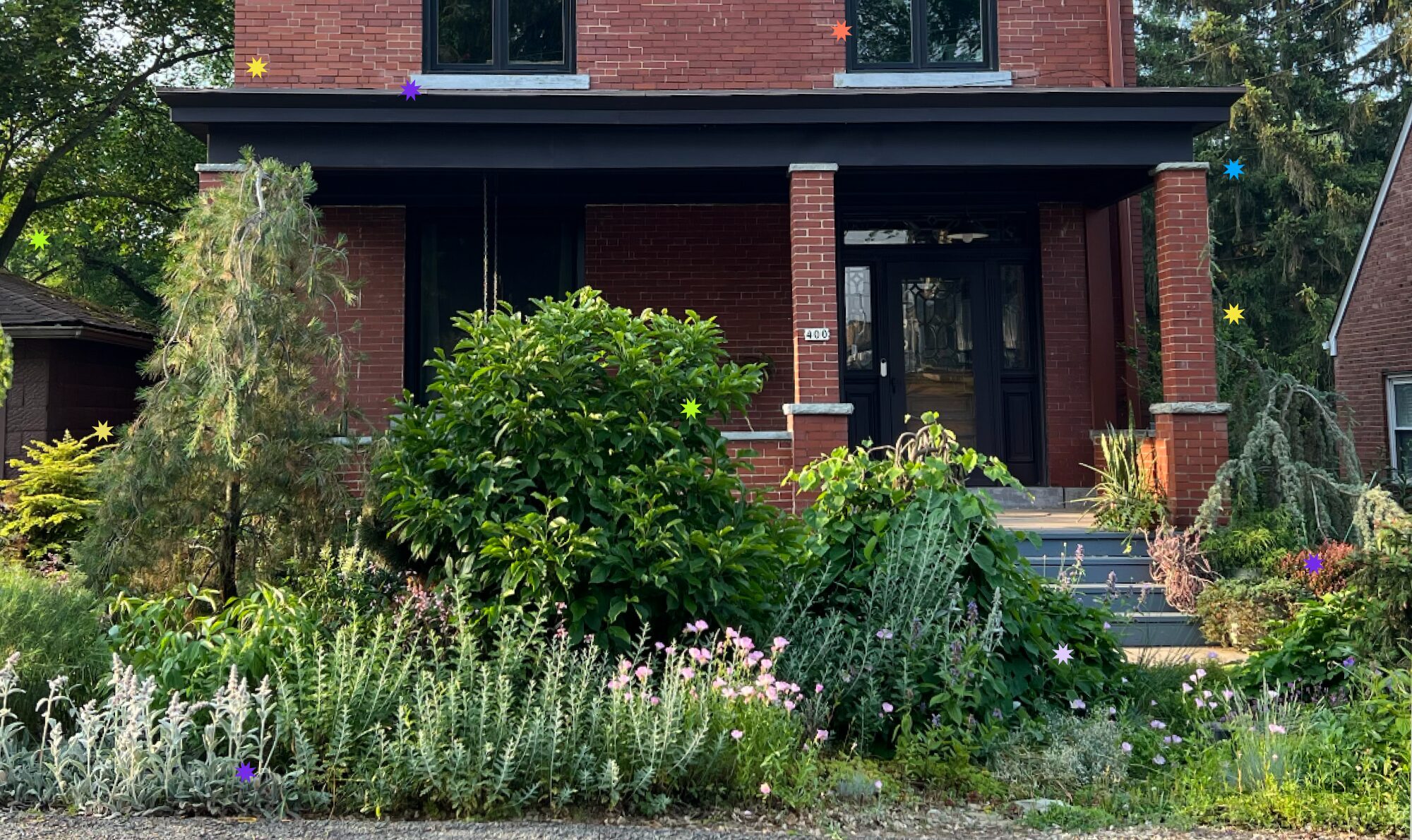
A suburban lawn can be a garden ❁
Designer Elana Schlenker on transforming her Pittsburgh yard into an ecological oasis.

The future of food is relational ❂
LinYee Yuan on how to design and build more resilient local food ecologies.

Finding the life world
Sarah Ryhanen on falling out of love with flowers, chasing friction, and becoming her own student at World’s End School.

An almanac for a tender world
Ana Bessie Ratner on cult-inspired farming, platforming life’s detritus, and her reimagined version of the world’s longest-running publication.

Not just a bunch of trees
Artist and environmentalist Zoe Keller on illustrating biodiversity, fighting to protect her beloved Zena Highwoods, and the developers who called the cops on her for looking at toads.

Tech support for a heated planet
Sanjana Paul on studying data centers, leaving NASA, being a “climate person,” and incrementally building our decarbonization muscles.