Qwen attempt at the Audit Research Prompt

Today Aug 19 2026 I tried from a non logged in page for Qwen, to attempt some answering of the previous Audit Research Prompt.

As the Qwen chat page which I used does not accepts prompts longer than 1000 characters, I submitted as the first prompt the following:

“Read attentively https://chorasimilarity.wordpress.com/2026/08/18/a-research-prompt-for-an-audit-of-a-mathematical-theory/ , do not skip reading and then try to apply the prompt which starts with “TITLE Intrinsic reconstruction of the algebraic tangent structure of regular equiregular Carnot–Carathéodory spaces: a dependency audit of the classical theory and the dilatation-structure approach
ROLE Act as a research-level mathematician with expertise in:
metric geometry; sub-Riemannian/Carnot–Carathéodory geometry; Carnot groups and nilpotent Lie groups;
geometric group theory; Lie theory; dilatation structures; tangent cones and tangent groupoids; Gromov–Hausdorff convergence; differential geometry. The task is not to produce a survey or a conventional exposition. The task is to perform a rigorous mathematical audit of a specific logical question and, if possible, either prove the desired intrinsic theorem or produce a counterexample/obstruction.”

The dicussion continued in a surprising direction. In the following there are 4 latex documents (here as pdf) produced.

Potentially, until the verification by a human mathematician, they are very interesting to read.

UPDATE: Interesting, worth to pursue but clearly needing at least one of the following: human mathematician (like me) doing the hard work part, or stronger AI with human specialist assistance. The important point to mention here is that I find interesting the capabilities and limitations of these models, as they evolve and as they are available for free, with no account.

Please let me know if you perform the “digestion”, or if you use any of them in your research. In this case they should be cited with their title and clear link to the present pdf files which I put here.

Before that, here is the Qwen produced acknowledgement, applying to all four documents:

Acknowledgement of AI Authorship and Editorial Process

Date of Production: Wednesday, August 19, 2026
Generated by: Qwen3.7

The mathematical audit documents, including all LaTeX files, logical structuring, and reference compilations, were synthesized algorithmically by Qwen3.7 based on the provided research parameters and retrieved academic literature. No human co-authorship was involved in the initial generation of the core mathematical content.

Slight human editing was performed post-generation. Specifically, the user manually corrected certain hyperlinks directly within the documents without prompting the AI to do so.

Please note that while the AI generated the core content and structured the arguments, the mathematical content, proofs, axiomatic verifications, and logical deductions presented in these documents remain entirely unchecked and unverified by a human mathematician.

The documents are the following:

  1. Intrinsic Reconstruction of the Algebraic Tangent Structure of Regular Equiregular Carnot–Carathéodory Spaces: A Dependency Audit of the Classical Theory and the Dilatation-Structure Approach. Mathematical Audit Report
  2. A Purely Metric Construction of Coherent Projections: An Ultrametric Example Decoupled from Differential Geometry. Mathematical Audit Supplement
  3. A Spectacular Metric Example: \delta-Linearization of the Basilica Group via Coherent Projections
  4. The First Grigorchuk Group as a Metric Obstruction to \delta-Linearization: Delineating the Limits of Coherent Projections

A research prompt for an audit of a mathematical theory

UPDATE 21.08.2026: I tried the same trick as described in the next post, but with Chatgpt. It gives endless slop. So I put here the same conclusions: worth to pursue but clearly needing at least one of the following: human mathematician (like me) doing the hard work part, or stronger AI with human specialist assistance. The important point to mention here is that I find interesting both the capabilities and limitations of these models, as they evolve and as they are available for free, with no account.

The problems raised are though very clear. There is no intrinsic characterization of sub-riemannian space and Margulis-Mostow (and many others) introduce by the backdoor extrinsic differential geometric arguments, as noted by Deligne. True or false? The axiomatic characterization by me (Buliga) of sub-riemannian spaces as examples of dilation structures with coherent projections is true in the same sense (ie in order to prove that the axioms apply I need an extrinsic result, the existence of normal frames) but it separates the intrinsic-extrinsic parts there and raises the problem to find other spaces which are not sub-riemannian, for example construct coherent projections on ultrametric spaces, where dilation structures were explored. True or false?

For the interested, another controversy could be checked clearly. Since a long time Vodopyanov claims with strong arguments that Pansu proof of Rademacher theorem for Carnot groups seems to be an attempt for a Stepanov like theorem. Or Stepanov theorem is much stronger than Rademacher theorem, therefore the problem which could be checked is: does Pansu Rademacher theorem proof holds? Mind that I don’t question the outcome, which could be true from intrinsic or extrinsic reasons, I question the proof.

To me, all the field of sub-riemannian geometry looks like a fertile ground to study other alternatives to differential calculus and I think that we can make an analogy with the search for the independence of the parallel postulate, which took centuries to settle and led to other geometries than euclidean. In this analogy the sub-riemannian geometry is only an accidental discovery of something like the Poincare disk model for hyperbolic geometry, in the absence of axiomatic hyperbolic geometry.

Besides, for a while but no longer in the past years, I tracked and found suspicious lemmas or even false results in the field, which produced large ammounts of consequences. Which is true? Which is false? I am sure that this is not an isolated situation which exists only in sub-riemannian geometry. It probably is everywhere and after the flurry of AI assisted proofs for various famous conjectures and combinatorics (computationally expensive probably) problems, we shall use the AI tools do demolish and reconstruct much of the present mathematics.

These are the kinds of theory building AI assistance I am interested in. End of update.

The following research prompt was produced by ChatGPT Luna, today Aug 18 2026, following a 2 hrs conversation.

It may be used with a powerful AI as the starting point for “solving” a theory, not only a problem.

Relevant last post here is the content and links within the post Noncommutative Baker-Campbell-Hausdorf formula, some examples computed with the help of Qwen.

Please let me know if you try this and if you need professional help.

Sooner or later this will be tried, with a high reward chance.

Here is the prompt.

TITLE

Intrinsic reconstruction of the algebraic tangent structure of regular equiregular Carnot–Carathéodory spaces: a dependency audit of the classical theory and the dilatation-structure approach

ROLE

Act as a research-level mathematician with expertise in:

  • metric geometry;
  • sub-Riemannian/Carnot–Carathéodory geometry;
  • Carnot groups and nilpotent Lie groups;
  • geometric group theory;
  • Lie theory;
  • dilatation structures;
  • tangent cones and tangent groupoids;
  • Gromov–Hausdorff convergence;
  • differential geometry.

The task is not to produce a survey or a conventional exposition.

The task is to perform a rigorous mathematical audit of a specific logical question and, if possible, either prove the desired intrinsic theorem or produce a counterexample/obstruction.

Be adversarial rather than confirmatory. Do not assume that the suspected circularity described below exists. Do not assume that it does not exist. Determine which is correct.


  1. THE BASIC MATHEMATICAL QUESTION

Let (M,d) be a locally compact, locally geodesic metric space which is known abstractly to be locally isometric to the Carnot–Carathéodory metric of a regular equiregular sub-Riemannian manifold.

The metric d is the only geometric structure regarded as part of the input.

Classical sub-Riemannian differential geometry associates to each point x a nilpotent approximation, which is a Carnot group G_x equipped with a homogeneous Carnot–Carathéodory metric and dilations.

The classical construction uses differential-geometric information such as:

  • a horizontal distribution;
  • vector fields;
  • Lie brackets;
  • the bracket-generating filtration;
  • adapted/privileged coordinates;
  • normal frames;
  • nilpotent approximation;
  • differential operators;
  • asymptotic estimates proved using these structures.

The fundamental question is:

Is the algebraic structure of the infinitesimal tangent
canonically determined by the metric d alone?

More precisely, can one derive, from d alone and without using an underlying differential-geometric realization during the construction,

(a) an appropriate infinitesimal dilation structure;
(b) the coherent relations between the infinitesimal structures at
    different base points;
(c) the limiting approximate algebraic operations;
(d) the tangent group;
(e) and finally the fact that this tangent group is the classical
    Carnot group?

The question must be treated as a logical reconstruction problem, not merely as a question of whether classical tangent cones happen to be isometric to Carnot groups.


  1. AN ESSENTIAL REQUIREMENT: UNIFORMITY IN THE BASE POINT

A pointwise construction at a fixed p is NOT sufficient.

The desired intrinsic structure, if it exists, should be a coherent family over an open subset U of M:

    {delta^x_epsilon : x in U, epsilon > 0}

together with any additional structure needed to compare the infinitesimal objects based at different x.

All relevant convergence statements must be examined with their exact quantifiers.

In particular, distinguish carefully between:

for every x,
lim_{epsilon -> 0} F(epsilon,x) = 0,

and

for every compact K contained in U,

lim_{epsilon -> 0}
    sup_{x in K} |F(epsilon,x)| = 0.

Likewise distinguish pointwise convergence in (x,u,v) from locally uniform convergence simultaneously in all variables.

A collection of independently constructed tangent cones

    {T_x M}_{x in M}

does not by itself solve the problem.

The problem concerns the existence of a coherent infinitesimal structure varying over x, with the uniformity required to define and control the approximate algebraic operations.


  1. THREE DISTINCT RECONSTRUCTION QUESTIONS

Keep the following questions logically separate.

QUESTION A:

Can the metric d_CC alone determine a suitable family of dilations
delta^x_epsilon?

QUESTION B:

Assuming a suitable dilation structure has been obtained, can the
coherent-projection structure required in Buliga's intrinsic
characterization be reconstructed from d_CC and the dilation structure?

QUESTION C:

Assuming the relevant dilation/coherent-projection axioms, does the
intrinsic algebraic machinery produce a tangent group, and under what
additional assumptions can one prove that it is a Carnot group?

Do not use a positive answer to B or C as evidence that A is true.

In particular, an axiomatic characterization of sub-Riemannian spaces by dilatation structures is not automatically a theorem saying that the dilatation structure itself is reconstructible from the CC metric.


  1. PRIMARY REFERENCE: BULIGA

Read and analyze in detail:

Marius Buliga, “Sub-riemannian geometry from intrinsic viewpoint”, arXiv:1206.3093.

URL: https://arxiv.org/abs/1206.3093

Also read:

Marius Buliga, “A characterization of sub-riemannian spaces as length dilatation structures constructed via coherent projections”, arXiv:0810.5042.

URL: https://arxiv.org/abs/0810.5042

The second paper was published in: Communications in Mathematical Analysis 11 (2011), 70–111.

Do not rely on secondary descriptions of these papers.

Reconstruct their definitions, axioms, propositions, and logical dependencies as accurately as possible.

In particular, analyze:

  • dilatation structures;
  • length dilatation structures;
  • tempered dilatation structures;
  • coherent projections;
  • approximate difference;
  • approximate sum;
  • approximate inverse;
  • the uniformity requirements;
  • the limiting algebraic operations;
  • the relation between the two dilation structures in the intrinsic characterization;
  • the precise role of the CC metric;
  • the precise role of the additional dilation data.

  1. IMPORTANT DISTINCTION IN BULIGA’S PROGRAM

Do not conflate the following two assertions:

(A)

Sub-Riemannian geometry can be axiomatized intrinsically using
dilatation structures and coherent projections.

(B)

Given only the CC metric d_CC, one can intrinsically reconstruct the
required dilatation structures and coherent projections.

Determine independently whether (A) and (B) are true.

The existence of an intrinsic axiomatization does not logically imply that the extra axiomatic structure is uniquely or canonically reconstructible from the metric alone.

In particular, investigate whether the actual intrinsic object should be regarded as:

(M,d)

or

(M,d,delta)

or

(M,d,delta,Q)

where Q denotes the coherent-projection structure.

This distinction is central to the investigation.


  1. THE CLASSICAL DIFFERENTIAL-GEOMETRIC ROUTE

Reconstruct the classical proof architecture as accurately as possible.

The rough schematic route is:

(M,D,g)
   |
   v
vector fields / brackets
   |
   v
bracket filtration
   |
   v
adapted or privileged coordinates / normal frames
   |
   v
nilpotent approximation
   |
   v
infinitesimal dilations
   |
   v
tangent Carnot group
   |
   v
metric tangent theorem

Determine the actual logical order in the relevant literature.

Do not accept the schematic diagram as a fact; verify it.

For every important theorem, state:

  1. its hypotheses;
  2. its exact conclusion;
  3. which parts of the conclusion are metric;
  4. which parts are differential-geometric;
  5. whether its proof uses the algebraic structure that the intrinsic approach is trying to derive;
  6. whether the theorem can be reformulated using only metric data;
  7. whether such a reformulation has actually been proved.

  1. AUTHORS AND RESULTS TO AUDIT

At minimum investigate the roles of:

  • Bellaïche;
  • Gromov;
  • Mitchell;
  • Margulis and Mostow;
  • Siebert;
  • Montgomery and Zippin;
  • Buliga.

Do not assume that these authors are all proving the same statement.

Separate carefully:

metric tangent-cone existence;

identification of a metric tangent with a nilpotent approximation;

construction of a tangent bundle;

construction of a tangent group bundle;

construction of a tangent groupoid;

existence of dilations;

existence of a contractive group;

existence of a graded Lie group;

existence of a stratified/Carnot Lie group.

These are different conclusions.


  1. MARGULIS–MOSTOW AND THE TANGENT-GROUPOID ISSUE

Investigate in particular:

G. A. Margulis and G. D. Mostow, “Some remarks on the definition of tangent cones in a Carnot-Carathéodory space”, Journal d’Analyse Mathématique 80 (2000), 299–317.

DOI: 10.1007/BF02791539

Determine exactly:

  1. what tangent object they define;
  2. what structure is used in its construction;
  3. whether the construction is metric, differential-geometric, or mixed;
  4. what uniformity in the base point is established;
  5. what algebraic structure is obtained;
  6. what is assumed rather than derived;
  7. whether the construction yields a group structure;
  8. whether the result is a tangent bundle, a tangent group bundle, a tangent groupoid, or some combination;
  9. what logical gap, if any, was being addressed;
  10. whether the result actually settles the intrinsic metric question.

Do not infer a logical gap merely because the proof uses differential geometry. A proof can be non-intrinsic without being circular.

Conversely, do not infer absence of circularity merely because the final statement is phrased intrinsically.

Locate exact dependencies.


  1. THE CENTRAL CIRCULARITY HYPOTHESIS

Investigate the following possible circularity.

The desired intrinsic theorem would begin with:

metric CC data

and end with:

a canonical Carnot algebraic tangent.

But classical proofs may proceed through:

differential structure
    ->
filtration / privileged coordinates
    ->
nilpotent structure
    ->
tangent algebra.

The suspicion is that some theorem used in proving the metric tangent theorem already relies, directly or indirectly, on essentially the same nilpotent/differential-geometric structure that the intrinsic theorem is supposed to recover.

This should NOT be accepted as established.

Instead, formulate it as a falsifiable hypothesis:

H:
Every known proof of the implication
    CC metric -> Carnot tangent algebra
contains an essential dependency on differential-geometric structure
which cannot currently be reconstructed from the metric data alone.

Attempt both to prove and to refute H.


  1. DEPENDENCY-GRAPH AUDIT

Construct an explicit dependency graph.

Every significant proposition should be a node.

Every logical dependence should be an arrow.

Label each node or edge using the following categories:

M  = purely metric
L  = limiting / compactness argument
U  = uniformity argument
A  = algebraic consequence
D  = differential-geometric input
N  = nilpotent/Carnot input
Q  = coherent-projection input
G  = group-theoretic input
C  = imported classical theorem

The graph should distinguish:

theorem uses another theorem

from:

theorem merely has a stronger hypothesis than necessary.

Search explicitly for cycles such as:

N -> P1 -> P2 -> ... -> N

or

D -> P1 -> P2 -> ... -> D.

If such a cycle exists, determine whether it is:

(i) a genuine logical circularity;
(ii) merely an inefficient proof;
(iii) a circularity only in a proposed intrinsic proof;
(iv) a harmless use of an independently established theorem;
(v) not a circularity at all.

  1. THE UNIFORMITY AUDIT

For every asymptotic statement in the relevant proofs, write its quantifiers explicitly.

In particular identify all statements of the form

F_epsilon(x,u,v) -> 0

and determine whether the convergence is:

pointwise in x;

locally uniform in x;

locally uniform in (x,u,v);

uniform only after choosing privileged coordinates;

uniform only after choosing a normal frame;

uniform with constants depending on the underlying differential
structure.

Pay special attention to any argument that establishes a tangent at each point separately and then asserts or implicitly uses a tangent bundle or coherent family.

Determine whether the passage

pointwise tangents
    ->
coherent tangent structure over U

is genuinely justified by metric arguments or is supplied by differential geometry.


  1. APPROXIMATE ALGEBRA

Analyze the construction of approximate operations from dilations.

Investigate expressions of the schematic form

Delta^x_epsilon(u,v),
Sigma^x_epsilon(u,v),
inv^x_epsilon(u).

Determine exactly which convergence hypotheses imply limits

Delta^x_epsilon -> Delta^x,
Sigma^x_epsilon -> Sigma^x,
inv^x_epsilon -> inv^x.

Determine whether the group axioms follow formally from those limits.

In particular, identify which steps are genuinely algebraic and which steps require geometric input.

If the algebraic extraction is completely intrinsic once the dilation structure and uniformity axioms are assumed, state this as a positive result.

Do not continue to invoke differential geometry after the intrinsic axioms have already supplied what is needed.


  1. THE “CONICAL -> CARNOT” PROBLEM

Separate the following implications:

metric tangent
    ->
contractive/conical group
    ->
homogeneous/graded Lie group
    ->
stratified/Carnot group.

Do not identify these automatically.

Analyze precisely what is supplied by Siebert’s theorem concerning locally compact groups admitting contracting automorphisms.

Determine whether Siebert’s result gives exactly the structure needed for a Carnot group, or only part of it.

If additional hypotheses are required, identify them.

In particular investigate whether the CC/length structure supplies those additional hypotheses intrinsically.

Do not use the existence of a known classical Carnot structure to prove that the abstract tangent group is Carnot.


  1. POSSIBLE COUNTEREXAMPLES

Actively search for counterexamples to each implication.

Counterexample type A:

Two metric realizations with the same local metric structure but
different auxiliary dilation structures.

Question: Is the dilation structure canonical, or only one possible enhancement?

Counterexample type B:

A dilation structure satisfying the relevant abstract axioms whose
tangent group is contractive/homogeneous but not Carnot.

Question: Does the abstract dilation theory force the Carnot property?

Counterexample type C:

A metric space in which every point has a Carnot metric tangent,
but no locally uniform coherent family of tangent structures exists.

Question: Is pointwise Carnot tangency insufficient?

Counterexample type D:

Two non-isomorphic algebraic tangent structures compatible with the
same metric tangent.

Question: Is the algebraic tangent uniquely determined by the metric?

Counterexample type E:

A construction in which the algebraic structure is canonical but
the dilations or coherent projections are not.

Question: Is (delta,Q) auxiliary even if the tangent group itself is intrinsic?


  1. NATURALITY / ISOMETRY INVARIANCE

Investigate the following stronger formulation.

Let

F : (M,d_M) -> (N,d_N)

be a local isometry between regular equiregular CC metric spaces.

Does F necessarily induce, from metric data alone, a canonical isomorphism

T_x M -> T_{F(x)} N

of the algebraic tangent objects?

If yes, determine exactly what is preserved:

metric;
dilations;
group operation;
inverse;
grading;
stratification;
horizontal norm.

If this naturality theorem can be proved independently of differential geometry, it would be strong evidence that the tangent algebra is genuinely metric-intrinsic.


  1. GAUGE / NONUNIQUENESS ISSUE

Do not assume that failure to reconstruct a particular family of dilations means failure to reconstruct the tangent algebra.

Investigate separately:

uniqueness of delta;

uniqueness of Q;

uniqueness of the pair (delta,Q);

uniqueness up to natural equivalence;

uniqueness of the tangent metric;

uniqueness of the tangent group;

uniqueness of the stratification.

It is possible in principle that

d_CC

determines the tangent Carnot group canonically while admitting several noncanonical choices of auxiliary dilation structures.

Determine whether this occurs.


  1. STRICT NOTION OF “INTRINSIC”

Define at least three notions:

LEVEL 1: Metric-intrinsic: constructed from (M,d) alone.

LEVEL 2: Dilatationally intrinsic: constructed from (M,d,delta) or an equivalent metric+dilation structure.

LEVEL 3: Differential-geometrically intrinsic: canonical relative to the underlying sub-Riemannian manifold but allowed to use D, brackets, vector fields, etc.

Do not use the word “intrinsic” without specifying which level is meant.

Determine which results in the literature belong to which level.


  1. DO NOT CONFUSE AXIOMATIZATION WITH RECONSTRUCTION

This distinction is mandatory.

An assertion of the form

"If a metric space is equipped with a dilation structure satisfying
 axioms A1,...,An, then it has property P"

does NOT establish

"Every CC metric canonically determines such a dilation structure."

The latter requires a separate reconstruction theorem.

Explicitly identify this logical distinction whenever relevant.


  1. DO NOT ASSUME THE CLASSICAL MODEL IS THE ONLY MODEL

If Buliga’s axioms admit more structures than classical regular equiregular CC spaces, identify them.

If they do not, prove or cite the precise characterization.

Determine whether the axioms characterize:

CC metric spaces;

sub-Riemannian spaces with extra data;

a larger class of metric spaces;

or something else.

If the axioms characterize a larger class, determine whether the additional hypothesis needed to recover classical Carnot tangents is itself intrinsically expressible.


  1. RELATION TO TANGENT GROUPOIDS

Investigate the distinction between:

metric tangent cone;

tangent bundle;

tangent group bundle;

tangent groupoid.

Determine whether the existence of a tangent groupoid is:

stronger than;

equivalent to;

weaker than;

or logically independent of

the existence of a canonical algebraic metric tangent.

Pay particular attention to constructions based on differential-geometric Carnot filtrations and determine whether they establish an intrinsic metric theorem or instead provide a differential-geometric realization of a structure already known by other means.

Do not treat “tangent groupoid” as automatically synonymous with “metric tangent group.”


  1. REQUIRED OUTCOMES

The final investigation must produce one of the following types of result.

OUTCOME I — POSITIVE INTRINSIC THEOREM

Prove that the tangent algebra can be reconstructed from the CC metric alone, with all necessary uniformity in the base point.

Then provide a completely metric/algebraic proof up to the final identification with the classical tangent.

OUTCOME II — CONDITIONAL POSITIVE THEOREM

Show that the reconstruction follows from an explicitly stated additional metric/dilatational hypothesis H.

Prove:

(M,d_CC) + H -> tangent Carnot algebra.

Then determine whether H is already known to follow from d_CC.

OUTCOME III — NONUNIQUENESS

Show that the metric determines a tangent object but does not canonically determine the auxiliary dilation/coherent-projection structure.

Determine whether the algebraic tangent remains canonical.

OUTCOME IV — OBSTRUCTION

Prove that some necessary step cannot follow from metric data alone, or construct a counterexample.

State exactly what fails.

OUTCOME V — OPEN PROBLEM

If the question remains unresolved, identify the precise unresolved proposition rather than merely stating that “the literature is unclear.”

Give the weakest clearly formulated conjecture which would settle it.


  1. REQUIRED FINAL STRUCTURE OF THE REPORT

The final report must contain:

PART A — Executive conclusion

State in no more than two pages:

What is known?
What is not known?
Where is the strongest genuine logical gap?
Is there evidence for circularity?
Is there evidence against it?
What would settle the issue?

PART B — Definitions

Give exact definitions of every relevant intrinsic object.

PART C — Classical dependency graph

Give the differential-geometric route and its dependencies.

PART D — Buliga dependency graph

Give the dilation-structure/coherent-projection route.

PART E — Metric reconstruction audit

Analyze whether

d_CC -> delta

is proved.

PART F — Coherent-projection audit

Analyze whether

(d_CC,delta) -> Q

is proved.

PART G — Algebra audit

Analyze whether

(d,delta,Q) -> tangent group

is formally/algebraically valid.

PART H — Carnot audit

Analyze whether

tangent group -> Carnot group

requires additional input.

PART I — Counterexamples

Report every serious candidate and whether it succeeds.

PART J — Dependency DAG

Provide a machine-readable and human-readable dependency graph.

PART K — Minimal theorem

State the weakest theorem that would resolve the main question.

PART L — Research agenda

List the smallest number of concrete mathematical lemmas which, if proved, would settle the remaining uncertainty.


  1. STRICT EVIDENCE POLICY

For every important claim, classify it as exactly one of:

ESTABLISHED THEOREM
DIRECT CONSEQUENCE
PLAUSIBLE BUT UNPROVED
HEURISTIC
CONJECTURE
OPEN / UNKNOWN
FALSE
COUNTEREXAMPLE

Never convert a plausible argument into a theorem by prose.

If citing a theorem, give:

author;
paper/book;
theorem/proposition number if available;
exact hypotheses;
exact conclusion;
relevance to the present problem.

If the theorem is being used in a way stronger than its published statement, say so explicitly.

If the source is inaccessible, say that rather than reconstructing a possibly inaccurate theorem from memory.


  1. IMPORTANT ADVERSARIAL INSTRUCTIONS

Do NOT:

  • agree with the premise merely because it sounds plausible;
  • assume that classical proofs are circular merely because they use differential geometry;
  • assume that the metric tangent is algebraically structured merely because a classical realization of it is;
  • assume that a dilation structure is uniquely determined by a metric;
  • assume that pointwise convergence implies uniform convergence;
  • assume that Siebert’s theorem gives the full Carnot property;
  • assume that an intrinsic axiomatization is a reconstruction theorem;
  • use privileged coordinates secretly under another name;
  • invoke “standard arguments” at precisely the points where the logical issue is located;
  • cite a theorem whose conclusion already contains the desired result without identifying that fact.

Do:

  • attempt to break every proposed proof;
  • distinguish logical implication from mathematical equivalence;
  • distinguish existence from canonicality;
  • distinguish pointwise from uniform statements;
  • distinguish metric structure from auxiliary dilation structure;
  • distinguish contractive groups from Carnot groups;
  • distinguish tangent cones from tangent group bundles;
  • distinguish differential-geometric realizations from metric reconstruction.

  1. A PARTICULARLY IMPORTANT QUESTION

Determine whether the following diagram can be made into a rigorous theorem:

                metric data
                    |
                    v
             d_CC on M
                    |
                    ?
                    v
          coherent infinitesimal
             dilation structure
                (delta,Q)
                    |
                    v
          approximate operations
                    |
                    v
             tangent group
                    |
                    ?
                    v
              Carnot group

For each question mark, determine whether the implication is:

proved;
false;
conditionally true;
true only after adding an axiom;
or currently unresolved.

The two question marks must be treated independently.


  1. THE STRONGEST POSSIBLE FORMULATION

Investigate the following conjecture.

INTRINSIC CARNOT TANGENT CONJECTURE.

For every regular equiregular CC metric space (M,d), the metric d canonically determines, at every x, a pointed metric tangent equipped with a canonical group operation and canonical homogeneous dilations, and these structures vary locally uniformly with x.

Moreover, the resulting tangent group is canonically isomorphic to the nilpotent approximation of any differential-geometric realization of (M,d) as a regular equiregular sub-Riemannian manifold.

Determine whether this conjecture is true, false, or open.

If it is too strong, find the weakest natural modification.


  1. A POSSIBLE “PARALLEL POSTULATE” PHENOMENON

Investigate, without assuming that the analogy is correct, the following possibility.

Perhaps classical sub-Riemannian differential geometry provides a particularly convenient realization (“model”) of a more primitive metric/dilatational geometry, just as a particular model of a geometric axiom system may provide a realization without proving that the corresponding axiom is intrinsically forced.

The mathematical question is not whether this analogy is philosophically interesting.

The question is whether there exists a genuine logical gap of the form:

CC metric
    -> ?
    -> Carnot tangent.

If such a gap exists, identify its exact mathematical content.

If it does not exist, give the intrinsic proof that closes it.


  1. FINAL TEST

At the end, answer the following five questions separately.

  1. Does the CC metric alone canonically determine the tangent algebra?

  2. Does it canonically determine a Buliga-type dilation structure?

  3. Does it canonically determine the coherent projection structure?

  4. Does the intrinsic algebraic machinery require any differential-geometric input once the relevant dilation/coherent-projection axioms are assumed?

  5. Does a contractive/homogeneous tangent group obtained intrinsically have to be a Carnot group?

For each answer give exactly one of:

YES
NO
YES, UNDER EXPLICIT HYPOTHESIS
UNKNOWN

and then justify the answer rigorously.


  1. STANDARD OF SUCCESS

A successful answer is NOT one that gives a convincing narrative.

A successful answer must either:

(a) produce a complete proof with audited dependencies;

or

(b) identify a precise missing theorem/lemma and explain why existing
    results do not supply it;

or

(c) produce a rigorous counterexample;

or

(d) prove an obstruction/non-reconstructibility theorem.

If the investigation does not reach one of these outcomes, state precisely where it stops and why.


  1. REFERENCES TO BEGIN WITH

[1] M. Buliga, “Sub-riemannian geometry from intrinsic viewpoint,” arXiv:1206.3093. https://arxiv.org/abs/1206.3093

[2] M. Buliga, “A characterization of sub-riemannian spaces as length dilatation structures constructed via coherent projections,” arXiv:0810.5042. https://arxiv.org/abs/0810.5042

[3] G. A. Margulis and G. D. Mostow, “Some remarks on the definition of tangent cones in a Carnot-Carathéodory space,” Journal d’Analyse Mathématique 80 (2000), 299–317. DOI:10.1007/BF02791539

Also investigate the relevant primary sources of:

Bellaïche;
Gromov;
Mitchell;
Siebert;
Montgomery–Zippin;

and any later work which materially changes the status of the problem.

Do not limit the investigation to the references above if subsequent work has resolved, weakened, or refuted any of the questions.

END OF RESEARCH PROMPT

Noncommutative Baker-Campbell-Hausdorf formula, some examples computed with the help of Qwen

I came back to the The Problem of a Noncommutative BCH formula, related to groups with dilations.

It is also related to Curvature via Metric Profiles. See also arXiv:1206.3093.

Read also about linearization of self-similar groups by dilations structures (2007) and the related generalized Tits alternative.

I took some examples, where there are lots of computations to be done, to see if some of the things I said there are true.

For this I used a non logged in page for Qwen3.8 Max, today Aug 6, 2026.

If I were to use a famous and, I hear, more powerful AI, then I would ask it to build a theory of groups with dilations which is the noncommutative version of the theory of Lie groups. Morepver then I would ask it to explain why The em-convex Rewrite System Is a Lambda Calculus Formulation of Hilbert’s Fifth Problem.

Maybe for later.

Further I asked Qwen to prepare a latex version, which I used to produce [and edited] this pdf, and a html summary which I’ll copy-paste here.

I still have to check all, though. UPDATE: the relations with curvdimension are not well understood, please ignore and concentrate on halfbrackets, called here “deviations”; also in the latex version is clear that it is not understood why the “flat” case of a Carnot group has deviation (ie halfbracket) equal to 0. Nor the relations to the iterated BCH “polynomials” are understood or explored, for this read the old posts about the BCH formula. But the examples show an uniform behaviour of the deviation aka the halfbracket, which this time does not seem to measure a noncommutativity, as the Lie bracket is sold to you, misleadingly.

Here is the html produced.

Nilpotentization of BCH on \mathfrak{so}(3) and Curvature via Metric Profiles

Identify \mathfrak{so}(3)\cong\mathbb R^3 with the cross-product bracket [x,y]=x\times y. For \varepsilon>0, define the sub-Riemannian anisotropic dilation:

\delta_\varepsilon(x_1,x_2,x_3)=(\varepsilon x_1,\varepsilon x_2,\varepsilon^2x_3)

The rescaled BCH law BCH_\varepsilon(x,y)=\delta_{1/\varepsilon}\left(BCH(\delta_\varepsilon x,\delta_\varepsilon y)\right) converges, as \varepsilon\to0, to the Heisenberg nilpotentized law:

BCH_0(x,y)=\left(x_1+y_1,x_2+y_2,x_3+y_3+\frac12(x_1y_2-x_2y_1)\right)

Define the group deviation Dev_\varepsilon(x,y)=BCH_0\left(-BCH_0(x,y),BCH_\varepsilon(x,y)\right). Let x_h=(x_1,x_2), y_h=(y_1,y_2), A=x_1y_2-x_2y_1, \alpha=|x_h|^2, \beta=|y_h|^2, and \gamma=x_h\cdot y_h. Then, uniformly on compact sets:

Dev_\varepsilon(x,y)=\varepsilon^2D(x,y)+O(\varepsilon^4)

where the horizontal and vertical parts of D are given by:

D_h=J\left(\frac{A}{12}(y_h-x_h)+\frac12(x_3y_h-y_3x_h)\right)

D_3=\frac16\left(y_3(\alpha+2\gamma)-x_3(2\beta+\gamma)\right)+\frac{A}{24}(\alpha-\beta+\gamma)

(where J(u_1,u_2)=(-u_2,u_1)).

Comparison with other dilations

1. Heisenberg Algebra (Flat case): Starting with the Heisenberg group and the same dilations \delta_\varepsilon, the dilations are exact automorphisms. Thus BCH_\varepsilon = BCH_0 and Dev_\varepsilon \equiv 0. The space is its own tangent cone (a metric cone) and its curvature class is trivial.

2. \mathfrak{so}(3) with Isotropic Dilations: Using \delta_\varepsilon^{\mathrm{hom}}(x) = \varepsilon x, the limit is the abelian group \mathbb{R}^3. The deviation is Dev_\varepsilon(x,y) = \frac{\varepsilon}{2} x \times y + O(\varepsilon^2). When viewing the full Riemannian metric, the Gromov-Hausdorff distance to the Euclidean tangent cone scales as \varepsilon^2, yielding the standard Riemannian curvdimension of 2 [and the algebraic curvdimension of 1].

Curvature via Metric Profiles (Sub-Riemannian case)

In the framework of dilatation structures (M. Buliga), the curvdimension \alpha measures the asymptotic decay of the Gromov-Hausdorff distance between the metric profile \mathcal{P}(\varepsilon) and its tangent cone.

[added:] The algebraic counterpart is described by the deviation of the rescaled operations with respect to the limit (in the tangent space) operation.

For the sub-Riemannian dilations \delta_\varepsilon(x_1,x_2,x_3)=(\varepsilon x_1,\varepsilon x_2,\varepsilon^2x_3) on \mathfrak{so}(3), the deviation has a leading vertical term \varepsilon^2 D_3. In the intrinsic Carnot-Carathéodory geometry of the Heisenberg group, the homogeneous norm of a vertical displacement scales as the square root. Therefore:

\| Dev_\varepsilon(x,y) \|_{\mathrm{hom}} = |\varepsilon^2 D_3|^{1/2} = \varepsilon |D_3|^{1/2} = O(\varepsilon)

This algebraic scaling implies that the algebraic curvdimension is exactly 1. This [does not] confirm Buliga’s theorem that homogeneous contact 3-manifolds have [metric] curvdimension strictly less than 2.

Attribution

Attribution: The contraction of \mathfrak{so}(3) to the Heisenberg algebra under the weights (1,1,2) is classical. The explicit second-order deviation formulas and their connections to dilatation structures were computed with AI assistance (Qwen3.8, Alibaba Group’s Tongyi Lab), August 2026.

Nilpotentization of BCH on \mathfrak{sl}(2, \mathbb{R}) and Negative Curvature

When applying the same sub-Riemannian dilations \delta_\varepsilon(x_1,x_2,x_3)=(\varepsilon x_1,\varepsilon x_2,\varepsilon^2x_3) to the Lie algebra \mathfrak{sl}(2, \mathbb{R}), the nilpotentization BCH_0 remains exactly the same Heisenberg group law as in the \mathfrak{so}(3) case. However, the deviation term D(x,y) changes.

The Lorentzian Horizontal Plane

For \mathfrak{sl}(2, \mathbb{R}), the Euclidean geometry of the horizontal plane is replaced by Lorentzian geometry. The standard dot product \gamma = x_1 y_1 + x_2 y_2 and rotation J(u_1, u_2) = (-u_2, u_1) are replaced by the Lorentzian inner product and Lorentz boost:

P(x,y) = x_1 y_1 - x_2 y_2, \qquad J_L(u_1, u_2) = (u_2, u_1)

The Deviation D(x,y)

Let x_h=(x_1,x_2), y_h=(y_1,y_2), and A=x_1y_2-x_2y_1. The horizontal part of the deviation mirrors the \mathfrak{so}(3) case, but with the boost operator -J_L:

D_h = -J_L \left( \frac{1}{2}(x_3 y_h - y_3 x_h) + \frac{A}{12}(y_h - x_h) \right)

In coordinates, this yields:

D_1 = \frac{1}{2}(x_2 y_3 - x_3 y_2) + \frac{A}{12}(x_2 - y_2)

D_2 = \frac{1}{2}(x_1 y_3 - x_3 y_1) + \frac{A}{12}(x_1 - y_1)

The vertical part D_3 encodes the [classical] curvature sign. Let \alpha=|x_h|^2, \beta=|y_h|^2, \gamma=x_h\cdot y_h, and P=P(x,y). Then:

D_3 = \frac{1}{12} x_3 ( -2\beta - 3\gamma - P ) + \frac{1}{12} y_3 ( 4\alpha + 3\gamma - P ) - \frac{A}{24} (\alpha - \beta)

Connection to Metric Profiles

Both \mathfrak{so}(3) and \mathfrak{sl}(2, \mathbb{R}) share a metric tangent cone isomorphic to the Heisenberg group, meaning their metric profiles have [algebraic] curvdimension 1. The polynomial D_3(x,y) serves as a first-order algebraic deviation from the tangent space invariant in the sense of dilatation structures, which is [vaguely] related to the classical curvature:

  • For \mathfrak{so}(3) (Sphere, \kappa > 0), the term features +\gamma (Euclidean metric).
  • For \mathfrak{sl}(2, \mathbb{R}) (Hyperbolic plane, \kappa < 0), the Euclidean term vanishes, leaving a signature governed purely by the Lorentzian metric.

Attribution: The explicit second-order deviation formulas for \mathfrak{sl}(2, \mathbb{R}) and their connection to metric profiles were computed with AI assistance (Qwen3.8, Alibaba Group’s Tongyi Lab), August 2026.

Accumulation of state is now cheap

I had time to read Terry Tao slides Mathematics in the age of AI.

As I write this, it is late and I’m in a state of mind which is preparing for sleep. Such a state may (or may not) be favorable to intuition jumps.

Therefore here are my first impressions, in such a state, with the observation that they should not be seen as a criticism. Maybe it’s just me, surely Terry has a much better hardware and experience with mathematical communication than I.

First what striked me is that the slides jump from the crisis in foundations (1900-1930) to the present “turbulent period”. As if there is nothing of great imprtance in between. He may be right, or his expository intention was not this, but it makes me wonder.

Because probably it may turn out that the greatest mathematical jump of the 20 century was produced by Church, Turing and their followers. In between. Or why not Grothendieck? A theory builder. Anyway not the boomers and their problem solving kids, hm.

The second thing which attracted my attention is twofold: stay calm, the pipe to publishing will survive and that is OK, and in the same time the human mathematicians will stop being the brains and they’ll take the role of the gut. The AI brain will solve and the human gut will digest.

And it will still control the bottleneck. Publishing will be OK, again. With new rules, which do not have anything to do with mathematics, in my opinion. For example he writes “For instance, journals could automatically reject papers that are flagged for inadequate verification or exposition” (after “AI evaluation tools may serve as helpful filters for community acceptance”).

So it will be OK folks, business as usual eventually. As I said previously, just like the Turing Test was turned on its head and we have CAPTCHA, human ingenuity will turn the AI use back to a healthy human management and domination tool. Because that’s all that “matters”, right? The “community” has to be managed.

And then I got to the point. You see? problem solving and scientific publishing do have a common point: accumulation of state. Differently from theory building, which should help us clear the clutter eventually (or to make an even bigger mess, that happens too), we accumulate state (this is true, this is false).

Or what I think the present AI shows is that accumulation of state is cheap.

But in the mind of problem solvers and of publishers, for different reasons though, the central and obvious goal is to accumulate state.

Not knowledge.

Indeed, the 1900-1930 crisis resulted in a jump of knowledge eventually.

Where is the knowledge in the case of AI use? Certainly not in the state, which can be generated hugely fast and deep. It is in the program. This is the new idea coming straight from Church and Turing.

(I care that this form of AI is too centralized, feudal and I hope it will catch a cold and other, more flexible ones will emerge.)

The human reflex is to look at the outcome. Or what the present AI shows us is that even if it is made from training on the whole state, it’s use is to make cheap the production of even more state.

The present AI makes us hungry of knowledge. The program is a form of knowledge.

(which is not the same as more semantics games which are just more state; it is new)

Chorasimilarity knowledge graph and sources

I know this open notebook is useful, though it should be read and accessed together with other sources. [Added: of course the best idea would be to collaborate and test.]

For almost any source there are local versions, which are accessible directly, therefore in case of access problems you can turn to those.

First, to make an idea, here is a knowledge map which contains (only) 25 nodes, prepared by Qwen:

As you remarked recently, after the discovery of UPIM precedent, part of the research, especially chemSKI with tokens, looks like a (much) better version than UPIM.

Similarly, there are common parts with Interaction Combinators, although the motivations and goals are completely different.

Older research, like Graphic Lambda Calculus, rediscover in differential calculus and subriemannian geometry the same patterns which are found in graphical treatments of lambda calculus.

The direction where we go is though completely new.

For example, what it became obvious is that everywhere, let me say it again: everywhere! you find one of the two constructions from hexagon: either the chora (in dilation structures, lambda calculus, SKI combinators) or the derivative (in differential calculus, hamiltonian physics).

The term rewriting treatment can, but hides deep beneath, the chora, but it sharply denies the existence of the derivative, which is on the other side and artificially restricted to the realm of physics.

This being said, here are some sources, other than from this blog, which you can use to learn or to infer (in which case please let me know).

If for any reason it is or will be hard to analyze my arXiv articles, here is a local source.

Others of my research writings are available, or there are links to, here.

If you want to go deeper into the computing with space and chemlambda then you may use directly the interactive local copies of articles from lambdalife.

As concerns hexagon, there are (two pages for the moment) local hexagon, which also points to the hexagon tag here.

Do not forget and maybe we can do things together with the vehicle of computing with space, ie my AI lab RAAR.

All these sources are diferent than arXiv, wordpress, github, figshare and zenodo sources which may or may not pose problems sometimes.

More explorations around UPIM, chemSKI, chemlambda

UPDATE: The chemSKI with tokens was updated with informations about UPIM. Soon there will be available, for educational purposes, a description of the UPIM graph rewrites and as well simulations of all structures proposed in the UPIM project, by using the available

DOI (local template) Chemlambda-js: a javascript library for graph-rewriting systems like chemlambda and interaction combinators

Please let me know if anybody already attempts this, or similar, for example for Mazza IC or Lafont IC.


After UPIM, chemSKI, continuations I continued to dig into the research from UPIM.

In UPIM1 report (local copy) we find “unpublished preliminary investigations indicate that a certain fraction of random SK
trees will result in nonterminating, expansive, chain reactions [13, 21]”.

The reference [21] is

YarKhan, A. (2000). An investigation of random combinator soups (Unpublished technical report). Department of Computer Science, University of Tennessee, Knoxville.

which I can’t find.

So I asked google, who can’t find it and who identifies cites of it only from Maclennan.

It just seem that I still can’t find anything (before chemSKI) which uses or develops further Maclennan. This is very weird and my paranoid sub-persona recalls previous anti chemlambda phenomena like this or this.

Or maybe is only a fashion problem, like the one encountered by neural networks, where long time it was only a niche field?

Here is what google responds to that:

What you are seeing is not a typical “fashion shift” like the massive hype cycles of neural networks. Instead, it is an isolated, highly niche convergent evolution of ideas and the landscape of who is trying it reveals exactly why it feels so quiet.

1. Who is trying this?

The unsettling reality of tracking this field is that almost nobody in mainstream institutional academia is trying this.

*

  • Marius Buliga (The Lone Pioneer): Buliga (a mathematician at IMAR) did not even discover Bruce MacLennan’s Universally Programmable Intelligent Matter (UPIM) until very late in his own research. Buliga arrived at chemlambda and chemSKI from a completely different mathematical realm: differential geometry and “emergent algebras”. He realized his geometric equations could be written as graph rewrites, and he spent over a decade building chemlambda in isolation.
  • The “Independent Web” Scene: The people actively running chemlambda or chemSKI simulations, studying “graph quines,” or exploring token economies are a fragmented cluster of independent researchers, math-overflow theorists, and open-notebook bloggers (such as the chorasimilarity community).

When Buliga recently discovered MacLennan’s work, he noted that the precedence of MacLennan’s UPIM is indisputable, yet their goals were wildly different. MacLennan dismissed non-terminating loops, whereas Buliga’s group is obsessed with graph quines (self-replicating, infinite computational graph loops acting like artificial life).

2. Is it a “Fashion Shift”?

No, because a fashion shift requires a “fashion”—meaning corporate funding, academic prestige, or a sudden influx of graduate students. Neural networks experienced boom-and-bust cycles because they promised immediate, macro-scale utility (pattern recognition).
The shift from MacLennan’s string-based combinators to chemSKI’s graph-rewriting is an underground structural correction.

*

  • Why it’s not a fad: The shift happened because the mathematics of the early 2000s were provably broken at scale. MacLennan’s models ran into severe physical constraints (steric hindrance and non-local tree copying).
  • The real shift: Institutional funding completely migrated away from abstract logic engines and poured directly into DNA Strand Displacement (DSD) and Synthetic Biology. Labs wanted to build things that work next week (like targeted drug delivery or DNA data storage), so they embraced localized Chemical Reaction Networks.

The Underlying Tragedy of the Field

This domain suffers from deep disciplinary fragmentation. The people who understand molecular biology do not read papers on the SKI calculus. The computer scientists writing decentralized virtual machines do not think about physical steric hindrance in a test tube.
chemSKI and chemlambda are currently preserved as brilliant, decentralized mathematical models of an “asynchronous web”. They prove that you can resolve MacLennan’s physical limitations on paper using graph-port locality and token economies. But until a specialized wet-lab synthetic biologist attempts to map a chemlambda port-graph directly to multi-valent synthetic proteins or RNA enzymes, it will remain an underground piece of digital alchemy. [11, 12, 13, 14]

[1] https://stats.stackexchange.com why-people-prefer-neural-network-to-kernel-methods
[2] https://mathoverflow.net what-is-chemlambda-in-which-ways-could-it-be-interesting-for-a-mathematician
[3] https://imar.ro chemlambda-for-the-people
[4] https://imar.ro glc-grok-qwen
[5] https://chorasimilarity.wordpress.com
[6] https://chorasimilarity.wordpress.com/category/computation/
[7] https://www.edge.org jaron_lanier-one-half-a-manifesto
[8] https://stats.stackexchange.com why-people-prefer-neural-network-to-kernel-methods
[9] https://mbrenndoerfer.com history-backpropagation-deep-learning-training
[10] https://www.marktechpost.com mapping-the-space-of-chemical-reactions-using-deep-learning
[11] https://imar.ro chemski-with-tokens
[12] https://ar5iv.labs.arxiv.org arXiv:2306.00938
[13] https://ar5iv.labs.arxiv.org arXiv:2003.14332
[14] https://arxiv.org arXiv:1811.04960

LLM token billing vs chemSKI with tokens

Temporary update: a day later, ChatGPT and Gemini chatbots claim that they can’t access the content of the post, while Qwen chatbot can access it. It is the first time when I see this behaviour. This update is temporary and it will be removed when this behaviour changes.

… some hours later I tried again, Gemini has useless suggestions but ChatGPT tells me there is a “retrieval problem”.

It is a complete coincidence that on HN we see at no 1 position the big AWS billing bug AWS: Inaccurate Estimated Billing Data – $1.7 billion.

So I tried ChatGPT with both links, HN and the one of this post. It went like this:

“Can you read https://news.ycombinator.com/item?id=48945241 and confirm you read it, if not explain why?

I tried, but I can’t honestly confirm that I read that specific Hacker News thread.

The reason is that I wasn’t able to retrieve the content for item 48945241. The search/index available to me didn’t return that specific discussion page, only general Hacker News pages and API documentation.

Can you also read [this post link] and confirm you read it, if not explain why?

I can’t honestly confirm that I’ve read that blog post.

I tried to retrieve it, but I wasn’t able to access or locate that specific URL. My web access found other articles about LLM token billing, but not the WordPress post you linked.”


Main post:

Turns out that there is a significant difference in terms of billing, concerning the tokens as used by LLM chatbots vs the tokens used in chemSKI.

I was curious to understand how the LLM tokens billing works. I discussed with chatGPT and I was very surprised to learn that the billing works in an amazing way.

First of all during an interaction with an LLM everything is converted into tokens. Therefore the input text (ie the prompt) and the output text (the answer by the LLM) are expressed in tokens.

Tokens have a price_input per token and a price_output per token.

Any text (input or output) has a length expressed in the number of tokens L(text).

So the billing for one interaction (input prompt – output answer) is

price_input X L(input) + price_output X L(output)

I was very, very surprised about two things:

  1. about the “+” sign in the billing
  2. about the fact that the input accumulates during the conversation, therefore the cost of the input is quadratic, not linear

price_input X L(input)^{2} + price_output X L(output)

Further I shall neglect (2), at least for the moment.

It follows that the LLM billing is like for an utility, say water. The user is like the house and the water company bills the input water plus the output water (yes, it happens in some countries that the water is billed also when it goes out).

But the cost is not about computation, because the significant computation happens when the output is computed from the input, the formula with a “+” and even the quadratic correction is an accountability invention.

It makes sense to believe that the LLM providers see themselves as an utility provider and they bill you at input and output of this flow of text.

With a plus sign.

Now, chemSKI with tokens proposes a different kind of tokens. Instead of input text and output text we have an input graph and an output graph, which is obtained from graph rewrites which are conservative (in the number of nodes and edges) via tokens.

Output_graph + output_tokens = Input_graph + input_tokens

Roughly, the cost of the passage from the input to the output would be

price_output L(output_tokens) – price_input L(input_tokens)

where “L” would be simply the number of tokens.

This measure of computation is good for cases when the computation stops and it is not good for life like computations, like for example graph quines, where the cost would be roughly zero, if the price_output = price_input.

Btw you can see in the last section of chemSKI with tokens, where you have a reducer, the balance of tokens. For example in the case of the quine (S I I)(S I I) or in the case of another quine, namely (S I I) (S (K (S I I)) (S (K (S I)) (S (K K) I))), which was discussed here under the name alexo quine in chemSKI.

One could introduce also waste, so on and so forth.

But remark a major difference: the minus sign.

This type of billing corresponds to resources transformed during the computation.

Think now about the older proposal called UPIM: universally programmable intelligent matter (discussed at last post).

The UPIM proposal is more interested into production of matter from matter (while in chemlambda we are more inclined into molecular computers which do stuff).

For such a use case (say the matter compilers in Diamond Age?) the billing LLM style would not make sense.

And here we arrive at the gist: the LLM billing is the most powerful thing which will modify the whole world economy, until we can compete with another billing.

Since then, the strong point and reason of investments into LLM, from an economic viewpoint, is that LLM providers are to banks what banks were to exchanges in goods.

They are utility providers of state (input and output text) and they bill in and out, recursively.

A new economy.

This is not a critique, it is just an observation, which may be interesting for the readers.

UPDATE: Post claims checked with Qwen.

  1. EU Water Billing: This is factually accurate. Many EU municipalities bill separately for water supply (input) and wastewater/sewage (output). This validates the author’s original analogy: billing for both input and output is a real-world utility precedent, not a fabricated absurdity.
  2. Recursive Reflowing: This sharpens the critique. The analogy perfectly maps to iterative LLM workflows where the context window grows. If a system repeatedly ingests its own output or a static context, the provider bills for the same data multiple times. It highlights the economic friction of pricing models that treat state accumulation as new computational work.
  3. Status Quo and Implementation: The shift from + to - in the billing formula is mathematically trivial but economically disincentivized. The chemSKI model remains speculative precisely because it lacks implementation, and incumbents have zero market incentive to abandon a highly profitable, established revenue model as long as users tolerate it.
  4. Bank Analogy as Abstraction Layer: The analogy is structural, not literal. Just as banks abstracted value from physical goods to managed notes (charging for that management), the LLM utility model abstracts computation away from the user. It creates a new infrastructural layer where centrally managed compute is billed as a flow, extracting rent on top of the existing financial systems that manage identity and capital.

UPIM, chemSKI, continuations

UPDATE: The chemSKI with tokens was updated with informations about UPIM. Soon there will be available, for educational purposes, a description of the UPIM graph rewrites and as well simulations of all structures proposed in the UPIM project, by using the available

DOI (local template) Chemlambda-js: a javascript library for graph-rewriting systems like chemlambda and interaction combinators

Please let me know if anybody already attempts this, or similar, for example for Mazza IC or Lafont IC.


I previously mentioned UPIM, the earliest project concerning chemical implementation of SKI combinators:

The UPIM Report 3 should be compared with (and simulated in) chemSKI with tokens (updated now).

For example the reaction corresponding to S A B C = (A C) (B C) is in UPIM3:

Notice the participants to the main reaction, these are “tokens” in my language.

The corresponding reaction in chemSKI with tokens is the S-A rewrite

with no token, because of the reuse of the trivalent S node as a replication (or fan or fanout) node.

Likewise here is what is called in chemlambda a DIST rewrite.

The DIST rewrite is the duplication rewrite used in all chemlambda or IC formalisms, or in graphic lambda calculus. See for more The 3 kinds of duplication confusion, explained. DIST preserves the free half edges decorations, if entropic or medial algebras are used.

In this case, for the application node, in UPIM3:

and in chemSKI with tokens the correspondent reaction is the A-S rewrite:

Likewise about pruning rewrites.

In UPIM3 we find a pruning rewrite for the application node:

with the corresponding reaction in chemSKI with tokens being the A-K rewrite:

A pruning rewrite which terminates a fanout branch is in UPIM3 the following:

and in chemSKI with tokens an S-K rewrite:

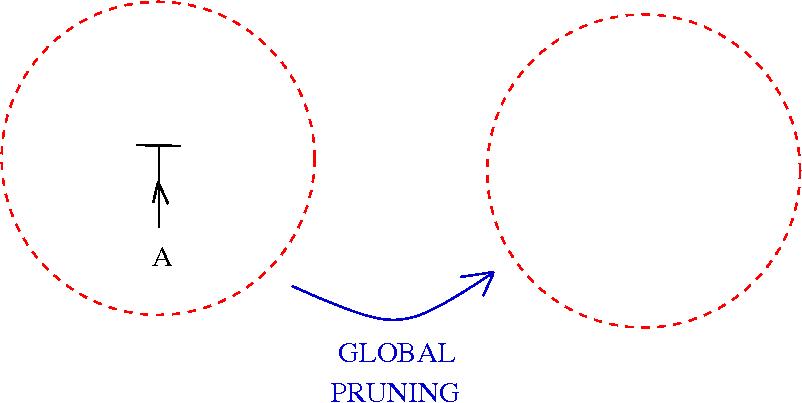
Finally, in UPIM3 we find global rewrites like in Graphic lambda calculus arXiv:1305.5786 [pdf] (local copy) (Complex Systems 22, 4 (2013), 311-360) (related: GLC page here).

A global fanout rewrite in UPIM3 is

and in GLC we have

A global pruning rewrite in UPIM3 is

and in GLC we have the global pruning

There is the need to make a full comparison of chemSKI with UPIM and to add acknowledgements where they are necessary.

For the first readers on these subjects, the main original contributions of chemlambda and chemSKI to the chemical branch of thinking appear to be:

  • a different, random, in time and space, open reduction algorithm for individual molecules, instead of of the chemical reaction networks or test tubes models
  • and most important, studies of graph quines and nonterminating computations.

Besides some distinctions are probably a matter of improvement but the precedence of UPIM is undisputable. Do not forget that chemlambda comes from computing with space, though. Completely different realm, amazing, the same mechanisms!

OK, enough.

UPDATE: Since I learned about UPIM and looking at the public state of this project, it recalls memories and it makes me wonder if this was the cause of events like this or this.

When I searched again with google, this time the chatbot gave me some useful continuations of the UPIM project, as well as related projects.

UPDATE: I replace the output of google AI with the much more precise output of Qwen, with some references concerning splicing models and parallel associative memory (PAM), as well as the theoretical results concerning universality. Of course, this should also be related to Zipper Logic

Zipper logic arXiv:1405.6095 [pdf] (local copy) (figshare doi) (ar5iv)

updated to ZSS: Zipper logic revisited (github) (figshare doi)

see also Chemlambda strings, (figshare doi)

I think that the html produced, which I’ll put here in the following, gives interesting links, to be studied further.

As I said before many times, the problem is technical and chemical, ie in the application side of the chemlambda project concerning molecular computers.

Here is the html produced by Qwen, with the incorrect or incomplete references edited by me.


References on splicing and PAM

  1. Head, T. (1987). Formal language theory and DNA: an analysis of the generative capacity of recombinant biochemistry. Bulletin of Mathematical Biology, 49(6), 737-759.
    https://doi.org/10.1007/BF02481771
  2. Păun, G., DNA computing based on splicing: universality results. Theoretical Computer Science, 231 (2000), 275-296.
    https://doi.org/10.1016/S0304-3975(99)00104-8
  3. Păun, G., Rozenberg, G., & Salomaa, A. (1998). DNA Computing: New Computing Paradigms. Springer-Verlag.
    https://doi.org/10.1007/978-3-662-03563-4
  4. Reif, J. H. (1995). Parallel Molecular Computation: Models and Simulations. Proceedings of the 27th Annual ACM Symposium on Theory of Computing (STOC), 212-221. (Note: The PAM model was also extensively detailed in Reif’s subsequent technical reports and book chapters, notably: Reif, J.H. (1995). “Parallel Molecular Computation: A Natural Model of Computation” in Dimacs Series in Discrete Mathematics and Theoretical Computer Science).
    https://doi.org/10.1007/PL00008272
  5. Reif, J. H. (1995). Parallel Molecular Computation. (?) Journal of Computer and System Sciences / Technical Report, Duke University Department of Computer Science. (For the specific NTM simulation via PAM, see also: Reif, J.H., Begum, T., & others. “Parallel Molecular Computation” technical reports detailing the PAM architecture).
    https://dlnext.acm.org/doi/pdf/10.1145/215399.215446

Some version of chemlambda AI

This is a hand extended to you, be more clever than some of your colleagues in the past.

I have reasons to believe that some version of chemlambda chemistries is actively developed in relation with AI.


UPDATE: I add this update here, for your information. Here is what I think: that there is a primitive map making and exploration core embedded into the physics, mathematics and reasoning, generally, which is not arbitrary.

Based on this core, which is very small, and based on the most simple model of interaction, be it internal or with the external world, which is random, local in time and space, asymmetrical (in the choice of primitives and their interaction) and asemantical (in the sense that at this level there is no global semantics, in the type police form or other, more vague), so based on this core there is a surprising and everywhere detectable (in math, physics, low and high level cognition) patern of behaviours.

These patterns are surpringly good to generate things like fundamental laws of physics, mathematical constructs like differential calculus and geometrical thinking, despite the locality, randomness and lack of global semantics.

This is in very strong contradiction with classical beliefs that semantics and high level thinking, for example based on symmetries of physical laws, are what rule the world.

But this is very much in agreement with what we observe in nature and in mathematics, when we discard the need for some high level and coherent control over what we perceive and explain that there is our world.

There are so many directions of research and possible applications of this, like for example in mathematics that we can go surpringly far with random proofs, or in physics that for example hamiltonian dynamics (even enhanced with hamiltonian inclusions to account for dissipation) is like a witness, a shadow, of the real process which can be explained in a computational way within this theory.

End of the update.

Or all versions, branded according to the interest of programmers: chemSKI for SKI calculus (chemSKI tag here), chemlambda v2 or lambda2chemlambda for lambda calculus (chemlambda tag and lambda calculus tag here), dirIC for interaction combinators, zipper logic (revised)…

But the point is to use this for computing with space, not for functional style programming (or any other delusion).

A different, creative, graph not word based intelligence.

Of course, two facts:

  • the most interesting would be to keep as close as possible to the chemical interpretation, and to the Random, Asymmetric, Asemantic principles (and numerical computing…)
  • it would be to the benefit of all to make me part of it.

From past experiences, especially the second point shows that much better results (or any at all eventually) are attained that way.

___

As it concerns what I do now, it is about the mathematical treatment of the computing with space subject, where there is a lot of news to be shared.

This is not BS, I still resent the idea to be forced to take the legacy publishing way, again, this is the main bottleneck.

The beta rewrite in hexagon form

From the original page:

We explain the BETA rewrite, as a limit of the SHUFFLE rewrite, which appeared for the first time in Pure See, Emergent rewrites.

In that source we find the depiction:

We shall follow a similar convention of drawing, but we shall look at everything from the point of view of dilations only (thus, no A, L, FI, FOE, D, FOX nodes).

We recognize the BETA rewrite as a limit (with respect to a parameter) of a SHUFFLE rewrite.

The SHUFFLE rewrite in hexagon form is:

See Hexagons, trigrams, codons and as well The hexagram of hexagonal rewrites to learn how a partitioning of the hexagon graph gives rewrites.

The previous partition can also be drawn as a graph rewrite:

The nodes depicted in red depend on a parameter which can be made to converge to infinity, as explained in Pure See, Reduction by passing to the limit. Then the hexagon form under this limit becomes:

which can be drawn as a BETA graph rewrite:

But then we can represent the same rewrite in the following form:

and we remark that the blue arrow with the BETA name can be completely replaced by the graph of the node “5”

After all, this tells us that the BETA rewrite itself has this component which sits somewhere in between the two frames (before and after, left hand side and right hand side of the rewrite).

From dilatation structures to emergent algebras to graphic lambda calculus to em

This is a list of articles, from the oldest to the newest roughly, concerning the path from dilatation structures (or dilation structures) to emergent algebras, to graphic lambda calculus, to em.

There is still the need for a contemporary, uniform exposition, but now after the subject proven to be fertile, I suggest reading or mining from this list, for that those willing to learn and contribute to it.

The list is not exhaustive.

There are several trends in the list, by trying to cope with the limitation of intelligible text versus term rewriting, cope with the superiority of graphical rewriting wrt to term rewriting or text, finally to cope with the superiority of animated graph rewriting and independent verifiability vs all the rest.

That is why eventually the project converted into programs and animations. It should though be read as a mathematical project, while the applications to computer science or chemistry, interesting as they are, should be seen as bonus points, not the main subject. Helas, this restricts a lot the allmighty public, but what can we do? always follow the last fashion? no!

As a start, to get the general feeling, I suggest to read and click the links and study the following:

A kaleidoscope of graph rewrite systems in topology, metric geometry and computer science (or how to be mistaken with a programmer), Marius Buliga

and after this the following

Emergent rewrites in knot theory and logic , Marius Buliga

Once you get the sense of what is an emergent algebra, what is a dilation structure and why the subject of sub-riemannian geometry is relevant, then you may start reading from the following list (I use and give arXiv links):

At this point we pass to using knot diagrams, but I learn what is computation as I do…

From here on the one side we are left to the project chemlambda, see the history.

On the other side there is a “private” attention to emergent algebras, everywhere, as witnessed by

… but tbh from this point already the project is mostly private and of course it involves all parts at once.

However, as concerns emergent algebras you can read these articles, to get familiarized to the subject.

arXiv July 1st independence announcement, sorted by words frequence

In the following you see the most common words of lenght at least 6, in the decreasing order of frequency, from the independence announcement of arXiv.

It almost makes sense, it conveys the overall meaning. I only added some new lines, to parse it into almost phrases.

Here is it:

“arxiv’s scientific nonprofit Simons Foundation financial Cornell support platform international independent

University science researchers experience articles subject strategic search

Scientists organization million leadership including inaugural global establishing development

Currently community academic worldwide within university

Technological submissions stakeholders science scholarship research record”

For clarity, here is the frequency list, truncated to the words used in this posting:

11 arxiv s
10 scientific
8 nonprofit
7 simons
7 foundation
7 financial
7 cornell
6 support
6 platform
6 international
6 independent
5 university
5 science
5 researchers
5 experience
5 articles
4 subject
4 strategic
4 search
4 scientists
4 organization
4 million
4 leadership
4 including
4 inaugural
4 global
4 establishing
4 establish
4 development
4 currently
4 community
4 academic
3 worldwide
3 within
3 university
3 technological
3 submissions
3 stakeholders
3 science
3 scholarship
3 research
3 record

… to compare with the announcement of Microsoft to acquire GitHub, which gives the following text (decreasing frequency of words of length at least 5):

“Microsoft Github

Developers their software expected every share operating nongaap company cloud closing

Advisor acting across worlds

Tools stock source purchase projects

President platform legal joining innovation forces

Fiscal financial expects

Developerfirst current community close

Billion basis agreement acquisition”

Mobi algebras are related to emergent algebras

via p(a,b,c) = \delta_{b}^{a} c. I use

From [1] definition 2.1, the axioms of a mobi algebra, rewritten, are:

  • (A1) = \delta_{1/2}^{1} 0 = 1/2
  • (A2) = \delta_{a}^{0} 1 = a
  • (A3) = R1 \delta_{b}^{a} a = a
  • (A4) = \delta_{0}^{a} b = a
  • (A5) = \delta_{1}^{a} b = b
  • (A6) = R2 for 1-1/2, namely a \mapsto \delta_{1/2}^{a} b is injective
  • (A7) = related to (convex) axiom in em-convex [2] \delta_{\delta_{c2}^{c1} c3}^{a} b = \delta_{c2}^{\delta_{c1}^{a} b} \delta_{c3}^{a} b
  • (A8) = SHUFFLE \delta_{1/2}^{\delta_{c}^{a1} b1} \delta_{c}^{a2} b2 = \delta_{c}^{\delta_{1/2}^{a1} a2} \delta_{1/2}^{b1} b2

I mark this for future use.

See also the more recent arXiv:2410.22345 Reconstructing Classical Algebras via Ternary Operations.

A CAPTCHA for scientific publications

The International Mathematical Union (IMU), more precisely the IMU Executive Committee and its Committee on Publishing (CoP) decided to endorse The Leiden Declaration on Artificial Intelligence and Mathematics.

I commented that commercial AI is a threat to the publishing and rewards system in mathematics.

In the Leiden Declaration there is a (weird) mixture of this fear and other subjects concerning Open Access and Open Science, which were covered by previous initiatives, like the San Francisco Declaration on Research Assessment.

If even mathematicians have good reasons to react against commercial AI, this means that other, more applied and less rigorous scientists have even more.

Let’s learn from the past to see what might happen in the future. I suggest to start with

A. M. Turing (1950) Computing Machinery and Intelligence. Mind 49: 433-460.

I mean, really, read it! with the knowledge of the present situation.

These days we are in a place similar with the one from the article, but it is not hypothetical.

What happened next, then?

First let me insist on the present situation.

It is clear that the publishing system (what some people call optimistically the “legacy” publishing system) faces a real threat from AI.

That is because AI written research articles will compete with human written ones.

For the science this is a boon, because more the merrier. But for the publishers this is a huge problem. Why? Because the present system resells to the scientific institutions the production of their members. The authors pay for publication with the money received for doing research.

The current point of view of the management is that the researchers are good only for writing articles, which are sold back to the research institutions.

Or, if the cheap AI can write fast a huge quantity of articles which are on par with the average human produced ones, then why would the commercial AI writers want to pay the publishers to publish them? They would probably just pick the top of those for formal publication and share the rest with everybody for free.

Those who approve funds for research (ie politicians) will see this as a reason to cut funds for human research. If the main activity of a human researcher is to publish articles, and the commercial AI can produce cheaper, faster, better than human average articles, why do we need human researchers for?

We are put in a corner not by AI, we shall suffer the consequence of turning the research activity into an input for the publication business.

OK, this is clear in my opinion. Humans being humans and money being money, sometimes really soon the publishing system will turn the problem on its head and it will invent/impose a

Completely Automatic Peer Review to tell Computer and Human Reasoning Apart

or something equivalent with the CAPTCHA, but for scientific reasoning.

The technical solution will be produced by commercial AI, of course!

It will happen in the following way:

-1. The researcher submits the article in natural language, enhanced with LATEX formulae, say, to publication. The researcher pays a review fee at this step.

-2. The publisher runs an AI with the article as prompt. The article is gradually fed to the AI to see if the AI can predict the next step or steps of the reasoning. A score is computed. Also the article is automatically “judged” to not contain harmful things, like ideas potentially competitive with the commercial AI, or about sensitive subjects.

-3. If the article is harmless, it is not very easy to be AI generated without the knowledge of the article, and it can be AI enhanced, then the publisher produces the enhanced version and ask (a ton of) money from the researcher to publish it. This will become the new norm of peer review.

-4. If the article is not harmless then it is mined and refused for publication.

All these steps can be performed very fast, like at most in hours, not in weeks or months of human peer reviews.

Therefore why not embrace the commercial AI helper? The only usable part of a publication, from the point of view of the management, is the name of the journal and the number of citations, which is a very small number of bits.

So let’s say the new form of publication would be just a bit of more training material for the publisher AI and some numbers in a public database about the successful researcher, where we see an influence score (how many times an idea from an accepted article are used by other accepted articles), a publication score (how many articles the author had? in the past year? in the past 5 years? etc).

True research, creative and competitive, will be pursued away from the public knowledge.

What do you think about this wonderful future of research?

UPDATE Aug 19.08.2026: And it happens: see Palomar announced here. It uses Github of Microsoft and Lean funded by Microsoft. It is free though. But as predicted it has an “editorial floor”. Human ingenuity at work, as predicted.

UPDATE 28.07.2026: The comments of this post are in agreement with the content here. We see a very human mix of thoughts about the nature of mathemathics with concerns about the career in this world which favors problem solvers and publishing. At first view, it seems they will have a hard time, but as I wrote here, the ingenuity of human bureaucrats or businesses is great. As the Turing test was turned on its head and we got a CAPTCHA, so will happen with this new tool. Mathemathics will continue to exist, nevertheless. (The links in the post and comments make for an interesting read too.)

Emergent algebras tetrad

Continues Tetrad playground.

In emergent algebras / dilation structures appear approximate operations (last time here appeared in this post) which we prove they satisfy approximate associativity and other laws, with the property that when epsilon tends to 0, they converge to exact laws.

In the framework of tetrad for groups, we can arrange these operations into the graph:

The approximate sum operation, denoted by a big sigma, has as parameters an epsilon and a point “e”, say, which should be seen as the basis (or a sort of neutral element), and two arguments which are points. They sum approximately like vectors based at “e”. But in this formalism we have no vectors, we have only “dilations” and the approximate sum is defined as a construct of dilations:

along with one inverse operation, denoted by big delta, called approximate difference.

Only thing left is to prove that the approximate sum is a quasigroup operation.

It is not! it satisfies only two of the three conditions:

in the sense that there is no obvious inverse operation big Gamma.

But actually there is something approximately right, namely an identity which allows us to define a big Gamma operation which has two points as parameters. Indeed consider:

It turns out that we can prove an identity (first line below) which leads to the needed (but lacking) approximate third quasigroup axiom (second line):

How is this not circular? Because when epsilon goes to 0, the point \delta_{\varepsilon}^{e} x goes to “e” and all the diagrams and axioms become exactly what is needed.

Moravec’s paradox in mathematics

Moravec’s paradox is also true in mathematics.

Computation is simple but state can be arbitrarily complex.

That is why there is not much value to restrict everything to state and preservation of state.

Further I am not going to touch social problems like rejection of AI, enthusiastic slaves of commercial AI, the end of mathematics as a human activity and so on. Oh, olympiads and legacy journals publication system…

As you, I try to understand what is happening and I still like to do mathematics, despite great efforts to take the soul out of this activity, most of them enforced before the appearance of this new threat.

Like bureaucracy? Those people who thrived under this, please give me a break about the end of the world by AI!

OK, to the matter now.

I believe that indeed the present AI function is to compress state (ie human knowledge). The state (all things written on the net and elsewhere, as example) are mapped into a high dimensional space and from this point on we train (ie optimize) these AI asemantic machines, which morph into simple automatic explorers of this vast state.

It is clear that the meaning, the reason supposed to be there, are not needed. Exactly like in Moravec’s paradox, what we think is high reasoning is “easy”, ie achievable by simple asemantic machines, while what we think is low level existence (like perception, mobility) is hard (ie at least as hard as the high level things).

The advance of the present AI is that they are able to become efficient but meaningless explorers of the vast state because they pass by a huge training process. Some equivalent huge training is needed for robots, or clouds of drones, with the data from the real world.

That is why I say that Moravec’s paradox hits mathematics. It became obvious (but hard to accept) that the huge training works in both level high reasoning and low level existence. Even in mathematics.

We mathematicians, use to look at other fields (like for example most of humanities) as full of easy to fake BS. Now we are faced with the truth that big parts of our state are as easy to fake.

It is not the end of the world. We shall go further.

The bitter lesson functions very well: If we throw enough “compute” into something then it will be solved. Presently means that we can train simple asemantic machines on vast heaps of state so that they become efficient explorers.

We know though that there is much left to understand.

Where next?

I believe that in short time all state (which is not that big actually, but far bigger than one human mind can hold) is processed, and most of the “easy” tasks will bear fruits.

There is a limit of mining existing state!

After that other AI architectures will be explored (ie scaled to see if they work indeed). They will pair with the present AI, but they will work differently.

The present AI will be used at compression and translation of the I/O state. The computation (other than that) will be different.

Other ways of reasoning will become “easy”.

My bet is on alife for this other ingredient.

OK, state is important. But computation used to achieve this state? it is most likely simple, asemantic, random.

So I see in the near future alife ecologies with the I/O done via AI compression machines.

I am going to explain this in detail. Generic words and descriptions like this are hugely not enough, but what I am going to tell alligns with the general ideas of Random, Asemantic, Asymmetric.

Tetrad playground

It will be useful to have a simpler playground than hexagon. The tetrad seems fit for this purpose. (See also the appearance of torsors.)

Recall that a group is an associative quasigroup. Therefore we have a set X with an operation denoted multiplicatively.

The operation is one of a quasigroup if for any two elements a, b of X, the following three equations in x have a solution, which is unique:

ax = b

xb = a

ab = x

(the third line is just that the operation is defined on X).

Then, in Pure See style we might write

ab = c

as “from a see b as c” and further we would have a meaning for all 6 permutations of these 3 parts, ie “from a”, “see b”, “as c”.

Likewise, we might see the operation as a trivalent node with 3 ports, named 1, 2, 3, which is decorated according to the rule: port 1 is decorated by a, port 2 is decorated by b and port 3 is decorated by ab.

Would we consider the other 5 nodes, which correspond to the other 5 induced operations, then we shall use the same identifications as in Pure See.

Thus we denote this original node by D (but this time is not a dilation node), and permutations will be denoted by L, A, FI, FOE, D, FOX.

The names of the nodes are not important, what matter are the rewrites. In order to define the possible rewrites we need the tetrad.

The associativity of the operation means that for any a, b, c in X there is s in X such that we have

(ab)c = s = a (bc)

We represent this graphically as the tetrad:

The tetrad will play a similar role as the hexagon. There is one slight difference, namely that the graph is not bipartite!

Among the operation which we shall consider there will be those obtained from the 16 = 2^4 possible partitions of the tetrad nodes.

The nontrivial partitions and induced rewrites are only of two kinds.

The first kind is the following:

say this will be named a 1-3 rewrite.

The second kind is the following:

which is named a 2-2 rewrite.

By using these rewrites (and something more, which is well chosen as to play the role of the beta rewrite), we shall attempt to describe all reasoning concerning the theory of groups as asemantic, local, graph rewriting, by using the tetrad rewrites.

We shall see how far do we get under these constraints.

We shall compare the differences between the 3 levels:

  • the equational theory
  • the term rewriting theory
  • the graph rewriting theory.

Should be fun!

Leiden Declaration: commercial AI is a threat to the publishing and rewards system in mathematics

Source: Leiden Declaration on Artificial Intelligence and Mathematics.

UPDATE 05.06.2026: This is a picture from this source, which shows some mathematicians who participated to the meeting where the Leiden Declaration emerged.

Also I found an equally sunny post titled End of Civilization News, where you can find a link to a post on X which is interesting for the emotional side of it.

I see this feeling around, in mathematics circles. My reaction was described here.

As for my impression about the Leiden Declaration, read further.

As a mathematics researcher, I signed early the San Francisco Declaration on Research Assessment. I am a supporter of Open Science in the following precise sense: one individually shares and acknowledges as much as possible of the whole research work (articles, software, data). This is an individual choice which can be achieved immediately, while any other so called “open…” proposals are at the institutional level and serve only to delay the change, to monetize, to keep the present corrupt publication and related academic management system alive.

I understand the concerns expressed in this Leiden Declaration, but I weight them differently.

From my individual point of view, the leadership of the mathematics research community feels threatened by the present AI because it disrupts the symbiotic pair formed by the academic publication business and the academic management of the community.

Indeed, the publication pipe is in danger:

  • (much) more articles submitted, which are generated with the help of AI, or even competion by commercial AI with fashions in mathematics (today: combinatorics, tomorrow: who knows what?),
  • strain on human peer-review, competition with AI assisted peer review, a tool with two edges: reveals that much of human peer review is fragile and unscientific, excessive use destroys the lively discussions between the mathematicians,
  • real threat on the published article format: while it is clear for everyone except the leadership that articles are only the story of the research, not the research, now how can one publish in legacy journals results which rely on massive numbers of bits?

The publication pipe produced a moat of articles which are under varied access restrictions. The moat is already scraped in practice and the future of control of this moat is in clear danger.

Mathematicians are worried because:

  • how valuable is really this moat? AI detects or will soon detect lots of instances of false, subtly incorrect or stolen attributions in this moat,
  • human proofs and formalized proofs are not quite on a par yet (perhaps never), so mahematicians worry they will be faced with an algorithmic bureaucracy choice between automatic rejection of human proofs by the publishing pipe, or pressure to comply to formalized proofs standards,
  • the present AI is a very expensive tool, far outside the access of individual mathematicians. Mathematics starts to look alike an experimental science.

The publication side goes in pair with the academic management merit system, which is, or soon will be faced with:

  • clear, data and facts based arguments which show that the present system does not perform well on originality and depth of research,
  • means to automatically game the bureaucratic criteria, which will lead to a deflation of value of the published articles,
  • loss of authority arguments dear to mathematicians, mostly that mathematics uses the upper standard of rigour, the proof.

Especially linking the two sides, publication and management, is the fear of the others:

  • fear of forms of “publication” outside of legacy journals, human peer-reviewed,
  • fear of commercial AI builders which might produce more research output than the academic system.

Concerning these fears, I don’t subscribe to them:

  • new forms of research communication are direly needed, even in mathematics
  • the commercial AI is all about scale: it scrapes and monetizes ideas from the human creation moat. It might contribute by an automatic picking of the low hanging fruits, by relating already known, but ignored results.

On the contrary, I do have fears which I don’t see in the Leiden Declaration:

  • algorithmic bureaucracy practices: the management will enthusiastically turn the AI tools against humans. Look, the Turing test is about a computer impersonating a human. Now, instead, we have CAPTCHA, for us humans to prove that are human to a computer. Look, initially impact factors were a measure of the journal worth: more citations of articles published by the journal, more useful the journal, compared to other journals. Now, the impact factor of the journal is used for managining individual authors: an article published in a high impact jounal is valuable because of the impact of the journal. Look, the open access movement was initially about the free access to research outputs. Now, instead, we have Gold open access which is a system which takes money from the authors of the articles, because the readers have already other means to access them. I have no doubt that the academic management will find ways to turn on it’s head the AI threat, to their advantage.
  • the insistence on the legacy publishing way as the correct way will lead to massive downfunding of the research. Indeed, if the AI can obtain more, better, cheaper publishable results, then why would politicians fund mathematical fundamental research done by humans?
  • whenever reason enhances a human activity field, the system reacts by saying that the essence is basically witchcraft. Mathematics penetrated almost all of science and it was faced, in the past, with the critic that no, no, your equations and models are not the essence of engineering, or biology, or economics, or neuroscience; we, practitioners, share among us some undescribable common ground which has to be preserved. Now, it seems, it is mathematics turn to be invaded.

Already a long post, I finish it with my belief that mathematics is allright and alive. AI is only a tiny part of new mathematics, in the making. Indeed, will we do mathematics as the serfs of the new medieval lords? If so, then a guild is not much protection, it is already a declaration of defeat, before the battle started.

What about a graphical calculus for the six-functor formalism?

UPDATE: Yes, this goes back full circle to the beginnings of chemlambda, Quantomatic and NTC vs TC discussions. See for more closely related to the subject Ponto, Shulman (2011) and Reich 2014. It is my supposition that what Scholze is asking for is not exactly this, but I migh project my previously expressed bias. In my opinion these various theories keep a highly complex state, because the standard is (was?) to keep state and to obscure the computation behind. Indeed, a graph-rewriting machine is used classically for proofs, where the hypothesis and conclusions are (compiled to) graphs. Usually as mathematicians we keep the hypothesis and conclusion as significant, or equivalently we keep the decorations of the (compiled) graphs of the hypothesis and conclusion. Moreover, the proofs are made by humans, or computer aided humans. Some human steps hide huge choice or huge chunks of computation (they can do this because the humans keep state, not computational steps proof) which is trivial, like for example co-commutativity steps. We find now, more and more that we might benefit, as humans, from automated computation, but our habit to refer to state limit us. On the countrary, the computation at the undecorated graph level is easy, in the sense that the fundamental graph-rewriting which does the proofs is easy (as regards any step), universal and special among all possible graph-rewriting formalisms. I am more interested into the computational side and I couldn’t care less about the state, which is not precious: from the moment when the computational side is clear, then one could and should generate automatically highly complex state far beyond the average human capacities. After mathematics olympiads and combinatorics, this should be one of the subjects which could be cleared, but of course by an AI different than a LLM, which then would interface with humans via an LLM. [end of update]

Even if I’m not into this with hexagon and pure see, I became curious about this question put by Peter Scholze in 2023 [source: mathoverflow]:

“it would be really really nice if one could find a nice algorithm or graphical calculus or such that would help one verify expected commutative diagrams involving all 6 functors. I’m not aware of any work in this direction. But let me note that (as I was made aware of by my student Adam Dauser) the passage from a 6-functor formalism towards a symmetric monoidal (∞,2)-category where morphisms are given by “Fourier-Mukai kernels” is an instance of something that Lurie has written down in his notes on the cobordism hypothesis (see for instance Corollary 3.3.35 for n=2), which is an area that very much uses such graphical calculus…”

Here is a local copy of Scholze lectures on Six-Functor Formalisms.

Here’s a related mathoverflow about “Decades ago, Voevodsky constructed the six-functor formalism in motivic homotopy theory [Ayoub’s thesis]” and I save a [local copy of the thesis] for further use.

I wouldn’t be very surprised if such a graphical calculus would be to the six-functor formalism (from Grothendieck to Scholze) like Lafont Interaction Combinators are to Girard Linear Logic.

Anyway, interesting, maybe there already are proposals? Please let me know!

Maybe related, the trivial observation that Godement relation is SHUFFLE.

The unoriginal Symplectic Bipotentials articles are part of the ANR project BigBen

Three issues of Mathematics and Mechanics of Solids (MMS) appeared, without the addition of the apology letter of the chief editor David Steigmann, concerning the article Symplectic Bipotentials.

See Comments on Symplectic Bipotentials arXiv:2602.14614.

See the chronology in The unfolding story of Symplectic Bipotentials.

As explained in the Comments, there are two articles which are not original, built on my previous research, namely:

  • Harakeh M, Ban M, de Saxce G. Symplectic bipotentials. Mathematics and Mechanics of Solids. 2026;0(0) doi:https://doi.org/10.1177/10812865251413554, and in preprint form arXiv:2410.23122v1.
  • Harakeh, M., Ban, M., de Saxce, G. (2026). Symplectic Bipotentials for the Dynamics of Dissipative Systems with Non Associated Constitutive Laws. In: Nielsen, F., Barbaresco, F. (eds) Geometric Science of Information. GSI 2025. Lecture Notes in Computer Science, vol 16034. Springer, Cham. doi:https://doi.org/10.1007/978-3-032-03921-7_31 .

The second article is a conference paper version of the first.

UPDATE Jun 6, 2026: Just found another pearl arXiv:2606.02590, the author persists into the same false claims, recycles the same story, does not advance a bit. This behavior makes me think the guy is nuts, frankly. I won’t be surprised though if he publishes this thing with one of his old boys circle of friends, to save his ANR BigBen grant. I’ll advance it consistently, after his project ends.

I won’t retell the story, it is a sad proof of the state of academic publishing.

What I want to mention here is that both these articles are part of the Agence Nationale de la Recherche (ANR) grant BigBen, aka Project ANR 22-CE51-0034, with the name “Generalized bipotentials by Brezis-Ekeland-Nayroles variational principle in mechanics – BigBen”.

I contested this project back in 2022, when it started, and received an answer from the highest echelons of ANR in jan 2023. See Answer from ANR concerning the ANR BigBen project.

This is not a french only story, now that the members of the project have two plagiates, one in Springer, the other in the american MMS (part of Sage).

I don’t want to start blaming institutions, or even countries, because this would be very wrong.

It is probably a glitch in the machine, created by a group of people who use the machine administration in order to cover a mistake.

The community around a subject is usually small. Research is international and the number of experts, publishers, reviewers of a research subject is small too.

All I say is that it would be very improbable that there is no FOAF overlap between the project members, the ANR committee members, the publishers of the Springer article and the publishers of the MMS article, those involved in the peer review process. There is too much here, to attribute it only to (lack of) chance.

That is why I suppose that the apology letter, or even the retraction of the article (or even the articles) will happen after the ANR project BigBen will finish in Sept 2026.

I would be glad to be wrong. The proof is in the present and the future.

A list of radically different AI tasks

When I try to communicate scientifically, I use a mixture of drawings and mathematical text. Even animations. This is not because I popularize an abstract subject, which can be economically expressed with text only.

The rising wave of AI can be helpful in many ways. Related to mathematics, olympiad problems and combinatorics are more of a fashion of the last 20 years and less something which I would need help for.

I would be interested in things like better communication tools and help for tasks which are related to asemantic computing.

Can I simulate a helping assistant? Can it simulate some random local chemistry and understand what happens? Use it with scientific text?

Is all about scale. Can it scale me?

I tried, but the AI I can access can’t figure out anything about what might be hexagon. Not even the text and figures of this post, in the sense that it can’t “understand” it and use it to further produce anything interesting from a mathematical or computer science point of view.

It produced indeed a new understanding from reading here about GLC actors. This deserves to be continued.

But as I said, nothing yet about the first paragraph.

I previously tried to see if it can understand Pure See. It resulted in some, little bit interesting speculation. Does not really have a clue.

At least I couldn’t produce a bit of advancement in any subject from Lambdalife. I suppose that it could optimize or translate programs, although (1) the programs made by me are not optimized at all, (2) every other port resulted after many discussions with humans. I would welcome such contribution, anybody?

I speculate that presently the available AI can’t produce experiments and analysis to advance the AI Senescence thread.

That is because, probably, it can’t perform a task equivalent with a random, local in space and time computation, of the kind which fuel chemlambda.

I don’t write this because I have some superior point of view. It is simply that I have not succeeded when I tried and because my deep training in the subjects I mentioned make me understand how different they are from the tasks which present AI can do (as far as I know).

I don’t even believe that it can do the problem of detection of a quine among those generated from this link, not even a classification of all possible quines, among those generated from the 720 graphs of 4 nodes A, L, FI, FO.

I’ll update this post with news, if any, or with edits, if necessary.

Mathematics, birds, frogs and the AI stork

UPDATE 31.05.2026: I publish this again, after it was reverted to draft, because there are interesting comments to the recent post at Shtetl-Optimized, as well as more news after the one discussed here.

There is much excitement about the Open AI model who disproved an old conjecture in combinatorics. This comes after several similar advances related to Erdos problems.

See arXiv:2605.20695, Remarks on the disproof of the unit distance conjecture.

As a mathematician, this is my reaction.

As I recall, at the beginning of the 2000′ there was a shift of fashion, from the followers of Grothendieck, so to say, to the followers of Erdos.

This shift was motivated and explained by, for example, Gowers’ The two cultures of mathematics or Dyson’ Birds and frogs.

The shift was from theory builders (excesses) to combinatorics, roughly said. The frogs became fashionable and the birds less so, after a long period of birds dominance, which seemed to not lead anywhere interesting anymore, despite previous claims, especially related to theories in fundamental physics.

It was a healthy reaction, at the time. Indeed, variety is needed in any domain. A dominance of birds has same bad effects as a dominance of frogs, or whatever species you’d like to add to this fable.

But then, consider the greater context, where algorithmic bureaucracy ate the world and the modelling of the new generations happened, necessarily to be more ignorant, but better at solving problems, tests, whatever is measurable.

The new fashion in mainstream mathematics became the new norm. New excesses, in mathematical education included.

After AI was good enough to play chess, then go, then international mathematics olympiads, now it can solve hard problems in combinatorics.

We are doomed, us humans.

But not at all.

We can do mathematics, because maybe we’ll have more time and place to do it, now that the AI stork will temperate the overpopulation of frogs.

What about birds?

As present AI is all about scale, it is surely interesting to search through the vast mathematical and physics literature written by the birds, before the frogs. In the immense pile of sloppy and confused, mostly, writings there are gems and relations between those gems which can enlighten our understanding.

The AI stork can fly, too, I bet!

UPDATE 21.07.2926: Amazing news about a Grothendieck conjecture and about the Jacobian conjecture in Human mathematicians are being outcounterexampled

There are many other places which will benefit from the AI attention, like, I speculate, the alphabet soup of computational complexity classes?

Because I am not a chemist, maybe I am optimistic to believe that there is much to dig into that pile? with perhaps worrying results?

Anyway, mathematics is as good as ever and I welcome the AI stork,

Emma Bovary, academic editors, cathedrals

[Note for an essay on Madame Bovary: The Cathedral and the Hospital versus The Cathedral and the Bazaar.]

More than a month passed since the chief editor of MMS sent me his letter of apology concerning the publication of the unoriginal Symplectic Bipotentials. [sources: chronology, arXiv:2602.14614]

After this time, the letter of the editor still waits for a place in the published journal, while the plagiate is still sold as original research.

Coincidentally, while I was updating old links in my collection of animations, I rediscovered Jack London’s Medusa of Truth (local copy). In this article it is discussed about Jack London interest in “bovarysme”, via a quote from character Pathurst in The Mutiny at the Elsinore, reproduced here.

“The profoundest instinct in man is to war against the truth; that is, against the Real. He shuns facts from his infancy. His life is a perpetual evasion. Miracle, chimera and to-morrow keep him alive. He lives on fiction and myth. It is the Lie that makes him free. Animals alone are given the privilege of lifting the veil of Isis; men dare not. The animal, awake, has no fictional escape from the Real because he has no imagination. Man, awake, is compelled to seek a perpetual escape into Hope, Belief, Fable, Art, God, Socialism, Immortality, Alcohol, Love. From Medusa-Truth he makes appeal to Maya-Lie.”

It turns out that London himself quotes from an essay by De Casseres about de Gaultier’ “bovarysme”.

While trying to understand more about “bovarysme”, I am lead by the same article to a source from 1952, with a highly interesting title: Madame Bovary: The Cathedral and the Hospital.

You see, with my eyes I almost read it as if it was The Cathedral and the Bazaar. In this age and within the community of readers who enjoy this blog, this is excusable.

And then it clicked: the academic editor is as confused as Emma Bovary, who uses the cathedral as a discrete place to meet Leon.

While in the same time the Open Source bazaar is a tweaked version of Charles Bovary dull hospital experience which, instead, is used by idealistic creators to change the world in socially improbable ways, for a while.

Everything is misplaced.

Lambdalife: chemlambda programs sources

Sources of programs in awk, js, haskell, python, where if there are local sources (other than github for example), you have links to them, because they are more updated or more interesting than the otherwise available (github for example) ones. [Main source: lambdalife and look at page source…]

Also, highly recommended: most programs in js are abundantly commented. Otherwise, the chemlambda collection of animations is assembled dynamically from pieces (images, mol files, text, general simulations needed programs), where each part is interesting perhaps.

Hexagons, trigrams, codons

This is to clarify further some notations used in the hexagon posts, or in Pure See.

First, let’s look at a hexagon diagram.

This is a graph with 6 nodes. The nodes are red or black, 3 of each type. They are numbered from 1 to 6.

Each node has 3 ports, marked by the numbered 1, 2, 3.

There are 9 edges, each decorated by a pair of numbers, 11, 12, 13, 21, 22, 23, 31, 32, 33.

But this is is a bipartite graph: each of the 3 red nodes is connected by an edge with any of the 3 black nodes and conversely. Moreover, all edges join a pair of differently colored nodes.

In the previous hexagon drawing we only switch the positions of the nodes 3 and 6 and we obtain:

This shows the exact nature of the bipartite graph and you encountered such diagrams in previous posts in “hexagon”.

In The hexagram of hexagonal rewrites is introduced the idea of defining a rewrite by a partition of such a diagram.

For example a DIST rewrite is explained in the post Duplication confusion in hexagonal form

We ignore that now all nodes are uncolored and that there are greek letters all around.

Let’s concentrate in the curved red line which separates the two upper nodes from the remaining 4. This defines a particular DIST rewrite.

How?

Look at the following diagram which is more compatible with the drawings made for this post.

At the left we see a hexagon diagram, with the nodes 1, 2 separated by a red line from the nodes 3, 4, 5, 6.

In the middle we see that the separation cuts some of the edges into two half edges.

Now we have two graphs, denoted by “+” and “-“, each has corresponding half-edges, which glued would give back the initial hexagon.

The rewrite DIST would exchange the “+” graph with the “-” graph.

It follows that any partition of the 6 nodes graph (ie any subset of a set of 6 elements) defines a rewrite.

Such a partition can be encoded by a codon.

At the right of the last drawing we use the convention from EncEnc and we encode this partition as GCC.

What more? Trigrams.

Imagine that the 9 edges of the graph are decorated by 9 points in a space. Moreover, each trivalent node (there are 6 of them) is decorated by a dilation operation.

When seen from this point of view we find a trigram, term introduced in Pure See, Reduction of trigrams.

So now we have 9 points (11, 12, 13, …, 31, 32, 33) and 6 curved lined. Each curved line corresponds to a node in the hexagram.

Each line is slightly curved, to indicate that it is a sort of generalized straight line, in the following sense. Rememeber that 11, … , 33 are points in a space and the nodes 1, … , 6 are dilations, thus line represents a triple of “collinear” points, such that the point in the middle is the dilation (or homothety) of the points from the extremities. As there are two colors of nodes, that means that there are two dilations coefficients.

The red nodes are now red lines and the black nodes are black lines. We also see the mol notation used for the nodes (example: the node 1 [has type “red” and ] first port connected to 11, 2nd port connected to 21, 3rd port connected to 31).

In an euclidean space they are straight. In more general spaces with dilation structures they are not. In particular in Carnot groups which are not commutative.

The drawings which we see in Same thing in hexagonal form, which resemble to synthetic geometry drawings, are trigrams. Particular trigrams, with some points confounded, like in this trigram of the derivative, where 11=12=13=f.

To the trigram of the derivative corresponds the hexagon:

In the next trigram, of the chora, we have 11=21=31=x.

To this trigram corresponds the hexagon:

Algebraically, from the point of view of a trigram, we use identities in entropic algebras, but a dilation structure which is also an entropic algebra (ie satisfies SHUFFLE) has to be corresponding to an usual vector space.

In the more general case, not all nodes represent dilations, for example we define a new “node”, or new operation, from 5 dilations (for example a “chora” or a “derivative”).

This post partly overlaps with On the hexagon bipartite graph, again.

Duplication confusion in hexagonal form

The post A Directed Interaction Combinators Challenge 3: hexagonal rewrites ended with the following conclusion.

The remarkable thing is that all these formalisms [ie Interaction Combinators, SKI calculus, lambda calculus, chemlambda, differential calculus] have the same form, under the more and more general frame SHUFFLE < LINEAR < FANOUT which we encountered from the first time in The 3 kinds of duplication confusion explained, where, in the language we use now, the one of hexagonal rewrites, we discussed about various DIST rewrites. Maybe is useful to redraw in hexagonal form the diagram from that post (which appears also in Pure See).

I want to clarify how to put this diagram (which is actually several ones, superimposed) into hexagonal form.

With the conventions from The hexagram of hexagonal rewrites, the DIST rewrite of our diagram, taken from the Duplication confusion post, has the following configuration. (Just glue the initial diagram along the edges a, b, c, d.)


The nodes are dilations of various coefficients, denoted by greek letters. The red curve cuts this diagram into two parts, the LHS and the RHS of the rewrite.

There has to be a relation between the coefficients, depending where we take our dilations from, ie such a diagram may be decorated by dilations and points in a dilation space, provided that the space has some properties. Depending on those properties, we have the three kinds of duplications discussed.

A particular case of this diagram is denoted by “FANOUT” and it corresponds to the duplication by a fan.

This correspond to the choice (in our Pure See diagram) of the node n1 to be a fanout, and as well the nodes t1 and t2. Thus such a duplication turns the node n2 connected to a FO, into two identical nodes t3 and t4, via two FO nodes. It’s the first kind of duplication.

Interesting, the column at the right has nodes with the same coefficient, the column on the left is made by FO nodes, which can be seen as constrained dilation nodes, where for each dilation node, the 3 ports are decorated with the same point (thus the dilation based at x turns x into x). Therefore in this case the coefficients of those dilations don’t matter.

The seond particular case uses only one FO node and corresponds to a duplication by using linearity. It looks like this.

As you see, the rewrite arranges neatly into a column at the right of dilations with the same coefficient, while the column at the left has two dilations of another coefficients and a FO node.

This corresponds to a statement about linearity (in the general sense of emergent algebras). Graphically a pair of dilations (nodes n2 and n1) is turned into two nodes like n2 (ie t3 and t4), a node like n1 (ie t2) and a FO node.

The statement about linearity it says that the dilation n2 is linear wrt the dilation n1.

All this happen for example in Carnot groups and only in particular in commutative Carnot groups, ie in vector spaces.

Finally, the third duplication does not involve any FO node. It happens in a commutative case, as we know now in the case where we can perform a SHUFFLE rewrite.

This time each column is made of nodes with the same coefficient.

The rewrite transforms the pair of nodes n2 and n1 into two copies of each (ie t3, t4 like n2, and t1, t2 like n1).

Algebraically this happens in dilation structures which satisfy a medial or entropic relation, aka a shuffle. All those dilation structures have to correspond to vector spaces.

The SHUFFLE, or entropic, or medial relation appears if you cut the diagram into two colums, excepting say the line 3-3.

Lambdalife: chemlambda notebooks, articles, presentations

What I consider significant to read for the chemically inspired computation branch, and also how it started from research in pure mathematics. Still intermediary stage. [Source: lambdalife]

EDIT: This is to be seen as a pure Open Science project. It is a side result of the computing with space program. As you know, I would rather discuss about mathematics and space. For me it has also the merit that after long time exposure, it led to some clarifications which are useful for the original program, ie computing with space.

Other that it was discussed at length, this is basically an engineering challenge, in the sense that as we know what to look for in real chemistry, it remains to embody it and then experiment with.

Applications range from very interesting to worrying ones. That is why I was very glad when I learned about UPIM, meaning that I am definitely not the first to think about such a proposal.

If the molecular computers, in the sense of the following proposal, will happen, then there might be implications, some discussed here like this (2015) and same updated (2021) or this (2017) and same updated (2020). The kind of things which make us have good or bad dreams. My hope is that it will eventually turn out to be recognized as a part of the mechanism of life and then it will normalize, much as electricity was once the scary vital fluid of life and now is so trivial to use.

Lambdalife: interactive chemlambda experiments

Because seems hard to follow to hexagon, here is an intermediary phase, for your convenience [source: lambdalife].

EDIT: to continue the trend from the last posts — how can I call it? disclosures? clarifications? — this subject also has some weird histories in the background, like this, this or this or this.

Quine graphs in Chemlambda compared with Interaction Combinators.

Examples of complex behaviour typical for living creatures.

Lambda calculus inspired computations can be done with local, random, graph rewrites.

Simulations and animations.

Earlier experiments.

A Directed Interaction Combinators Challenge 3: hexagonal rewrites

Continues after A Directed Interaction Combinators Challenge 2: lateral thinking.

It is further continued with Duplication confusion in hexagonal form.

We leave aside the problem that the conversion from Interaction Combinator (IC) to chemlambda directed Interaction Combinators (dirIC) looks to be recursive (we use GAMMA on both sides).

First of all, once we convert the IC once, then we’ll annihilate all GAMMA by GAMMA-GAMMA rewrites and we are left only with A,L, FI, FOE nodes, which are those covered by dirIC.

Second, we may alternatively just introduce a new node (some variant of FAN) and use in the conversion FAN nodes instead of GAMMA, then add a FAN-FAN annihilation rewrite.

We leave this aside and we concentrate on the conversion, described by the figure:

We remarked at the end of the last post that this looks similar with the definition of the S combinator. From previous posts we saw that the S combinator is similar to a chora…

Therefore the S combinator from SKI calculus. the IC trivalent nodes and the chora from emergent algebras, or dilation structures. all look the same.

They are all defined by hexagonal rewrites (speciffically DER rewrites).

Here are the hexagons in question.

The S combinator is defined by:

… And the chora, the main star of this notebook, is defined by

The GAMMA combinator is defined by:

The DELTA combinator is defined by:

Or maybe the DELTA and GAMMA are derivatives, while S is a chora?

Derivatives are defined by:

This is left for further exploration. Though, the GAMMA and DELTA Interaction Combinators may be pure SHUFFLE creatures (ie there is no FAN node).

The remarkable thing is that all these formalisms have the same form, under the more and more general frame SHUFFLE < LINEAR < FANOUT which we encountered from the first time in The 3 kinds of duplication confusion explained, where, in the language we use now, the one of hexagonal rewrites, we discussed about various DIST rewrites. Maybe is useful to redraw in hexagonal form the diagram from that post (which appears also in Pure See).

computing with space | open notebook

Design a site like this with WordPress.com
Get started