with env_var("GIT_DIR", self.repo_dir):
        with env_var("GIT_WORK_TREE", self.work_dir):
            result = subprocess.run(command, ...)
to
    with env_var("GIT_DIR", self.repo_dir, "GIT_WORK_TREE", self.work_dir):
        result = subprocess.run(command, ...)
but I didn't understand why. I said:
This was so unexpected that I wondered if the real problem was
nondeterministic and if some of the debugging messages had somehow
perturbed it. But I removed everything but the context manager
change and ran another test, which succeeded. By then I was five
and half hours into the debugging and I didn't have any energy left
to actually understand what the problem had been. I still don't
know.
The problem re-manifested again today, and this time I was able to
track it down and fix it. The context manager code I mentioned above
was not the issue.
That subprocess.run call is made inside a git_util object which,
as you can see in the tiny excerpt above, has a self.work_dir
attribute that tells it where to find the working tree. Just before
running a Git command, the git_util object installs self.work_dir
into the environment to tell Git where the working tree is.
The git_util object is originally manufactured by Greenlight itself,
which sets the work_dir attribute to a path that contains the
current process ID number. Just before the process exits, Greenlight
destroys the working tree. This way, concurrent processes never try
to use the same working tree, which would be a mess.
When Greenlight needs to operate on the repository, it uses its
git_util object directly. It also creates a submission object to
represent the submitted branch, and it installs the git_util object
into the submission object, so that the submission object can also
operate on the repository. For example, the submission object may ask
its git_util object if it needs to be rebased onto some other
branch, and if so to please do it. So:
Greenlight has a submission.
submission.git is the git_util object that deals with Git.
submission.git.work_dir is the path to the per-process temporary working tree.
Greenlight's main purpose is to track these submission objects, and it
has a database of them. To save time when writing the initial
implementation, instead of using a real database, I had Greenlight use
Python's “pickle”
feature to pickle
the list of submissions.
Someone would submit a branch, and Greenlight would pickle the
submission. The submission contained its git_util object, and that
got pickled along with the rest. Then Greenlight would exit and, just
before doing so, it would destroy its temporary working tree.
Then later, when someone else wanted to approve the submission for
publication, Greenlight would set up a different working tree with its
new process ID, and unpickle the submission. But the submission's
git.work_dir had been pickled with the old path, which no longer
existed.
The context manager was working just fine. It was setting
GIT_WORK_TREE to the work_dir value in the git_util object. But
the object was obsolete and its work_dir value pointed to a
directory that had been destroyed!
Adding to the confusion:
Greenlight's own git_util object was always fresh and had the
right path in it, so Git commands run directly by Greenlight all
worked properly.
Any new submission objects created by Greenlight would have the
right path, so Git commands run by fresh submissions also worked
properly.
Greenlight doesn't always destroy the working tree when it exits.
If it exits abnormally, it leaves the working tree intact, for a
later autopsy. And the unpickled submission would work perfectly
if the working tree still existed, and it would be impossible to
reproduce the problem!
Toward the end of the previous article, I said:
I suspect I'm being sabotaged somewhere by Python's weird implicit
ideas of scope and variable duration, but I don't know. Yet.
For the record, then: The issue was indeed one of variable duration.
But Python's weird implicit ideas were, in this instance, completely
blameless. Instead the issue was caused by a software component even
more complex and more poorly understood: “Dominus”.
This computer stuff is amazingly complicated. I don't know how anyone
gets anything done.
There are combinatorial objects called
necklaces
and
bracelets
and I can never remember which is which.
Both are finite sequences of things (typically symbols) where the
start point is not important. So the bracelet ABCDE is considered
to be the same as the bracelets BCDEA, CDEAB, DEABC, and
EABCD.
One of the two also disregards the direction you go, so that
ABCDE is also considered the same as EDCBA (and so also DCBAE,
etc.). But which? I have to look it up every time.
I have finally thought of a mnemonic. In a necklace, the direction is
important, because to reverse an actual necklace you have to pull it
off over the wearer's head, turn it over, and put it back on. But in
a bracelet the direction is not important, because it could be on
either wrist, and a bracelet on the left wrist is the same as the
reversed bracelet on the right wrist.
Okay, silly, maybe, but I think it's going to work.
I'm working on a large and wonderful project called “Greenlight”.
It's a Git branch merging service that implements the following
workflow:
Submitter submits a branch to Greenlight (greenlight submit my-topic-branch)
Greenlight analyzes the branch to decide if it changes anything
that requires review and signoff
If so, it contacts the authorized reviewers, who then inform
Greenlight that they approve the changes (greenlight approve 03a46dc1)
Greenlight merges the branch to master and publishes the result
to the central repository
Of course, there are many details elided here.
Multiple instances of Greenlight share a local repository, but to avoid
confusion each has its own working tree. In Git you can configure
these by setting GIT_DIR and GIT_WORK_TREE environment variables,
respectively. When Greenlight needs to run a Git command, it does so
like this:
    with env_var("GIT_DIR", self.repo_dir):
        with env_var("GIT_WORK_TREE", self.work_dir):
            result = subprocess.run(command, ...)
The env_var here is a Python context manager that saves the old
environment, sets the new environment variable, and then when the body
of the block is complete, it restores the environment to the way it
was. This worked in testing every time.
But the first time a beta tester ran the approve command, Greenlight
threw a fatal exception. It was trying to run git checkout --quiet
--detach, and this was failing, with Git saying
fatal: this operation must be run in a work tree
Where was the GIT_WORK_TREE setting going? I still don't know. But
in the course of trying to track the problem down, I changed the code
above to:
    with env_var("GIT_DIR", self.repo_dir, "GIT_WORK_TREE", self.work_dir):
        result = subprocess.run(command, ...)
and the problem, whatever it was, no longer manifested.
But this revealed a second bug: Greenlight no longer failed in the
approval phase. It went ahead and merged the branch, and then tried
to publish the merge with git push origin .... But the push was
rejected.
This is because the origin repository had an update hook that ran
on every push, which performed the same review analysis that Greenlight
was performing; one of Greenlight's main purposes is to be a
replacement for this hook. To avoid tying up the main repository for
too long, this hook had a two-minute timeout, after which it would die
and reject the push. This had only happened very rarely in the past,
usually when someone was inadvertently trying to push a malformed
branch. For example, they might have rebased all of master onto
their topic branch. In this case, however, the branch really was
legitimately enormous; it contained over 2900 commits.
“Oh, right,” I said. “I forgot to add the exception to the hook that
tells it that it can immediately approve anything pushed by
Greenlight.” The hook can assume that if the push comes from
Greenlight, it has already been checked and authorized.
Pushes are happening via SSH, and Greenlight has its own SSH identity,
which is passed to the hook itself in the GL_USERNAME variable.
Modifying the hook was easy: I just added:
      if environ["GL_USERNAME"] == 'greenlight':
            exit(0)
This didn't work. My first idea was that Greenlight's public SSH key
had not been installed in the authorized_keys file in the right
place. When I grepped for greenlight in the authorized_keys file,
there were no matches. The key was actually there, but in Gitlab the
authorized_keys file doesn't have actual usernames in it. It has
internal userids, which are then mapped to GL_USERNAME variables by
some other entity. So I chased that wild goose for a while.
Eventually I determined that the key was in the right place, but
that the name of the Greenlight identity on the receiving side was not
greenlight but bot-greenlight, which I had forgotten.
So I changed the exception to say:
      if environ["GL_USERNAME"] == 'bot-greenlight':
            exit(0)
and it still didn't work. I eventually discovered that when
Greenlight did the push, the GL_USERNAME was actually set to mjd.
“Oh, right,” I said. “I forgot to have Greenlight use its own
SSH credentials in the ssh connection.”
The way you do this is to write a little wrapper program that obtains
the correct credentials and runs ssh, and then you set GIT_SSH to
point to the wrapper. It looks like this:
But wait, why hadn't I noticed this before? Because, apparently,
every single person who had alpha-tested Greenlight had had their own
credentials stored in ssh-agent, and every single one had had
agent-forwarding enabled, so that when Greenlight tried to use ssh
to connect to the Git repository, SSH duly forwarded their credentials
along and the pushes succeeded. Amazing.
With these changes, the publication went through. I committed the
changes to the SSH credential stuff, and some other unrelated changes,
and I looked at what was left to see what had actually fixed the
original bug. Every change but one was to add diagnostic messages and
logging. The fix for the original bug had been to replace the nested
context managers with a single context manager. This was so
unexpected that I wondered if the real problem was nondeterministic
and if some of the debugging messages had somehow perturbed it. But I
removed everything but the context manager change and ran another
test, which succeeded. By then I was five and half hours into the
debugging and I didn't have any energy left to actually understand
what the problem had been. I still don't know.
If you'd like to play along at home, the context manager looks like
this, and did not change during the debugging process:
    from contextlib import contextmanager

    @contextmanager
    def env_var(*args):

        # Save old values of environment variables in `old`
        # A saved value of `None` means that the variable was not there before
        old = {}
        for i in range(len(args)//2):
            (key, value) = (args[2*i : 2*i+2])
            old[key] = None
            if key in os.environ:
                old[key] = os.environ[str(key)]

            if value is None: os.environ.pop(str(key), "dummy")
            else:
                os.environ[str(key)] = str(value)

        yield

        # Undo changes from versions saved in `old`
        for (key, value) in old.items():
            if value is None: os.environ.pop(str(key), "dummy")
            else:             os.environ[str(key)] = value
I suspect I'm being sabotaged somewhere by Python's weird implicit
ideas of scope and variable duration, but I don't know. Yet.
This computer stuff is amazingly complicated. I don't know how anyone
gets anything done.
… for !!N=6!!, I found it hard to enumerate. I think there are nine
shapes but I might have missed one, because I know I kept making
mistakes in the enumeration …
I missed three. The nine I got were:
And the three I missed are:
I had tried to break them down by the arrangement of the outside ring
of edges, which can be described by a composition. The first two of these have type
!!1+1+1+1+2!! (which I missed completely; I thought there were none of
this type) and the other has type !!1+2+1+2!!, the same as the
!!015342!! one in the lower right of the previous diagram.
I had ended by saying:
I would certainly not trust myself to hand-enumerate the
!!N=7!! shapes.
Good call, Mr. Dominus! I considered filing this under “oops” but I decided that although I had
gotten the wrong answer, my confidence in it had been adequately low.
On one level it was a mistake, but on a higher and more important
level, I did better.
I am going to try the (Cauchy-Frobenius-)Burnside-(Redfield-)Pólya
lemma on it next and see if I can get the right answer.
Thanks again to Rahul Narain for bringing this to my attention.
Take !!N!! equally-spaced points on a circle. Now connect them in a
loop: each point should be connected to exactly two others, and each
point should be reachable from the others. How many geometrically
distinct shapes can be formed?
For example, when !!N=5!!, these four shapes can be formed:
(I phrased this like a geometry problem, but it should be clear it's
actually a combinatorics problem. But it's much easier to express as
a geometry problem; to talk about the combinatorics I have to ask you
to consider a permutation !!P!! where !!P(i±1)≠P(i)±1!! blah blah blah…)
For !!N<5!! it's easy. When !!N=3!! it is always a triangle. When !!N=4!! there are
only two shapes: a square and a bow tie.
But for !!N=6!!, I found it hard to enumerate. I think there are nine
shapes but I might have missed one, because I know I kept making
mistakes in the enumeration, and I am not sure they are all corrected:
It seems like it ought not to be hard to generate and count these,
but so far I haven't gotten a good handle on it. I produced the
!!N=6!! display above by considering the
compositions of the number !!6!!:
Composition
How many loops?
6
1
1+5
—
2+4
1
3+3
1
1+1+4
—
1+2+3
1
2+2+2
2
1+1+1+3
—
1+1+2+2
1
1+2+1+1
1
1+1+1+1+2
—
1+1+1+1+1+1
1
Total
9 (?)
(Actually it's the compositions, modulo
bracelet symmetries — that is,
modulo the action of the dihedral group.)
But this is fraught with opportunities for mistakes in both
directions. I would certainly not trust myself to hand-enumerate the
!!N=7!! shapes.
[ Addendum: For !!N=6!! there are 12 figures, not 9. For !!N=7!!,
there are 39. Further
details. ]
A couple of years back I was thinking about how to draw a good
approximation to an equilateral triangle on a piece of graph
paper. There are
no lattice points that are exactly the vertices of an equilateral
triangle, but you can come close, and one way to do it is to find
integers !!a!! and !!b!! with !!\frac ba\approx \sqrt 3!!, and then
!!\langle 0, 0\rangle, \langle 2a, 0\rangle,!! and !!\langle a,
b\rangle!! are almost an equilateral triangle.
But today I came back to it for some reason and I wondered if it would
be possible to get an angle closer to 60°, or numbers that were simpler,
or both, by not making one of the sides of the
triangle perfectly horizontal as in that example.
So okay, we want to find !!P = \langle a, b\rangle!! and !!Q = \langle
c,d\rangle!! so that the angle !!\alpha!! between the rays
!!\overrightarrow{OP}!! and !!\overrightarrow{OQ}!! is as close as
possible to !!\frac\pi 3!!.
The first thing I thought of was that the dot product !!P\cdot Q =
|P||Q|\cos\alpha!!, and !!P\cdot Q!! is super-easy to calculate, it's
just !!ac+bd!!. So we want $$\frac{ad+bc}{|P||Q|} = \cos\alpha \approx \frac12,$$ and
everything is simple, except that !!|P||Q| =
\sqrt{a^2+b^2}\sqrt{c^2+d^2}!!, which is not so great.
Then I tried something else, using high-school trigonometry.
Let !!\alpha_P!! and !!\alpha_Q!! be the angles that the rays make
with the !!x!!-axis. Then !!\alpha = \alpha_Q - \alpha_P = \tan^{-1}
\frac dc - \tan^{-1} \frac ba!!, which we want close to !!\frac\pi3!!.
Taking the tangent of both sides and applying the formula
$$\tan(q-p) = \frac{\tan q - \tan p}{1 + \tan q \tan p}$$
we get $$ \frac{\frac dc - \frac ba}{1 + \frac dc\frac ba} \approx \sqrt3.$$
Or simplifying a bit, the super-simple $$\frac{ad-bc}{ac+bd} \approx \sqrt3.$$
After I got there I realized that my dot product idea had almost
worked. To get rid of the troublesome !!|P||Q|!!
you should consider
the cross product also. Observe that the magnitude of !!P\times Q!!
is !!|P||Q|\sin\alpha!!, and is also
$$\begin{vmatrix}
a & b & 0 \\
c & d & 0 \\
1 & 1 & 1 \end{vmatrix} = ad - bc$$
so that !!\sin\alpha = \frac{ad-bc}{|P||Q|}!!. Then if we divide, the
!!|P||Q|!! things cancel out nicely:
$$\tan\alpha = \frac{\sin\alpha}{\cos\alpha} = \frac{ad-bc}{ac+bd}$$
which we want to be as close as possible to !!\sqrt 3!!.
Okay, that's fine. Now we need to find some integers !!a,b,c,d!! that
do what we want. The usual trick, “see what happens if !!a=0!!”, is
already used up, since that's what the previous article was about.
So let's look under the next-closest lamppost, and let !!a=1!!. Actually we'll
let !!b=1!! instead to keep things more horizonal. Then, taking !!\frac74!!
as our approximation for !!\sqrt3!!, we want
$$\frac{ad-c}{ac+d} = \frac74$$
or equivalently $$\frac dc = \frac{7a+4}{4a-7}.$$
Now we just tabulate !!7a+4!! and !!4a-7!! looking for nice fractions:
!!a!!
!!d =!! !!7a+4!!
!!c=!! !!4a-7!!
2
18
1
3
25
5
4
32
9
5
39
13
6
46
17
7
53
21
8
60
25
9
67
29
10
74
33
11
81
37
12
88
41
13
95
45
14
102
49
15
109
53
16
116
57
17
123
61
18
130
65
19
137
69
20
144
73
Each of these gives us a !!\langle c,d\rangle!! point, but some are
much better than others. For example, in line 3, we have
take !!\langle 5,25\rangle!! but we can use !!\langle 1,5\rangle!!
which gives the same !!\frac dc!! but is simpler.
We still get !!\frac{ad-bc}{ac+bd} = \frac 74!! as we want.
Doing this gives us the two points !!P=\langle 3,1\rangle!! and
!!Q=\langle 1, 5\rangle!!. The angle between !!\overrightarrow{OP}!!
and !!\overrightarrow{OQ}!! is then !!60.255°!!. This is exactly the
same as in the approximately equilateral !!\langle 0, 0\rangle,
\langle 8, 0\rangle,!! and !!\langle 4, 7\rangle!! triangle I
mentioned before, but the numbers could not possibly be easier to
remember. So the method is a success: I wanted simpler numbers or a
better approximation, and I got the same approximation with simpler
numbers.
To draw a 60° angle on graph paper, mark !!P=\langle 3,1\rangle!!
and !!Q=\langle 1, 5\rangle!!, draw lines to them from the origin
with a straightedge, and there is your 60° angle, to better than a
half a percent.
There are some other items in the table (for example row 18 gives
!!P=\langle 18,1\rangle!! and !!Q=\langle 1, 2\rangle!!) but because
of the way we constructed the table, every row is going to give us the
same angle of !!60.225°!!, because we approximated
!!\sqrt3\approx\frac74!! and !!60.225° = \tan^{-1}\frac74!!. And the
chance of finding numbers better than !!\langle 3,1\rangle!! and
!!\langle 1, 5\rangle!! seems slim. So now let's see if we can
get the angle closer to exactly !!60°!! by using a better
approximation to !!\sqrt3!! than !!\frac 74!!.
The next convergents to !!\sqrt 3!! are !!\frac{19}{11}!! and
!!\frac{26}{15}!!. I tried the same procedure for !!\frac{19}{11}!!
and it was a bust. But !!\frac{26}{15}!! hit the jackpot: !!a=4!!
gives us !!15a-26 = 34!! and !!26a-15=119!!, both of which are
multiples of 17. So the points are !!P=\langle 4,1\rangle!! and
!!Q=\langle 2, 7\rangle!!, and this time the angle between the rays is
!!\tan^{-1}\frac{26}{15} = 60.018°!!. This is as accurate as anyone
drawing on graph paper could possibly need; on a circle with a
one-mile radius it is an error of 20 inches.
Of course, the triangles you get are no longer equilateral, not even close. That
first one has sides of !!\sqrt{10}, \sqrt{20}, !! and !!\sqrt{26}!!,
and the second one has sides of !!\sqrt{17}, \sqrt{40}, !! and
!!\sqrt{53}!!. But! The slopes of the lines are so simple, it's easy to
construct equilateral triangles with a straightedge and a bit of easy measuring.
Let's do it on the !!60.018°!! angle and see how it looks.
!!\overrightarrow{OP}!! has slope !!\frac14!!, so the perpendicular to it
has slope !!-4!!, which means that you can draw the perpendicular by
placing the straightedge between !!P!! and some point !!P+x\langle -1,
4\rangle!!, say !!\langle 2, 9\rangle!! as in the picture. The straightedge should have slope
!!-4!!, which is very easy to arrange: just imagine the little squares
grouped into stacks of four, and have the straightedge go through
opposite corners of each stack. The line won't necessarily intersect
!!\overrightarrow{OQ}!! anywhere great, but it doesn't need to,
because we can just mark the intersection, wherever it is:
Let's call that intersection !!A!! for “apex”.
The point opposite to !!O!! on the other side of !!P!! is even easier;
it's just !!P'=2P =\langle 8, 2\rangle!!. And the segment !!P'A!! is the
third side of our equilateral triangle:
This triangle is geometrically similar to a triangle with vertices
at
!!\langle 0, 0\rangle,
\langle 30, 0\rangle,!! and !!\langle 15, 26\rangle!!, and the angles
are just close to 60°, but it is much smaller.
I think I forgot to mention that I was looking recently at hamiltonian
cycles on a dodecahedron. The dodecahedron has 30 edges and 20
vertices, so a hamiltonian path contains 20 edges and omits 10. It
turns out that it is possible to color the edges of the dodecahedron
in three colors so that:
Every vertex is incident to one edge of each color
The edges of any two of the three colors form a hamiltonian cycle
Marvelous!
(In this presentation, I have taken one of the vertices and sent it
away to infinity. The three edges with arrowheads are all attached to
that vertex, off at infinity, and the three faces incident to it
have been stretched out to cover the rest of the plane.)
Every face has five edges and there are only three colors, so the
colors can't be distributed evenly around a face. Each face
is surrounded by two edges of one color, two of a second color, and
only one of the last color. This naturally divides the 12 faces into
three classes, depending on which color is assigned to only one edge
of that face.
Each class contains two pairs of two adjacent
pentagons, and each adjacent pair is adjacent to the four pairs in the
other classes but not to the other pair in its own class.
Each pair shares a single edge, which we might call its “hinge”. Each
pair has 8 vertices, of which two are on its hinge, four are adjacent
to the hinge, and two are not near of the hinge. These last two
vertices are always part of the hinges of the pairs of a different
class.
I could think about this for a long time, and probably will. There is
plenty more to be seen, but I think there is something else I was
supposed to be doing today, let me think…. Oh yes! My “job”! So I will
leave you to go on from here on your own.
[ Addendum 20181203: David Eppstein has written a much longer and more
detailed article about triply-Hamiltonian edge
colorings,
using this example as a jumping-off point. ]
Yesterday Katara asked me out of nowhere “When you make a stella
octangula, do you build it up from an octahedron or a tetrahedron?”
Stella octangula was her favorite polyhedron
eight years ago.
“Uh,” I said. “Both?”
Then she had to make one to see what I meant. You can start with a
regular
octahedron:
Then you erect spikes onto four of the octahedron's faces; this
produces a regular tetrahedron:
Then you erect spikes onto the other four of the octahedron's faces.
Now you have a stella octangula.
So yeah, both. Or instead of starting with a unit octahedron and
erecting eight spikes of size 1, you can start with a unit tetrahedron
and erect four spikes of size ½. It's both at once.
This is the kind of thing that the computer answers easily, so that's
where I started, and unfortunately that's also where I finished,
saying:
I'm still working out a combinatorial method of calculating the
answer, and I may not be successful.
Another user reminded me of this and I took another whack at it. I
couldn't remember what my idea had been last year, but my idea this
time around was to think of the dodecahedron as the Cayley graph for a
group, and then the paths are expressions that multiply out to a
particular group element.
I started by looking at a tetrahedron instead of at a dodecahedron, to
see how it would work out. Here's a tetrahedron.
Let's say we're counting paths from the center vertex to one of the
others, say the one at the top. (Tetrahedra don't have opposite
vertices, but that's not an important part of the problem.) A path is
just a list of edges, and each edge is labeled with a letter !!a!!,
!!b!!, or !!c!!. Since each vertex has exactly one edge with each
label, every sequence of !!a!!'s, !!b!!'s, and !!c!!'s represents a
distinct path from the center to somewhere else, although not
necessarily to the place we want to go. Which of these paths end at
the bottom vertex?
The edge labeling I chose here lets us play a wonderful trick.
First, since any edge has the same label at both ends, the path !!x!!
always ends at the same place as !!xaa!!, because the first !!a!! goes
somewhere else and then the second !!a!! comes back again, and
similarly !!xbb!! and !!xcc!! also go to the same place. So if we
have a path that ends where we want, we can insert any number of pairs
!!aa, bb, !! or !!cc!! and the new path will end at the same place.
But there's an even better trick available. For any starting point,
and any letters !!x!! and !!y!!,
the path !!xy!! always ends at the same place as !!yx!!. For example,
if we start at the middle and follow edge !!b!!, then !!c!!, we end at
the lower left; similarly if we follow edge !!c!! and then !!b!!
we end at the same place, although by a different path.
Now suppose we want to find all the paths of length 7 from the middle
to the top. Such a path is a sequence of a's, b's, and c's of length
7. Every such sequence specifies a different path out of the middle
vertex, but how can we recognize which sequences end at the top
vertex?
Since !!xy!! always goes to the same place as !!yx!!, the order of the
seven letters doesn't matter.
A complicated-seeming path like abacbcb must go to the same place
as !!aabbbcc!!, the same path with the letters in alphabetical order.
And since !!xx!! always goes back to
where it came from, the path !!aabbbcc!! goes to the same place as !!b!!
Since the paths we want are those that go to the same place as the
trivial path !!c!!, we want paths that have an even number of !!a!!s
and !!b!!s and an odd number of !!c!!s. Any path fitting that
description will go to same place as !!c!!, which is the top vertex.
It's easy to enumerate such paths:
Prototypical path
How many?
ccccccc
1
cccccaa
21
cccccbb
21
cccaaaa
35
cccaabb
210
cccbbbb
35
caaaaaa
7
caaaabb
105
caabbbb
105
cbbbbbb
7
Total
547
Here something like “cccbbbb” stands for all the paths that have three
c's and four b's, in some order; there are !!\frac{7!}{4!3!} = 35!!
possible orders, so 35 paths of this type. If we wanted to consider
paths of arbitrary length, we could use Burnside's
lemma, but I consider the tetrahedron to
have been sufficiently well solved by the observations above (we
counted 547 paths by hand in under 60 seconds) and I don't want to
belabor the point.
Okay! Easy-peasy!
Now let's try cubes:
Here we'll consider paths between two antipodal vertices in the upper
left and the lower right, which I've colored much darker gray than the
other six vertices.
The same magic happens as in the tetrahedron. No matter where we
start, and no matter what !!x!! and !!y!! are, the path !!xy!! always
gets us to the same place as !!yx!!. So again, if some complicated
path gets us where we want to go, we can permute its components into
any order and get a different path of the same length to the same
place. For example, starting from the upper left, bcba, abcb, and
abbc all go to the same place.
And again, because !!xx!! always make a trip along one edge and then
back along the same edge, it never goes anywhere. So the three paths
in the previous paragraph also go to the same place as ac and ca
and also aa bcba bb aa aa aa aa bb cc cc cc bb.
We want to count paths from one dark vertex to the other. Obviously
abc is one such, and so too must be bac, cba, acb, and so
forth. There are six paths of length 3.
To get paths of length 5, we must insert a pair of matching letters
into one of the paths of length 3. Without loss of generality we can
assume that we are inserting aa. There are 20 possible orders for
aaabc, and three choices about which pair to insert, for a total of
60 paths.
To get paths of length 7, we must insert two pairs. If the two pairs
are the same, there are !!\frac{7!}{5!} = 42!! possible orders and 3
choices about which letters to insert, for a total of 126. If the two
pairs are different, there are !!\frac{7!}{3!3!} = 140!! possible
orders and again 3 choices about which pairs to insert, for a total of
420, and a grand total of !!420+126 = 546!! paths of length 7.
Counting the paths of length 9 is almost as easy. For the general
case, again we could use Burnside's lemma, or at this point we could
look up the unusual sequence !!6, 60, 546!! in
OEIS
and find that the number of paths of length !!2n+1!! is already known to be
!!\frac34(9^n-1)!!.
So far this technique has worked undeservedly well. The original
problem wanted to use it to study paths on a dodecahedron. Where,
unfortunately, the magic property !!xy=yx!! doesn't hold. It is
possible to label the edges of the dodecahedron so that every sequence
of labels determines a unique path:
but there's nothing like !!xy=yx!!. Well, nothing exactly like it.
!!xy=yx!! is equivalent to !!(xy)^2=1!!, and here instead we have
!!(xy)^{10}=1!!. I'm not sure that helps. I will probably need
another idea.
The method fails similarly for the octahedron — which is good, because
I can use the octahedron as a test platform to try to figure out a new
idea. On an octahedron we need to use four kinds of labels because
each vertex has four edges emerging from it:
Here again we don't have !!(xy)^2=1!! but we do have !!(xy)^3 =
1!!. So it's possible that if I figure out a good way to enumerate
paths on the octahedron I may be able to adapt the technique to the
dodecahedron. But the octahedron will be !!\frac{10}3!! times easier.
Viewed as groups, by the way, these path groups are all examples of
Coxeter groups. I'm not sure this is actually a useful observation,
but I've been wanting to learn about Coxeter groups for a long time
and this might be a good enough excuse.
I think this would be fun for a suitably-minded bright kid of maybe
12–15 years old.
Consider the following table of numbers of the form !!2^i3^j!!:
1
3
9
27
81
243
2
6
18
54
162
…
4
12
36
108
…
…
8
24
72
216
…
…
16
48
144
…
…
…
32
96
…
…
…
…
64
192
…
…
…
…
128
…
…
…
…
…
Given a number !!n!!, it is possible to represent !!n!! as a sum of
entries from the table, with the following constraints:
No more than one entry from any column
An entry may only be used if it is in a strictly higher row than any
entry to its left.
For example, one may not represent !!23 = 2 + 12 + 9!!, because the
!!12!! is in a lower row than the !!2!! to its left.
1
3
9
27
2
6
18
54
4
12
36
108
But !!23 = 8 + 6
+ 9!! is acceptable, because 6 is higher than 8, and 9 is higher than 6.
1
3
9
27
2
6</>
18
54
4
12
36
108
8
24
72
216
Or, put another way: can we represent any number !!n!! in the form
$$n = \sum_i 2^{a_i}3^{b_i}$$ where the
!!a_i!! are strictly decreasing and the !!b_i!! are strictly increasing?
Spoiler:
    maxpow3 1 = 1
    maxpow3 2 = 1
    maxpow3 n = 3 * maxpow3 (n `div` 3)

    rep :: Integer -> [Integer]
    rep 0 = []
    rep n = if even n then map (* 2) (rep (n `div` 2))
        else (rep (n - mp3)) ++ [mp3] where mp3 = maxpow3 n
Sadly, the representation is not unique. For example, !!8+3 = 2+9!!,
and !!32+24+9 = 32+6+27 = 8+12=18+27!!.
I'm doing more work on matrix functions. A matrix represents a
relation, and I am representing a matrix as a [[Integer]]. Then
matrix addition is simply liftA2 (liftA2 (+)). Except no, that's
not right, and this is not a complaint, it's certainly my mistake.
The overloading for liftA2 for lists does not do what I want, which
is to apply the operation to each pair of correponding elements. I want
liftA2 (+) [1,2,3] [10,20,30] to be [11,22,33] but it is not.
Instead liftA2 lifts an operation to apply to each possible pair of
elements, producing [11,21,31,12,22,32,13,23,33].
And the twice-lifted version is
similarly not what I want:
No problem, this is what ZipList is for. ZipLists are just regular
lists that have a label on them that advises liftA2 to lift an
operation to the element-by-element version I want instead of the
each-one-by-every-other-one version that is the default. For instance
liftA2 (+) (ZipList [1,2,3]) (ZipList [10,20,30])
gives ZipList [11,22,33], as desired. The getZipList function
turns a ZipList back into a regular list.
But my matrices are nested lists, so I need to apply the ZipList
marker twice, once to the outer list, and once to each of the inner
lists, because I want the element-by-element behavior at both
levels. That's easy enough:
    matrix :: [[a]] -> ZipList (ZipList a)
    matrix m = ZipList (fmap ZipList m)
(The fmap here is actually being specialized to map, but that's
okay.)
does indeed produce the result I want, except that the type markers
are still in there: instead of
[[11,22],[33,44]]
I get
ZipList [ ZipList [11, 22], ZipList [33, 44] ]
No problem, I'll just use getZipList to turn them back again:
    unmatrix :: ZipList (ZipList a) -> [[a]]
    unmatrix m = getZipList (fmap getZipList m)
And now matrix addition is finished:
    matrixplus :: [[a]] -> [[a]] -> [[a]]
    matrixplus m n = unmatrix $ (liftA2 . liftA2) (+) (matrix m) (matrix n)
This works perfectly.
But the matrix and unmatrix pair bugs me a little. This business
of changing labels at both levels has happened twice already and
I am likely to need it again. So I will turn the two functions
into a single higher-order function by abstracting over ZipList.
This turns this
matrix m = ZipList (fmap ZipList m)
into this:
twice zl m = zl (fmap zl m)
with the idea that I will now have matrix = twice ZipList and
unmatrix = twice getZipList.
The first sign that something is going wrong is that twice does not
have the type I wanted. It is:
twice :: Functor f => (f a -> a) -> f (f a) -> a
where I was hoping for something more like this:
twice :: (Functor f, Functor g) => (f a -> g a) -> f (f a) -> g (g a)
which is not reasonable to expect: how can Haskell be expected to
figure out I wanted two diferent functors in there when there is only one
fmap? And indeed twice does not work; my desired matrix = twice
ZipList does not even type-check:
    <interactive>:19:7: error:
        • Occurs check: cannot construct the infinite type: a ~ ZipList a
          Expected type: [ZipList a] -> ZipList a
            Actual type: [a] -> ZipList a
        • In the first argument of ‘twice’, namely ‘ZipList’
          In the expression: twice ZipList
          In an equation for ‘matrix’: matrix = twice ZipList
        • Relevant bindings include
            matrix :: [[ZipList a]] -> ZipList a (bound at <interactive>:20:5)
Telling GHC explicitly what type I want for twice doesn't work
either, so I decide it's time to go to lunch. I take paper with me,
and while I am eating my roast pork hoagie with sharp provolone and
spinach (a popular local delicacy) I work out the results of the type
unification algorithm on paper for both cases to see what goes wrong.
I get the same answers that Haskell got, but I can't see where the
difference was coming from.
So now, instead of defining matrix operations, I am looking into the
type unification algorithm and trying to figure out why twice
doesn't work.
And that is yet another reason why I never finish my Haskell programs.
(“What do you mean, λ-abstraction didn't work?”)
I want to build an adjacency matrix for the vertices of a cube; this
is a matrix that has m[a][b] = 1 exactly when vertices a and b
share an edge. We can enumerate the vertices arbitrarily but a
convenient way to do it is to assign them the numbers 0 through 7 and
then say that vertices !!a!! and !!b!! are adjacent if, regarded as
binary numerals, they differ in exactly one bit, so:
   import Data.Bits
   a `adj` b = if (elem (xor a b) [1, 2, 4]) then 1 else 0
This compiles and GHC infers the type
adj :: (Bits a, Num a, Num t) => a -> a -> t
Fine.
Now I want to build the adjacency matrix, which is completely
straightforward:
    cube = [ [a `adj` b | b <- [0 .. 7] ] | a <- [0 .. 7] ]  where
      a `adj` b = if (elem (xor a b) [1, 2, 4]) then 1 else 0
Ha ha, no it isn't; in Haskell nothing is straightforward. This
produces 106 lines of type whining, followed by a failed compilation.
Apparently this is because because 0 and 7 are overloaded, and
could mean some weird values in some freakish instance of Num, and
then 0 .. 7 might generate an infinite list of 1-graded torsion
rings or something.
To fix this I have to say explicitly what I mean by 0. “Oh, yeah,
by the way, that there zero is intended to denote the integer zero,
and not the 1-graded torsion ring with no elements.”
        cube = [ [a `adj` b | b <- [0 :: Integer .. 7] ] | a <- [0 .. 7] ]  where
          a `adj` b = if (elem (xor a b) [1, 2, 4]) then 1 else 0
Here's another way I could accomplish this:
        zero_i_really_mean_it = 0 :: Integer
        cube = [ [a `adj` b | b <- [zero_i_really_mean_it .. 7] ] | a <- [0 .. 7] ] where
          a `adj` b = if (elem (xor a b) [1, 2, 4]) then 1 else 0
Or how about this?
        cube = [ [a `adj` b | b <- numbers_dammit [0 .. 7] ] | a <- [0 .. 7] ] where
          p `adj` q = if (elem (xor p q) [1, 2, 4]) then 1 else 0
          numbers_dammit = id :: [Integer] -> [Integer]
I think there must be something really wrong with the language design
here. I don't know exactly what it is, but I think someone must have
made the wrong tradeoff at some point.
Yesterday I wanted to reconfigure the sshd on a remote machine.
Although I'd never done sshd itself, I've done this kind of thing
a zillion times before. It looks like this: there is a configuration
file (in this case /etc/ssh/sshd-config) that you modify. But this
doesn't change the running server; you have to notify the server that
it should reread the file. One way would be by killing the server and
starting a new one. This would interrupt service, so instead you can
send the server a different signal (in this case SIGHUP) that tells
it to reload its configuration without exiting. Simple enough.
Except, it didn't work. I added:
 Match User mjd
   ForceCommand echo "I like pie!"
and signalled the server, then made a new connection to see if it
would print I like pie! instead of starting a shell. It started a
shell. Okay, I've never used Match or ForceCommand before, maybe
I don't understand how they work, I'll try something simpler. I
added:
PrintMotd yes
which seemed straightforward enough, and I put some text into
/etc/motd, but when I connected it didn't print the motd.
I tried a couple of other things but none of them seemed to work.
Okay, maybe the sshd is not getting the signal, or something? I
hunted up the logs, but there was a report like what I expected:
sshd[1210]: Received SIGHUP; restarting.
This was a head-scratcher. Was I modifying the wrong file? It semed
hardly possible, but I don't administer this machine so who knows? I
tried lsof -p 1210 to see if maybe sshd had some other config file
open, but it doesn't keep the file open after it reads it, so that was
no help.
Eventually I hit upon the answer, and I wish I had some useful piece
of advice here for my future self about how to figure this out. But I
don't because the answer just struck me all of a sudden.
(It's nice when that happens, but I feel a bit cheated afterward: I
solved the problem this time, but I didn't learn anything, so how
does it help me for next time? I put in the toil, but I didn't get
the full payoff.)
“Aha,” I said. “I bet it's because my connection is multiplexed.”
Normally when you make an ssh connection to a remote machine, it
calls up the server, exchanges credentials, each side authenticates
the other, and they negotiate an encryption key. Then the server
forks, the child starts up a login shell and mediates between the
shell and the network, encrypting in one direction and decrypting in
the other. All that negotiation and authentication takes time.
There is a “multiplexing” option you can use instead. The handshaking
process still occurs as usual for the first connection. But once the
connection succeeds, there's no need to start all over again to make a
second connection. You can tell ssh to multiplex several virtual
connections over its one real connection. To make a new virtual
connection, you run ssh in the same way, but instead of contacting
the remote server as before, it contacts the local ssh client that's
already running and requests a new virtual connection. The client,
already connected to the remote server, tells the server to allocate a
new virtual connection and to start up a new shell session for it.
The server doesn't even have to fork; it just has to allocate another
pseudo-tty and run a shell in it. This is a lot faster.
I had my local ssh client configured to use a virtual connection if
that was possible. So my subsequent ssh commands weren't going
through the reconfigured parent server. They were all going through
the child server that had been forked hours before when I started my
first connection. It wasn't affected by reconfiguration of the parent
server, from which it was now separate.
I verified this by telling ssh to make a new connection without
trying to reuse the existing virtual connection:
ssh -o ControlPath=none -o ControlMaster=no ...
This time I saw the MOTD and when I reinstated that Match command I
got I like pie! instead of a shell.
(It occurs to me now that I could have tried to SIGHUP the child
server process that my connections were going through, and that would
probably have reconfigured any future virtual connections through that
process, but I didn't think of it at the time.)
Then I went home for the day, feeling pretty darn clever, right up
until I discovered, partway through writing this article, that I can't
log in because all I get is I like pie! instead of a shell.
One of my favorite programs is a super simple Git utility called
git-vee
that I just love, and I use fifty times a day. It displays a very
simple graph that shows where two branches diverged. For example, my
push of master was refused because it was not a
fast-forward. So I
used git-vee to investigate, and saw:
    * a41d493 (HEAD -> master) new article: Migraine
    * 2825a71 message headers are now beyond parody
    | * fa2ae34 (origin/master) message headers are now beyond parody
    |/
    o 142c68a a bit more information
The current head (master) and its upstream (origin/master) are
displayed by default. Here the nearest common ancestor is 142c68a,
and I can see the two commits after that on master that are
different from the commit on origin/master. The command is called
git-vee because the graph is (usually) V-shaped, and I want to find
out where the point of the V is and what is on its two arms.
From this V, it appears that what happened was: I pushed fa2ae34,
then amended it to produce 2825a71, but I have not yet force-pushed
the amendment. Okay! I should simply do the force-push now…
Except wait, what if that's not what happened? What if what
happened was, 2825a71 was the original commit, and I pushed it, then
fetched it on a different machine, amended it to produce fa2ae34,
and force-pushed that? If so, then force-pushing 2825a71 now would
overwrite the amendments. How can I tell what I should do?
Formerly I would have used diff and studied the differences, but now
I have an easier way to find the answer. I run:
git q HEAD^ origin/master
and it produces the dates on which each commit was created:
    2825a71 Fri Nov 2 02:30:06 2018 +0000
    fa2ae34 Fri Nov 2 02:25:29 2018 +0000
Aha, it was as I originally thought: 2825a71 is five minutes newer.
The force-push is the right thing to do this time.
Although the commit date is the default output, the git-q
command can
produce any of the information known to git-log, using the usual
escape sequences.
For example, git q %s ... produces subject lines:
    % git q %s HEAD origin/master 142c68a

    a41d493 new article: Migraine
    fa2ae34 message headers are now beyond parody
    142c68a a bit more information
and git q '%an <%ae>' tells you who made the commits:
    a41d493 Mark Jason Dominus (陶敏修) <mjd@plover.com>
    fa2ae34 Mark Jason Dominus (陶敏修) <mjd@plover.com>
    142c68a Mark Jason Dominus (陶敏修) <mjd@plover.com>
I spent a big chunk of today fixing a bug that should have been easy
but that just went deeper and deeper. If you look over in the left
sidebar there you'll se a sub-menu titled “subtopics” with a
per-category count of the number of articles in each section of this
blog. (Unless you're using a small display, where the whole sidebar
is suppressed.) That menu was at least a year out of date. I wanted
to fix it.
The blog software I use is the wonderfully terrible
Blosxom. It has a plugin system,
and the topic menu was generated by a plugin that I wrote some time
ago. When the topic plugin starts up it opens two Berkeley
DB files. Each is a simple
key-value mapping. One maps topic names to article counts. The other
is just a set of article IDs for the articles that have already been
counted. These key-value mappings are exposed in Perl as hash
variables.
When I regenerate the static site, the topic plugin has a
subroutine, story, that is called for each article in each generated
page. The business end of the subroutine looks something like this:
      sub story {
        # ... acquire arguments ..

        if ( $Seen{ $article_id } ) {
          return;
        } else {
          $topic_count{ $article_topic }++;
          $Seen{ $article_id } = 1;
        }
      }
The reason the menu wasn't being updated is that at some point in the
past, I changed the way story plugins were called. Out of the box,
Blosxom passes story a list of five arguments, like this:
my ($pkg, $path, $filename, $story_ref, $title_ref) = @_;
Over the years I had extended this to eight or nine, and I felt it was
getting unwieldy, so at some point I changed it to pass a hash, like
this:
         my %args = (
              category   => $path, # directory of this story
              filename   => $fn,   # filename of story, without suffix
              ...
         )
         $entries = $plugin->story(\%args);
When I made this conversion, I had to convert all the plugins. I
missed converting topic. So instead of getting the eight or nine
arguments it expected, it got two: the plugin itself, and the hash.
Then it used the hash as the key into the databases, which by now
were full of thousands of entries for things like HASH(0x436c1d)
because that is what Perl silently and uselessly does if you try to
use a hash as if it were a string.
Anyway, this was easily fixed, or should have been easily fixed.
All I needed to do was convert the plugin to use the new calling
convention. Ha!
One thing all my plugins do when they start up is write a diagnostic
log, something like this:
    sub start {
      open F, ">", "/tmp/topic.$>";
      print F "Writing to $blosxom::plugin_state_dir/topics\n";
    }
Then whenever the plugin has something to announce it just does
print F. For example, when the plugin increments the count for a
topic, it inserts a message like this:
print F "'$article_id' is item $topic_count{$article_topic} in topic $article_topic.\n";
If the article has already been seen, it remains silent.
Later I can look in /tmp/topic.119 or whatever to see what it said.
When I'm debugging a plugin, I can open an Emacs buffer on this file
and put it in auto-revert mode so that Emacs always displays the
current contents of the file.
Blosxom has an option to generate pages on demand for a web browser,
and I use this for testing. https://blog.plover.com/PATH is the
static version of the article, served from a pre-generated static
file. But https://blog.plover.com/test/PATH calls Blosxom as a CGI
script to generate the article on the fly and send it to the browser.
So I visited https://blog.plover.com/test/2018/, which should
generate a page with all the articles from 2018, to see what the
plugin put in the file. I should have seen it inserting a lot of
HASH(0x436c1d) garbage:
    'lang/etym/Arabic-2' is article 1 in topic HASH(0x22c501b)
    'addenda/200801' is article 1 in topic HASH(0x5300aa2)
    'games/poker-24' is article 1 in topic HASH(0x4634a79)
    'brain/pills' is article 1 in topic HASH(0x1a9f6ab)
    'lang/long-s' is article 1 in topic HASH(0x29489be)
    'google-roundup/200602' is article 1 in topic HASH(0x360e6f5)
    'prog/van-der-waerden-1' is article 1 in topic HASH(0x3f2a6dd)
    'math/math-se-gods' is article 1 in topic HASH(0x412b105)
    'math/pow-sqrt-2' is article 1 in topic HASH(0x23ebfe4)
    'aliens/dd/p22' is article 1 in topic HASH(0x878748)
I didn't see this. I saw the startup message and nothing else. I did
a bunch of very typical debugging, such as having the plugin print a
message every time story was called:
    sub story {
        print F "Calling 'story' (@_)\n";
        ...
    }
Nothing. But I knew that story was being called. Was I maybe
editing the wrong file on disk? No, because I could introduce a
syntax error and the browser would happily report the resulting 500
Server Error. Fortunately, somewhere along the way I changed
open F, ">", "/tmp/topic.$>";
to
open F, ">>", "/tmp/topic.$>";
and discovered that each time I loaded the page, the plugin was run
exactly twice. When I had had >, the second run would immediately
overwrite the diagnostics from the first run.
But why was the plugin being run twice? This took quite a while to
track down. At first I suspected that Blosxom was doing it, either on
purpose or by accident. My instance of Blosxom is a hideous
Frankenstein monster that has been cut up and reassembled and hacked
and patched dozens of times since 2006 and it is full of unpleasant
surprises. But the problem turned out to be quite different. Looking
at the Apache server logs I saw that the browser was actually making
two requests, not one:
Since the second request was for a nonexistent article, the story
callback wasn't invoked in the second run. So I would see the startup
message, but I didn't see any messages from the story callback.
They had been there in the first run for the first request, but that
output was immediately overwritten on the second request.
BLOGIMGREF is a tag that I include in image URLs, that expands to
whatever is the appropriate URL for the images for the particular
article it's in. This expansion is done by a different plugin, called
path2, and apparently in this case it wasn't being expanded. The
place it was being used was easy enough to find; it looked like this:
So I dug down into the path2 plugin to find out why BLOGIMGREF
wasn't being replaced by the correct URL prefix, which should have
been in a different domain entirely.
This took a very long time to track down, and I think it was totally
not my fault. When I first wrote path2 I just had it do a straight
text substitution. But at some point I had improved this to use a real
HTML parser, supplied by the Perl HTML::TreeBuilder module. This
would parse the article body and return a tree of HTML::Element
objects, which the plugin would then filter, looking for img and a
elements. The plugin would look for the magic tags and replace them
with the right URLs.
This magic tag was not in an img or an a element, so the plugin
wasn't finding it. I needed to tell the plugin to look in source
elements also. Easy fix! Except it didn't work.
Then began a tedious ten-year odyssey through the HTML::TreeBuilder
and HTML::Element modules to find out why it hadn't worked. It took
a long time because I'm good at debugging. When you lose your wallet,
you look in the most likely places first, and I know from many years
of experience what the most likely places are — usually in my
misunderstanding of the calling convention of some library I didn't
write, or my misunderstanding of what it was supposed to do; sometimes
in my own code. The downside of this is that when the wallet is in
an unlikely place it takes a really long time to find it.
The end result this time was that it wasn't in any of the usual
places. It was 100% not my fault: HTML::TreeBuilder has a bug in
its parser. For
some reason it completely ignores source elements:
No trace of the source element. I reported the bug, commented out
the source element in the article, and moved on. (The article was
unpublished, in part because I could never get the video to play
properly in the browser. I had been tearing my hair about over it,
but now I knew why! The BLOGIMGREF in the URL was not being
replaced! Because of a bug in the HTML parser!)
With that fixed I went back to finish the work on the topic plugin.
Now that the diagnostics were no longer being overwritten by the bogus
request for /test/2018/BLOGIMGREF/horseshoe-curve-small.mp4, I
expected to see the HASH(0x436c1d) garbage. I did, and I fixed
that. Then I expected the 'article' is article 17 in topic prog
lines to go away. They were only printed for new articles that hadn't
been seen before, and by this time every article should have been in
the %Seen database.
But no, every article on the page, every article from 2018, was being
processed every time I rebuilt the page. And the topic counts were
going up, up, up.
This also took a long time to track down, because again the cause was
so unlikely. I must have been desperate because I finally found it by
doing something like this:
Yep, it died. Either Berkeley DB, or Perl's BerkeleyDB module, was
just flat-out not working. Both of them are ancient, and this kind of
shocking bug should have been shaken out 20 years go. WTF, indeed,
I fixed this by discarding the entire database and rebuilding it. I
needed to clean out the HASH(0x436c1d) crap anyway.
I am sick of DB files. I am never using them again. I have been
bitten too many times. From now on I am doing the smart thing, by
which I mean the dumb thing, the worse-is-better thing: I will
read a plain text file into memory, modify it, and write out the
modified version whem I am done. It will be simple to debug the code
and simple to modify the database.
Well, that sucked. Usually this sort of thing is all my fault, but
this time I was only maybe 10% responsible.
At least it's working again.
[ Addendum: I learned that discarding the source element is a
⸢feature⸣ of HTML::Parser. It has a list of valid HTML4 tags and by
default it ignores any element that isn't one. The maintainer won't
change the default to HTML5 because that might break backward
compatibility for people who are depending on this behavior. ]
Yesterday I described what I thought was a cool hack I had seen in
rsync, to try several
possible methods and then remember which one worked so as to skip the
others on future attempts. This was abetted by a different hack, for
automatically generating the case labels for the switch, which I
thought was less cool.
Simon Tatham wrote to me with a technique for compile-time generation
of case labels that I liked better. Recall that the context is:
        int set_the_mtime(...) {
          static int switch_step = 0;
          switch (switch_step) {

        #ifdef METHOD_1_MIGHT_WORK
            case ???:
              if (method_1_works(...))
                break;
              switch_step++;
              /* FALLTHROUGH */
        #endif

        #ifdef METHOD_2_MIGHT_WORK
            case ???:
              if (method_2_works(...))
                break;
              switch_step++;
              /* FALLTHROUGH */
        #endif

        ... etc. ...
          }
          return 1;
        }
M. Tatham suggested this:
#define NEXT_CASE switch_step = __LINE__; case __LINE__
You use it like this:
        int set_the_mtime(...) {
          static int switch_step = 0;
          switch (switch_step) {

            default:
        #ifdef METHOD_1_MIGHT_WORK
            NEXT_CASE:
              if (method_1_works(...))
                break;
              /* FALLTHROUGH */
        #endif

        #ifdef METHOD_2_MIGHT_WORK
            NEXT_CASE:
              if (method_2_works(...))
                break;
              /* FALLTHROUGH */
        #endif

        ... etc. ...
          }
          return 1;
        }
The case labels are no longer consecutive, but that doesn't matter;
all that is needed is for them to be distinct. Nobody is ever going
to see them except the compiler. M. Tatham called this
“the case __LINE__ trick”, which suggested to me that it was
generally known. But it was new to me.
One possible drawback of this method is that if the file contains more
than 255 lines, the case labels will not fit in a single byte. The
ultimate effect of this depends on how the compiler handles switch.
It might be compiled into a jump table with !!2^{16}!! entries, which
would only be a problem if you had to run your program in 1986. Or it
might be compiled to an if-else tree, or something else we don't want.
Still, it seems like a reasonable bet.
You could use case 0: at the beginning instead of default:, but
that's not as much fun. M. Tatham observes that it's one of very few
situations in which it makes sense not to put default: last. He
says this is the only other one he knows:
        switch (month) {
            case SEPTEMBER:
            case APRIL:
            case JUNE:
            case NOVEMBER:
                days = 30;
                break;
            default:
                days = 31;
                break;
            case FEBRUARY:
                days = 28;
                if (leap_year)
                    days = 29;
                break;
        }
Addendum 20181029: Several people have asked for an explanation of why
the default is in the middle of the last switch. It follows the
pattern of a very well-known mnemonic
poem that goes
Thirty days has September,
April, June and November.
All the rest have thirty-one
Except February, it's a different one:
It has 28 days clear,
and 29 each leap year.
Wikipedia says:
[The poem has] been called “one of the most popular and oft-repeated verses in
the English language” and “probably the only sixteenth-century
poem most ordinary citizens know by heart”.
I was looking at the rsync source code today and I saw a neat trick
I'd never seen before. It wants to try to set the mtime on a file,
and there are several methods that might work, but it doesn't know
which. So it tries them in sequence, and then it remembers which one
worked and uses that method on subsequent calls:
    int set_the_mtime(...) {
      static int switch_step = 0;

      switch (switch_step) {

        case 0:
          if (method_0_works(...))
            break;

          switch_step++;
          /* FALLTHROUGH */

        case 1:
          if (method_1_works(...))
            break;

          switch_step++;
          /* FALLTHROUGH */

        case 2:
        ...

        case 17:
          if (method_17_works(...))
            break;

          return -1;   /* ultimate failure */
      }
      return 0;  /* success */
    }
The key item here is the static switch_step variable. The first
time the function is called, its value is 0 and the switch starts at
case 0. If methods 0 through 7 all fail and method 8 succeeds,
switch_step will have been set to 8, and on subsequent calls to the
function the switch will jump immediately to case 8.
The actual code is a little more sophisticated than this. The list of
cases is built depending on the setting of several compile-time config
flags, so that the code that is compiled only includes the methods
that are actually callable. Calling one of the methods can produce
three distinguishable results: success, real failure (because of
permission problems or some such), or a sort of fake failure
(ENOSYS) that only means that the underlying syscall is
unimplemented. This third type of result is the one where it makes
sense to try another method. So the cases actually look like this:
        case 7:
              if (method_7_works(...))
                break;
              if (errno != ENOSYS)
                return -1;   /* real failure */
              switch_step++;
              /* FALLTHROUGH */
On top of this there's another trick: since the various cases are
conditionally compiled depending on the config flags, we don't know
ahead of time which ones will be included. So the case labels
themselves are generated at compile time this way:
        #include "case_N.h"
            if (method_7_works(...))
              break;
            ...
        #include "case_N.h"
            if (method_8_works(...))
              break;
            ...
The first time we #include "case_N.h", it turns into case 0:; the
second time, it turns into case 1:, and so on:
    #if !defined CASE_N_STATE_0
    #define CASE_N_STATE_0
            case 0:
    #elif !defined CASE_N_STATE_1
    #define CASE_N_STATE_1
            case 1:
    ...
    #else
    #error Need to add more case statements!
    #endif
Unfortunately you can only use this trick one switch per file.
Although I suppose if you really wanted to reuse it you could make a
reset_case_N.h file which would contain
Maybe someone can explain to me why this is
a useful behavior, and then explain why it is so useful that it should
happen automatically …
“This” being that instead of raising a type error, Haskell quietly
accepts this nonsense:
fmap ("super"++) (++"weasel")
but it clutches its pearls and faints in horror when confronted
with this expression:
fmap ("super"++) "weasel"
Nobody did explain this.
But I imagined
someone earnestly explaining: “Okay, but in the first case, the
(++"weasel") is interpreted as a value in the environment functor,
so fmap is resolved to its the environment instance, which is (.).
That doesn't happen in the second example.”
Yeah, yeah, I know that. Hey, you know what else is a functor? The
identity functor. If fmap can be quietly demoted to its (->) e
instance, why can't it also be quietly demoted to its Id instance,
which is ($), so that fmap ("super"++) "weasel" can quietly
produce "superweasel"?
I understand this is a terrible idea. To be clear, what I want is
for it to collapse on the divan for both expressions.
Pearl-clutching is Haskell's finest feature and greatest strength, and
it should do it whenever possible.
…ancient custom and law gave the Lord of the Manor the authority to
execute summarily by decapitation any thief caught with stolen
goods to the value of 13½d or more…
My question being: why 13½ pence?
This immediately attracted an answer that was no good at all. The
author began by giving up:
This question is historically unanswerable.
I've met this guy and probably you have too: he knows everything worth
knowing, and therefore what he doesn't know must be completely beyond
the reach of mortal ken. But that doesn't mean he will shrug and
leave it at that, oh no. Having said nobody could possibly know, he
will nevertheless ramble for six or seven decreasingly relevant
paragraphs, as he did here.
13½d is a historical value called a loonslate. According to
William Hone, it has a Scottish origin, being two-thirds of the
Scottish pound, as the mark was two-thirds of the English
pound. The same value was proposed as coinage for South
Carolina in 1700.
This answer makes me happy in several ways, most of them positive. I'm
glad to have a lead for where the 13½ pence comes from. I'm glad to
learn the odd word “loonslate”. And I'm glad to be introduced to the
bizarre world of pre-union Scottish currency, which, in addition to
the loonslate, includes the bawbee, the unicorn, the
hardhead, the bodle, and the plack.
My pleasure has a bit of evil spice in it too. That fatuous claim
that the question was “historically unanswerable” had been bothering
me for years, and M. Brick's slam-dunk put it right where it
deserved.
I'm still not completely satisfied. The Scottish mark was worth ⅔ of
a pound Scots, and the pound Scots, like the English one, was divided
not into 12 pence but into 20 shillings of 12 pence each, so that a
Scottish mark was worth 160d, not 13½d. Brick cites William Hone, who
claims that the pound Scots was divided into twelve pence, rather than
twenty shillings, so that a mark was worth 13⅔ pence, but I can't find
any other source that agrees with him. Confusing the issue is that
starting under the reign of James VI and I in 1606, the Scottish pound
was converted to the English at a rate of twelve-to-one, so that a
Scottish mark would indeed have been convertible to 13⅔ English
pence, except that the English didn't denominate pence in thirds, so
perhaps it was legally rounded down to 13½ pence. But this would all
have been long after the establishment of the 13½d in the Halifax
gibbet law and so unrelated to it.
Or would it? Maybe the 13½d entered popular consciousness in the 17th
century, acquired the evocative slang name “hangman’s wages”, and then
an urban legend arose about it being the cutoff amount for the Halifax gibbet, long after the gibbet itself
was dismantled arond 1650. I haven't found any really convincing
connection between the 13½d and the gibbet that dates earlier than
1712. The appearance of the 13½d in the gibbet law could be
entirely the invention of Samuel Midgley.
I may dig into this some more. The 1771 Encyclopædia Britannica has a
16-page article on “Money” that I can look at. I may not find out
what I want to know, but I will probably find out something.
I complained recently about GHC not being able to infer an
Applicative instance from a type that already has a Monad
instance, and there is a related complaint that the Monad instance
must define >>=. In some type classes, you get a choice about
what to define, and then the rest of the functions are built from the
ones you provided. To take a particular simple example, with Eq
you have the choice of defining == or /=, and if you omit one
Haskell will construct the other for you. It could do this with >>=
and join, but it doesn't, for technical reasons I don't
understand
[1][2][3].
But both of these problems can be worked around. If I have a
Monad instance, it seems to work just fine if I say:
    instance Applicative Tree where
      pure = return
      fs <*> xs = do
          f <- fs
          x <- xs
          return (f x)
Where this code is completely canned, the same for every Monad.
And if I know join but not >>=, it seems to work just fine if I say:
    instance Monad Tree where
      return = ...
      x >>= f  = join (fmap f x) where
        join tt = ...
I suppose these might faul foul of whatever problem is being described
in the documents I linked above. But I'll either find out, or I
won't, and either way is a good outcome.
[ Addendum: Vaibhav Sagar points out that my definition of <*> above
is identical to that of Control.Monad.ap, so that instead of
defining <*> from scratch, I could have imported ap and then
written <*> = ap. ]
[ Addendum 20221021: There are actually two definitions of <*> that will work. [1][2] ]
While I was writing up last week's long article about
Traversable, I wrote this stuff about
Applicative also. It's part of the story but I wasn't sure how to work it
into the other narrative, so I took it out and left a remark that
“maybe I'll publish a writeup of that later”. This is a disorganized
collection of loosely-related paragraphs on that topic.
It concerns my attempts to create various class instance definitions
for the following type:
    data Tree a = Con a | Add (Tree a) (Tree a)
        deriving (Eq, Show)
which notionally represents a type of very simple expression tree over
values of type a.
I need some function for making Trees that isn't too
simple or too complicated, and I went with:
    h n | n < 2 = Con n
    h n = if even n then Add (h (n `div` 2)) (h (n `div` 2))
                    else Add (Con 1) (h (n - 1))
Now I wanted to traverse h [1,2,3] but I couldn't do that because I
didn't have an Applicative instance for Tree. I had been putting off
dealing with this, but since Traversable doesn't really make sense without
Applicative I thought the day of reckoning would come. Here it was. Now is
when I learn how to fix all my broken monads.
To define an Applicative instance for Tree I needed to define pure, which
is obvious (it's just Con) and <*> which would apply a tree of
functions to a tree of inputs to get a tree of results. What the hell
does that mean?
Well, I can kinda make sense of it. If I apply one function to a
tree of inputs, that's straightforward, it's just fmap, and I get a
tree of results. Suppose I have a tree of functions, and I replace
the function at each leaf with the tree of its function's results.
Then I have a tree of trees. But a tree that has trees at its leaves
is just a tree. So I could write some tree-flattening function that
builds the tree of trees, then flattens out the type. In fact this is just
join that I already know from Monad world.
The corresponding operation for lists takes a list of lists
and flattens them into a single list.) Flattening a tree is quite easy to do:
and since this is enough to define a Monad instance for Tree I
suppose it is enough to get an Applicative instance also, since every Monad
is an Applicative. Haskell makes this a pain. It should be able to infer
the Applicative from this, and I wasn't clever enough to do it myself. And
there ought to be some formulaic way to get <*> from >>= and
join and fmap, the way you can get join from >>=:
join = (>>= id)
but I couldn't find out what it was. This gets back to my original
complaint: Haskell now wants every Monad instance to be an instance
of Applicative, but if I give it the fmap and the join and the return
it ought to be able to figure out the Applicative instance itself instead of
refusing to compile my program. Okay, fine, whatever. Haskell's
gonna Hask.
(I later realized that building <*> when you have a Monad instance
is easy once you know the recipe; it's just:
    fs <*> xs = do
      f <- fs
      x <- xs
      return (f x)
So again, why can't GHC infer <*> from my Monad instance, maybe
with a nonfatal warning?
Warning: No Applicative instance provided for Tree; deriving one from Monad
This is not a rhetorical question.)
(Side note: it seems like there ought to be a nice short abbreviation
of the (<*>) function above, the way one can write join = (>>=
id). I sought one but did not find any. One can eliminate the do
notation to obtain the expression:
but that is not any help unless we can simplify the expression with
the usual tricks, such as combinatory logic and η-conversion. I was
not able to do this, and the automatic pointfree
converter produced
(. ((. (return .)) . (>>=))) . (>>=) ARGH MY EYES.)
Anyway I did eventually figure out my <*> function for trees by
breaking the left side into cases. When the tree of functions is Con
f it's a single function and we can just use fmap to map it over
the input tree:
(Con f) <*> tv = fmap f tv
And when it's bigger than that we can break it up recursively:
(Add lt rt) <*> tv = Add (lt <*> tv) (rt <*> tv)
Once this is written it seemed a little embarrassing that it took me so
long to figure out what it meant but this kind of thing always seems
easier from the far side of the fence. It's hard to understand until
you understand it.
Actually that wasn't quite the <*> I wanted. Say we have a tree of
functions and a tree of arguments.
Add (Con (* 10))
    (Con (* 100))
Add (Add (Con 3) (Con 4)) (Con 5)
I can map the whole tree of functions over each single leaf on the
right, like this:
The code I showed earlier does the second of those. You can see it from
the fmap f tv expression, which takes a single function and maps it over a whole
tree of values. I had actually wanted the other one, but there isn't
anything quite like fmap for that. I was busy trying to
understand Applicative and I was afraid if I got distracted trying to invent
a reverse fmap I might lose the thread. This happens to me a lot
with Haskell. I did eventually go back and figure it out. The
reverse fmap is
pamf fs v = fmap ($ v) fs -- good
or
pamf = flip (fmap . flip id) -- yuck
Now there's a simple answer to this which occurs to me now that I
didn't think of before, but I'm going to proceed with how I planned to
do it before, with pamf. The <*> that I didn't want looked like this:
    (Con f) <*> tv = fmap f tv
    (Add lt rt) <*> tv = Add (lt <*> tv) (rt <*> tv)
I need to do the main recursion on the values argument instead of on the
functions argument:
    tf <*> (Con v)    = pamf tf v
       where pamf fs v = fmap ($ v) fs
    tf <*> (Add lv rv) = Add (tf <*> lv) (tf <*> rv)
(This is an interesting example: usually the base case is trivial and
the recursive clause is harder to write, but this time it's the base
case that's not perfectly straightforward.)
Anyway, this worked, but there was an easier solution at hand. The
difference between the first version and the second is exactly the
same as the difference between
fs <*> xs = do
f <- fsx <- xs
return (f x)
and
fs <*> xs = do
x <- xsf <- fs
return (f x)
Digging deeper into why this worked this way was interesting, but
it's bed time, so I'm going to cut the scroll here.
Haskell evolved a lot since the last time I seriously wrote any
Haskell code, so much so that all my old programs broke. My Monad
instances don't compile any more because I'm no longer allowed to
have a monad which isn't also an instance of Applicative. Last time I used
Haskell, Applicative wasn't even a thing. I had read the McBride and
Paterson paper that introduced applicative functors, but that was
years ago, and I didn't remember any of the details. (In fact, while
writing this article, I realized that the paper I read was a preprint,
and I probably read it before it was published, in 2008.) So to
resuscitate my old code I had to implement a bunch of <*> functions
and since I didn't really understand what it was supposed to be doing
I couldn't do that. It was a very annoying experience.
Anyway I got that more or less under control (maybe I'll publish a
writeup of that later) and moved on to Traversable which, I hadn't realized
before, was also introduced in that same paper. (In the
prepublication version, Traversable had been given the unmemorable name
IFunctor.) I had casually looked into this several times in the
last few years but I never found anything enlightening. A Traversable is a
functor (which must also implement Foldable, but let's pass over that
for now, no pun intended) that implements a traverse method with the
following signature:
traverse :: Applicative f => (a -> f b) -> t a -> f (t b)
The traversable functor itself here is t. The f thing is an
appurtenance. Often one looks at the type of some function and says “Oh, that's what
that does”, but I did not get any understanding from this signature.
The first thing to try here is to make it less abstract. I was
thinking about Traversable this time because I thought I might want
it for a certain type of tree structure I was working with. So I
defined an even simpler tree structure:
    data Tree a = Con a | Add (Tree a) (Tree a)
        deriving (Eq, Show)
Defining a bunch of other cases wouldn't add anything to my
understanding, and it would make it take longer to try stuff, so I
really want to use the simplest possible example here. And this is
it: one base case, one recursive case.
Then I tried to make this type it into a Traversable instance. First we need
it to be a Functor, which is totally straightforward:
    instance Functor Tree where
        fmap f (Con a) = Con (f a)
        fmap f (Add x y) = Add (fmap f x) (fmap f y)
Then we need it to be a Foldable, which means it needs to provide a
version of foldr. The old-fashioned foldr was
foldr :: (a -> b -> b) -> b -> [a] -> b
but these days the list functor in the third place has been generalized:
foldr :: Foldable f => (a -> b -> b) -> b -> f a -> b
The idea is that foldr fn collapses a list of as into a single b
value by feeding in the as one at a time. Each time, foldr takes
the previous b and the current a and constructs a new b. The
second argument is the initial value of b.
Another way to think about it is that every list has the form
e1 : e2 : .... : []
and foldr fn b applied to this list replaces the (:) calls with fn
and the trailing [] with b, giving me
e1 `f` e2 `f` .... `f` b
The canonical examples
for lists are:
sum = foldr (+) 0
(add up the elements, starting with zero) and
length = foldr (\_ -> (+ 1)) 0
(ignore the elements, adding 1 to the total each time, starting with
zero). Also foldr (:) [] is the identity function for lists because
it replaces the (:) calls with (:) and the trailing [] with [].
Anyway for Tree it looks like this:
   instance Foldable Tree where
        foldr f b (Con a) = f a b
        foldr f b (Add x y) = (foldr f) (foldr f b x) y
The Con clause says to take the constant value and combine it with
the default total. The Add clause says to first fold up the
left-side subtree x to a single value, then use that as the initial
value for folding up the right-side subtree y, so everything gets
all folded up together. (We could of course do the right subtree
before the left; the results would be different but just as good.)
I didn't write this off the top of my head, I got it by following the
types, like this:
In the first clause
foldr f b (Con a) = ???
we have a function f that wants an a value and
a b value, and we have both an a and a b, so put the tabs in the
slots.
In the second clause
foldr f b (Add x y) = ???
f needs an a value and none is available, so we can't use f
by itself. We can only use it recursively via foldr. So forget
f, we will only be dealing only with foldr f, which has type
b -> Tree a -> b. We need to apply this to a b value and the
only one we have is b, and then we need to apply that to one of
the subtrees, say x, and thus we have synthesized the
foldr f b x subexpression. Then pretty much the same process
gets us the rest of it: we need a b and the only one we have now
is foldr f b x, and then we need another tree and the only one we
haven't used is y.
It turns out it is easier and more straightforward to write foldMap
instead, but I didn't know that at the time. I won't go into it
further because I have already digressed enough. The preliminaries
are done, we can finally get on to the thing I wanted, the Traversable:
    instance Traversable Tree where
      traverse = ....
and here I was stumped. What is this supposed to actually do?
For our Tree functor it has this signature:
traverse :: Applicative f => (a -> f b) -> Tree a -> f (Tree b)
Okay, a function a -> f b I understand, it turns each tree leaf
value into a list or something, so at each point of the tree it gets
out a list of bs, and it potentially has one of those for each item
in the input tree. But how the hell do I turn a tree of lists into
a single list of Tree b? (The answer is that the secret sauce is
in the Applicative, but I didn't understand that yet.)
I scratched my head and read a bunch of different explanations and
none of them helped. All the descriptions I found were in either
prose or mathematics and I still couldn't figure out what it was for.
Finally I just wrote a bunch of examples and at last the light came
on. I'm going to show you the examples and maybe the light will come
on for you too.
We need two Traversable functors to use as examples. We don't have a Traversable
implementation for Tree yet so we can't use that. When I think of
functors, the first two I always think of are List and Maybe, so
we'll use those.
Okay, I think I could have guessed that just from the types. And
going the other way is not very interesting because the output, being
a Maybe, does not have that much information in it.
> let f x = if even x then Just (x `div` 2) else Nothing
If the !!x!! is even then the result is just half of !!x!!, and
otherwise the division by 2 “fails” and the result is nothing.
Now:
    > traverse f [ 1, 2, 3, 4 ]
    Nothing
    > traverse f [ 10, 4, 18 ]
    Just [5,2,9]
It took me a few examples to figure out what was going on here: When
all the list elements are even, the result is Just a list of half of
each. But if any of the elements is odd, that spoils the whole result
and we get Nothing. (traverse f [] is Just [] as one would
expect.)
That pretty much exhausts what can be done with lists and maybes. Now
I have two choices about where to go next: I could try making both
functors List, or I could use a different functor entirely. (Making
both Maybe seemed like a nonstarter.) Using List twice seemed
confusing, and when I tried it I could kinda see what it was doing but
I didn't understand why. So I took a third choice: I worked up a Traversable
instance for Tree just by following the types even though I didn't
understand what it ought to be doing. I thought I'd at least see if I
could get the easy clause:
    traverse :: Applicative f => (a -> f b) -> Tree a -> f (Tree b)

    instance Traversable Tree where
      traverse fn (Con a) = ...
In the ... I have fn :: a -> f b and I have at hand a single a. I need to
construct a Tree b. The only way to get a b is to apply fn to
it, but this gets me an f b and I need f (Tree b). How do I get the
Tree in there? Well, that's what Con is for, getting Tree in
there, it turns a t into Tree t. But how do I do that inside of
f? I tinkered around a little bit and eventually found
traverse fn (Con a) = Con <$> (fn a)
which not only type checks but looks like it could even be correct.
So now I have a motto for what <$> is about: if I have some
function, but I want to use it inside of some applicative functor
f, I can apply it with <$> instead of with $.
Which, now that I have said it myself, I realize it is exactly what
everyone else was trying to tell me all along: normal function
application takes an a -> b and applies to to an a giving a b.
Applicative application takes an f (a -> b) and applies it to an f a
giving an f b. That's what applicative functors are all about,
doing stuff inside of f.
Okay, I can listen all day to an explanation of what an electric
drill does, but until I hold it in my hand and drill some holes I
don't really understand.
Encouraged, I tried the hard clause:
traverse fn (Add x y) = ...
and this time I had a roadmap to follow:
traverse fn (Add x y) = Add <$> ...
The Con clause had fn a at that point to produce an f b but that won't
work here because we don't have an a, we have a whole Tree a, and we
don't need an f b, we need an f (Tree b). Oh, no problem,
traverse fn supposedly turns a Tree a into an f (Tree b), which
is just what we want.
And it makes sense to have a recursive call to traverse because this is the
recursive part of the recursive data structure:
This looks plausible. It compiles, so it must be doing something.
Partial victory! But what is it doing? We can run it and see, which
was the whole point of an exercise: work up a Traversable instance for Tree
so that I can figure out what Traversable is about.
(I also tried Add (Con 3) (Add (Con 4) (Con 2)) but it did not
contribute any new insights so I will leave it out of this article.)
First we'll try Maybe. We still have that f function from before:
f x = if even x then Just (x `div` 2) else Nothing
but traverse f t1, traverse f t2, and traverse f t3 only produce
Nothing, presumably because of the odd numbers in the trees. One
odd number spoils the whole thing, just like in a list.
So try:
traverse f (Add (Add (Con 10) (Con 4)) (Con 18))
which yields:
Just (Add (Add (Con 5) (Con 2)) (Con 9))
It keeps the existing structure, and applies f at each value
point, just like fmap, except that if f ever returns Nothing
the whole computation is spoiled and we get Nothing. This is
just like what traverse f was doing on lists.
But where does that spoilage behavior come from exactly? It comes
from the overloaded behavior of <*> in the Applicative instance of Maybe:
Once we get a Nothing in there at any point, the Nothing takes
over and we can't get rid of it again.
I think that's one way to think of traverse: it transforms each
value in some container, just like fmap, except that where fmap
makes all its transformations independently, and reassembles the exact
same structure, with traverse the reassembly is done with the
special Applicative semantics. For Maybe that means “oh, and if at any
point you get Nothing, just give up”.
Now let's try the next-simplest Applicative, which is List. Say,
g n = [ 1 .. n ]
Now traverse g (Con 3) is [Con 1,Con 2,Con 3] which is not exactly
a surprise but traverse g (Add (Con 3) (Con 4)) is something that
required thinking about:
This is where the light finally went on for me. Instead of thinking
of lists as lists, I should be thinking of them as choices. A list
like [ "soup", "salad" ] means that I can choose soup or salad, but
not both. A function g :: a -> [b] says, in restaurant a, what
bs are on the menu.
The g function says what is on the menu at each node. If a node has
the number 4, I am allowed to choose any of [1,2,3,4], but if it has
the number 3 then the choice 4 is off the menu and I can choose only
from [1,2,3].
Traversing g over a Tree means, at each leaf, I am handed a menu,
and I make a choice for what goes at that leaf. Then the result of
traverse g is a complete menu of all the possible complete trees I
could construct.
Now I finally understand how the t and the f switch places in
traverse :: Applicative f => (a -> f b) -> t a -> f (t b)
I asked “how the hell do I turn a tree of lists into a single list
of Tree b”? And that's the answer: each list is a local menu of
dishes available at one leaf, and the result list is the global menu
of the complete dinners available over the entire tree.
Okay! And indeed traverse g (Add (Add (Con 3) (Con 4)) (Con 2)) has
24 items, starting
That was traversing a list function over a Tree. What if I go the
other way? I would need an Applicative instance for Tree and I didn't
really understand Applicative yet so that wasn't going to happen for a
while. I know I can't really understand Traversable without understanding
Applicative first but I wanted to postpone the day of reckoning as long as
possible.
What other functors do I know? One easy one is the functor that takes
type a and turns it into type (String, a). Haskell even has a
built-in Applicative instance for this, so I tried it:
Huh, I don't know what I was expecting but I think that wouldn't have
been it. But I figured out what was going on: the built-in Applicative
instance for the a -> (String, a) functor just concatenates the
strings. In general it is defined on a -> (m, b) whenever m is a
monoid, and it does fmap on the right component and uses monoid
concatenation on the left component. So I can use integers instead of
strings, and it will add the integers instead of concatenating the
strings. Except no, it won't, because there are several ways to make
integers into a monoid, but each type can only have one kind of
Monoid operations, and if one was wired in it might not be the one I
want. So instead they define a bunch of types that are all integers
in obvious disguises, just labels stuck on them that say “I am not an
integer, I am a duck”; “I am not an integer, I am a potato”. Then
they define different overloadings for “ducks” and “potatoes”. Then
if I want the integers to get added up I can put duck labels on my
integers and if I want them to be multiplied I can stick potato labels
on instead. It looks like this:
   import Data.Monoid
   h n = (Sum 1, n*10)
Sum is the duck label. When it needs to combine two
ducks, it will add the integers:
   > traverse h [5,29,83]
   (Sum {getSum = 3},[50,290,830])
But if we wanted it to multiply instead we could use the potato label,
which is called Data.Monoid.Product:
Here instead of multiplying together a bunch of sevens we multiply
together the leaf values themselves.
The McBride and Paterson paper spends a couple of pages talking about
traversals over monoids, and when I saw the example above it started
to make more sense to me. And their ZipList example became clearer
too. Remember when we had a function that gave us a menu at every
leaf of a tree, and traverse-ing that function over a tree gave us a
menu of possible trees?
There's another useful way to traverse a list
function. Instead of taking each choice at each leaf we make a
single choice ahead of time about whether we'll take the first,
second, or third menu item, and then we take that item every time:
There's a built-in instance for Either a b also. It's a lot like
Maybe. Right is like Just and Left is like Nothing. If all
the sub-results are Right y then it rebuilds the structure with all
the ys and gives back Right (structure). But if any of the
sub-results is Left x then the computation is spoiled and it gives
back the first Left x. For example:
 > traverse (\x -> if even x then Left (x `div` 2) else Right (x * 10)) [3,17,23,9]
 Right [30,170,230,90]
 > traverse (\x -> if even x then Left (x `div` 2) else Right (x * 10)) [3,17,22,9]
 Left 11
This could have been a great chart, but I think it has a big problem:
It appears that the death toll started
increasing in early August, even though the hurricane didn't hit until
20 September. According to this chart, the hurricane was shortly
followed by a drastic decrease in the death rate.
What's actually going on is that the August value is a total for all
of August and is typically low, the September value is a total for
all of September and is atypically high, and the chart designer has
drawn a straight line between the August and September values,
implying a linear increase over the course of August. The data for
August is at the mark “A” on the chart, which seems reasonable, except
that one has to understand that “A” as marking the end of August
instead of the beginning, which is the opposite of the usual convention.
I think a bar chart would have been a better choice here. The lines
imply continuous streams of data, but the reality is that each line
represents only twelve data points. Maybe something like this
instead?
I'm not sure the historical range bars are really adding much.
If I were designing this from scratch I think I might replace the blue
bars with brackets (although maybe the LA Times knows that their
readership finds those confusing?). Or maybe plot the difference
between the 2017 data and ths historical average. But I think you get
the point.
Reading over my recent article complaining about the environment
functor I realized
there's yet another terminology problem that makes the discussion
unnecessarily confusing. “The” environment functor isn't unique.
There is a family of environment functors, one for each possible
environment type e. If g is the environment functor at type e,
a value of type g t is a function e → t. But e could be
anything and if g and h are environment functors at two different
types e and e’ they are of course different functors.
This is even obvious from the definition:
    data Environ e t = Env (e -> t)
    instance Functor (Environ e) where
      fmap f (Env x) = Env $ \e -> f (x e)
The functor isn't Environ, it's Environ e, and the functor
instance declaration, as it says on line 2. (It seems to me that the
notation is missing a universal quantifier somewhere, but I'm not
going to open that issue.)
We should speak of Environ e as an environment functor, not
the environment functor. So for example instead of:
When operating in the environment functor, fmap has the type (a ->
b) -> g a -> g b
I should have said:
When operating in an environment functor, fmap has the type (a ->
b) -> g a -> g b
And instead of:
A function p -> q is a q
parcel in the environment functor
I should have said:
A function p -> q is a q
parcel in an environment functor
or
A function p -> q is a q
parcel in the environment functor at p
although I'm not sure I like the way the prepositions are
proliferating there.
I'm beginning to find remarkable how much basic terminology Haskell is
missing or gets wrong. Mathematicians have a very keen appreciation
of the importance of specific and precise terminology, and you'd think
this would have filtered into the Haskell world. People are forever
complaining that Haskell uses unfamiliar terms like “functor”, and the
community's response is (properly, I think) that these terms are
pre-existing and there is no point to inventing a new term that will
be just as unfamiliar, or, worse, lure people into thinking that the
know what it means when they don't. You don't want to call a functor
a “container”, says the argument, because many functors (environment
functors for example) are nothing at all like containers. I think
this is wise.
But having planted their flag on that hill, the Haskell folks don't
then use their own terminology correctly. I complained years
ago that the term
“monad” was used interchangeably for four subtly different concepts,
and here we actually have a fifth. I pointed out that in the case of
Environment e t, common usage refers to both Environment e and
Environment e t as monads, and only the first is correct. But when
people say “the environment monad” they mean that Environment itself
is a monad, which it is not.
Is there any good terminology for a
value of type f a when f is an arbitrary functor?
I will try calling an f t value a “t parcel” and see how that
works.
The more I think about “parcel” the happier I am with it. It strongly
suggests container types, of course, so that a t parcel might be a
boxful of ts. But it also hints at some other possible situations:
You might open the parcel and find it empty. (Maybe t)
You might open the parcel and find, instead of the t you expected,
a surprising prank snake. (Either ErrorMessage t)
You might open the parcel and find that your t has been shipped with assembly required. (env -> t)
The parcel might explode when you open it. (IO t)
And, of course, a burrito is a sort of parcel of meat and beans.
I coined “parcel” thinking that one would want different terminology
for values of type f t depending on whether f was a functor
(“parcel”) or also a monad (“mote”). Of course every mote is a
parcel, but not always vice versa. Now I'm not sure that both terms
are needed. Non-monadic functors are unusual, and non-applicative
functors rare, so perhaps one term will do for all three.
It takes a single function and a (collection of input values /
decorated input value / something something input value) and produces
a (collection of output values / decorated output value / something
something output value).
Yow, that language is not going to work. Is there any good terminology for a
value of type f a when f is an arbitrary functor? A while back I
discussed a similar
problem and suggested
the term “mote” for a value in a monadic type. I will try calling an
f t value a “t parcel” and see how that works. So
[t], Maybe t, and IO t are all examples of t parcels, in
various functors.
Starting over then. Here we have the well-known fmap function:
fmap :: Functor f => (a -> b) -> f a -> f b
It takes a single function, and an a parcel, and produces a b
parcel, by applying the function independently to the a values in
the parcel.
Here is a sort of reversed version of fmap that I call pamf:
pamf :: Functor f => f (a -> b) -> a -> f b
It takes a parcel of functions and a single input, and produces a
parcel of outputs, by applying each function in the parcel
independently to the single a value. It can be defined in terms of
fmap:
pamf fs a = fmap ($ a) fs
So far so good. Now I ask you to predict the type of
pamf fmap
Certainly it should start out with
pamf fmap :: (Functor f, Functor g) => ...
because the pamf and the fmap might be operating in two different
functors, right? Indeed, if I compose the functions the other way
around, fmap pamf, the type does begin this way; it is:
(Functor f, Functor g) => f (g (a -> b)) -> f (a -> g b)
The f here is the functor in which fmap operates, and the g is
the functor in which pamf is operating. In general fmap takes an
arbitrary function
a -> b
and lifts it to a new function that operates in the f functor:
f a -> f b
Here it has taken pamf, which is a function
g (a -> b) -> (a -> g b)
and lifted it to a new function that operates in the f functor:
f (g (a -> b)) -> f (a -> g b)
This is complicated but straightforward. Okay, that was fmap pamf.
What about pamf fmap though? The computed type is
pamf fmap :: Functor f => f a -> (a -> b) -> f b
and when I saw this I said “What. Where did g go? What happened to
g?”
Then I paused and for a while and said “… I bet it's that goddamn
environment thing again.” Yep, that's what it was. It's the
environment functor, always turning up where I don't want it and
least expect it, like that one guy we all went to college with. The
environment functor, by the way, is yet another one of those things
that Haskell ought to have a standard name for, but doesn't. The
phrase “the reader monad” is fairly common, but here I only want the
functor part of the monad. And people variously say “reader monad”,
“environment monad”, and “evaluation monad” to mean the same thing.
In this article, it will be the environment functor.
Here's what happened. Here are fmap and pamf again:
    fmap :: Functor f => (p -> q) -> f p -> f q

    pamf :: Functor g => g (a -> b) -> a -> g b
The first argument to pamf should be a parcel in the g functor.
But fmap is not a parcel, so pamf fmap will be a type error,
right? Wrong! If you are committed enough, there is a way to
construe any function as a parcel. A function p -> q is a q
parcel in the environment functor. Say that g denotes an
environment functor. In this functor, a parcel of type g t is a
function which consults an “environment” of type e and yields a
result of type t. That is, $$g\ t \equiv e \to t.$$
When operating in the environment functor, fmap has the type (a ->
b) -> g a -> g b, which is shorthand for (a -> b) -> (e -> a) -> (e
-> b). This instance of fmap is defined this way:
fmap f x = \e -> f (x e)
or shorter and more mysteriously
fmap = (.)
which follows by η-reduction, something Haskell enthusiasts never seem
to get enough of.
In fmap f x, the x isn't the actual value to give to f; instead
it's a parcel, as it always is with fmap. In the context of the
environment functor, x is a function that consults the environment
e and returns an a. The result of fmap f x is a new parcel: it
uses x to consult the supplied environment for a value of type a,
which it then feeds to f to get the required value of type b.
In the application pamf fmap, the left side pamf wants fmap to
be a parcel. But it's not a parcel, it's a function. So, type error,
right? No! Any function is a parcel if you want it to be, it's a
parcel in the environment functor! And fmap is a function:
fmap :: Functor f => (p -> q) -> f p -> f q
so it can be understood as a parcel in the environment functor, where
the environment e has type p -> q. Then pamf is operating in
this environment functor, so $$g\ t = (p \to q) \to t.$$ A g t parcel
is a function that consults an “environment” of type p -> q and
somehow produces a t value. (Haskell folks, who are obsessed with
currying all the things, will write this as the
nearly unreadable g = ((->) (p -> q)).)
We wanted pamf to have this type:
pamf :: Functor g => g (a -> b) -> a -> g b
and since Haskell has decided that g must be the environment functor
with !!g\ x \equiv (p \to q) \to x!!,
this is an abbreviation for:
pamf :: ((p -> q) -> (a -> b)) -> a -> ((p -> q) -> b)
To apply this to fmap, we have to unify the type of pamf's
argument, which is (p -> q) -> (a -> b), and the type of fmap,
which is (p -> q) -> (f p -> f q). Then !!a\equiv f\ p!! and !!b
\equiv f\ q!!, so the result of pamf fmap is
pamf fmap :: Functor f => f p -> ((p -> q) -> f q)
Where did g go? It was specialized to mean the environment functor
((->) (p -> q)), so it's gone.
The funny thing about the type of pamf fmap is that it is exactly
the type of flip fmap, which is fmap with the order of its two
arguments reversed:
(flip fmap) x f ≡ fmap f x
and indeed, by some theorem or other, because the types are identical,
the functions themselves must be identical also! (There are some side
conditions, all of which hold here.) The two functions pamf fmap and
flip fmapare identical. Analogous to the way fmap, restricted
to the environment functor, is identical to (.), pamf, when
similarly restricted, is exactly
flip. You can even see this from its type:
pamf :: ((p -> q) -> (a -> b)) -> a -> ((p -> q) -> b)
Or, cleaning up some superfluous parentheses and inserting some new ones:
pamf :: ((p -> q) -> a -> b) -> (a -> (p -> q) -> b)
And putting !!c = p\to q!!:
    pamf :: (c        -> a -> b) -> (a -> c        -> b)
    flip :: (                 the same                 )
Honestly, I would have preferred a type error: “Hey, dummy, fmap has
the wrong type to be an argument to pamf, which wants a functorial
value.” Instead I got “Okay, if you want functions to be a kind of
functor I can do that, also wouldn't it be simpler if the universe was
two-dimensional and there were only three kinds of quarks? Here you
go, no need to thank me!” Maybe someone can explain to me why this is
a useful behavior, and then explain why it is so useful that it should
happen automatically and implicitly instead of being triggered
by some lexical marker like:
    newtype Environment e a = Environment (e -> a)
    instance Functor (Environment e) where
      fmap f (Environment x) = Environment $ \e -> f (x e)
I mean, seriously, suppose you wrote a + b where b was
accidentally a function instead of a number. What if when you did
that, instead of a type error, Haskell would silently shift into some
restricted domain in which it could implicitly interpret b as a
number in some weird way and give you something totally bizarre?
Isn't the whole point of Haskell supposed to be that it doesn't
implicitly convert things that way?
Minecraft makes maps in-game, and until now I would hold up the map in
the game, take a screenshot, print it out, and annotate the printout.
Now I can do better. I have a utility that takes multiple the map
files direcly from the Minecraft data directory and joins them
together into a single PNG image that I can then do whatever with.
Here's a sample, made by automatically processing the 124(!) maps that
exist in my current Minecraft world.
Notice how different part of the
result are at different resolutions. That is because Minecraft maps
are in five different resolutions, from !!2^{14}!! to !!2^{22}!!
square meters in area, and these have been stitched together properly.
My current base of operations is a little comma-shaped thingy about
halfway down in the middle of the ocean, and on my largest ocean map
it is completely invisible. But here it has been interpolated into
the correct tiny scrap of that big blue map.
Bonus: If your in-game map is lost or destroyed, the data file still
hangs around, and you can recover the map from it.
A couple of years ago someone accidentally committed a 350 megabyte
file to our Git repository. Now it's baked in. I wanted to get rid
of it. I thought that I might be able to work out a partial but
lightweight solution using git-replace.
Summary: It didn't work.
Details
In 2016 a programmer commited a 350 megabyte file to my employer's
repo, then in the following commit they removed it again. Of course
it's still in there, because someone might check out the one commit
where it existed. Everyone who clones the repo gets a copy of the big
file. Every copy of the repo takes up an extra 350 megabytes on disk.
The usual way to fix this is onerous:
Use git-filter-branch to rebuild all the repository history after
the bad commit.
Update all the existing refs to point to the analogous rebuilt
objects.
Get everyone in the company to update all the refs in their local
copies of the repo.
I thought I'd tinker around with git-replace to see if there was
some way around this, maybe something that someone could do locally on
their own repo without requiring everyone else to go along with it.
The git-replace command annotates the Git repository to say that
whenever object A is wanted, object B should be used instead. Say
that the 350 MB file has an ID of
ffff9999ffff9999ffff9999ffff9999ffff9999. I can create a small file
that says
 This is a replacement object.  It replaces a very large file
 that was committed by mistake.  To see the commit as it really
 was, use

      git --no-replace-objects show 183a5c7e90b2d4f6183a5c7e90b2d4f6183a5c7e
      git --no-replace-objects checkout 183a5c7e90b2d4f6183a5c7e90b2d4f6183a5c7e

 or similarly.  To see the file itself, use

      git --no-replace-objects show ffff9999ffff9999ffff9999ffff9999ffff9999
I can turn this small file into an object with git-add; say the new
small object has ID 1111333311113333111133331111333311113333. I
then run:
This creates
.git/refs/replace/ffff9999ffff9999ffff9999ffff9999ffff9999, which
contains the text 1111333311113333111133331111333311113333.
thenceforward, any Git command that tries to access the original
object ffff9999 will silently behave as if it were 11113333
instead. For example, git show 183a5c7e will show the diff between
that commit and the previous, as if the user had committed my small
file back in 2016 instead of their large one. And checking out that
commit will check out the small file instead of the large one.
So far this doesn't help much. The checkout is smaller, but nobody
was likely to have that commit checked out anyway. The large file is
still in the repository, and clones and transfers still clone and
transfer it.
The first thing I tried was a wan hope: will git gc discard the
replaced object? No, of course not. The ref in refs/replace/
counts as a reference to it, and it will never be garbage-collected.
If it had been, you would no longer be able to examine it with the
--no-replace-objects commands. So much for following the rules!
Now comes the hacking part: I am going to destroy the actual object.
Say for example, what if:
Now the repository is smaller! And maybe Git won't notice, as long as
I do not use --no-replace-objects?
Indeed, much normal Git usage doesn't notice. For example, I can make
new commits with no trouble, and of course any other operation that
doesn't go back as far as 2016 doesn't notice the change. And
git-log works just fine even past the bad commit; it only looks at
the replacement object and never notices that the bad object is
missing.
But some things become wonky. You get an error message when you clone
the repo because an object is missing. The replacement refs are local
to the repo, and don't get cloned, so clone doesn't know to use the
replacement object anyway. In the clone, you can use git replace -f
.... to reinstate the replacement, and then all is well unless
something tries to look at the missing object. So maybe a user could
apply this hack on their own local copy if they are willing to
tolerate a little wonkiness…?
No. Unfortunately, there is a show-stopper: git-gc no longer
works in either the parent repo or in the clone:
fatal: unable to read ffff9999ffff9999ffff9999ffff9999ffff9999
error: failed to run repack
and it doesn't create the pack files. It dies, and leaves behind a
.git/objects/pack/tmp_pack_XxXxXx that has to be cleaned up by hand.
I think I've reached the end of this road. Oh well, it was worth a look.
[ Addendum 20181009: A lot of people have unfortunately missed the
point of this article, and have suggested that I use
BFG or
reposurgeon. I have a small
problem and a large problem. The small problem is how to remove some
files from the repository. This is straightforward, and the tools
mentioned will help with it. But because of the way Git works, the
result is effectively a new repository. The tools will not help with
the much larger problem I would have then: How to get 350 developers
to migrate to the new repository at the same time. The approach I
investigated in this article was an attempt to work around this
second, much larger problem. ]
Last week we visited Toph's school and I saw a big map of
Pennsylvania. I was struck by something I had never noticed before.
Here's a detail of central Pennsylvania, an area roughly 100 miles
(160 km) square:
As you can see, a great many lines on this map start in the lower
left, proceed in roughly parallel tracks north-by-northeast, then bend
to the right, ending in the upper right corner. Many of the lines
represent roads, but some represent county borders, and some represent
natural features such as forests and rivers.
When something like this happens, it is
almost always for some topographic reason. For example, here's a map
of two adjacent communities in Los Angeles:
You can see just from the pattern of the streets that these two places
must have different topography. The streets in Santa Monica are a
nice rectangular grid. The streets in Pacific Palisades are in groups
of concentric squiggles. This is because Pacific Palisades is hilly,
and the roads go in level curves around the hills, whereas Santa
Monica is as flat as a squid.
I had never noticed before that all the lines in central Pennsylvania
go in the same direction. From looking at the map, one might guess
that central Pennsylvania was folded into many long parallel wrinkles,
and that the roads, forests, and rivers mostly lay in the valleys
between the wrinkles. This is indeed the case. This part of
Pennsylvania is part of the Ridge-and-Valley
Appalachians, and the pattern of
ridges and valleys extends far beyond Pennsylvania.
The wrinkling occurred over a long period, ending
around 260 million years ago, in an event called the Alleghanian
orogeny. North America and Africa (then
part of the supercontinents Euramerica and Gondwana, respectively)
collided with one another, and that whole part of North America
crumpled up like a sheet of aluminum foil. People in Harrisburg and
State College are living in the crumples.
A long time ago, I wrote up a blog article about how to derive the
linear regression formulas from first principles. Then I decided it
was not of general interest, so I didn't publish it. (Sometime later
I posted it to math stack
exchange, so the
effort wasn't wasted.)
The basic idea is, you have some points !!(x_i, y_i)!!, and you assume
that they can be approximated by a line !!y=mx+b!!. You let the error
be a function of !!m!! and !!b!!: $$\varepsilon(m, b) = \sum (mx_i + b -
y_i)^2$$ and you use basic calculus to find !!m!! and !!b!! for which
!!\varepsilon!! is minimal. Bing bang boom.
I knew this for a long time but it didn't occur to me until a few
months ago that you could use basically the same technique to fit any
other sort of curve. For example, suppose you think your data is not
a line but a parabola of the type !!y=ax^2+bx+c!!. Then let the error
be a function of !!a, b, !! and !!c!!:
$$\varepsilon(a,b,c) = \sum (ax_i^2 + bx_i + c - y_i)^2$$
and again minimize !!\varepsilon!!. You can even get a closed form as
you can with ordinary linear regression.
I especially wanted to try fitting hyperbolas to data that I expected
to have a Zipfian distribution. For
example, take the hundred most popular names for girl babies in
Illinois in 2017. Is
there a simple formula which, given an ordinal number like 27, tells
us approximately how many girls were given the 27th most popular name
that year? (“Scarlett”? Seriously?)
I first tried fitting a hyperbola of the form !!y = c + \frac ax!!.
We could, of course, take !!y_i' = \frac 1{y_i}!! and then try to
fit a line to the points !!\langle x_i, y_i'\rangle!! instead. But
this will distort the measurement of the error. It will tolerate
gross errors in the points with large !!y!!-coordinates, and it will
be extremely intolerant of errors in points close to the
!!x!!-axis. This may not be what we want, and it wasn't what I wanted.
So I went ahead and figured out the Zipfian regression formulas:
$$
\begin{align}
a & = \frac{HY-NQ}D \\
c & = \frac{HQ-JY}D
\end{align}
$$
Where:
$$\begin{align}
H & = \sum x_i^{-1} \\
J & = \sum x_i^{-2} \\
N & = \sum 1\\
Q & = \sum y_ix_i^{-1} \\
Y & = \sum y_i \\
D & = H^2 - NJ
\end{align}
$$
When I tried to fit this to some known hyperbolic data, it worked just
fine. For example, given the four points !!\langle1, 1\rangle,
\langle2, 0.5\rangle, \langle3, 0.333\rangle, \langle4, 0.25\rangle!!,
it produces the hyperbola $$y = \frac{1.00018461538462}{x} -
0.000179487179486797.$$ This is close enough to !!y=\frac1x!! to
confirm that the formulas work; the slight error in the coefficients
is because we used !!\bigl\langle3, \frac{333}{1000}\bigr\rangle!!
rather than !!\bigl\langle3, \frac13\bigr\rangle!!.
Unfortunately these formulas don't work for the Illinois baby data.
Or rather, the hyperbola fits very badly. The regression
produces !!y = \frac{892.765272442475}{x} + 182.128894972025:!!
I think maybe I need to be
using some hyperbola with more parameters, maybe something like !!y =
\frac a{x-b} + c!!.
In the meantime, here's a trivial script for fitting !!y = \frac ax +
c!! hyperbolas to your data:
while (<>) {
  chomp;
  my ($x, $y) = split;
  ($x, $y) = ($., $x) if not defined $y;
  $H += 1/$x;
  $J += 1/($x*$x);
  $N += 1;
  $Q += $y/$x;
  $Y += $y;
}

my $D = $H*$H - $J*$N;
my $c = ($Q*$H - $J*$Y)/$D;
my $a = ($Y*$H - $Q*$N)/$D;

print "y = $a / x + $c\n";
A while back I said I wanted to memorize all the prime numbers under
1,000, because I am tired of getting some number like 851 or 857, or
even 307, and then not knowing whether it is prime.
The straightforward way to deal with this is: just memorize the list.
There are only 168 of them, and I have the first 25 or so memorized
anyway.
But I had a different idea also. Say that a set of numbers from
!!10n!! to !!10n+9!! is a “decade”. Each decade contains at most 4
primes, so 4 bits are enough to describe the primes in a single
decade. Assign a consonant to each of the 16 possible patterns, say
“b” when none of the four numbers is a prime, “d” when only !!10n+1!!
is prime, “f” when only !!10n+3!! is, and so on.
Now memorizing the primes in the 90 decades is reduced to memorizing
90 consonants. Inserting vowels wherever convenient, we have now
turned the problem into one of memorizing around 45 words. A word
like “potato” would encode the constellation of primes in three
consecutive decades. 45 words is only a few sentences, so perhaps
we could reduce the list of primes to a short and easily-remembered
paragraph. If so, memorizing a few sentences should be much easier
than memorizing the original list of primes.
The method has several clear drawbacks. We would have to memorize the
mapping from consonants to bit patterns, but this is short and maybe
not too difficult.
More significant is that if we're trying to decide if, say, 637 is
prime, we have to remember which consonant in which word represents
the 63rd decade. This can be fixed, maybe, by selecting words and
sentences of standard length. Say there are three sentences and each
contains 30 consonants. Maybe we can arrange that words always appear
in patterns, say four words with 1 or 2 consonants each that together
total 7 consonants, followed by a single long word with three
consonants. Then each sentence can contain three of these five-word
groups and it will be relatively easy to locate the 23rd consonant in
a sentence: it is early in the third group.
Katara and I tried this, with not much success. But I'm not ready to
give up on the idea quite yet. A problem we encountered early on is
that we remember consonants not be how words are spelled but by how
they sound. So we don't want a word like “hammer” to represent the
consonant pattern h-m-m but rather just h-m.
Another problem is that some constellations of primes are much more
common than others. We initially assigned consonants to
constellations in order. This assigned letter “b” to the decades that
contain no primes. But this is the most common situation, so the
letter “b” tended to predominate in the words we needed for our
mnemonic. We need to be careful to assign the most common
constellations to the best letters.
Some consonants in English like to appear in clusters, and it's not
trivial to match these up with the common constellations. The mapping
from prime constellations to consonants must be carefully chosen to
work with English. We initially assigned “s” to the constellation
“☆•☆☆” (where !!10n+1, 10n+7,!! and !!10n+9!! are prime
but !!10n+3!! is not) and “t” to the constellation “☆☆••”
(where !!10n+1!! and !!10n+3!! are prime but !!10n+7!! and !!10n+9!!
are not) but these constellations cannot appear consecutively, since
at least one of !!10n+7, 10n+9, 10n+11!! is composite. So any word
with “s” and “t” with no intervening consonants was out of play. This
eliminated a significant fraction of the entire dictionary!
People complain that the trouble of working on mature software like
Git is to understand the way the code is structured, its conventions,
the accumulated layers of cruft, and where everything is. I think
this is a relatively minor difficulty. The hard part is no so much
doing what you want, as knowing what you want to do.
My original idea for the fix was this: I can give git log a new
option, say --follow-size-threshhold=n. This would disable all
copy and rename detection for any files of size less than n bytes.
If not specified or configured, n would default to 1, so that the
default behavior would disable copy and rename detection of empty
files but not of anything else. I was concerned that an integer
option was unnecessarily delicate. It might have been sufficient to
have a boolean --follow-empty-files flag. But either way the
programming would be almost the same and it would be easy to simplify
the option later if the Git maintainers wanted it that way
I excavated the code and found where the change needed to go. It's
not actually in git-log itself. Git has an internal system for
diffing pairs of files, and git-log --follow uses this to decide
when two blobs are similar enough for it to switch from following one
to the other. So the flag actually needed to be added to git-diff,
where I called it --rename-size-threshhold. Then git-log would
set that option internally before using the Git diff system to detect
renames.
But then I ran into a roadblock. Diff already has an undocumented
flag called --rename-empty that tells it to report on renames of
empty files in certain contexts — not the context I was interested in
unfortunately. The flag is set by default, but it is cleared internally
when git-merge is resolving conflicts. The issue it addresses is
this: Suppose the merge base has some empty file X. Somewhere along
the line X has been removed. In one branch, an unrelated empty file
Y has been created, and in the other branch a different unrelated
empty file Z has been created. When merging these two branches, Git
will detect a merge conflict: was file X moved to location Y or to
location Z? This ⸢conflict⸣ is almost certainly spurious, and is is
very unlikely that the user will thank us for demanding that they
resolve it manually. So git-merge sets --no-rename-empty
internally and Git resolves the ⸢conflict⸣ automatically.
The roadblock is: how does --rename-empty fit together with my
proposed --rename-size-threshhold flag? Should they be the same
thing? Or should they be separate options? There appear to be at
least three subsystems in Git that try to decide if two similar or
identical files (which might have different names, or the same name in
different directories) are “the same file” for various purposes. Do
we want to control the behavior of these subsystems separately or in
unison?
If they should be controlled in unison, should
--rename-size-threshhold be demoted to a boolean, or should
--rename-empty be promoted to an integer? And if they should be the
same, what are the implications for backward compatibility? Should
the existing --rename-empty be documented?
If we add new options, how do they interact with the existing and
already non-orthogonal flags that do something like this? They
include at least the following options of git-diff, git-log, and
git-show:
Only git-log has --follow and my new feature was conceived as a
modification of it, which is why I named it
--follow-size-threshhold. But git-log wouldn't be implementing
this itself, except to pass the flag into the diff system. Calling it
--follow-size-threshhold in git-diff didn't make sense because
git-diff doesn't have a --follow option. It needs a different
name. But if I do that, then we have git-diff and git-log options
with different names that nevertheless do exactly the same thing.
Confusing!
Now suppose you would like to configure a default for this option in
your .gitconfig. Does it make sense to have both
diff.renameSizeThreshhold and log.followSizeThreshhold options?
Not really. It would never be useful to set one but not the other.
So eliminate log.followSizeThreshhold. But now someone like me who
wants to change the behavior of git-log --follow will not know to
look in the right place for the option they need.
The thing to do at this point is to come up with some
reasonable-seeming proposal and send it to Jeff King, who created the
undocumented --rename-empty feature, and who is also a good person
to work with. But coming up with a good solution entirely on my own
is unlikely.
Doing any particular thing would not be too hard. The hard part is
deciding what particular thing to do.
Long ago I worked among the graduate students at the University of
Pennsylvania department of Computer and Information Sciences. Among
other things, I did system and software support for them, and being
about the same age and with many common interests, I socialized with
them also.
There was one Chinese-Malaysian graduate student who I thought of as
having poor English. But one day, reading one of his emailed support
requests, I was struck by how clear and well-composed it was. I
suddenly realized I had been wrong. His English was excellent. It
was his pronunciation that was not so good. When speaking to him in
person, this was all I had perceived. In email, his accent vanished
and he spoke English like a well-educated native. When I next met him
in person I paid more careful attention and I realized that, indeed, I
had not seen past the surface: he spoke the way he wrote, but his
accent had blinded me to his excellent grammar and diction.
Once I picked up on this, I started to notice better. There were many
examples of the same phenomenon, and also the opposite phenomenon,
where someone spoke poorly but I hadn't noticed because their
pronunciation was good. But then they would send email and the veil
would be lifted. This was even true of native speakers, who can get
away with all sorts of mistakes because their pronunciation is so
perfect. (I don't mean perfect in the sense of pronouncing things the
way the book says you should; I mean in the sense of pronouncing
things the way a native speaker does.) I didn't notice this unless I
was making an effort to look for it.
I'm not sure I have anything else to say about this, except that it
seems to me that when learning a foreign language, one ought to
consider whether one will be using it primarily for speech or
primarily for writing, and optimize one's study time accordingly. For
speech, concentrate on good pronunciation; for writing, focus on
grammar and diction.
Hmm, put that way it seems obvious. Also, the sky is sometimes blue.
I don't know why [Ken] Iverson thought the hook was the thing to embed in
the [J] language.
And I think I now recall that the name of the language itself, J, is
intended to showcase the hook, so he must have thought it was pretty
wonderful.
A helpful Hacker News
comment pointed me to
the explanation. Here Iverson explains why the “hook”
feature: it is actually the
S combinator in disguise. Recall that
$${\bf S} x y z = x z (y z).$$ This is exactly what J's hook computes
when you write (x y) z. For instance, if I understand correctly, in
J (+ !) means the one-place operation that takes an argument !!z!!
to !!z + z! !!.
As McBride and Paterson point
out, S
is also the same as the <*> operator in the Reader instance of
Applicative.
Since in J the only possible inputs to a hook are functions, it is
operating in the Reader idiom and in that context its hook is doing
the same thing as Haskell's <*>. Similarly, J's “fork” feature can
be understood as essentially the same as the Reader insance of
Haskell's liftA2.
This bug I just found in git log --follow is impressively massive.
Until I worked out what was going on I was really perplexed, and even
considered that my repository might have become corrupted.
I knew I'd written a draft of a blog article about the Watchmen
movie, and I went to find out how long it had been sitting around:
    % git log -- movie/Watchmen.blog
    commit 934961428feff98fa3cb085e04a0d594b083f597
    Author: Mark Dominus <mjd@plover.com>
    Date:   Fri Feb 3 16:32:25 2012 -0500

        link to Mad Watchmen parody
        also recategorize under movie instead of under book
The log stopped there, and the commit message says clearly that the
article was moved from elsewhere, so I used git-log --follow --stat
to find out how old it really was. The result was spectacularly
weird. It began in the right place:
    commit 934961428feff98fa3cb085e04a0d594b083f597
    Author: Mark Dominus <mjd@plover.com>
    Date:   Fri Feb 3 16:32:25 2012 -0500

        link to Mad Watchmen parody
        also recategorize under movie instead of under book

     {book => movie}/Watchmen.blog | 8 +++++++-
     1 file changed, 7 insertions(+), 1 deletion(-)
Okay, it was moved, with slight modifications, from book to movie,
as the message says.
    commit 5bf6e946f66e290fc6abf044aa26b9f7cfaaedc4
    Author: Mark Jason Dominus (陶敏修) <mjd@plover.com>
    Date:   Tue Jan 17 20:36:27 2012 -0500

        finally started article about Watchment movie

     book/Watchmen.blog | 40 ++++++++++++++++++++++++++++++++++++++++
     1 file changed, 40 insertions(+)
Okay, the previous month I added some text to it.
Then I skipped to the bottom to see when it first appeared, and the
bottom was completely weird, mentioning a series of completely
unrelated articles:
The log is showing unrelated files being moved to totally unrelated
places. And also, the log messages do not seem to match up. “First
chunk of linear regression article” should be on some commit that adds
text to math/linear-regression.notyet or
math/linear-regression.blog. But according to the output above,
that file is still empty after that commit. Maybe I added the text in
a later commit? “Maxims directory reorganization” suggests that I
reorganized the contents of prog/maxims, but the stat says
otherwise.
My first thought was: when I imported my blog from CVS to Git, many
years ago, I made a series of mistakes, and mismatched the log
messages to the commits, or worse, and I might have to do it over
again. Despair!
But no, it turns out that git-log is just intensely confused.
Let's look at one of the puzzling commits. Here it is as reported by
git log --follow --stat:
This is easy to understand. The commit message was correct: the
maxims are being reorganized. But git-log --stat, in conjunction
with --follow, has produced a stat that has only a tenuous
connection with reality.
I believe what happened here is this: In 2012 I “finally started
article”. But I didn't create the file at that time. Rather, I
had created the file in 2009 with the intention of putting something
into it later:
It appears that Git, having detected that book/Watchmen.blog was
moved to movie/Watchmen.blog in Febraury 2012, is now following
book/Watchmen.blog backward in time. It sees that in January 2012
the file was modified, and was formerly empty, and after that it sees
that in June 2009 the empty file was created. At that time there was
another empty file, wikipedia/mega.notyet. And git-log decides that the
empty file book/Watchmen.blog was copied from the other empty
file.
At this point it has gone completely off the rails, because it is now
following the unrelated empty file wikipedia/mega.notyet. It then
makes more mistakes of the same type. At one point there was an empty
wikipedia/mega.blog file, but commit ff0d744d5 added some text to it
and also created an empty wikipedia/mega.notyet alongside it. The
git-log --follow command has interpreted this as the empty
wikipedia/mega.blog being moved to wikipedia/mega.notyet and a
new wikipedia/mega.blog being created alongside it. It is now following
wikipedia/mega.blog.
Commit ff398402 created the empty file wikipedia/mega.blog fresh,
but git-log --follow interprets the commit as copying
wikipedia/mega.blog from the already-existing empty file
tech/mercury.notyet. Commit 1273c618 created tech/mercury.notyet,
and after that the trail comes to an end, because that was shortly
after I started keeping my blog in revision control; there were no
empty files before that. I suppose that attempting to follow the
history of any file that started out empty is going to lead to the
same place, tech/mercury.notyet.
On a different machine with a different copy of the repository, the
git-log --follow on this file threads its way through ten
irrelvant files before winding up at tech/mercury.notyet.
There is a --find-renames=... flag to tell Git how conservative to
be when guessing that a file might have been renamed and modified at
the same time. The default is 50%. But even turning it up to 100%
doesn't help with this problem, because in this case the false
positives are files that are actually identical.
As far as I can tell there is no option to set an absolute threshhold
on when two files are considered the same by --follow. Perhaps it
would be enough to tell Git that it should simply not try to follow
files whose size is less than !!n!! bytes, for some small !!n!!, perhaps
even !!n=1!!.
The part I don't fully understand is how git-log --follow is
generating its stat outputs. Certainly it's not doing it in the
same way that git show is. Instead it is trying to do something
clever, to highlight the copies and renames it thinks it has found,
and in this case it goes badly wrong.
The problem appears in Git 1.7.11, 2.7.4, and 2.13.0.
$$\begin{align}
\left((\sqrt\bullet) \cdot x + \left(\frac1\bullet\right) \cdot 1 \right) ⊛
(9x+4) & = \sqrt9 x^2 + \sqrt4 x + \frac19 x + \frac14 \\
& = 3x^2 + \frac{19}{9} x + \frac 14
\end{align}$$
Here the left-hand argument is like a polynomial, except that the
coefficients are functions. The right-hand argument is an ordinary
polynomial.
It occurs to me that the APL progamming lanaguage (invented around
1966) actually has something almost like this, in its generalized
matrix product.
In APL, if ? and ! are any binary operators, you can write ?.!
to combine them into a matrix operator. Like ordinary matrix
multiplication, the new operator combines an !!m×n!! and an !!n×r!! matrix
into an !!m×r!! matrix. Ordinary matrix multiplication is defined like
this:
The APL ?.! operator replaces the addition with ? and the
multiplication with !, so that +.× is exactly the standard matrix
multiplication. Several other combined operations of this type are,
if not common, at least idiomatic. For example, I have seen, and
perhaps used, ∨.∧, +.∧, and ⌈.⌊. (⌈ and ⌊ are APL's
two-argument minimum and maximum operators.)
With this feature, the ⊛ operator I proposed above would be something
like +.∘, where ∘ means function composition. To make it work you
need to interpret the coefficients of an ordinary polynomial as
constant functions, but that is not much of a stretch. APL doesn't
actually have a function composition operator.
APL does have a ∘ symbol, but it doesn't mean function composition,
and also the !.? notation is special cased, in typically APL style,
so that ∘.? does something sort of related but rather different.
Observe also that if !!a!! and !!b!! are !!1×n!! and !!n×1!! matrices,
respectively, then !!a +.× b!! ought to be dot product of !!a!! and !!b!!:
it is a !!1×1!! matrix whose sole entry is:
and similarly if !!a!! is !!n×1!! and !!b!! is !!1×m!! then !!a +.× b!! is the
outer product, the !!n×m!! matrix whose !!c_{ij} = a_i × b_j!!. But I
think APL doesn't distinguish between a !!1×n!! matrix and a vector,
though, and always considers them to be vectors, so that in such cases
!!a +.× b!! always gets you the dot product, if !!a!! and !!b!! are the same
length, and an error otherwise. If you want the outer product of two
vectors you use a ∘.× b instead. a ∘.+ b would be the outer
product matrix with !!c_{ij} = a_i + b_j!!. APL is really strange.
I applied for an APL job once; I went to a job fair (late 1980s
maybe?) and some Delaware bank was looking for APL programmers to help
maintain their legacy APL software. I was quite excited at the idea
of programming APL professionally, but I had no professional APL
experience so they passed me over. I think they made a mistake,
because there are not that many people with professional APL
experience anyway, and how many twenty-year-olds are there who know
APL and come knocking on your door looking for a job? But whatever,
it's probably better that I didn't take that route.
The +.× thing exemplifies my biggest complaint about APL semantics:
it was groping toward the idea of functional programming without quite
getting there, never quite general enough. You could use !/, where
! was any built-in binary operator, and this was quite like a fold.
But you couldn't fold a user-defined function of two arguments! And
you couldn't write a higher-order fold function either.
I was pleased to find out that Iverson had designed a successor
language, J, and then quickly disappointed when I saw how little it
added. For example, it has an implicit “hook” construction, which is
a special case in the language for handling one special case of
function composition. In Haskell it would be:
hook f g x = x `f` (g x)
but in J the hook itself is implicit. If you would rather use (g x) `f` x
instead, you are out of luck because that is not built-in. I don't
know why Iverson thought the hook was the thing to embed in the
language. (J also has an implicit “fork” which is fork f g h x =
(f x) `g` (h x).)
Meanwhile the awful APL notation has gotten much more awful in J, and
you get little in return. You even lose all the fun of the little
squiggles. Haskell is a much better J than J ever was. Haskell's
notation can be pretty awful too ((.) . (.)?), but at least you are
are getting your money's worth.
I thought I'd see about implementing APL's !.? thing in Haskell to
see what it would look like. I decided to do it by implementing a
regular matrix product and then generalizing. Let's do the simplest
thing that could possibly work and represent a matrix as a list of
rows, each of which is a list of entries.
For a regular matrix product, !!C = AB!! means that !!c_{ij}!! is the
dot product of the !!i!!th row of !!A!! and the !!j!!th column of
!!B!!, so I implemented a dot product function:
    dot_product :: Num b => [b] -> [b] -> b
    dot_product a b = foldr (+) 0 $ zipWith (*) a b
OK, that was straightforward.
The rows of !!A!! are right there, but we also need the columns from
!!B!!, so here's a function to get those:
    transpose ([]:_) = []
    transpose x = (map head x) : transpose (map tail x)
Also straightforward.
After that I toiled for a very long time over the matrix product
itself. My first idea was to turn !!A!! into a list of functions,
each of which would dot-product one of the rows of !!A!! by a given
vector. Then I would map each of these functions over the columns of
!!B!!.
Turning !!A!! into a list of functions was easy:
map dot_product a :: [ [x] -> x ]
and getting the columns of !!B!! I had already done:
transpose b :: [[x]]
and now I just need to apply each row of functions in the first part
to each column in the second part and collect the results:
??? (map dot_product a) (transpose b)
I don't know why this turned out to be so damn hard. This is the sort
of thing that ought to be really, really easy in Haskell. But I had
many difficulties.
First I wasted a bunch of time trying to get <*> to work, because it
does do something like that.
But the thing
I wanted has signature
??? :: [a -> b] -> [a] -> [[b]]
whereas <*> flattens the result:
<*> :: [a -> b] -> [a] -> [b]
and I needed to keep that extra structure. I tried all sorts of
tinkering with <*> and <$> but never found what I wanted.
Another part of the problem was I didn't know any primitive for “map a
list of functions over a single argument”. Although it's not hard to
write, I had some trouble thinking about it after I wrote it:
pamf fs b = fmap ($ b) fs
Then the “map each function over each list of arguments” is map . pamf, so I got
(map . pamf) (map dot_product a) (transpose b)
and this almost works, except it produces the columns of the results
instead of the rows. There is an easy fix and a better fix. The easy
fix is to just transpose the final result. I never did find the
better fix. I thought I'd be able to replace map . pamf with pamf
. map but the latter doesn't even type check.
Anyway this did work:
    matrix_product a b =
       transpose $ (map . pamf) (map dot_product a) (transpose b)
but that transpose on the front kept bothering me and I couldn't
leave it alone.
So then I went down a rabbit hole and wrote nine more versions of
???:
    fs `op` as  = do
       f <- fs
       return $ fmap f as

    fs `op2` as = fs >>= (\f -> return $ fmap f as)

    fs `op3` as = fs >>= (return . flip fmap as )
    fs `op4` as = fmap ( flip fmap as ) fs
    op5 as = fmap ( flip fmap as )
    op6 :: [a -> b] -> [a] -> [[b]]
    op6 = flip $ fmap . (flip fmap)

    fs `op7` as = map (\f -> [ f a | a <- as ]) fs
    fs `op8` as = map (\f -> (map f as)) fs
    fs `op9` as = map (flip map as) fs
I finally settled on op6, except it takes the arguments in the
“wrong” order, with the list of functions second and their arguments
first. But I used it anyway:
matrix_product a b = (map . flip map) (transpose b) (map dot_product a)
The result was okay, but it took me so long to get there.
Now I have matrix_product and I can generalize it to uses two
arbitrary operations instead of addition and multiplication. And
hey, I don't have to touch matrix_product! I only need to change
dot_product because that's where the arithmetic is. Instead of
dot_product a b = foldr (+) 0 $ zipWith (*) a b
just use:
inner_product u v = foldr add 0 $ zipWith mul u v
Except uh oh, that 0 is wrong. It might not be the identity for
whatever weird operation add is; it might be min and then we need
the 0 to be minus infinity.
I tinkered a bit with requiring a Monoid instance for the matrix
entries, which seemed interesting at least, but to do that I would
need to switch monoids in the middle of the computation and I didn't
want to think about how to do that. So instead I wrote a version of
foldr that doesn't need an identity element:
foldr' f (a:as) = foldr f a as
This fails on empty lists, which is just fine, since I wasn't planning
on multiplying any empty matrices.
Then I have the final answer:
    general_matrix_product add mul a b =
      (map . flip map) (transpose b) (map inner_product a) where
        inner_product u v = foldr' add $ zipWith mul u v
It's nice and short, but on the other hand it has that mysterious map
. flip map in there. If I hadn't written that myself I would see it
and ask what on earth it was doing. In fact I did write it myself
and I although I do know what it is doing I don't really understand
why.
As for the shortness, let's see what it looks like in a more
conventional language:
    def transpose(m):
      return list(zip(*m))
Wow, that was amazingly easy.
    def matrix_product(a, b):
      def dot_product(u, v):
        total = 0
        for pair in zip(u, v):
          total += pair[0] * pair[1]
        return total

      bT = transpose(b)
      c = []
      for i in range(len(a)):
        c.append([])
        for j in range(len(bT)):
          c[-1].append(None)
          c[i][j] = dot_product(a[i], bT[j])
      return c
Okay, that was kind of a mess. The dot_product should be shorter
because Python has a nice built-in sum function but how do I build
the list of products I want to sum? It doesn't have map because it
doesn't have lambdas. I know, I know, someone is going to insist that
Python has lambdas. It does, sort of, but they suck.
I think the standard Python answer to this is that you don't need
map because you're supposed to use list comprehension instead:
      def dot_product(u, v):
        return sum([ x*y for (x, y) in zip(u, v) ])
I don't know how I feel about that argument in general but in this
case the result was lovely. I have no complaints.
While I was writing the Python program I got a weird bug that turned
out to be related to mutability: I had initialized c with
c = [[None] * len(bT)] * len(a)
But this makes the rows of c the same mutable object, and then
installing values in each row overwrites the entries we stored in the
previous rows. So definitely score one point for Haskell there.
A lot of the mess in the code is because Python is so obstinate about
extending lists when you need them extended, you have to say pretty
please every time. Maybe I can get rid of that by using more list
comprehensions?
    def matrix_product2(a, b):
      def dot_product(u, v):
        return sum([ x*y for (x, y) in zip(u, v) ])

      return [ [ dot_product(u, v) for v in transpose(b) ] for u in a ]
Python's list comprehensions usually make me long for Haskell's, which
are so much nicer, but this time they were fine. Python totally wins
here. No wait, that's not fair: maybe I should have been using list
comprehensions in Haskell also?
matrix_product = [ [ dot_product row col | col <- transpose b ] | row <- a ]
Yeah, okay. All that map . flip map stuff was for the birds. Guido
thinks that map is a bad idea, and I thought he was being silly, but
maybe he has a point. If I did want the ??? thing that applies a
list of functions to a list of arguments, the list comprehension
solves that too:
[ f x | f <- fs, x <- xs ]
Well, lesson learned.
I really wish I could write Haskell faster. In the mid-1990s I wrote
thousands of lines of SML code and despite (or perhaps because of)
SML's limitations I was usually able to get my programs to do what I
wanted. But when I try to write programs in Haskell it takes me a
really long time to get anywhere.
Apropos of nothing, today is the 77th birthday of Dennis M. Ritchie.
[ Addendum: It took me until now to realize that, after all that, the
operation I wanted for polynomials is not matrix multiplication.
Not at all! It is actually a convolution:
$$ c_k = \sum_{i+j=k} a_ib_j $$
or, for my weird functional version, replace the multiplication !!a_ib_j!! with
function composition !!a_i ∘ b_j!!. I may implement this later, for practice. And
it's also tempting to try to do it in APL, even though that would most
likely be a terrible waste of time… ]
[ Addendum 20180909: Vaibhav Sagar points out that my foldr' is the
standard Prelude function
foldr1.
But as I said in the previous
article, one of the
problems I have is that faced with a need for something like foldr1,
instead of taking one minute to write it, I will waste fifteen minutes
looking for it in Hoogle. This time I opted to not do that. In
hindsight it was a mistake, perhaps, but I don't regret the choice.
It is not easy to predict what is worth looking for. To see the
downside risk, consider pamf. A Hoogle search for
pamf
produces nothing like what I want, and, indeed, it doesn't seem to
exist. ]
Here's something else that often goes wrong when I am writing a
Haskell program. It's related to the problem in the previous
article but not the same.
Let's say I'm building a module for managing polynomials. Say
Polynomial a is the type of (univariate) polynomials over some
number-like set of coefficients a.
Now clearly this is going to be a functor, so I define the Functor
instance, which is totally straightforward:
      instance Functor Polynomial where
          fmap f (Poly a) = Poly $ map f a
Then I ask myself if it is also going to be an Applicative.
Certainly the pure function makes sense; it just lifts a number to
be a constant polynomial:
pure a = Poly [a]
But what about <*>? This would have the
type:
(Polynomial (a -> b)) -> Polynomial a -> Polynomial b
The first argument there is a polynomial whose coefficients are
functions. This is not something we normally deal with. That ought
to be the end of the matter.
But instead I pursue it just a little farther. Suppose we did have
such an object. What would it mean to apply a functional polynomial
and an ordinary polynomial? Do we apply the functions on the left to
the coefficients on the right and then collect like terms? Say for
example
$$\begin{align}
\left((\sqrt\bullet) \cdot x + \left(\frac1\bullet\right) \cdot 1 \right) ⊛
(9x+4) & = \sqrt9 x^2 + \sqrt4 x + \frac19 x + \frac14 \\
& = 3x^2 + \frac{19}{9} x + \frac 14
\end{align}$$
Well, this is kinda interesting. And it would mean that the pure
definition wouldn't be what I said; instead it would lift a number to
a constant function:
pure a = Poly [λ_ -> a]
Then the ⊛ can be understood to be just like polynomial
multiplication, except that coefficients are combined with function
composition instead of with multiplication. The operation is
associative, as one would hope and expect, and even though the ⊛
operation is not commutative, it has a two-sided identity element,
which is Poly [id]. Then I start to wonder if it's useful for anything, and
how ⊛ interacts with ordinary multiplication, and so forth.
This is different from the failure mode of the previous article
because in that example I was going down a Haskell rabbit hole of more
and more unnecessary programming. This time the programming is all
trivial. Instead, I've discovered a new kind of mathematical
operation and I abandon the programming entirely and go off chasing a
mathematical wild goose.
Whenever I try to program in Haskell, the same thing always goes
wrong. Here is an example.
I am writing a module to operate on polynomials. The polynomial
!!x^3 - 3x + 1!! is represented as
Poly [1, -3, 0, 1]
[ Addendum 20180904: This is not an error. The !!x^3!! term is last,
not first. Much easier that way. Fun fact: two separate people on
Reddit both commented that I was a dummy for not doing it the easy
way, which is the way I did do it. Fuckin' Reddit, man. ]
I want to add two polynomials. To do this I just add the
corresponding coefficients, so it's just
(Poly a) + (Poly b) = Poly $ zipWith (+) a b
Except no, that's wrong, because it stops too soon. When the lists
are different lengths, zipWith discards the extra, so for example it
says that !!(x^2 + x + 1) + (2x + 2) = 3x + 3!!, because it has
discarded the extra !!x^2!! term. But I want it to keep the extra, as
if the short list was extended with enough zeroes. This would be a
correct implementation:
    (Poly a) + (Poly b) = Poly $ addup a b   where
       addup [] b  = b
       addup a  [] = a
       addup (a:as) (b:bs) = (a+b):(addup as bs)
and I can write this off the top of my head.
But do I? No, this is where things go off the rails. “I ought to be
able to generalize this,” I say. “I can define a function like
zipWith that is defined over any Monoid, it will combine the
elements pairwise with mplus, and when one of the lists
runs out, it will pretend that that one has some memptys stuck on the
end.” Here I am thinking of something like ffff :: Monoid a => [a] ->
[a] -> [a], and then the (+) above would just be
(Poly a) + (Poly b) = Poly (ffff a b)
as long as there is a suitable Monoid instance for the as and bs.
I could write ffff in two minutes, but instead I spend fifteen
minutes looking around in Hoogle to see if there is already an ffff,
and I find mzip, and waste time being confused by mzip, until I
notice that I was only confused because mzip is for Monad, not
for Monoid, and is not what I wanted at all.
So do I write ffff and get on with my life? No, I'm still not done.
It gets worse. “I ought to be able to generalize this,” I say. “It
makes sense not just for lists, but for any Traversable… Hmm, or
does it?” Then I start thinking about trees and how it should decide
when to recurse and when to give up and use mempty, and then I start
thinking about the Maybe version of it.
Then I open a new file and start writing
    mzip :: (Traversable f, Monoid a) => f a -> f a -> f a
    mzip as bs = …
And I go father and farther down the rabbit hole and I never come back
to what I was actually working on. Maybe the next step in this
descent into madness is that I start thinking about how to perform
unification of arbitrary algebraic data structures, I abandon mzip
and open a new file for defining class Unifiable…
Actually when I try to program in Haskell there a lot of things that
go wrong and this is only one of them, but it seems like this one
might be more amenable to a quick fix than some of the other things.
[ Addendum 20180904: A lobste.rs
user
points out that I don't need Monoid, but only Semigroup, since
I don't need mempty. True that! I didn't know there was a
Semigroup class. ]
[ Addendum 20181109: More articles in this series:
[2][3] ]
On long road trips I spend a lot of time listening to music and even
more time talking to myself. My recent road trip was longer than
usual and I eventually grew tired of these amusements. I got the
happy idea that I might listen to an audiobook, something I've never
done before. Usually the thought of sitting and listening to someone
droning out a book for 14 hours makes me want to dig my heart out with
a spoon (“You say a word. Then I think for a long time. Then you say
another word.”) but I had a long drive and I was not going anywhere
anyway, so thought it might be a good way to pass the time.
The first thing I thought to try was Ann Leckie's Ancillary Justice,
which everyone says is excellent, and which I had wanted to read. I
was delighted to learn that I could listen to the first hour or so
before paying anything, so I downloaded the sample.
It was intolerable. The voice actor they chose (Celeste Ciulla) was
hilariously inappropriate, so much so that, had I not gotten the book
from the most unimpeachable source, I would have suspected I was being
pranked. Ancillary Justice is a hard-boiled military story in which
the protagonist is some sort of world-weary slave or robot, or at
least so I gather from the first half of the first chapter.
Everything that appears in the first chapter is terrible: the people, the
situation, the weather. It opens with these words:
The body lay naked and facedown, a deathly gray, spatters of blood
staining the snow around it. It was minus fifteen degrees Celsius and
a storm had passed just hours before.
But Ms. Ciulla's voice… there's nothing wrong
with it, maybe — but for some other book. I can imagine listening to
her reading What Katy Did or Eight
Cousins or some other 19th-century girl
story.
I found myself mockingly repeating Ciulla's pronunciation. And about
twelve minutes in I gave up and turned it off. Here's a sample of
that point. It ends with:
“What do you want?” growled the shopkeeper.
Is Ciulla even capable of growling? Unclear.
I figured that the book was probably good, and I was afraid Ciulla
would ruin it for me permanently.
Spotify had a recording of Sir Christopher Lee reading Dr. Jekyll and
Mr. Hyde, so I listened to that instead.
I think I could do a better job reading than most of the audiobook
actors I sampled, and I might give it a try later. I think I might
start with The 13 Clocks. Or maybe something by C.A. Stephens,
which is in the public domain.
Yogi, accompanied by his constant companion Boo-Boo Bear, would
often try to steal picnic baskets from campers in the park, much to
the displeasure of Park Ranger Smith.
I had dental x-rays today and I wondered how much time elapsed between
the discovery of x-rays and their use by dentists.
About two weeks, it turns out. Roentgen's original publication
was in late 1895.
Dr. Otto
Walkhoff made the first
x-ray picture of teeth 14 days later. The exposure took 25 minutes.
Despite the long exposure time, dentists had already begun using
x-rays in their practices in the next two years.
Dr. William J. Morton presented the new
technology to the New York Odontological Society in April 1896, and
his dental radiography, depicting a molar with an artificial crown
clearly visible, was published in a dental journal later that year.
Morton's subject had been a dried skull. The first dental x-ray of a
living human in the United States was made by Charles Edmund
Kells in April or May
of 1896. In July at the annual meeting of the Southern Dental
Association he presented a dental clinic in which he demonstrated the
use of his x-ray equipment on live patients. The practice seems to have rapidly
become routine.
The following story about Morton is not dental-related but I didn't
want to leave it out:
In March 1896, strongman Eugene Sandow, considered the father of
modern bodybuilding, turned to Morton in an effort to locate the
source of a frustrating pain he was experiencing in his foot.
Apparently Sandow had stepped on some broken glass, but even his
personal physician could not specify the location of the glass in his
foot. The potential for the x-ray must have seemed obvious, and
Sandow reached out specifically to Morton to see if he could be of
help. Morton was eager to oblige. He turned the x-rays on Sandow’s
foot and located the shard of glass disturbing Sandow’s equanimity. A
surgeon subsequently operated and removed the glass, and the story
made national news.
[ Epistemic status: uninformed musings; anything and everything in
here might be wrong or ill-conceived. ]
Suppose !!V!! is some vector space, and let
!!V_n!! be the family of all !!n!!-dimensional subspaces of !!V!!.
In particular !!V_1!! is the family of all one-dimensional subspaces
of !!V!!. When !!V!! is euclidean space, !!V_1!! is the corresponding
projective space.
if !!L!! is a nonsingular linear mapping !!V\to V!!, then !!L!!
induces a mapping !!L_n!! from !!V_n\to V_n!!. (It does not make
sense to ask at this point if the induced mapping is linear because we
do not have any obvious linear structure on the projective space. Or
maybe there is but I have not heard of it.)
The eigenspaces of !!V!! are precisely the fixed points of !!L_n!!.
(Wrong! Any subspace generated by an !!n!!-set of eigenvectors is a
fixed point of !!L_n!!. But such a subspace is not in general an
eigenspace. (Note this includes the entire space as a special case.)
The converse, however, does hold, since any eigenspace is generated by
a subset of eigenvectors.)
Now it is an interesting and useful fact that for typical mappings,
say from !!\Bbb R\to\Bbb R!!, fixed points tend to be attractors or repellers.
(For example, see this earlier article.)
This is true of !!L_1!! also. One-dimensional eigenspaces whose
eigenvalues are larger than !!1!! are attractors of !!L_1!!, and those
whose eigenvalues are smaller than !!1!! are repellers, and this is
one reason why the eigenspaces are important: if !!L!! represents the
evolution of state space, then vectors in !!V!! will tend
to evolve toward being eigenvectors.
So consider, say, the projective plane !!\Bbb P^2!!, under the
induced mapping of some linear operator on !!\Bbb R^3!!. There will
be (typically) three special points in !!\Bbb P^2!! and other points
will typically tend to gravitate towards one or more of these. Isn't
this interesting? Is the three-dimensional situation more
interesting than the two-dimensional one? What if a point attracts in
one dimension and repels in the other? What can the orbits look like?
Or consider the Grassmanian space !!Gr(2, \Bbb R^3)!! of all planes in
!!\Bbb R^3!!. Does a linear operator on !!\Bbb R^3!! tend to drive
points in !!Gr(2, \Bbb R^3)!! toward three fixed points? (In general,
I suppose !!Gr(k, \Bbb R^n)!! will have !!n\choose k!! fixed points,
some of which might attract and some repel.) Is there any geometric
intuition for this?
I have been wanting to think about Grassmanian spaces more for a long
time now.
This week I switched from using the konsole terminal program to using gnome-terminal,
because the former gets all sorts of font widths and heights wrong for
high-bit characters like ⇒ and ③, making it very difficult to edit
such text, and the latter, I discovered doesn't. Here's how konsole
displays the text ☆☆★★★ “Good” as I move the cursor rightwards
through it:
Uggggggh. Why did I put up with this bullshit for so long?
(I know, someone is going to write in and say the problem isn't in konsole,
it's in the settings for the KooKooFont 3.7.1 package, and I can
easily fix this by adding, removing, or adjusting the appropriate
directives in
/usr/share/config/fontk/config/fontulator-compat.d/04-spatulation,
and… I don't care, gnome-terminal works and konsole doesn't.)
So I switched terminals, but this introduced a new problem: konsole would
detect when a shell command had been run, and automatically retitle
the tab it was run in, until the command exited. I didn't realize until this
feature went away how much I had been depending on it to tell the tabs
apart. Under gnome-terminal all the tabs just said Terminal.
Reaching back into my memory, to a time even before there were tabs, I
recalled that there used to be a simple utility I could run on the
command line to set a terminal title. I did remember xsetname,
which sets the X window title, but I didn't want that in this
case. I looked around through the manual and my bin directory and
didn't find it, so I decided to write it fresh.
It's not hard. There's an escape sequence which, if received by the
terminal, should cause it to retitle itself. If
the terminal receives
ESC ] 0 ; pyrzqxgl \cG
it will change its title to pyrzqxgl. (Spaces in the display above
are for clarity only and should be ignored.)
It didn't take long to write the program:
#!/usr/bin/python3

from sys import argv, stderr

if len(argv) != 2:
    print("Usage: title 'new title'", file=stderr)
    exit(-2)

print("\033]0;{}\a".format(argv[1]), end="")
The only important part here is the last line. I named the program
title, installed it in ~/bin, and began using it
immediately.
A few minutes later I was looking for the tab that had an SSH session
to the machine plover.com, and since the title was still Terminal,
once I found it, I ran title plover, which worked. Then I stopped
and frowned. I had not yet copied the program to Plover. What just
happened?
Plover already had a ~/bin/title that I wrote no less than
14½ years ago:
-rwxr-xr-x 1 mjd mjd 138 Feb 11 2004 /home/mjd/bin/title
Why didn't I find that before I wrote the other one?
The old program is better-written too. Instead of wasting code
to print a usage message if I didn't use it right, I had spent that code
in having it do something useful instead.
L. Frank Baum's The Wonderful Wizard of Oz was a runaway success,
and he wrote thirteen sequels. It's clear that he didn't want to
write 13 more Oz books. He wanted to write fantasy adventure
generally. And he did pretty well at this. His non-Oz books like
Zixi of Ix and John Dough and the Cherub are considerably above
average, but were not as commercially successful.
In the sequel to The Wonderful Wizard, titled The Marvelous Land of
Oz, he brought back the Scarecrow, the Tin Woodman, and Glinda, with
the other characters being new. But the fans demanded Dorothy (who
returned in every book thereafter) and the Wizard (from book 4 onward).
Book 3, Ozma of Oz, is excellent, definitely my favorite. It
introduces the malevolent Nome King, whom Baum seems to have loved,
as he returned over and over.
Ozma of Oz has a superb plot with building dramatic tension involving a frightening
magical competition. But by the fourth book, Dorothy and the Wizard in
Oz, Baum had gone too many times to the well. The new characters (a
workhorse, a farmhand, and a pink kitten) are forgettable and forgotten.
There is
no plot, just visits to a series of peculiar locations, terminating in
the characters’ arrival in Oz. Steve Parker, whose summary review of the Oz
books
has stuck with me for many years,
said:
The Oz books fall into two categories: Icky-cute twee travelogues
(characters go from icky-cute place to icky-cute place. Nothing
happens) and darned good stories (key feature: they have conflict).
Signs of this are already in The Wonderful Wizard itself. The
original book is roughly in three phases: Dorothy and her associates journey to the
Emerald City, where they confront the Wizard. The Wizard demands that
they destroy the Wicked Witch of the West, which they do, but then
abandons Dorothy. And then there is a third part in which they travel
south to ask Glinda to help send Dorothy home.
In the 1939 MGM movie, which otherwise sticks closely to the plot of the
book, the third part was omitted entirely. Glinda arrives immediately
after the Wizard absconds and wraps up the story. As a small child I
was incensed by this omission. But if I were making a movie of The
Wizard of Oz I would do exactly the same. The third part of the book
is superfluous. The four companions visit a country where everyone is a
decorative china figure (nothing happens), a forest where the trees
refuse to admit them (the Woodman chops them), another forest where the
denizens are being terrorized by a monster (the Lion kills the monster),
and a hill guarded by surly armless men whose heads fly off like corks
from popguns (they fly over). Having bypassed these obstacles, they
arrive at Glinda's palace and the story can get moving again.
But it isn't until Dorothy and the Wizard in Oz that the “twee
travelogue” mode really gets going, and it continues in the fifth book,
The Road to Oz.
By the sixth book, The Emerald City of Oz, it was clear that Baum was
sick of the whole thing. The story is in two parts that alternate
chapters. In one set of chapters, Dorothy and her uncle and aunt go on
a pointless carriage tour of twee locations in Oz, completely unaware
that in the intervening chapters, the wicked General Guph is gathering
armies of malevolent beings to tunnel under the desert, destroy Oz, and
enslave the Oz people. These chapters with Guph are really good, some
of the best writing Baum ever did. Guph is easily the most interesting
person in the book and Baum is certainly more interested in him than in
Dorothy's visit to the town where everything is made of biscuits, the
town where everything is made of paper, the town where everyone is
made of jigsaw puzzles, and the town where everyone is a rabbit. But
Baum couldn't really go through with his plan to destroy Oz. At the end
of the book Guph's plan is foiled.
Baum nevertheless tried to throw Holmes down Reichenbach Falls. Glinda
casts a powerful magic spell to seal off Oz from the rest of the world entirely:
The writer of these Oz stories has received a little note from
Princess Dorothy of Oz which, for a time, has made him feel rather
discontented. The note was written on a broad white feather from a
stork's wing, and it said:
You will never hear anything more about Oz, because we are now
cut off forever from all the rest of the world. But Toto and I
will always love you and all the other children who love us.
DOROTHY GALE.
But as for Conan Doyle, it didn't work. The public demanded more, and
just as Holmes came back from the grave, so did Oz. After a delay of
three years, the seventh book, The Patchwork Girl of Oz, appeared.
By this time Baum had had an inspiration. This book is the sort of
magical fantasy he wanted to write. People only wanted to read about
Oz, so Baum has set it in the Oz continuity. Ojo and his uncle
supposedly live in
the Munchkin country, but must flee their home in search of food,
despite the fact that nobody in Oz ever has to do that. They visit
the magician Dr. Pipt. He is is stated to be the same as the
anonymous one mentioned in passing in The Marvelous Land of Oz, but
this is not a plot point. Until the second half there is no
significant connection to the rest of the series. The
characters are all new (the Patchwork Girl, the Glass Cat, and the
Woozy) and go on a quest to restore Ojo's uncle, who has been
accidentally turned to stone. (Dorothy and other familiar characters
do eventually join the proceedings.)
Baum apparently felt this was an acceptable compromise,
because he repeatedly used this tactic of grafting Oz bits onto an
otherwise unrelated fantasy adventure. The following book, Tik-Tok
of Oz, takes the pattern quite far. Its main characters are Queen
Ann and her subjects. Ann is Queen of Oogaboo, which is part of Oz,
except, ha ha, fooled you, it isn't:
Away up in the mountains, in a far corner of the beautiful fairyland
of Oz, lies a small valley which is named Oogaboo … the simple folk
of Oogaboo never visited Ozma.
Oogaboo is separated from the rest of Oz by a mountain pass, and when
Ann and her army try to reach Oz through this pass, it is magically
twisted around by Glinda (who does not otherwise appear in the book) and
they come out somewhere else entirely. A variety of other characters join
them, including Polychrome and the Shaggy Man (from the awful Road to
Oz), and Tik-Tok (from Ozma) and they struggle with the perennially
villainous Nome King, of whom Baum seemingly never tired. But there is
no other connection to Oz until the plot has been completely wrapped up,
around the end of chapter 23. Then Ozma and Dorothy appear from nowhere
and bring everyone to Oz for two unbearably sentimental final chapters.
The ninth book, The Scarecrow of Oz, often cited as the best of the
series, follows exactly the same pattern. The main characters of this
one are Trot, Cap'n Bill, and the Ork, who had appeared before in two of
Baum's non-Oz novels, which did not sell well. No problem, Baum can
bring them to Oz, where they may find more popularity among readers.
So he has them find their way to Oogaboo. Excuse me, to Jinxland.
“I'm sorry to say that Jinxland is separated from the rest of the
Quadling Country by that row of high mountains you see yonder, which
have such steep sides that no one can cross them. So we live here
all by ourselves, and are ruled by our own King, instead of by Ozma
of Oz.”
The main plot takes place entirely in Jinxland, and concerns the
struggles of Pon, the gardener's boy, to marry the Princess Gloria
against the wishes of King Krewl. The Scarecrow is dispatched to Jinxland
to assist,
but none of the other Oz people plays an important part, and once the
plot is wrapped up in chapter 20 Ozma and Dorothy arrange to bring
everyone back to the Emerald City for a party at which Baum drops the
names of all the characters who did not otherwise appear in the book.
The excellent tenth book, Rinkitink in Oz, repeats the pattern. In
fact, Rinkitink was written much earlier, around 1907, but Baum
couldn't get it published. So in 1916 he appended a couple of
chapters in which Dorothy and the Wizard appear from nowhere to
resolve the plot, and then in chapter 22 Ozma brings everyone back to
the Emerald City for a party at which Baum drops the names of all the
characters who did not otherwise appear in the book.
Well, you get the idea. The last few books are pretty good when they are
in the "not really Oz but let's say it is" mode of The Scarecrow or
Rinkitink, and pretty awful when they are in "twee travelogue" mode of
The Road to Oz:
The Lost Princess of Oz has a good plot with a new set of characters
from Oogaboo (excuse me — I mean from the Yip Country) searching for a
stolen magical dishpan, and a travelogue plot with Dorothy
etc. searching for Ozma. The characters meet up at the end and
defeat the evil shoemaker who has stolen both, and Baum recycles his
“the enchanted person was in the little boy's pocket the whole time”
trope from Ozma of Oz. Probably they all go back to the Emerald
City for a name-dropping party, but I forget.
The Tin Woodman of Oz, generally considered one of the worst of the
books, is almost entirely travelogue. There are no new characters
of note.
The Magic of Oz sees the return (again!) of the Nome King and a new scheme
to destroy Oz. Again, it takes place in Oogaboo. Excuse me, in
Gugu Forest:
In the central western part of the Gillikin Country is a great
tangle of trees called Gugu Forest … home of most of the wild beasts
that inhabit Oz. These are seldom disturbed in their leafy haunts
because there is no reason why Oz people should go there, except on
rare occasions, and most parts of the forest have never been seen by
any eyes but the eyes of the beasts who make their home there.
Dorothy and the Wizard do play an important part. The plot is
wrapped up with the same device as in The Emerald City.
Oh, and the book ends with a literal birthday party at which the
omitted characters are mentioned by name.
Glinda of Oz, like the several that precede it, takes place in
Oogaboo, this time called the Skeezer country. Ozma says:
The Skeezer Country is 'way at the upper edge of the Gillikin
Country, with the sandy, impassable desert on one side and the
mountains of Oogaboo on another side. That is a part of the Land
of Oz of which I know very little.
Glinda, Dorothy, Ozma, and the Wizard do appear, but spend much of
the book trapped in the underwater city of the Skeezers. Meanwhile the
interesting part of the story concerns Ervic, a Skeezer who schemes
and dissembles in order to persuade a recalcitrant witch to
disenchant three Adepts of Magic who have been transformed into
fish. For variety, the scene with every previous character sitting around
a table is at the beginning instead of at the end.
Glinda was published posthumously, and Baum, who had died in 1919,
was free of Oz at last.
let us say that there are currently around 1620 priests total in
the other six dioceses. (This seems on the high side, since my
hand-count of Pittsburgh priests contains only about 200. I don't
know what to make of this.)
Later I added a guess about why:
I wonder if it is because my hand counts, taken
from diocesan directory pages, include only diocesan priests, where
the total of 2500 also includes the religious priests. I should look
into this.
I think this is probably correct. The list of Pittsburgh
priests has a section at the bottom
headed “Religious Priests Serving in the Diocese”, but it is empty.
Kennedy's Catholic Directory
While attempting to get better estimates for the total number of
active priests, I located part of The Official Catholic
Directory
of P.J. Kennedy & Sons for the year 1980, available on the Internet
Archive. It appears that this is only one volume of many, and
unfortunately IA does not seem to have the others. Luckily,
though, this happens to be the volume that includes information for
Philadelphia, Pittsburgh, and Scranton. It reports:
Philadelphia
Pittsburgh
Scranton
(p. 695)
(p. 715)
(p. 892)
Priests: diocesian active in diocese
831
547
374
Priests: active outside diocese
33
29
13
Priests: retired, sick or absent:
121
60
52
Diocesan Priests in foreign missions
2
2
26
Religious Priests resident in diocese
553
243
107
Religious Priests from diocese
in foreign missions:
93
78
26
Total Priests in Diocese
1631
957
572
I have no idea how authoritative this is, or what is the precise
meaning of “official” in the title. The front matter would probably
explain, but it does not appear in the one volume I have. The cover
also advises “Important: see explanatory notes, pp. vi–viii”, which I
have not seen.
The Directory also includes information for the Ukrainian Catholic
Archepathy of
Philadelphia,
which, being part of a separate (but still Catholic) church is
separate from the Philadelphia Roman Catholic dioceses. (It reports
127 total priests.) It's not clear whether to absorb this into my
estimate because I'm not sure if it was part of the total number I got
from the Pennsylvania Catholic Conference.
But I am not going back to check because I feel there is no point in
trying to push on in this way. An authoritative and accurate answer
is available from the official census, and my next step, should I care
to take one, should be to go to the library and look at it, rather
than continuing to pile up inaccurate guesses based on incomplete
information.
Sipe's earlier estimate
Jonathan Segal points out that A.W. Richard
Sipe,
a famous expert on clergy sexual abuse, had estimated in 1990 that
about 6% of U.S. priests has sexually abused children. This is close
to my own estimate of 6.1% for the six Pennsylvania dioceses. Most of
this agreement should be ascribed to luck.
Pope Francis issued a letter to Catholics around the world Monday
condemning the "crime" of priestly sexual abuse and its cover-up and
demanding accountability…
The Vatican issued the three-page letter ahead of Francis' trip this
weekend to Ireland, a once staunchly Roman Catholic country where
the church's credibility has been damaged by years of revelations
that priests raped and molested children with impunity and their
superiors covered up for them.
The grand jury report on Catholic clergy sexual
abuse
has been released and I have been poring over it. The great majority of
it is details about the church's handling of the 301 “predator priests”
that the grand jury identified.
I have seen several places the suggestion that this is one-third of a
total of 900. This is certainly not the case. There may be 900 priests
there now, but the report covers all the abuse that the grand jury
found in examining official records from the past seventy years or so.
Taking a random example, pages 367–368 of the report concern the
Reverend J. Pascal Sabas, who abused a 14-year-old boy starting in
1964. Sabas was ordained in 1954 and died in 1996.
I tried to get a good estimate of the total number of priests over the
period covered by the report. Information was rather sketchy. The
Vatican does do an annual census of priests, the Annuarium Statisticum
Ecclesiae, but I could not find it online and hardcopies sell for
around
€48.
Summary information by continent is reported
elsewhere[2],
but the census unfortunately aggregates North and South America as a
single continent. I did not think it reasonable to try to extrapolate
from the aggregate to the number of priests in the U.S. alone, much less
to Pennsylvania.
Still we might get a very rough estimate as follows. The
Pennsylvania Catholic
Conference
says that there were a total of just about 2500 priests in
Pennsylvania in 2017 or 2016. The Philadelphia Archdiocese and the
Altoona-Johnstown Diocese are not discussed in the grand jury report,
having been the subject of previous investigations. The official
websites of these two dioceses contain lists of priests and I counted
792 in the Philadelphia
directory and 80 in
the Altoona-Johnstown directory,
so let us say that there are currently around 1620 priests total in
the other six dioceses. (This seems on the high side, since my
hand-count of Pittsburgh priests contains only about 200. I don't
know what to make of this.)
[ Addendum 20180820: I wonder if it is because my hand counts, taken
from diocesan directory pages, include only diocesan priests, where
the total of 2500 also includes the religious priests. I should look
into this. ]
Suppose that in 1950 there were somewhat more, say 2160. The average
age of ordination is around 35 years; say that a typical priestly
career lasts around 40 years further. So say that each decade, around
one-quarter of the priesthood retires. If around 84% of the retirees
are replaced, the replacement brings the total number back up to 96%
of its previous level, so that after 70 years about 75% remain. Then
the annual populations might be approximately:
From the guesses above we might estimate a total number of individual
priests serving between 1950 and 2018 as !!2160 + 2810 - 70 = 4900!!.
(That's 2160 priests who were active in 1950, plus 2810 new arrivals
since then, except minus !!354\cdot20\% \approx 70!! because it's only
2018 and 20% of the new arrivals for 2010–2020 haven't happened
yet.)
So the 301 predator priests don't represent one-third of the population,
they probably represent “only” around !!\frac{301}{4900} \approx 6.1\%!!.
[ Addenda: An earlier version of this article estimated around 900
current priests instead of 1620; I believe that this was substantially
too low. Also, that earlier version incorrectly assumed that
ordinations equalled new priests, which is certainly untrue, since
ordained priests can and do arrive in Pennsylvania from elsewhere. ]
A few years ago Katara was very puzzled by traffic jams and any time
we were in a traffic slowdown she would ask questions about it. For
example, why is traffic still moving, and why does your car eventually
get through even though the traffic jam is still there? Why do they
persist even after the original cause is repaired? But she seemed
unsatisfied with my answers. Eventually in a flash of inspiration I
improvised the following example, which seemed to satisfy her, and I
still think it's a good explanation.
Suppose you have a four-lane highway where each lane can carry up to
25 cars per minute. Right now only 80 cars per minute are going by so
the road is well under capacity.
But then there is a collision or some other problem that blocks one of
the lanes. Now only three lanes are open and they have a capacity of
75 cars per minute. 80 cars per minute are arriving, but only 75 per
minute can get past the blockage. What happens now? Five cars more
are arriving every minute than can leave, and they will accumulate at
the blocked point. After two hours, 600 cars have piled up.
But it's not always the same 600 cars! 75 cars per minute are still
leaving from the front of the traffic jam. But as they do, 80 cars
have arrived at the back to replace them. If you are at the back,
there are 600 cars in front of you waiting to leave. After a minute,
the 75 at the front have left and there are only 525 cars in front of
you; meanwhile 80 more cars have joined the line. After 8 minutes
all the cars in front of you have left and you are at the front and
can move on. Meanwhile, the traffic jam has gotten bigger.
Suppose that after two hours the blockage is cleared. The road again
has a capacity of 100 cars per minute. But cars are still arriving at
80 per minute, so each minute 20 more cars can leave than arrived.
There are 600 waiting, so it takes another 30 minutes for the entire
traffic jam to disperse.
This leaves out some important second-order (and third-order) effects.
For example, traffic travels more slowly on congested roads; maximum
safe speed decreases with following distance. But as a first
explanation I think it really nails the phenomenon.
I was fairly confident I had seen something like this somewhere
before, and that it was not original to me.
Jeremy Yallop brought up an example that I had definitely seen
before.
In 2008 Conor McBride and Ross
Paterson wrote an influential
paper, “Idioms: applicative programming with
effects” that introduced the
idea of an applicative functor, a sort of intermediate point between
functors and monads. It has since made its way into standard Haskell
and was deemed sufficiently important to be worth breaking backward
compatibility.
McBride and Paterson used several notations for operations in an
applicative functor. Their primary notation was !!\iota!! for what is
now known as pure and !!\circledast!! for what has since come to be written
as <*>. But the construction
$$\iota f \circledast is_1 \circledast \ldots \circledast is_n$$
came up so often they wanted a less cluttered notation for it:
We therefore find it convenient, at least
within this paper, to write this form using a special notation
$$ [\![ f is_1 \ldots is_n ]\!] $$
The brackets indicate a shift into an idiom where a pure function is
applied to a sequence of computations. Our intention is to provide a
sufficient indication that effects are present without compromising
the readability of the code.
On page 5, they suggested an exercise:
… show how to replace !![\![!! and !!]\!]!!
by identifiers iI and Ii whose computational behaviour
delivers the above expansion.
They give a hint, intended to lead the reader to the solution, which
involves a function named iI that does some legerdemain on the front
end and then a singleton type data Ii = Ii that terminates the legerdemain on
the back end. The upshot is that one can write
iI f x y Ii
and have it mean
(pure f) <*> x <*> y
The haskell wiki has
details, written by Don
Stewart when the McBride-Paterson paper was still in preprint. The
wiki goes somewhat further, also defining
data J = J
so that
iI f x y J z Ii
now does a join on the result of f x y before applying the result
to z.
I have certainly read this paper more than once, and I was groping for
this example while I was writing the original article, but I couldn't
quite put my finger on it. Thank you, M. Yallop!
[ By the way, I am a little bit disappointed that the haskell wiki is not
called “Hicki”. ]
In the previous article I
described a rather odd abuse of the Haskell type system to use a
singleton type as a sort of pseudo-keyword, and asked if anyone had
seen this done elsewhere.
 data QED = QED
 infixl 2 ***

 (***) :: a -> QED -> Proof
 _ *** _ = ()
so that they can end every proof with *** QED:
singletonP x
      =   reverse [x]
      ==. reverse [] ++ [x]
      ==. [] ++ [x]
      ==. [x]
      *** QED
This example is from Vazou et al., Functional Pearl: Theorem Proving
for All, p. 3. The authors
explain: “The QED argument serves a purely aesthetic purpose,
allowing us to conclude proofs with *** QED.”.
Or see the examples from the bottom of the LH splash
page, proving the
associative law for ++.
I looked in the rest of the LiquidHaskell distribution but did not
find any other uses of the singleton-type trick. I would still be
interested to see more examples.
A friend asked me the other day about techniques in Haskell to pretend
to make up keywords. For example, suppose we want something like a
(monadic) while loop, say like this:
      while cond act =
          cond >>= \b -> if b then act >> while cond act
                              else return ()
This uses a condition cond (which might be stateful or
exception-throwing or whatever, but which must yield a boolean value)
and an action act (likewise, but its value is ignored) and it
repeates the action over and over until the condition is false.
Now suppose for whatever reason we don't like writing it as while
condition action and we want instead to write while condition do
action or something of that sort. (This is a maximally simple
example, but the point should be clear even though it is silly.) My
first suggestion was somewhat gross:
while c _ a = ...
Now we can write
while condition "do" action
and the "do" will be ignored. Unfortunately we can also write
while condition "wombat" action and you know how programmers are
when you give them enough rope.
But then I had a surprising idea. We can define it this way:
      data Do = Do
      while c Do a = ...
Now we write
      while condition
        Do action
and if we omit or misspell the Do we get a compile-time type error
that is not even too obscure.
For a less trivial (but perhaps sillier) example, consider:
    data Exception a = OK a | Exception String
    instance Monad Exception where ...

    data Catch = Catch
    data OnSuccess = OnSuccess
    data AndThen = AndThen

    try computation Catch handler OnSuccess success AndThen continuation =
      case computation of OK a        -> success >> (OK a) >>= continuation
                          Exception e ->            (handler e) >>= continuation
The idea here is that we want to try a computation, and do one thing
if it succeeds and another if it throws an exception. The point is
not the usefulness of this particular and somewhat contrived exception
handling construct, it's the syntactic sugar of the Catch,
OnSuccess, and AndThen:
    try (evaluate some_expression)
      Catch (\error -> case error of "Divison by zero" -> ...
                                      ... )
      OnSuccess ...
      AndThen ...
I was fairly confident I had seen something like this somewhere
before, and that it was not original to me. But I've asked several
Haskell experts and nobody has said it was familar. I thought perhaps
I had seen it somewhere in Brent Yorgey's code, but he vehemently
denied it.
So my question is, did I make up this technique of using a one-element
type as a pretend keyword?
[ Addendum: Jeremy Yallop points out that a similar trick was hinted
at in McBride and Paterson
“Idioms: applicative programming with effects” (2008), with which I am
familiar, although their trick is both more useful and more complex.
So this might have been what I was thinking of. ]
A professor of mine once said to me that all teaching was a process of
lying, and then of replacing the lies with successively better
approximations of the truth. “I say it's like this,” he said, “and
then later I say, well, it's not actually like that, it's more like
this, because the real story is too complicated to explain all at
once.” I wouldn't have phrased it like this, but I agree with him in
principle. One of the most important issues in pedagogical practice
is deciding what to leave out, and for how long.
Kids inevitably want to ask about numerical infinity, and many adults
will fumble the question, mumbling out some vague or mystical blather.
Mathematics is prepared to offer a coherent and carefully-considered answer.
Unfortunately, many mathematically-trained people also fumble the
question, because mathematics is prepared to offer too many answers.
So the mathematical adult will often say something like “well, it's a
lot of things…” which for this purpose is exactly not what is wanted.
When explaining the concept for the very first time, it is better to
give a clear and accurate partial explanation than a vague and
imprecise overview. This article suggests an answer that is short, to
the point, and also technically correct.
In mathematics “infinity” names a whole collection of not always
closely related concepts from analysis, geometry, and set theory.
Some of the concepts that come under this heading are:
The !!+\infty!! and !!-\infty!! one meets in real analysis, which can
be seen either as a convenient fiction (with “as !!x!! goes to
infinity” being only a conventional rephrasing of “as !!x!! increases
without bound”) or as the endpoints in the two-point
compactification of !!\Bbb R!!.
The !!\infty!! one meets in complex analysis, which is a single
point one adds to compactify the complex plane into the Riemann
sphere.
The real version of the preceding, the “point at infinity” on the
real projective line.
The entire “line at infinity” that bounds the real projective plane.
The vast family of set-theoretic infinite cardinals !!\aleph_0,
\aleph_1, \ldots!!.
The vast family of set-theoretic infinite ordinals, !!\omega,
\omega+1, \ldots, \epsilon_0, \ldots, \Omega, \ldots!!.
I made a decision ahead of time that when my kids first asked what infinity
was, I would at first adopt the stance that “infinity” referred specifically to
the set-theoretic ordinal !!\omega!!, and that the two terms were
interchangeable. I could provide more details later on.
But my first answer to “what is infinity” was:
It's the smallest number you can't count to.
As an explanation of !!\omega!! for kids, I think this is flawless.
It's brief and it's understandable. It phrases the idea in familiar
terms: counting.
And it is technically unimpeachable. !!\omega!! is, in fact,
precisely the unique smallest number you can't count to.
How can there be a number that you can't count to? Kids who ask about infinity
are already quite familiar with the idea that the sequence of
natural numbers is unending, and that they can count on and on without
bound. “Imagine taking all the numbers that you could reach by
counting,” I said. “Then add one more, after all of them. That is
infinity.” This is a bit mind-boggling, but again it is technically
unimpeachable, and the mind-bogglyness of it is nothing more than the
intrinsic mind-bogglyness of the concept of infinity itself. None has
been added by vagueness or imprecise metaphor. When you grapple with
this notion, you are grappling with the essence of the problem of the
completed infinity.
In my experience all kids make the same move at this point, which is
to ask “what comes after infinity?” By taking “infinity” to mean
!!\omega!!, we set ourselves up for an answer that is much better than
the perplexing usual one “nothing comes after infinity”, which, if
infinity is to be considered a number, is simply false. Instead we
can decisively say that there is another number after infinity, which
is called “infinity plus one”. This suggests further questions. “What
comes after infinity plus one?” is obvious, but a bright kid will
infer the existence of !!\omega\cdot 2!!. A different bright kid
might ask about !!\omega-1!!, which opens a different but fruitful
line of discussion: !!\omega!! is not a successor ordinal, it is a
limit ordinal.
Or the kid might ask if infinity plus one isn't equal to infinity, in
which case you can discuss the non-commutativity of ordinal addition:
if you add the “plus one” at the beginning, it is the same (except
for !!\omega!! itself, the
picture has just been shifted over on the page):
But if you add the new item at the other end, it is a different
picture:
Before there was only one extra item on the right, and now there are
two. The first picture exemplifies the Dedekind property, which is an
essential feature of infinity. But the existence of an injection from
!!\omega+1!! to !!\omega!! does not mean that every such map is injective.
Just use !!\omega!!. Later on the kid may ask questions that will
need to be answered with “Earlier, I did not tell you the whole
story.” That is all right. At that point you can reveal the next
thing.
As a very small child, I loved The Poppy Seed Cakes (1924), by
Margery Clark. Later I read it to my own kids. Toph never cared for
it, but it was by far Katara's favorite book when she was three. The
illustrations are by Maud and Miska
Petersham, who later won the Caldecott
Medal.
(At left, the protagonist, Andrewshek, meeting Auntie Katushka's new
white goat, who has run home from the market without her. He is
swinging on the gate, which his Autie Katushka has specifically told
him not to do, or the chickens will run out into the road. At right,
Auntie Katushka arriving from the Old Country. Depicted are the fine
feather bed, the umbrella with the crooked handle, and probably the
bag of poppy seeds, all of which are plot points.)
As an adult I wanted to know if Margery Clark had written anything
else. And the answer was, yes! Margery Clark, I learned, was a
pseudonym for the two authors, Margery Closey Quigley and
Mary E. Clark, who were librarians in Endicott, New York. The town
was full of Russian and Polish immigrants who came there to make
shoes, and Andrewshek and his Auntie Katushka were no doubt inspired
by real library patrons. I looked up maps of Endicott in 1924 and
found the little park with the stream where Andrewshek's picnic was
nearly stolen by a swan. I spent way too much time trying to find
out if Andrewshek was more likely to be Russian or Polish by poring
over census data.
And Quigley had written another book! After Endicott she became a
librarian in Montclair, New Jersey and wrote Portrait of a Library
(1936) about how the Montclair Public Library was run. I found it
fascinating and compelling. One detail I remember is that when
automobiles became common, they started to offer a pickup and delivery
service, which the citizens loved:
Delivery of books has been added to the borrowing system. Delivery
is made by parcel-post, by Postal Telegraph, by the library
messenger, and by the A. & P. delivery man. A messenger who spends
one day a week following up overdue books was added in the fall of
1930.
She mentions that in 1934, over 3,000 books were delivered via Western
Union messenger, with the borrower paying the 10¢ delivery fee. I
think it's pretty awesome that they were able to press the A&P guy
into library service.
My favorite detail, though, concerned a major renovation to the
library building. They took the opportunity to reorganize the layout
of the sections and shelves:
… the confusion and the press of work upon assistants and the
criticisms from the public about overcrowding at the
library came much too thick and fast. At this point
an offer of professional services came from one of
Montclair's citizens who is an efficiency engineer.
Simultaneously government-subsidized workers were
assigned to the library.
The findings made by the library staff under the
direction of the efficiency engineer became the beginning of a complete physical rearrangement of the
main library and of a redistribution of duties among
the staff.
(But I see now that I was wrong! Montclair was home to two world-famous
efficiency engineers, but one of them had died in
1924, and the library renovation was done in 1931–1932. Quigley's
efficiency engineer was surely Lillian Moller
Gilbreth. Ooops!)
Regrettably, the Internet Archive has only an abridged version of The
Poppy Seed Cakes, with only three of the eight stories. I may have
it professionally scanned.
When I was a kid I enjoyed a story called George Washington's Breakfast, which I
have since learned was written in 1969 by Jean
Fritz. The protagonist is a boy named George Washington Allen who
is fascinated by all things related to his namesake. One morning at
breakfast he wonders what George Washington ate for his own breakfast. He has read
all the books in his school library about George Washington, but does not know this
important detail. His grandmother promises him that when he finds out
what George Washington had for breakfast, she will cook it for him, whatever it is.
This launches the whole family on an odyssey that takes them as far as
Mount Vernon, but even the people at Mount Vernon don't know. In the
end George gets lucky: he finds an old book in the attic that
authoritatively states that George Washington
breakfasts about seven o'clock on three small Indian hoecakes, and as
many dishes of tea.
George is thrilled, and, having looked up
hoecake in the dictionary to
find out what it is (a corn cake cooked in the fireplace, on a hoe),
jumps up from the table. His grandmother asks him where he is going,
and of course he is going to the basement to get the hoe. Grandma
refuses to cook on a hoe; George objects.
“When you were in George Washington's kitchen in Mount Vernon, did you see any hoes?”
“Well no, but…”
“Did you see any black iron griddles?”
“Yes.”
“Then that's what I'll use.”
This stuck with me for many years, and thinking back on it one day as
an adult, I was suddenly certain that George Allen and his family were
black, notwithstanding the plump white kid in the illustrations. At
some point I even looked up the original publication to see if the kid
was black in the 1969 illustrations. Nope, they are by Paul Galdone
and he has made George white. A new edition was published in 1998
with new illustrations by Tomie dePaola, again with a white
kid. Ms. Fritz died last year at the age of 102, so it is too late to
ask her what she had in mind. But it doesn't matter to me; I am sure
George is black. There was a trend in the 1960s for white authors of
children’s books to
make an effort to depict black kids. (For example:
The Snowy Day (1962) and its sequels (through
1968); Corduroy (1968); and many others less
well-known.)
Anyway, chalk this up as another story that could not happen in 2018.
George's family would search on the Internet, and immediately find out
about the hoecakes. I don't recall exactly what book it was that George
found in the attic, but in a minute’s searching I was able to find out
that it was probably Paul Leicester Ford’s George
Washington
(1896), and the authoritative statement about Washington's
hoecake-and-tea breakfast, on page 193, is quoted from Samuel
Stearns, a contemporary of Washington's.
The Stearns quotation definitely appeared in Fritz's story; I remember
the wording, and even Samuel Stearns rings a bell now that I see his
name again.
For oddballs like me and George Washington Allen, who become obsessed by trivial
questions, the Internet is a magnificent and glorious boon. I often
think that for me, one of the best results of the rise of the Internet
is that I can now track down all the books from my childhood that I
liked but only half-remember, find out who wrote them and read them
again.
[ Addendum 20230807: The “hoe” in hoecake is apparently not a literal
garden hoe, but
a regional Virginia term for a skillet,
as George's grandmother surmised. It was sometimes called a “bread
hoe” to distinguish it from a garden hoe. ]
There are well-known tests if a number (represented as a base-10
numeral) is divisible by 2, 3, 5, 9, or 11. What about 7?
Let's look at where the divisibility-by-9 test comes from.
We add up the digits of our number !!n!!. The sum !!s(n)!! is divisible by
!!9!! if and only if !!n!! is. Why is that?
Say that
!!d_nd_{n-1}\ldots d_0!! are the digits of our number !!n!!. Then
$$n = \sum 10^id_i.$$
The sum of the digits is
$$s(n) = \sum d_i$$
which differs from !!n!! by $$\sum (10^i-1)d_i.$$ Since !!10^i-1!! is
a multiple of !!9!! for every !!i!!, every term in the last sum is a
multiple of !!9!!. So by passing from !!n!! to its digit sum, we have
subtracted some multiple of !!9!!, and the residue mod 9 is
unchanged. Put another way:
The same argument works for the divisibility-by-3 test.
For !!11!! the analysis is similar. We add up the digits
!!d_0+d_2+\ldots!! and !!d_1+d_3+\ldots!! and check if the sums are
equal mod 11. Why alternating digits? It's because !!10\equiv
-1\pmod{11}!!, so $$n\equiv \sum (-1)^id_i \pmod{11}$$
and the sum is zero only if the sum of the positive terms is equal to
the sum of the negative terms.
The same type of analysis works similarly for !!2, 4, 5, !! and
!!8!!. For !!4!! we observe that !!10^i\equiv 0\pmod 4!! for all
!!i>1!!, so all but two terms of the sum vanish, leaving us with the
rule that !!n!! is a multiple of !!4!! if and only if
!!10d_1+d_0!! is. We could simplify this a bit: !!10\equiv 2\pmod 4!!
so !!10d_1+d_0 \equiv 2d_1+d_0\pmod 4!!, but we don't usually bother.
Say we are investigating !!571496!!; the rule tells us to just
consider !!96!!. The "simplified" rule says to consider !!2\cdot9+6 =
24!! instead. It's not clear that that is actually easier.
This approach works badly for divisibility by 7, because
!!10^i\bmod 7!! is not simple. It repeats with period 6.
Take the units digit. Add three times the ones digit, twice the
hundreds digit, six times the thousands digit… (blah blah blah) and
the original number is a multiple of !!7!! if and only if the sum is
also.
My kids were taught the practical divisibility tests in school, or
perhaps learned them from YouTube or something like that. Katara was
impressed by my ability to test large numbers for divisibility by 7
and asked how I did it. At first I didn't think about my answer
enough, and just said “Oh, it's not hard, just divide by 7 and look at
the remainder.” (“Just count the legs and divide by 4.”) But I
realized later that there are several tricks I was using that are not
obvious. First, she had never learned short division. When I was in
school I had been tormented extensively with long division, which
looks like this:
This was all Katara had been shown, so when I said “just divide by 7”
this is what she was thinking of. But you only need long division for
large divisors. For simple divisors like !!7!!, I was taught short
division, an easier technique:
Another one of the tricks I was using that wasn't obvious to
Katara was: we don't care about the quotient anyway, only the remainder.
So when I did this in my head, I discarded the parts of the
calculation that were about the quotient, and only kept the steps that
pertained to the remainder. The way I was actually doing this
sounded like this in my mind:
7 into 12 leaves 5. 7 into 53 leaves 4. 7 into 44 leaves 2. 7
into 25 leaves 4. 7 into 46 leaves 4. 7 into 57 leaves 5. 7 into
58 leaves 9. The answer is 9.
At each step, we consider only the leftmost part of the number,
starting with !!12!!. !!12\div 7 !! has a remainder of 5, and to this 5
we append the next digit of the dividend, 3, giving 53. Then we
continue in the same way: !!53\div 7!! has a remainder of 4, and to
this 4 we append the next digit, giving 44. We never calculate the
quotient at all.
I explained the idea with a smaller example, like this:
Suppose you want to see if 1234 is divisible by 7. It's
1200-something, so take away 700, which leaves 500-something.
500-what? 530-something. So take away 490, leaving 40-something.
40-what? 44. Now take away 42, leaving 2. That's not 0, so 1234 is
not divisible by 7.
This is how I actually do it. For me this works reasonably well up to
13, and after that it gets progressively more difficult until by 37 I
can't effectively do it at all. A crucial element is having the
multiples of the divisor memorized. If you're thinking about the
mod-13 residue of 680-something, it is a big help to know immediately
that you can subtract 650.
A year or two ago I discovered a different method, which I'm sure must
be ancient, but is interesting because it's quite different from the
other methods I described.
Suppose that the final digit of !!n!! is !!b!!, so that !!n=10a+b!!.
Then !!-2n = -20a-2b!!, and this is a multiple of !!7!! if and only if
!!n!! is. But !!-20a\equiv a\pmod7 !!, so !!a-2b!! is a multiple of
!!7!! if and only if !!n!! is. This gives us the rule:
To check if !!n!! is a multiple of 7, chop off the last digit,
double it, and subtract it from the rest of the number. Repeat
until the answer becomes obvious.
For !!1234!! we first chop off the !!4!! and subtract !!2\cdot4!! from
!!123!! leaving !!115!!. Then we chop off the !!5!! and subtract
!!2\cdot5!! from !!11!!, leaving !!1!!. This is not a multiple of
!!7!!, so neither is !!1234!!. But with !!1239!!, which is a multiple
of !!7!!, we get !!123-2\cdot 9 = 105!! and then !!10-2\cdot5 = 0!!,
and we win.
In contrast to the other methods in this article, this method does
not tell you the remainder on dividing because it does not preserve
the residue mod 7. When we started with !!1234!! we ended with !!1!!.
But !!1234\not\equiv 1\pmod 7!!; rather !!1234\equiv 2!!. Each step
in this method multiplies the residue by -2, or, if you prefer, by 5.
The original residue was 2, so the final residue is !!2\cdot-2\cdot-2
= 8 \equiv 1\pmod 7!!. (Or, if you prefer, !!2\cdot 5\cdot 5= 50
\equiv 1\pmod 7!!.) But if we only care about whether the residue is
zero, multiplying it by !!-2!! doesn't matter.
There are some shortcuts in this method too. If the final digit is
!!7!!, then rather than doubling it and subtracting 14 you can just
chop it off and throw it away, going directly from !!10a+7!! to !!a!!.
If your number is !!10a+8!! you can subtract !!7!! from it to make it
easier to work with, getting !!10a+1!! and then going to !!a-2!!
instead of to !!a-16!!. Similarly when your number ends in !!9!! you
can go to !!a-4!! instead of to !!a-18!!. And on the other side, if
it ends in !!4!! it is easier to go to !!a-1!! instead of to !!a-8!!.
But even with these tricks it's not clear that this is faster or
easier than just doing the short division. It's the same number of
steps, and it seems like each step is about the same amount of work.
Finally, I once wowed Katara on an airplane ride by showing her this:
To check !!1429!! using this device, you start at ⓪. The first
digit is !!1!!, so you follow one black arrow, to ①, and then a blue
arrow, to ③. The next digit is
!!4!!, so you follow four black arrows, back to ⓪, and then a blue
arrow which loops around to ⓪ again.
The next digit is !!2!!, so you follow two black arrows to
② and then a blue arrow to ⑥.
And the last digit is 9 so you then follow 9 black arrows to ①
and then stop. If you end where you started, at ⓪, the
number is divisible by 7. This time we ended at ①, so !!1429!! is not
divisible by 7. But if the last digit had been !!1!! instead, then in
the last step we would have followed only one black arrow from ⑥ to ⓪,
before we stopped, so !!1421!! is a multiple of 7.
This probably isn't useful for mental calculations, but I can imagine
that if you were stuck on a long plane ride with no calculator and you
needed to compute a lot of mod-7 residues for some reason, it could be
quicker than the short division method. The chart is easy to
construct and need not be memorized. The black arrows obviously point
from !!n!! to !!n+1!!, and the blue arrows all point from !!n!! to
!!10n!!.
I made up a whole set of these
diagrams and I think
it's fun to see how the conventional divisibility rules turn up in
them. For example, the rule for divisibility by 3 that says just add
up the digits:
Or the rule for divisibility by 5 that says to ignore everything but
the last digit:
In my email today I found a note I sent to myself on 24 June 2015 that
says only:
Self-warming sake bottle
which would be useful, if you don't drink your sake so quickly that it
is gone before it has cooled.
As far as I know, these are not common and perhaps do not exist at
all. Why not? Is this a billion-dollar idea?
A few problems come to mind. If the bottle has a cord, it will be
hard to pour and will be easily upset. Maybe the best choice here
would be a special power supply with relatively high voltage and a
thin cord such as is used for earbuds. But this might be dangerous,
or impractical for other reasons I am not thinking of.
I think battery power is also probably impractical. Heating requires
a lot of energy and batteries don't supply enough. They would need to be
frequently replaced, which gets expensive.
Also temperature control might be troublesome. You would need some
sort of thermostat in the bottle. Typical inexpensive heating
containers and immersion heaters are for bringing water to a boil,
which is much simpler than warming sake to the right temperature: just
dump in as much heat as possible, as quickly as possible, and perhaps
also arrange to have the heat shut off if the heating element gets
up to 100°C. This is much too hot for sake.
I think a more practical solution would be a tabletop hot water bath
with a bottle-shaped depression in it. The hot water bath could have
the thermostat and be permanently attached to a wall outlet. You
insert the bottle in its bath to keep it warm when you are not
pouring.
This seems practical enough that I imagine it already exists. In fact
it occurs to me that I owned a similar sort of warmer at one point,
for warming baby bottles. But a quick perusal of available sake
warmers suggests that this approach is not common. What gives?
The paper “Verification of
Identities”
(1997) of Rajagopalan and Schulman discusses fast ways to test whether
a binary operation on a finite set is associative. In general, there
is no method that is faster than the naïve algorithm of simply
checking whether $$a\ast(b\ast c) = (a\ast b)\ast c$$ for all triples
!!\langle a, b, c\rangle!!. This is because:
For every !!n≥3!!, there exists an operation with just one nonassociative triple.
(Page 3.)
But R&S do not give an example. I now have a very nice example, and I
think the process that led me to it is a good example of Lower
Mathematics at work.
Let's say that an operation !!\ast!! is “good” if it is associative
except in exactly one case. We want to find a “good” operation. My
first idea was that if we could find a primitive good operation on a
set of 3 elements, we could probably extend it to give a good
operation on a larger set. Say the set is !!\{a_0, a_1, a_2, b_0,
b_1, \ldots, b_{n-4}\}!!. We just need to define the extended
operation so that if either of the operands is !!b_i!!, it is
associative, and if both operands are !!a_i!! then it is the same as
the primitive good operation we already found. The former part is
easy: just make it constant, say !!x\ast y = b_0!! except when
!!x,y\in\{a_0, a_1, a_2\}!!.
So now all we need to do is find a single good primitive operation,
and I did not expend any thought on this at all. There are only
!!3^9=19683!! binary operations, and we could quite easily write a
program to check them all. In fact, we can do better: generate a
binary operation at random and check it. If it's not the primitive
good operation we want, just throw it away and try again. This could
take longer to run than the exhaustive search, if there happen to be
very few good operations and if the program is unlucky, but the
program is easier to write, and the run time will be utterly
insignificant either way.
This is associative except for the case !!1\ast(2\ast 1) \ne (1\ast
2)\ast 1!!. This solves the problem. But confirming that this is a
good operation requires manually checking 27 cases, or a
perhaps not-immediately-obvious case analysis.
But on a later run of the program, I got lucky and it found a
simpler operation, which I can explain without a table:
!!a\ast b = 0!!, except !!2\ast 1=2!!.
Now we don't have to check 27 cases. The operation is simpler, so the
proof is too:
We know !!b\ast c\ne 1!!, so !!a\ast(b\ast c) !! must be !!0!!. And
the only way !!(a \ast b)\ast c \ne 0!! can occur is when !!a\ast b=2!! and
!!c=1!!, so !!a=2, b=1, c=1!!.
Now we can even dispense with the construction that extended the
operation from !!3!! to !!n!! elements, because the description of the
extended operation is the same. We wanted to extend it to be constant
whenever !!a!! or !!b!! was larger than !!2!!, and that's what the
description already says!
So that reduces the whole thing to about two sentences, which explain
the example and why it works. But when reduced in that way, you see
how the example works but not how you might go about finding it. I
think the interesting part is to see how to get there, and quite a lot
of mathematical education tends to over-emphasize analysis (“how can
we show this is a good operation?”) at the expense of synthesis (“how
can we find a good operation?”).
The exhaustive search would probably have produced the simple
operation early on in its run, so there is something to be said for
that approach too.
In the past I have boldfaced posts that seemed more likely to be of
general interest. None of these seem likely to be of general interest.
Also, I think it is time to stop posting these roundups. By now
everyone who wants to know about shitpost.plover.com is aware
of it and can follow along without prompting. So I expect this will
be the last of these posts. Shitposting will continue, but without these summaries.
[ I wrote this in 2007 and it seems I forgot to publish it. Enjoy! ]
I eat pretty much everything. Except ketchup. I can't stand ketchup.
When I went to Taiwan a couple of years ago my hosts asked if there
were any foods I didn't eat. I said no, except for ketchup.
"Ketchup? You mean that red stuff?"
Right. Yes, it's strange.
When I was thirteen my grandparents took me to Greece, and for some
reason I ate hardly anything but souvlaki the whole time. When I got
home, I felt like a complete ass. I swore that I would never squander
another such opportunity, and that if I ever went abroad again I would
eat absolutely everything that was put before me.
This is a good policy not just because it exposes me to a lot of
delicious and interesting food, and not just because it prevents me
from feeling like a complete ass, but also because I don't have to
worry that perhaps my hosts will be insulted or disappointed that I
won't eat the food they get for me.
On my second trip to Taiwan, I ate at a hot pot buffet restaurant.
They give you a pot of soup, and then you go to the buffet and load up
with raw meat and vegetables and things, and cook them at your table
in the soup. It's fun. In my soup there were some dark
reddish-brown cubes that had approximately the same texture as soft
tofu. I didn't know what it was, but I ate it and tried to figure it
out.
The next day I took the bus to Lishan (梨山), and through good fortune
was invited to eat dinner with a Taiwanese professor of
criminology and his family. The soup had those red chunks in it
again, and I said "I had these for lunch yesterday! What are they?"
I then sucked one down quickly, because sometimes people interpret
that kind of question as a criticism, and I didn't want to offend the
professor.
Actually it's much easier to ask about food in China than it is in,
say, Korea. Koreans are defensive about their cuisine. They get
jumpy if you ask what something is, and are likely to answer "It's
good. Just eat it!". They are afraid that the next words out of your
mouth will be something about how bad it smells. This is because the
Japanese, champion sneerers, made about one billion insulting remarks
about smelly Korean food while they were occupying the country between
1911 and 1945. So if you are in Korea and you don't like the food,
the Koreans will take it very personally.
Chinese people, on the other hand, know that they have the best
food in the world, and that everyone loves Chinese food. If you don't
like it, they will not get offended. They will just conclude that you
are a barbarian or an idiot, and eat it themselves.
Anyway, it turns out that the reddish-brown stuff was congealed duck's
blood. Okay. Hey, I had congealed duck blood soup twice in two days!
No way am I going home from this trip feeling like an ass.
So the eat-absolutely-everything policy has worked out well for me,
and although I haven't liked everything, at least I don't feel like I
wasted my time.
The only time I've regretted the policy was on my first trip to
Taiwan. I was taken out to dinner and one of the dishes turned out
to be pieces of steamed squid. That's not my favorite food, but I can
live with it. But the steamed squid was buried under a big, quivering
mound of sugared mayonnaise.
I remembered my policy, and took a bite.
I'm sure I turned green.
 sub function {
   my ($self, $cookie) = @_;
   $cookie = ref $cookie && $cookie->can('value') ? $cookie->value : $cookie;
   ...
 }
The idea here is that we are expecting $cookie to be either a
string, passed directly, or some sort of cookie object with a value
method that will produce the desired string.
The ref … && … condition
distinguishes the two situations.
A relatively minor problem is that if someone passes an object with no
value method, $cookie will be set to that object instead of to a
string, with mysterious results later on.
But the real problem here is that the function's interface is not
simple enough. The function needs the string. It should insist on
being passed the string. If the caller has the string, it can pass
the string. If the caller has a cookie object, it should extract the
string and pass the string. If the caller has some other object that
contains the string, it should extract the string and pass the string.
It is not the job of this function to know how to extract cookie
strings from every possible kind of object.
I have seen code in which this obsequiousness has escalated to
absurdity. I recently saw a function whose job was to send an email.
It needs an EmailClass object, which encapsulates the message
template and some of the headers. Here is how it obtains that object:
    12    my $stash = $args{stash} || {};
    …
    16    my $emailclass_obj = delete $args{emailclass_obj}; # isn't being passed here
    17    my $emailclass = $args{emailclass_name} || $args{emailclass} || $stash->{emailclass} || '';
    18    $emailclass = $emailclass->emailclass_name if $emailclass && ref($emailclass);
    …
    60    $emailclass_obj //= $args{schema}->resultset('EmailClass')->find_by_name($emailclass);
Here the function needs an EmailClass object. The caller can pass
one in $args{emailclass_obj}. But maybe the caller doesn't have
one, and only knows the name of the emailclass it wants to use. Very
well, we will allow it to pass the string and look it up later.
But that string could be passed in any of $args{emailclass_name}, or
$args{emailclass}, or $args{stash}{emailclass} at the caller's
whim and we have to rummage around hoping to find it.
Oh, and by the way, that string might not be a string! It might be
the actual object, so there are actually seven possibilities:
Notice that if $args{emailclass_name} is actually an emailclass
object, the name will be extracted from that object on line 18, and
then, 42 lines later, the name may be used to perform a database
lookup to recover the original object again.
We hope by the end of this rigamarole that $emailclass_obj will
contain an EmailClass object, and $emailclass will contain its
name. But can you find any combinations of arguments where this turns
out not to be true? (There are several.) Does the existing code
exercise any of these cases? (I don't know. This function is called
in 133 places.)
All this because this function was not prepared to insist firmly that
its arguments be passed in a simple and unambiguous format, say like
this:
    my $emailclass = $args->{emailclass}
          || $self->look_up_emailclass($args->{emailclass_name})
          || croak "one of emailclass or emailclass_name is required";
I am not certain why programmers think it is a good idea to have
functions communicate their arguments by way of a round of Charades.
But here's my current theory: some programmers think it is
discreditable for their function to throw an exception. “It doesn't
have to die there,” they say to themselves. “It would be more
convenient for the caller if we just accepted either form and did what
they meant.” This is a good way to think about user interfaces! But
a function's calling convention is not a user interface. If a
function is called with the wrong arguments, the best thing it can do
is to drop dead immediately, pausing only long enough to gasp out a
message explaining what is wrong, and incriminating its caller.
Humans are deserving of mercy; calling functions are not.
Allowing an argument to be passed in seven different ways may be
convenient for the programmer writing the call, who can save a few
seconds looking up the correct spelling of emailclass_name, but
debugging what happens when elaborate and inconsistent arguments are
misinterpreted will eat up the gains many times over. Code is
written once, and read many times, so we should be willing to spend
more time writing it if it will save trouble reading it again later.
Novice programmers may ask “But what if this is business-critical
code? A failure here could be catastrophic!”
Perhaps a failure here could be catastrophic. But if it is a
catastrophe to throw an exception, when we know the caller is so
confused that it is failing to pass the required arguments, then how
much more catastrophic to pretend nothing is wrong and to continue
onward when we are surely ignorant of the caller's intentions? And
that catastrophe may not be detected until long afterward, or at all.
[ This article has undergone major revisions since it was first
published yesterday. ]
Here is a line of Perl code:
if ($self->fidget && blessed $self->fidget eq 'Widget::Fidget') {
This looks to see if $self has anything in its fidget slot, and if
so it checks to see if the value there is an instance of the class
Widget::Fidget. If both are true, it runs the following block.
That blessed check is bad practice for several reasons.
It duplicates the declaration of the fidget member data:
has fidget => (
  is  => 'rw',
  isa => 'Widget::Fidget',
  init_arg => undef,
);
So the fidget slot can't contain anything other than a
Widget::Fidget, because the OOP system is already enforcing that.
That means that the blessed … eq test is not doing anything —
unless someone comes along later and changes the declared type,
in which case the test will then be checking the wrong condition.
Actually, that has already happened! The declaration, as written,
allows fidget to be an instance not just of Widget::Fidget but
of any class derived from it. But the blessed … eq check
prevents this. This reneges on a major promise of OOP, that if a
class doesn't have the behavior you need, you can subclass it and
modify or extend it, and then use objects from the subclass
instead. But if you try that here, the blessed … eq check will
foil you.
So this is a prime example of “… in which case the test will be
checking the wrong condition” above. The test does not match the
declaration, so it is checking the wrong condition. The
blessed … eq check breaks the ability of the class to work with
derived classes of Widget::Fidget.
Similarly, the check prevents someone from changing the declared
type to something more permissive, such as
“either Widget::Fidget or Gidget::Fidget”
or
“any object that supports wiggle and waggle methods”
or
“any object that adheres to the specification of Widget::Interface”
and then inserting a different object that supports the same
interface. But the whole point of object-oriented programming is
that as long as an object conforms to the required interface, you
shouldn't care about its internal implementation.
In particular, the check above prevents someone from creating a
mock Widget::Fidget object and injecting it for testing purposes.
We have traded away many of the modularity and interoperability
guarantees that OOP was trying to preserve for us. What did we get
in return? What are the purported advantages of the blessed …
eq check? I suppose it is intended to detect an anomalous
situation in which some completely wrong object is somehow stored
into the self.fidget member. The member declaration will prevent
this (that is what it is for), but let's imagine that it has
happened anyway. This could be a very serious problem. What will
happen next?
With the check in place, the bug will go unnoticed because the
function will simply continue as if it had no fidget. This could
cause a much more subtle failure much farther down the road.
Someone trying to debug this will be mystified: At best “it's
behaving as though it had no fidget, but I know that one was set
earlier”, and at worst “why is there two years of inconsistent data
in the database?” This could take a very long time to track down.
Even worse, it might never be noticed, and the method might quietly
do the wrong thing every time it was used.
Without the extra check, the situation is much better: the function
will throw an exception as soon as it tries to call a fidget
method on the non-fidget object. The exception will point a big
fat finger right at the problem: “hey, on line 2389 you tried to
call the rotate method on a Skunk::Stinky object, but that
class has no such method`. Someone trying to debug this will
immediately ask the right question: “Who put a skunk in there
instead of a widget?”
It's easy to get this right. Instead of
if ($self->fidget && blessed $self->fidget eq 'Widget::Fidget') {
one can simply use:
if ($self->fidget) {
Moral of the story: programmers write too much code.
I am reminded of something chess master Aron Nimzovitch once said,
maybe in Chess Praxis, that amateur chess players are always trying
to be Doing Something.
My employer ZipRecruiter had a giant crisis at last month, of a scale
that I have never seen at this company, and indeed, have never seen at
any well-run company before. A great many of us, all the way up to
the CTO, made a heroic effort for a month and got it sorted out.
It reminded me a bit of when Toph was three days old and I got a call
from the hospital to bring her into the emergency room immediately.
She had jaundice, which is not unusual in newborn babies. It is easy
to treat, but if untreated it can cause permanent brain damage. So
Toph and I went to the hospital, where she underwent the treatment,
which was to have very bright lights shined
directly on her skin for thirty-six hours. (Strange but true!)
The nurses in the hospital told me they had everything under control,
and they would take care of Toph while I went home, but I did not go.
I wanted to be sure that Toph was fed immediately and that her diapers
were changed timely. The nurses have other people to take care of,
and there was no reason to make her wait to eat and sleep when I could
be there tending to her. It was not as if I had something else to do
that I felt was more important. So I stayed in the room with Toph
until it was time for us to go home, feeding her and taking care of
her and just being with her.
It could have been a very stressful time, but I don't remember it that
way. I remember it as a calm and happy time. Toph was in no real
danger. The path forward was clear. I had my job, to help Toph get
better, and I was able to do it undistracted. The hospital
(Children's Hospital of Philadelphia) was wonderful, and gave me all
the support I needed to do my job. When I got there they showed me the
closet where the bedding was and the other closet where the snacks
were and told me to help myself. They gave me the number to call at
mealtimes to order meals to be sent up to my room. They had wi-fi so
I could work quietly when Toph was asleep. Everything went smoothly,
Toph got better, and we went home.
This was something like that. It wasn't calm; it was alarming and
disquieting. But not in an entirely bad way; it was also exciting and
engaging. It was hard work, but it was work I enjoyed and that I felt
was worth doing. I love working and programming and thinking about
things, and doing that extra-intensely for a few weeks was fun.
Stressful, but fun.
And I was not alone. So many of the people I work with are so good
at their jobs. I had all the support I needed. I could focus on my
part of the work and feel confident that the other parts I was
ignoring were being handled by competent and reasonable people who
were at least as dedicated as I was. The higher-up management was
coordinating things from the top, connecting technical and business
concerns, and I felt secure that the overall design of the new system
would make sense even if I couldn't always understand why. I didn't
want to think about business concerns, I wanted someone else to do it
for me and tell me what to do, and they did. Other teams working on
different components that my components would interface with would
deliver what they promised and it would work.
And the other programmers in my group were outstanding. We were
scattered all over the globe, but handed off tasks to one another
without any mishaps. I would come into work in the morning and the
guys in Europe would be getting ready to go to bed and would tell me
what they were up to and the other east-coasters and I could help pick
up where they left off. The earth turned and the west-coasters
appeared and as the end of the day came I would tell them what I had
done and they could continue with it.
I am almost pathologically averse to belonging to groups. It makes me
uncomfortable and even in groups that I have been associated with for
years I feel out of place and like my membership is only provisional
and temporary. I always want to go my own way and if everyone around
me is going the same way I am suspicious and contrarian. When
other people feel group loyalty I wonder what is wrong with them.
The up-side of this is that I am more willing than most people to
cross group boundaries. People in a close-knit community often read
all the same books and know all the same techniques for solving
problems. This means that when a problem comes along that one of them
can't solve, none of the rest can solve it either. I am sometimes the
person who can find the solution because I have spent time in a
different tribe and I know different things. This is a role I enjoy.
Higher-Order Perl exemplifies this. To write Higher-Order Perl I
visited functional programming communities and tried to learn
techniques that those communities understood that people outside those
communities could use. Then I came back to the Perl community with
the loot I had gathered.
But it's not all good. I have sometimes been able to make my
non-belonging work out well. But it is not a choice; it's the way I
am made, and I can't control it. When I am asked to be part of a
team, I immediately become wary and wonder what the scam is. I can be
loyal to people personally, but I have hardly any group loyalty.
Sometimes this can lead to ugly situations.
But in fixing this crisis I felt proud to be part of the team. It
is a really good team and I think it says something good about me that
I can work well with the rest of them. And I felt proud to be part of
this company, which is so functional, so well-run, so full of kind and
talented people. Have I ever had this feeling before? If I have it
was a long, long time ago.
G.H. Hardy once wrote that when he found himself forced to listen to
pompous people, he would console himself by thinking:
Well, I have done one thing you could never have done, and that is
to have collaborated with Littlewood and Ramanujan on something like
equal terms.
Well, I was at ZipRecruiter during the great crisis of June 2018 and I
was able to do my part and to collaborate with those people on equal
terms, and that is something to be proud of.
A co-worker introduced me to Craig Hanson and Pat Crain's performance
mantras, which neatly summarize much of what we do in performance
analysis and tuning. They are:
Performance mantras
Don't do it
Do it, but don't do it again
Do it less
Do it later
Do it when they're not looking
Do it concurrently
Do it cheaper
I found this striking because I took it to be an obvious reference
Michael A. Jackson's advice in his
brilliant 1975 book Principles of Program Design. Jackson said:
We follow two rules in the matter of optimization:
Rule 1: Don't do it.
Rule 2 (for experts only). Don't do it yet.
The intent of the two passages is completely different. Hanson
and Crain are offering advice about what to optimize. “Don't do it”
means that to make a program run faster, eliminate some of the things
it does. “Do it, but don't do it again” means that to make a program
run faster, have it avoid repeating work it has already done, say by
caching results. And so on.
Jackson's advice is of a very different nature. It is only indirectly
about improving the program's behavior. Instead it is addressing the
programmer's behavior: stop trying to optimize all the damn time!
It is not about what to optimize but whether, and Jackson says
that to a first approximation, the answer is no.
Here are Jackson's rules with more complete context. The quotation is
from the preface (page vii) and is discussing the style of the
examples in his book:
Above all, optimization is avoided. We follow two rules in the matter
of optimization:
Rule 1. Don't do it.
Rule 2 (for experts only). Don't do it yet — that is, not until you have a perfectly clear and unoptimized solution.
Most programmers do too much optimization, and virtually all
do it too early. This book tries to act as an antidote. Of course,
there are systems which must be highly optimized if they are to be
economically useful, and Chapter 12 discusses some relevant
techniques. But two points should always be remembered: first,
optimization makes a system less reliable and harder to maintain, and
therefore more expensive to build and operate; second, because
optimization obscures structure it is
difficult to improve the efficiency of a system which is already partly optimized.
Here's some code I dealt with this month:
    my $emailclass = $args->{emailclass};
    if (!$emailclass && $args->{emailclass_name} ) {
      # do some caching so if we're called on the same object over and over we don't have to do another find.
      my $last_emailclass = $self->{__LAST_EMAILCLASS__};
      if ( $last_emailclass && $last_emailclass->{name} eq $args->{emailclass_name} ) {
        $emailclass = $last_emailclass->{emailclass};
      } else {
        $emailclass = $self->schema->resultset('EmailClass')
          ->find_by_name($args->{emailclass_name});
        $self->{__LAST_EMAILCLASS__} = {
                                        name => $args->{emailclass_name},
                                        emailclass => $emailclass,
                                       };
      }
    }
Holy cow, this is wrong in so many ways. 8 lines of this mess, for
what? To cache a single database lookup (the ->find_by_name call),
in a single object, if it happens to be looking for the same name as
last time. If caching was actually wanted, it should have been
addressed in the ->find_by_name call, which could do the caching
more generally, and which has some hope of knowing something about
when the cache entries should be expired. Even stipulating that
caching was wanted and for some reason should have been put here, why
such an elaborate mechanism, all to cache just the last lookup? It
could have been:
    $emailclass = $self->emailclass_for_name($args->{emailclass_name});
    ...

    sub emailclass_for_name {
      my ($self, $name) = @_;
      $self->{emailclass}{$name} //=
        $self->schema->resultset('EmailClass')->find_by_name($name);
      return $self->{emailclass}{$name};
    }
I was able to do a bit better than this, and replaced the code with:
My first thought was that the original caching code had been written
by a very inexperienced programmer, someone who with more maturity
might learn to do their job with less wasted effort. I was wrong; it
had been written by a senior developer, someone who with more maturity
might learn to do their job with less wasted effort.
The tragedy did not end there. Two years after the original code was
written a more junior programmer duplicated the same unnecessary code
elsewhere in the same module, saying:
I figured they must have had a reason to do it that way…
Thus is the iniquity of the fathers visited on the children.
In a nearby piece of code, an object A, on the first call to a
certain method, constructed object B and cached it:
Then on
subsequent calls, it reused B from the cache.
But the cache was shared among many instances of A, not all of which
had the same ->schema member. So some of those instances of A
would ask B a question and get the answer from the wrong database.
A co-worker spent hours and hours in the middle of the night last
month tracking this down. Again, the cache was not only broken but
completely unnecesary. What was being saved? A single object
construction, probably a few hundred bytes and a few hundred
microseconds at most. And again, the code was perpetrated by a senior
developer who should have known better. My co-worker replaced 13
lines of broken code with four that worked.
Brendan Gregg is unusually clever, and an exceptional case. Most
programmers are not Brendan Gregg, and should take Jackson's advice
and stop trying to be so clever all the time.
It seems like this example could be useful in other circumstances
too. Does it have a name?
Several Gentle Readers have written in to tell me that that this
metric is variously known as the British Rail metric, French Metro
metric, or SNCF metric. (SNCF = Société nationale des chemins de
fer français, the French national railway company). In all cases the
conceit is the same (up to isomorphism): to travel to a destination
on another railway line one must change trains in London / Paris,
where all the lines converge.
Wikipedia claims this is called the post office metric, again I
suppose because all the mail comes to the central post office for
sorting. I have not seen it called the FedEx metric, but it could
have been, with the center of the disc in Memphis.
[ Addendum 20180621: Thanks for Brent Yorgey for correcting my claim
that the FedEx super hub is in Nashville. It is in Memphis ]
I somehow managed to miss the notion of totally
bounded when I was learning topology,
and it popped up on stack exchange recently. It is a stronger version
of boundedness for metric spaces: a space !!M!! is totally bounded if, for
any chosen !!\epsilon!!, !!M!! can be covered by a finite family of
balls of radius !!\epsilon!!.
This is a strictly stronger property than ordinary boundedness, so the
question immediately comes up: what is an example of a space that is
bounded but not totally bounded. Many examples are well-known. For
example, the infinite-dimensional unit ball is bounded
but not totally bounded. But I didn't think of this right away.
Instead I thought of the following rather odd example: Let !!S!! be
the closed unit disc and assign each point a polar coordinate
!!\langle r,\theta\rangle!! as usual. Now consider the following metric:
The idea is this: you can travel between points only along the radii
of the disc. To get from !!p_1!! to !!p_2!! that are on different
radii, you must go through the origin:
Now clearly when !!\epsilon < \frac12!!, the !!\epsilon!!-ball that
covers each point point !!\left\langle 1, \theta\right\rangle!! lies
entirely within one of the radii, and so an uncountable number of such
balls are required to cover the disc.
It seems like this example could be useful in other circumstances
too. Does it have a name?
In yesterday's article I
described a simple and useful feature that could have been added to
the standard I/O library, to allow an environment variable to override
the default buffering behavior. This would allow the invoker of a
program to request that the program change its buffering behavior even
if the program itself didn't provide an option specifically for doing
that.
ptyget is a universal pseudo-terminal interface. It is designed to be
used by any program that needs a pty.
ptyget can also serve as a wrapper to improve the behavior of existing
programs. For example, ptybandage telnet is like telnet but
can
be put into a pipeline. nobuf grep is like grep but won't
block-buffer if it's redirected.
Previous pty-allocating programs — rlogind, telnetd, sshd, xterm,
screen, emacs, expect, etc. — have caused dozens of security problems.
There are two fundamental reasons for this. First, these programs are
installed setuid root so that they can allocate ptys; this turns every
little bug in hundreds of thousands of lines of code into a potential
security hole. Second, these programs are not careful enough to
protect
the pty from access by other users.
ptyget solves both of these problems. All the privileged code is in
one
tiny program. This program guarantees that one user can't touch
another
user's pty.
ptyget is a complete rewrite of pty 4.0, my previous pty-allocating
package. pty 4.0's session management features have been split off
into
a separate package, sess.
Leonardo Taccari informed me that NetBSD's stdio actually
has the environment variable feature I was asking for! Christos
Zoulas suggested adding stdbuf similar to the GNU and FreeBSD
implementations, but the NetBSD people observed, as I did, that it
would be simpler to just control stdio directly with an environment
variable, and did it. Here's the relevant part of the NetBSD setbuf(3) man
page:
The default buffer settings can be overwritten per descriptor
(STDBUFn) where n is the numeric value of the file descriptor
represented by the stream, or for all descriptors (STDBUF). The
environment variable value is a letter followed by an optional
numeric value indicating the size of the buffer. Valid sizes range
from 0B to 1MB. Valid letters are:
Finally, Mariusz Ceier pointed out that there is an ancient bug report in
glibc
suggesting essentially the same environment variable mechanism that I
suggested and that was adopted in NetBSD. The suggestion was firmly
and summarily rejected. (“Hell, no … this is a terrible idea.”)
Interesting wrinkle: the bug report was submitted by Pádraig Brady,
who subsequently wrote the stdbuf command I described above.
Thank you, Gentle Readers!
Addenda
20240820
nabijaczlewelihas pointed out that my explanation of the GNU stdbuf
command above is not accurate. I said "it works by forcing the child
program to dynamically load a custom replacement for stdio". It's
less heavyweight than that. Instead, it arranges to load
a dynamic library
that runs before the rest of the program starts, examines the
environment, and simply calls setvbuf as needed on the three
standard streams.
Some Unix commands, such as grep, will have a command-line flag to
say that you want to turn off the buffering that is normally done in
the standard I/O library. Some just try to guess what you probably
want. Every command is a little different and if the command you want
doesn't have the flag you need, you are basically out of luck.
Maybe I should explain the putative use case here. You have some
command (or pipeline) X that will produce dribbles of data at
uncertain intervals. If you run it at the terminal, you see each
dribble timely, as it appears. But if you put X into a pipeline,
say with
X | tee ...
or
X | grep ...
then the dribbles are buffered and only come out of X when an entire
block is ready to be written, and the dribbles could be very old
before the downstream part of the pipeline, including yourself, sees
them. Because this is happening in user space inside of X, there is
not a damn thing anyone farther downstream can do about it. The only
escape is if X has some mode in which it turns off standard I/O
buffering. Since standard I/O buffering is on by default, there is a
good chance that the author of X did not think to affirmatively add
this feature.
Note that adding the --unbuffered flag to the downstream grep does
not solve the problem; grep will produce its own output timely, but
it's still getting its input from X after a long delay.
One could imagine a program which would interpose a pseudo-tty, and
make X think it is writing to a terminal, and then the standard I/O
library would stay in line-buffered mode by default. Instead of
running
X | tee some-file | ...
or whatever, one would do
pseudo-tty-pipe -c X | tee some-file | ...
which allocates a pseudo-tty device, attaches standard output to it,
and forks. The child runs X, which dribbles timely into the
pseudo-tty while the parent runs a read loop to remove dribbles from
the master end of the TTY and copy them timely into the pipe. This
would work. Although tee itself also has no --unbuffered flag
so you might even have to:
pseudo-tty-pipe -c X | pseudo-tty-pipe -c 'tee some-file' | ...
I don't think such a program exists, and anyway, this is all
ridiculous, a ridiculous abuse of the standard I/O library's buffering
behavior: we want line buffering, the library will only give it to us
if the process is attached to a TTY device, so we fake up a TTY just
to fool stdio into giving us what we want. And why? Simply because
stdio has no way to explicitly say what we want.
But it could easily expose this behavior as a controllable
feature. Currently there is a branch in the library that says how to
set up a buffering mode when a stream is opened for the first time:
if the stream is for writing, and is attached to descriptor 2,
it should be unbuffered; otherwise …
if the stream is for writing, and connects descriptor 1 to a
terminal device, it should be line-buffered; otherwise …
if the moon is waxing …
…
otherwise, the stream should be block-buffered
To this, I propose a simple change, to be inserted right at the beginning:
If the environment variable STDIO_BUF is set to "line", streams
default to line buffering. If it's set to "none", streams default
to no buffering. If it's set to "block", streams default to block
buffered. If it's anything else, or unset, it is ignored.
Now instead of this:
pseudo-tty-pipe --from X | tee some-file | ...
you write this:
STDIO_BUF=line X | tee some-file | ...
Problem solved.
Or maybe you would like to do this:
export STDIO_BUF=line
which then it affects every program in every pipeline in the rest of
the session:
X | tee some-file | ...
Control is global if you want it, and per-process if you want it.
This feature would cost around 20 lines of C code in the standard I/O
library and would impose only an insigificant run-time cost. It would
effectively add an --unbuffered flag to every program in the
universe, retroactively, and the flag would be the same for every
program. You would not have to remember that in mysql the magic
option is -n and that in GNU grep it is --line-buffered and that
for jq is is --unbuffered and that Python scripts can be
unbuffered by supplying the -u flag and that in tee you are just
SOL, etc. Setting STDIO_BUF=line would Just Work.
Programming languages would all get this for free also. Python
already has PYTHONUNBUFFERED but in other languages
you have to do something or other; in Perl you use some
horrible Perl-4-ism like
{ my $ofh = select OUTPUT; $|++; select $ofh }
This proposal would fix every programming language everywhere. The
Perl code would become:
$ENV{STDIO_BUF} = 'line';
and every other language would be similarly simple:
    /* In C */
    putenv("STDIO_BUF=line");
[ Addendum 20180521: Mariusz Ceier corrects me,
pointing out that this will not work for the process’ own standard
streams, as they are pre-opened before the process gets a chance to
set the variable. ]
It's easy to think of elaborations on this: STDIO_BUF=1:line might
mean that only standard output gets line-buffering by default,
everything else is up to the library.
This is an easy thing to do. I have wanted this for twenty years.
How is it possible that it hasn't been in the GNU/Linux standard
library for that long?
This weekend I got a very exciting text message from Katara:
I have a math question for you
Oh boy! I hope it's one I can answer.
Okay
there's this game called spot it where you have cards with 8 symbols
on them like so
and the goal is to find the one matching symbol on your card and the
one in the middle
how is it possible that given any pair of cards, there is exactly one
matching symbol
Well, whatever my failings as a dad, this is one problem I can solve.
I went a little of overboard in my reply:
You need a particular kind of structure called a projective plane.
They only exist for certain numbers of symbols
A simpler example has 7 cards with 3 symbols each.
One thing that's cool about it is that the symbols and the cards are
"dual": say you give each round card a name. Then make up a new deck
of square cards. There's one square card for each symbol. So there's a
square"Ladybug" card. The Ladybug card has on it the names of the
round cards that have the Ladybug. Now you can play Spot with the
square cards instead of the round ones: each two square cards have
exactly one name in common.
In a geometric plane any two points lie on exactly one common line and
any two lines intersect in exactly one common point. This is a sort of
finite model of that, with cards playing the role of lines and symbols
playing the role of points. Or vice versa, it doesn't matter.
More than you wanted to know 😂
ah thank you, I'm pretty sure I understand, sorry for not responding,
my phone was charging
I still couldn't shut up about the finite projective planes:
No problem! No response necessary.
It is known that all finite projective planes have n²+n+1 points for
some n. So I guess the Spot deck has either 31, 57, or 73 cards and
the same number of symbols. Is 57 correct?
Must be 57 because I see from your picture that each card has 8
symbols.
Katara was very patient:
I guess, I would like to talk about this some more when i get home if
that's okay
Anyway this evening I cut up some index cards, and found a bunch of
stickers in a drawer, and made Katara a projective plane of order 3.
This has 13 cards, each with 4 different stickers, and again, every
two cards share exactly one sticker. She was very pleased and wanted
to know how to make them herself.
Each set of cards has an order, which is a non-negative integer.
Then there must be !!n^2 + n + 1!! cards, each with !!n+1!! stickers
or symbols. When !!n!! is a prime power, you can use field theory to
construct a set of cards from the structure of the (unique) field of
order !!n!!.
Fields to projective planes
Order 2
I'll describe the procedure using the plane of order !!n=2!!, which is
unusually simple. There will be !!2^2+2+1 = 7!! cards, each with
!!3!! of the !!7!! symbols.
Here is the finite field of order 2, called !!GF(2)!!:
+
0
1
0
0
1
1
1
0
×
0
1
0
0
0
1
0
1
The stickers correspond to ordered triples of elements of !!GF(2)!!, except that !!\langle 0,0,0\rangle!! is always omitted. So they are:
Of course, you probably do not want to use these symbols exactly.
You might decide that !!\langle 1,0,0\rangle!! is a sticker with a
picture of a fish, and !!\langle 0,1,0\rangle!! is a sticker with a
ladybug.
Each card will have !!n+1 = 3!! stickers. To generate a card, pick
any two stickers that haven't appeared together before and put them
on the card. Say these stickers correspond to the triples !!\langle
a,b,c\rangle!! and !!\langle x,y,z\rangle!!. To find the triple for
the third sticker on the card, just add the first two triples
componentwise, obtaining !!\langle a+x,b+y,c+z\rangle!!. Remember
that the addition must be done according to the !!GF(2)!! addition table
above! So for example if a card has !!\langle 1,0,1\rangle!! and
!!\langle 0,1,1\rangle!!, its
third triple will be
Observe that it doesn't matter which two triples you add; you always get the third one!
Okay, well, that was simple.
Larger order
After Katara did the order 2 case, which has 7 cards, each with 3 of
the 7 kinds of stickers, she was ready to move on to something
bigger. I had already done the order 3 deck so she decided to do
order 4. This has !!4^2+4+1 = 21!! cards each with 5 of the 21 kinds
of stickers. The arithmetic is more complicated too; it's !!GF(2^2)!! instead
of !!GF(2)!!:
+
0
1
2
3
0
0
1
2
3
1
1
0
3
2
2
2
3
0
1
3
3
2
1
0
×
0
1
2
3
0
0
0
0
0
1
0
1
2
3
2
0
2
3
1
3
0
3
1
2
When the order !!n!! is larger than 2, there is another wrinkle.
There are !!4^3 = 64!! possible triples, and we are throwing away
!!\langle 0,0,0\rangle!! as usual, so we have 63. But we need
!!4^2+4+1 = 21!!, not !!63!!.
Each sticker is represented not by one triple, but by three. The
triples !!\langle a,b,c\rangle, \langle 2a,2b,2c\rangle,!! and
!!\langle 3a,3b,3c\rangle!! must be understood to represent the same
sticker, all the multiplications being done according to the table
above. Then each group of three triples corresponds to a sticker, and
we have 21 as we wanted.
Each triple must have a leftmost non-zero entry, and in each group of
three similar triples, there will be one where this leftmost non-zero
entry is a !!1!!; we will take this as the canonical representative of
its class, and it can wear a costume or a disguise that makes it
appear to begin with a !!2!! or a !!3!!.
We can stop there, because everything after
!!\langle 1,3,3 \rangle!!
begins with a !!2!! or a !!3!!, and so is some other triple in
disguise. For example
what sticker goes with
!!\langle 0,2,3 \rangle!!? That's actually
!!\langle 0,1,2 \rangle!! in disguise, it's
!!2·\langle 0,1,2 \rangle!!, which is “dice”. Okay, how about !!\langle 3,3,1
\rangle!!? That's the same as !!3\cdot\langle 1,1,2 \rangle!!,
which is “ladybug”.
There are !!21!!, as we wanted. Note that the !!21!! naturally
breaks down as !!1+4+4^2!!, depending on how many zeroes are at the
beginning;
that's where that comes from.
Now, just like before, to make a card, we pick two triples that have
not yet gone together, say !!\langle 0,0,1 \rangle!! and !!\langle
0,1,0 \rangle!!. We start adding these together as before, obtaining
!!\langle 0,1,1 \rangle!!. But we must also add together the
disguised versions of these triples, !!\langle 0,0,2 \rangle!! and
!!\langle 0,0,3 \rangle!! for the first, and !!\langle 0,2,0 \rangle!!
and !! \langle 0,3,0 \rangle!! for the second. This gets us two
additional sums, !!\langle 0,2,3 \rangle!!, which is !!\langle 0,1,2
\rangle!! in disguise, and !!\langle 0,3,2 \rangle!!, which is
!!\langle 0,1,3 \rangle!! in disguise.
It might seem like it also gets us !!\langle 0,2,2 \rangle!! and
!!\langle 0,3,3 \rangle!!, but these are just !!\langle 0,1,1
\rangle!! again, in disguise. Since there are three disguises for
!!\langle 0,0,1 \rangle!! and three for !!\langle 0,1,0 \rangle!!, we
have nine possible sums, but it turns out that the nine sums are only
three different triples, each in three different disguises. So our
nine sums get us three additional triples, and, including the two we
started with, that makes five, which is exactly how many we need for
the first card. The first card gets the stickers for triples
!!\langle 0,0,1 \rangle,
\langle 0,1,0 \rangle
\langle 0,1,1 \rangle
\langle 0,1,2 \rangle,!! and
!!\langle 0,1,3 \rangle,!! which are apple, bicycle,
carrot, dice, and elephant.
That was anticlimactic. Let's do one more. We don't have a card yet
with ladybug and trombone. These are !!\langle 1,1,2 \rangle!! and
!!\langle 1,3,2 \rangle!!, and we must add them together, and also the
disguised versions:
These nine results do indeed pick out three triples in three disguises
each, and it's easy to select the three of these that are canonical:
they have a 1 in the leftmost nonzero position, so the three sums are
!!\langle 0,1,0 \rangle,!! !!\langle 1,0,2 \rangle,!! and !!\langle
1,2,2 \rangle!!, which are bicycle, hat, and piano. So the one card
that has a ladybug and a trombone also has a bicycle, a hat, and a
piano, which should not seem obvious. Note that this card does have
the required single overlap with the other card we constructed: both
have bicycles.
Well, that was fun. Katara did hers with colored dots instead of
stickers:
The ABCDE card is in the upper left; the
bicycle-hat-ladybug-piano-trombone one is the second row from the
bottom, second column from the left. The colors look bad in this
picture; the light is too yellow and so all the blues and purples look
black.
After I took this picture, we checked these cards and found a couple
of calculation errors, which we corrected. A correct set of cards is:
This construction always turns a finite field of order !!n!! into a
finite projective plane of order !!n!!.
A finite field of order !!n!! exists exactly when !!n!! is a prime
power and then there is exactly one finite
field. So this construction gives us finite projective planes of
orders !!1,2,3,4,5,7,8,9,11,13,16!!, but not of orders
!!6,10,12,14,15!!. Do finite projective planes of those latter
orders exist?
Is this method the only way to construct a finite projective plane? Yes,
when !!n<9!!. But there are four non-isomorphic projective planes of
order !!9!!, and this only constructs one of them.
Last month I regretted making only 22 posts but I promised:
April will be better; I'm on pace to break the previous volume record,
and I've also been doing a good job of promoting better posts to the
major leagues.
I blew it! I tied the previous volume record. But I also think I
did do a decent job promoting the better posts. Usually I look over
the previous month's posts and pick out two or three that seem to be
of more interest than the others. Not this month! They are all
shit, except the one
ghostwritten by Annette Gordon-Reed. If this keeps up, I will stop
doing these monthly roundup posts.
Andrew Rodland and Adam Vartanian explained ramp
metering. Here's M. Rodland's
explanation:
ramp metering is the practice of installing signals on freeway
onramps that only allow one car every few seconds, so that cars
enter the freeway at evenly-spaced intervals instead of in bunches
and don't cause as many problems merging.
He added that it was widely used in California. McCain is
headquartered in California, and mentions frequently on their web
site that their equipment conforms to Caltrans standards.
M. Vartanian and Richard Soderberg also suggested an explanation for
why the traffic control system might also control sprinklers and
pumps. M. Soderberg says:
DOTs in California and presumably elsewhere often have a need for
erosion control on the steep inclines of earth surrounding their
highway ramps. So any time you see a 45-degree incline covered in
greenery, chances are it has a
sprinkler system attached and carefully maintained by the DOT. Those
same sprinklers are often within a few feet of the ramp's metering
lights…
That makes perfect sense! I had been imagining fire sprinklers, and
then I was puzzled: why would you need fire sprinklers at an
intersection?
Hogs are kept in poor and inhumane conditions (often true, but
their accommodations must still be much more expensive than the
flies’)
Hog farmers are exempted from paying for the negative
externalities of their occupation such as environmental
degradation and antibiotic resistance (often true, but the fly
farmers cannot be paying that much to offset externalities)
Slaughterhouse waste and rotten fruit are more expensive than the
corn and soy on which hogs are fed (I think slaughterhouse waste
and waste fruit are available essentially free to anyone who wants
to haul them away)
The drying process is difficult and expensive (but the listed
price for undried maggots is twice as high)
But I find Marcel Fourné's suggestion much more plausible: the pork
price is artificially depressed by enormous government subsidies.
I started looking into the numbers on this, and got completely
sidetracked on something only peripherally related:
According to the USDA Census of Agriculture for
2012,
in 2012 U.S. farms reported an inventory of 66 million pigs and hogs,
and sales of 193 million pigs and hogs. (Table 20, page 22.)
When I first saw this, I thought I must be misunderstanding the
numbers. I said to myself:
!!\frac{193}{66}\approx 3!!, so the inventory must be turning over
three times a year. But that means that the average hog goes to
market when it is four months old. That can't be right.
Of course it isn't right, it isn't even close, it's complete
nonsense. I wrote up my mistake but did not publish it, and while I
was doing that I forgot to finish working on the subsidy numbers.
James Kushner directed my attention to the MUTCD news
feed and in particular
this amusing item:
the FHWA issued Official Interpretation
4(09)-64
to clarify that the flash rate for traffic control signals and
beacons is a single repetitive flash rate of approximately once
per second, and that a combination of faster and slower flash
rates that result in 50 to 60 flashes per minute is not compliant…
James writes:
I imagined a beacon that flashed once every ten seconds; after
five such iterations, there was one iteration where the beacon
would flash fifty times in a second. "But it flashes 55 times
every minute, so, you know, it, uh, conforms to the standard..."
But the Official Interpretation also says
You asked whether the FHWA would be willing to consider
experimentation with alternative flash rates for warning
beacons. Any requests for experimentation would be evaluated on
their merits and would be addressed separately from this official
ruling.
so there is still hope for James’ scheme.
Two readers suggested musical jokes.
Jordan Fultz asks:
Q: How does Lady Gaga like her steak?
A: Raw, raw, raw-raw-raw!
Last Monday some folks were working on this thing on Walnut Street. I
didn't remember having seen the inside of one before, so I took some
pictures of it to look at later.
Thanks to the Wonders of the Internet, it didn't take long to figure
out what it is for. It is a controller for the traffic lights at the
intersection.
The descriptions of the controllers are written in a dense traffic
control jargon that I find fascinating but opaque. For example, the
170 controller's product
description
reads:
The McCain 170E, 170E HC11, and 170 ATC HC11 controllers’
primary design function is to operate eight-phase dual ring
intersections. Based on the software control package utilized,
the 170’s control applications can expand to include: ramp
metering, variable message signs, sprinklers, pumps, and
changeable lane control.
I think I understand what variable message signs are, and I can guess
at changeable lane control, but what are the sprinklers and pumps for?
What is ramp metering?
The eight-phase dual ring intersection, which I had never heard of
before, is an important topic in the traffic control world. I gather
that it is a four-way intersection with a four-way traffic light that
also has a left-turn-only green arrow portion. The eight “phases”
refer to different traffic paths through the intersections that must
be separately controlled: even numbers for the four paths through the
intersection, and odd numbers 1,3,5,7 for the left-turn-only paths
that do not pass through. Some phases conflict; for example phase 5
(left-turning in some direction, say from south to east), conflicts
with phase 6 (through-passing heading in the opposite direction) but
not with phase 1 (left-turning from north to west).
There's plenty of detailed information about this available.
For example, the U.S. Federal Highway Administration publishes their
Traffic Signal Timing
Manual.
(Published in 2008, it has since been superseded.) Unfortunately,
this seems to be too advanced for me! Section 4.2.1 (“Definitions and
Terminology”) is the first place in the document that mentions the
dual-ring layout, and it does so without explanation — apparently this
is so elementary that anyone reading the Traffic Signal Timing Manual
will already be familiar with it:
Over the years, the description of the “individual movements” of the
dual-ring 8-movement controller as “phases” has blurred into common
communicated terminology of “movement number” being synonymous as
“phase number”.
But these helpful
notes explain
in more detail: a “ring” is “a sequence of phases that are not
compatible and that must time sequentially”.
Then we measure the demand for each phase, and there is an interesting
and complex design problem: how long should each phase last to
optimize traffic flow through the intersection for safety and
efficiency? See chapter
3a
for more details of how this is done.
I love when I discover there is an entire technical domain that I
never even suspected existed. If you like this kind of thing, you may
enjoy geeking out over the Manual of Uniform Traffic Control
Devices,
which explains what traffic signs should look like and what each one
means. Have you ever noticed that the green guide signs on the
highway have up-pointing and down-pointing arrows that are totally
different shapes?
That's because they have different meanings: the up-pointing arrows
mean “go this way” and the down-pointing arrows mean “use this lane”.
The MUTCD says what the arrows should look like, how big they should
be, and when each one should be used.
The MUTCD is the source of one of my favorite quotations:
Regulatory and warning signs should be used conservatively because
these signs, if used to excess, tend to lose their effectiveness.
Words to live by! Programmers in particular should keep this in mind
when designing error messages. You could spend your life studying
this 864-page manual, and I think some people do.
Related geekery: Geometric highway
design: how
sharply can the Interstate curve and still be safe, and how much do
the curves need to be banked? How do you design an interchange
between two major highways? How about a highway exit?
Here's a
highway off-ramp, exit 346A on Pennsylvania I-76 West:
Did you know that the long pointy triangle thing is called a “gore”?
What happens if you can't make up your mind whether to stay on the
highway or take the exit, you drive over the gore, and then smack into
the thing beyond it where the road divides? Well, you might survive,
because there is a thing there that is designed to crush when you hit
it. It might be a QuadGuard Elite Crash Cushion
System,
manufactured by Energy Absorption Systems,
Inc..
In August 2011, on a particular famous discussion
forum (brought up on this blog again
and again) an individual A, notorious for such acts, posts a
quasi-philosophical
inquiry, incurring
unpopularity, antagonism, and many bad marks, although also a
surprising quantity of rational discussion, including a thoughtful
solution or two.
Many months forward, a distinct party B puts up a substantial
bounty on this inquiry, saying:
I would like a complete
answer to this question which does not use the letter "e" at any
point.
(My apology for any anguish you may go through at this point in my
story on account of this quotation and its obvious and blatant faults.
My wrongdoing was involuntary, but I had no way to avoid it and still
maintain full accuracy.)
Here is a list of March's
shitposts. I don't recall what
my excuse was for there being only 22, but in my defense, I will add
that they were almost all terrible. There was one decent math post I
maybe should have promoted.
(And also Nancy and Squid, which was
awesome, and also 100% Grade A shitpost. I thought when I posted it a
crowd of people would burst into the room and carry me off on their
shoulders. Instead, nobody seems to have noticed.)
April will be better; I'm on pace to break the previous volume record,
and I've also been doing a good job of promoting better posts to the
major leagues.
There have been recurring news stories about the use of dried maggots
as protein supplement in animal feed. For example Insects could feed
the animals of tomorrow’s meat
industry
(maggots fed on slaughterhouse waste, particularly blood) or
Insect farms gear up to feed soaring global protein
demand
(maggots fed on rotten fruit). Then they dry the larvae and
either use them whole or grind them into meal. In particular the fly
meal can be used as a replacement for fish meal, which is ground dried
fish that is used as feed for fish in fish farms. (Yep, we grind up
fish we don't like, to feed to other, better fish.)
I was referred to that second article by
Metafilter
and The Google, in its infinite wisdom, decided to show me an
advertisement for dried fly larvae. The ad was for
NaturesPeck, which sells bagged fly larvae
and fly meal for use as poultry feed or wild bird feed. They have a
special “value pack” that contains 16 pounds of dried larvae for $88.
That is $5.50 a pound! Holy cow, WTF? How can that even be possible
when my local grocery store is selling boneless center cut pork chops
for $2.50 per pound?
Okay, I thought maybe NaturesPeck was some sort of boutique operation,
charging a high markup for small quantities, maybe they claim to have
sustainably-harvested fly meal from free-range organically-fed flies
or something. So I went looking for an industrial wholesaler of bulk
fly meal and quickly found Haocheng Mealworms
Inc. in Xiangtan,
China. This is definitely
what I was looking for; they will be glad to sell you a standard
40-foot shipping container full of dried maggots or other larvae. The
quoted price for dried mealworm larvae is $8400 per metric tonne, plus
shipping ($170–200 per tonne).
Prices, converted to U.S. dollars per pound, are as follows:
So it wasn't just that NaturesPeck was marking them up. Even the
least expensive product costs as much as retail pork chops.
I don't get it. There must be some important aspect of this that I am
missing, because a market failure of this magnitude is impossible.
BTW, Haocheng recommends that:
As a source of high protein additive, put [mealworms] into the
bread, flour, instant noodle, pastry, biscuit, candy, condiment, and
direct into the dishes on the dining table like the foodstuff, and
process into the health care nourishment to improve the human body
immunity ability.
[ Warning: this article is mathematically uninteresting. ]
I woke up in the middle of the night last night and while I was
waiting to go back to sleep, I browsed math Stack Exchange. At four in
the morning I am not at my best, but sometimes I can learn something
and sometimes I can even contribute.
The question that grabbed my attention this time was Arithmetic
sequence where every term is
prime?. OP wants to
know if the arithmetic sequence $$d\mapsto a+d b$$
contains composite elements for every fixed positive integers !!a,b!!.
Now of course the answer is yes, or the counterexample would give us a
quick and simple method for constructing prime numbers, and finding
such has been an open problem for thousands of years. OP was
certainly aware of this, but had not been able to find a simple proof.
Their searching was confounded by more advanced matters relating to
the Green-Tao theorem and such like, which, being more interesting,
are much more widely discussed.
There are a couple of remarkable things about the answers that were
given. First, even though the problem is easy, the first two answers
posted were actually wrong, and another (quickly deleted) was so
complicated that I couldn't tell if it was right or not.
One user immediately commented:
What happens if !!d=a!!?
which is very much to the point; when !!d=a!! then the element of the
sequence is !!a+ab!! which is necessarily composite…
…unless !!a=1!!. So the comment does not quite take care of the
whole question. A second user posted an answer with this same
omission, and had to correct it later.
I might not have picked up on this case either, during the daytime.
But at 4 AM I was not immediately certain that !!a+ab!! was composite
and I had to think about it. I factored it to get !!a(1+b)!! and then I saw
that if !!a=1!! or !!1+b=1!! then we lose. (!!1+b=1!! is impossible.
!!a+ab!! might of course be composite even if !!a=1!!, but further
argumentation is needed.)
So I did pick up on this, and gave a complete answer, of which the
important part is:
Just take !!d=kb+k+a!! for any !!k!! whatever. Then the element is
$$kb^2+(k+a)b+a = (kb+a)(b+a)$$ which is composite.
Okay, fine. But OP asked how I came up with that and if it was pure
“insight”, so I thought I'd try to reconstruct how I got there at 4
AM. The problem is simple enough that I think I can remember most of
how I got to the answer.
As I've mentioned before, I am not a pure insight kind of person.
While better mathematicians are flitting swiftly from peak to peak, I
plod along in the dark and gloomy valleys. I did not get !!d=kb+k+a!!
in a brilliant flash of inspiration.
Instead, my thought process, as well as I can remember it, went like this:
“That doesn't work when !!a=1!!. But there must be composite numbers in
sequences of the form !!d b+1!!. I wonder what they look like?”
“I guess I'll try an example. How about !!4d+1!!?”
“Hmm, it starts at 5, 5 is composite… No it isn't.”
“But it's increasing by 4 each time so it must hit each mod-5
residue class in some order.”
I should cut in at this point to add that my thinking was nowhere near
this articulate or even verbal. The thing about the sequence hitting
all the residue classes was more like a feeling in my body, like when
I am recognizing a familiar place. When !!a!! and !!b!! are
relatively prime, that means that when you are taking steps of size
!!b!!, you hit all the !!a!!'s and don't skip any; that's what
relatively prime is all about.
So maybe that counts as “insight”? Or “intuition about relative
primality”? I think that description makes it sound much more
impressive than it really is. I do not want a lot of credit for this.
Maybe a better way to describe it is that I had been in this familiar
place many times before, and I recognized it again.
Anyway I continued something like this:
“If it hits every residue class over and over in sequence it
must hit residue class !!0!! infinitely often. How does that go? It
hits !!5!!, so it hits !!5+4·5 = 25!! also.”
That was good enough for me; I did not even consider the next hit,
!!45!!, perhaps because that number was too big for me to calculate at
that moment.
I didn't use the phrase “residue class” either. That's just my verbal
translation of my 4AM nonverbal thinking. At the time it was more
like: there are some good things to hit and some bad ones, and the
good ones are evenly spaced out, so if we hit each position in the
even spacing-ness we must periodically hit some of the good things.
“Okay, then the first element of !!1+d b!! is !!1+b!!, and then
every !!1+b!! steps after that it hits another multiple of !!1+b!!, so we
want every !!1+b!! elements, so take !!d = 1 + k(1+b)!!.”
Then I posted the answer, saying that when !!a=1!! you take
!!d=1+k(1+b)!! and the sequence element is !!1+b+kb+kb^2 =
(1+b)(1+kb)!!.
Then I realized that I had the same feeling in my body even when
!!a≠1!!, because it only depended on the way the residue classes
repeated, and changing !!a!! doesn't affect that, it just slides
everything left or right by a constant amount. So I went back to edit
the !!1+k(1+b)!! to be !!a+k(1+b)!! instead.
I have no particular conclusion to draw about this.
where we allow an arbitrarily large number of M's on the front, so
that every number has a unique representation. For example the number
10,067 is represented by !!\text{MMMMMMMMMMLXVII}!!.
Now sort the list into alphabetical order.
It is easy to show that it begins with !!\text{C}, \text{CC}, \text{CCC}, \text{CCCI},
\ldots!! and ends !!\text{XXXVII},
\text{XXXVIII}!!. But it's still an infinite list! Instead of
being infinite at one end or the other, or even both, like most infinite
lists, it's infinite in the middle.
Of course once you have the idea it's easy to think of more examples
(!!\left\{ \frac1n\mid n\in\Bbb Z, n\ne 0\right\}!! for instance) but
I hadn't seen anything like this before and I was quite pleased.
Number is a multitude brought together or assembled from several
units, and always from two at least, as in the case of 2, which is
the first and the smallest number.
(English translations are from David Eugene Smith, A Source Book in
Mathematics (1959). A complete translation appears in
Frank J. Swetz, Capitalism and Arithmetic The New Math of the
Fifteenth Century (1987).)
The high-voltage power lines run along the New Jersey Turnpike for a
long way, and there is this one short stretch of road where the wires
have red, white, and yellow blobs on them. Google's Street View
shot shows them quite clearly.
A thousand feet or so farther down the road, no more blobs.
I did Internet searches to find out what the blobs were about, and
everyone seemed to agree that they were to make the wires more visible
to low-flying aircraft. Which seemed reasonable, but puzzling,
because as far as I knew there was no airport in the vicinity. And
anyway, why blobs only on that one short stretch of wire?
Last week I drove Katara up to New York and when I saw the blobs
coming I asked her to photograph them and email me the pictures. She
did, and as I hoped, there in the EXIF data in the images was the
exact location at which the pictures had been taken: !!(40.2106,
-74.57726675)!!. I handed the coordinates to Google and it gave me
the answer to my question:
The wires with blobs are exactly in line with the runway of nearby
Trenton-Robbinsville Airport.
Mystery solved!
(It is not surprising that I didn't guess this. I had no idea there
was a nearby airport. Trenton itself is about ten miles west of
there, and its main airport, Trenton-Mercer
Airport,
is another five miles beyond that.)
I have been wondering for years why those blobs were in that exact
place, and I am really glad to have it cleared up. Thank you, Google!
Dear vision-impaired readers: I wanted to add a description of the
view in the iframed Google Street View picture above. Iframes do not
support an alt attribute, and MDN says that longdesc is “not
helpful for non-visual
browsers”.
I was not sure what to do.
(The image is a wide-angle shot of a view of the right-hand shoulder of
a highway. There is a low chain-link fence in the foreground, and an
autumnal landscape behind. The sky is blue but partly obscured by
clouds. A high-voltage power pylon is visible at far left and several
sets of wires go from it rightward across the whole top of the
picture, reaching the top right-hand corner. On the upper sets of
wires are evenly-spaced colored balls in orange-red, yellow, and
white. Rotating the street view reveals more colored balls,
stretching into the distance, but only to the north. To the south
there is an overpass, and beyond the overpass the wires continue with
no balls.)
In the future, is there a better place to put a description of an
iframed image? Thanks.
As an undergraduate I wondered and wondered about how manifolds and
things are classified in algebraic topology, but I couldn't find any
way into the subject. All the presentations I found were too abstract
and I never came out of it with any concrete idea of how you would
actually calculate any specific fundamental groups. I knew that the
fundamental group of the circle was !!\Bbb Z!! and the group of the
torus was !!\Bbb Z^2!! and I understood basically why, but I didn't
know how you would figure this out without geometric intuition.
This was fixed for me in the very last undergrad math class I took, at
Columbia University with Johan Tysk. That was the lowest point of my
adult life, but the algebraic topology was the one bright spot in it.
I don't know what might have happened to me if I hadn't had that class
to sustain my spirit. And I learned how to calculate homotopy groups!
(We used Professor Tysk's course notes, supplemented by William
Massey's introduction to algebraic
topology. I didn't
buy a copy of Massey and I haven't read it all, but I think I can
recommend it for this purpose. The parts I have read seemed clear and
direct.)
Anyway there things stood for a long time. Over the next few decades
I made a couple of superficial attempts to find out about homology
groups, but again the presentations were too abstract. I had been
told that the homology approach was preferred to the homotopy approach
because the groups were easier to actually calculate. But none of the
sources I found seemed to tell me how to actually calculate anything
concrete.
Then a few days ago I was in the coffee shop working on a geometry
problem involving an
icosi-dodecahedron,
and the woman next to me asked me what I was doing. Usually when someone asks
me this in a coffee shop, they do not want to hear the answer, and I
do not want to give it, because if I do their eyes will glaze over and
then they will make some comment that I have heard before and do not
want to hear again. But it transpired that this woman was a math
postdoc at Penn, and an algebraic topologist, so I could launch into
an explanation of what I was doing, comfortable in the knowledge that
if I said something she didn't understand she would just stop me and
ask a question. Yay, fun!
Her research is in “persistent homology”, which I had never heard of.
So I looked that up and didn't get very far, also because I still
didn't know anything about homology. (Also, as she says, the
Wikipedia article is kinda crappy.) But I ran into her again a couple
of days later and she explained the persistent part, and I know enough
about what homology is that the explanation made sense.
Her research involves actually calculating actual homology groups of
actual manifolds on an actual computer, so I was inspired to take
another crack at understanding homology groups. I did a couple of web
searches and when I searched for “betti number tutorial” I hit
paydirt: these notes titled “persistent homology
tutorial” by
Xiaojin Zhu of the University
of Wisconsin at Madison. They're only 37 slides long, and I could
skip the first 15. Then slide 23 gives the magic key. Okay! I have
not yet calculated any actual homology groups, so this post might be
premature, but I expect I'll finish the slides in a couple of days and
try my hand at the calculations and be more or less successful. And
the instructions seem clear enough that I can imagine implementing a
computer algorithm to calculate the homology groups for a big ugly
complex, as this math postdoc does.
I had heard before that the advantage of the homology approach over
the homotopy approach is that the homologies are easier to actually
calculate with, and now I see why. I could have programmed a computer
to do homotopy group calculations, but the output would in general
have been some quotient of a free group given by a group presentation,
and this is basically useless as far as further computation goes. For
example the question of whether two differently-presented groups are
isomorphic is undecidable, and I think similar sorts of questions,
such as whether the group is abelian, or whether it is infinite, are
similarly undecidable.
Sometimes you get a nice group, but usually you don't. For example
the homotopy group of the Klein bottle is the quotient of the free
group on two generators under the smallest equivalence relation
in which !!aba = b!!; that is:
$$\langle a, b\mid abab^{-1}\rangle$$
which is not anything I have seen in any other context. Even the
question of whether two given group elements are equal is in general
undecidable. So you get an answer, but then you can't actually do
anything with it once you have it. (“You're in a balloon!”) The
homology approach throws away a lot of information, enough to render
the results comprehensible, but it also leaves enough to do something
with.
Philosophy makes a distinguish between necessary and contingent
facts, but I'm not exactly sure what it is. I think they would say
that the election of Al Gore in 2000 is contingent because it's
easy to imagine a universe in which it went the other way and the
other guy won. But that seems to depend on our powers of
imagination, which doesn't seem very rigorous. Is the mass of the
electron necessary or contingent? What about the fine-structure
constant?
What facts are necessary? Often in this context people fall back on
mathematical truths, for example !!1+1=2!!, which does seem hard to
assail. But I recently thought of something even farther down the
scale, which seems to me even harder to argue.
Mathematics deals with many sorts of objects which are more or less
like the ordinary numbers. Some are more complicated, and ordinary
numbers are special cases, for example functions and matrices. Some
are simpler, and are special cases themselves. Mathematicians can and
do define !!2!! in many different ways. There are mathematical
systems with !!1!! and !!+!! in which there is no !!2!!, and instead
of !!1+1=2!! we have !!1+1=0!!. Well, not quite; there is !!2!!, but
!!2=0!!. So one can say that !!1+1=2!! still, but the !!2!! is not
very much like the !!2!! that we usually mean when we say !!1+1=2!!.
Anyway certainly there is such a system, and I can certainly conceive
of it, so there might be a philosophical argument that could be made
that !!1+1=2!! is a contingent fact about how numbers happen to work
in the universe in which we happen to find ourselves: we are not
living in a universe where numbers form a field of characteristic 2.
But here's a fact that I think is unassailably necessary: rubies are
red. Why? By definition! A ruby is a kind of gemstone, a type of
aluminum oxide called a corundum, that has a deep red color. There
are non-red corundums, but they are sapphires, not rubies, because a
ruby is a red corundum. There is no such thing as a blue or a green
ruby; a blue or green ruby is not a ruby at all, but a sapphire.
How about over in Narnia, where rubies are blue? Well, maybe the
Narnians people call hats “avocadoes”, but whether those things are
hats or avocadoes depends not on what the Narnians call them but on
their properties. If those things are made of felt and the Narnians
wear them on their heads, they are hats, regardless of what the
Narnians call them; they are avocadoes only if they are globular and
can be eaten on toast. Narnians might put actual avocadoes on their
heads and then there might be an argument that these things were hats,
but if the avocado is a hat it is only because it is customarily worn
on the head.
And so too the Narnians can call !!2!! an avocado and say that
!!1+1=\text{avocado}!! but that doesn't mean that !!1+1!! is an
avocado, even in Narnia. Maybe the Narnians call avocadoes “rubies”,
but they're still avocadoes, not rubies. And maybe the Narnians call
blue corundums “rubies”, but they're still sapphires, not rubies,
because rubies are red.
So I think it might be conceivable that !!1+1=2!! is contingent, and
it's certainly easy to conceive of a universe with no rubies at all,
but I can't conceive of any way that a ruby could be other than red.
[ Note: None of this is a joke, nothing here is intended humorously,
and certainly none of it should be taken as mockery or
disparagement. The naming conventions of Saudi royalty are not for me
to judge or criticize, and if they cause problems for me, the problems
are my own. It is, however, a serious lament. ]
He was the seventh son of the Emir of the Second Saudi State,
Abdul Rahman bin Faisal.
Yesterday I tried to verify this claim and I was not able to do it.
Somewhere there must be a complete and authoritative pedigree of the
entire Saudi royal family, but I could not find it online, perhaps
because it is very big. There is a Saudi royal family official web
site, and when I found that it does have a
page about the family
tree, I rejoiced,
thinking my search was over. But the tree only lists the descendants
of King Abdulaziz Ibn Saud, founder of the modern
Saudi state. Abdullah was his half-brother and does not appear there.
Well, no problem, just Google the name, right? Ha!
Problem 1: These princes all have at least twenty kids each. No, seriously. The
Wikipedia article on Ibn Saud himself lists twenty-one wives and then gives up, ending with an
exhausted “Possibly other wives”. There is a separate article on his
descendants that lists 72 children of
various sexes, and the following section on grandchildren begins:
Due to the Islamic traditions of polygyny and easy divorce (on the
male side), King Abdul Aziz [Ibn Saud] has approximately a thousand
grandchildren.
Problem 2: They reuse many of the names. Because of course they do;
if wife #12 wants to name her first son the same as the sixth son of
wife #2, why not? They don't live in the same house. So among the
children of Ibn Saud there are two Abdullahs (“servant of God”), two
Badrs (“full moon”), two Fahds (“leopard”), two each of Majid
(“majestic”), Mishari (I dunno), Talal (dunno), and Turki
(“handsome”). There are three sons named Khalid (“eternal”). There is a Sa'ad
and a Saad, which I think are the exact same
name (“success”) as spelled by two different Wikipedia editors.
And then they reuse the names intergenerationally. Among Ibn Saud's
numerous patrilineal grandsons there are at least six more Fahds, the
sons respectively of Mohammed, Badr (the second one), Sultan, Turki
(also the second one), Muqrin, and Salman. Abdulaziz Ibn Saud has a
grandson also named Abdulaziz, whose name is therefore Abdulaziz bin
Talal bin Abdulaziz Al Saud. (The “bin” means “son of”; the feminine
form is “bint”.) It appears that the House of Saud does not name sons
after their fathers, for which I am grateful.
Ibn Saud's father was Abdul Rahman (this is the Abdul Rahman of
Abdullah bin Abdul-Rahman, who is the subject of this article.
Remember him?) One of Ibn Saud's sons is also Abdul Rahman, I think
probably the first one to be born after the death of his grandfather,
and at least two of his patrilineal grandsons are also.
Problem 3: Romanization of Arabic names is done very inconsistently.
I mentioned “Saad” and “Sa'ad” before. I find the name Abdul Rahman
spelled variously “Abdul Rahman”, “Abdulrahman”, “Abdul-Rahman”, and
“Abd al-Rahman”. This makes text searches difficult and
unreliable. (The name, by the way, means "Servant of the gracious
one”, referring to God.)
Problem 4: None of these people has a surname. Instead they are all
patronymics. Ibn Saud has six grandsons named Fahd; how do you tell
them apart? No problem, their fathers all have different names, so
they are
Fahd bin Mohammed,
Fahd bin Badr,
Fahd bin Sultan,
Fahd bin Turki,
Fahd bin Muqrin,
and
Fahd bin Salman. But again this confuses text searches terribly.
You
can search for “Abdullah bin Abdul-Rahman” but many of the results
will be about his descendants
Fahd bin Abdullah bin Abdul Rahman,
Fahd bin Khalid bin Abdullah bin Abdul Rahman,
Fahd bin Muhammad bin Abdullah bin Abdul Rahman,
Abdullah bin Bandar bin Abdullah bin Abdul Rahman,
Faisal bin Abdullah bin Abdul Rahman,
Faisal bin Abdul Rahman bin Abdullah bin Abdul Rahman,
etc.
In combination with the reuse of the same few names, the result is
even more confusing. There is Bandar bin Khalid, and Khalid
bin Bandar; Fahad bin Khalid and Khalid bin Fahd.
There is Mohammed al Saud (Mohammed of (the house of) Saud) and
Mohammed bin Saud (Mohammed the son of Saud).
There are grandsons named Saad bin Faisal, Faisal bin Bandar, Bandar bin Sultan,
Sultan bin Fahd, Fahd bin Turki, Turki bin Talal, Talal bin Mansour,
Mansour bin Mutaib, Mutaib bin Abdullah, and Abdullah bin Saad. I swear I
am not making this up.
Perhaps Abdullah was the seventh son of Abdul Rahman.
Today I went to see The Death of
Stalin. If someone is going
to go to the trouble of making a comedy about the death of Stalin,
that seems like a worthy attempt, and I will do them the courtesy of
going to watch it. At least I can be sure it will not be the same old
shit.
I was interested to see if it was possible to make a comedy about the
death of Stalin, and if so, would it would be funny? I got my answer: no,
you can't, and it isn't.
It was worth a shot, I guess, and I give the writers and director top marks for
audacity. The cast was great. The acting was great. I thought Jason
Isaacs as Marshal Zhukov stole every scene he was in. But yeah, it's
hard to be funny when Lavrenty Beria is raping a bunch of
fourteen-year-old girls, and the movie didn't work for me.
There's a long and solid tradition of comedy about completely
loathsome people, but I think most of it follows pretty much the same
pattern: terrible stuff happens to the loathsome people and it is
funny because the people are so loathsome and because they so richly
deserve all the terrible stuff that happens to them. It can be fun to
see a horrible person sabotage themselves with their own horribleness.
(Examples off the top of my head: Fawlty Towers. Otto in A Fish
Called Wanda. Jack Vance's Cugel books. Married With Children.
I think this might have been the main attraction of Seinfeld,
although if it is I didn't get the joke until after the series was
over.)
Unfortunately this movie, being historical fiction, has to stick to
the history: Malenkov gets swept under a rug. Khrushchev seizes
power. Molotov keeps on doing what he does. Beria is murdered, but
there is nothing funny about it, and I found it unsatisfying. Indeed,
all of these horrible people are suffering because of the horrible
world they have created for themselves, but I found no fun in it
because there were another 170 million people suffering much worse
from the same horrible crap. The coyote's look of dismay as he
falls of the cliff loses all its savor if he has the road runner's
broken body in his jaws when it happens.
So, eh. Sorry, Iannucci. I wanted to like your movie.
[ Odd trivium: I started writing articles in the “movies” section of
this blog back in 2007, but this is the first one that has seen
publication. ]
It's been a while since we had one of these. But gosh, people have
sent me quite a lot of really interesting mail lately.
I related my childhood disappointment at the limited number of cool
coordinate systems. Norman Yarvin directed me to prolate
spheroidal coordinates which are
themselves a three-dimensional version of elliptic
coordinates which are a system of
exactly the sort I escribed in the article, this time parametrized
by a family of ellipses and a family of hyperbolas, all of which
share the same two foci; this article links in turn to parabolic
coordinates in which the two families
are curves are up-facing and down-facing parabolas that all share a
focus. (Hmm, this seems like a special case of the ellipses, where
one focus goes to infinity.)
Walt Mankowski also referred me to the Smith
chart, shown at right, which is definitely
relevant. It is a sort of nomogram, and parametrizes certain points
by their position on circles from two families
Electrical engineers use this for some sort of electrical engineer
calculation. They use the letter !!j!! instead of !!i!! for the
imaginary unit because they had already used !!i!! to stand for
electrical current, which is totally reasonable because “electrical
current” does after all start with the letter !!i!!. (In French!
The French word is courant. Now do you understand? Stop asking
questions!)
Regarding what part of the body Skaði was looking at when the Norse
text says fótr, which is probably something like the foot,
Alexander Gurney and Brent Yorgey reminded me that Biblical Hebrew
often uses the foot as a euphemism for the genitals. One example
that comes immediately to mind is important in the book of Ruth:
And when Boaz had eaten and drunk, and his heart was merry, he
went to lie down at the end of the heap of corn: and she came softly,
and uncovered his feet, and laid her down. (Ruth 3:7)
M. Gurney suggested Isaiah 6:2. (“Above him were seraphim, each with
six wings: With two wings they covered their faces, with two they
covered their feet, and with two they were flying.”) I think
Ezekiel 16:25 is also of this type.
I mentioned to Brent that I don't think Skaði was looking at the
Æsir's genitals, because it wouldn't fit the tone of the story.
Alexander Gurney sent me a lot of other interesting material. I had
translated the Old Icelandic hreðjar as “scrotum”, following
Zoëga. But M. Gurney pointed out that the modern Icelandic for
“radish” is hreðka. Coincidence? Or was hreðjar a euphemism
even then? Zoëga doesn't mention it, but he doesn't say what word
was used for “radish”, so I don't know.
He also pointed me to Parts of the body in older Germanic and
Scandinavian
by Torild Washington Arnoldson. As in English, there are many words
for the scrotum and testicles;
some related to bags, some to balls, etc. Arnoldson does mention
hreðjar in the section about words that are bag-derived but
doesn't say why. Still if Arnoldson is right it is not about
radishes.
I should add that the Skáldskaparmál itself has a section about
parts of the body listing suitable words and phrases for use by
skálds:
Hönd, fótr.
… Á fæti heitir lær, kné,
kálfi, bein, leggr, rist, jarki, il, tá. …
(… The parts
of the legs are called thigh, knee, calf, lower leg, upper leg,
instep, arch, sole, toe … [ Brodeur ])
I think Brodeur's phrase “of the legs” here is an interpolation.
Then he glosses lær as “thigh”, kné as “knee”, kálfi as
“calf”, and so on. This passage is what I was thinking of when I said
Many of the words seem to match, which is sometimes helpful but
also can be misleading, because many don't.
I could disappear down this rabbit hole for a long time.
Regarding mental estimation of the number of primes less than 1,000,
which the Prime Number Theorem says is approximately
!!\frac{1000}{\ln 1000}!!, several people pointed out that if I had
memorized !!\ln 10\approx 2.3!! then I would have had that there are
around !!\frac{1000}{3·2.3}!! primes under 1,000.
Now it happens that I do have memorized !!\ln 10\approx 2.3!! and
although I didn't happen come up with it while driving that day, I
did come up with it a couple of days later in the parking lot of a
Wawa where I stopped to get coffee before my piano lesson. The next
step, if you are in a parking lot, is to approximate the division as
!!\frac{1000}{6.9} \approx \frac{1000}7 = 142.857\ldots!! (because
you have !!\frac17=0.\overline{142857}!! memorized, don't you?) and
that gives you an estimate of around 145 primes.
Which, perhaps surprisingly, is worse than what I did the first
time around; it is 14% too low instead of 8% too high. (The right
answer is 168 and my original estimate was 182.)
The explanation is that for small !!n!!, the approximation
!!\pi(N)\sim\frac{N}{\ln N}!! is not actually very good, and I think
the interpolation I did, using actual low-value counts, takes better
account of the low-value error.
Here is a list of February's
shitposts, later than usual, but
who cares? Boldface indicates the articles that may (may) be of
more general interest (ha). I think that I did a better job of
noticing when a post wasn't shitty enough and promoting it,
pre-publication, to this blog, so you will have seen all the better
stuff already.
I'm pleased, volume over January is slightly up, and quality is
definitely down, especially in the last half of the month. But I
posted on only 21 of 28 days; I'll have to work on that.
(Warning: I do not know anything about Old Norse, so everything I say
about it should be understood as ill-informed speculation. I welcome
corrections.)
In one of my favorite episodes from Norse mythology, the Æsir owe a
payment to the Jötunn Skaði in compensation for killing her father.
But they know she is very wealthy, and offer her an alternative
compensation: one of their men in marriage.
Skaði wants to marry Baldr, because he is extremely handsome. But
Baldr is already married. Odin proposes a compromise: the Æsir will
line up behind a short curtain, and Skaði will choose her husband.
She will marry whomever she picks; if she can pick out Baldr by his
legs, she can have him. Skaði agrees, assuming that the beautiful
Baldr will have the best legs.
(She chooses wrong. Njörðr has the best legs.)
Thinking on this as an adult, I said to myself “Aha, this is like
that horn full of milk that was actually
mead. I bet this was also cleaned
up in the version I read, and that in the original material, Skaði was
actually choosing the husband with the best butt.”
I went to check, and I was wrong. The sources say she was looking
only at their feet.
I was going to just quote this:
she should choose for herself a husband from among the Æsir and
choose by the feet only, seeing no more of him.
But then I got worried. This is of course not the original source
but an English translation; what if it is inaccurate?
Well, there was nothing else to do but ask Snorri about it. He says:
En æsir buðu henni sætt ok yfirbætr ok it fyrsta, at hon skal kjósa
sér mann af ásum ok kjósa at fótum ok sjá ekki fleira af.
(Sætt is recompense or settlement; yfirbætr similarly. (Bætr is
a cure, as in “I was sick, but I got better”.) The first (fyrsta)
part of the settlement is that she “shall choose a man for herself”
(skal kjósa sér mann) but choose by the feet (kjósa at fótum)
seeing nothing else (sjá ekki fleira af).)
The crucial word here is fótum, which certainly looks like “foot”.
(It is the dative form of fótr.) Could it possibly mean the
buttocks? I don't think so. It's hard to be 100% certain, because it
could be a euphemism — anything could be a euphemism for the buttocks
if you paused before saying it and raised one eyebrow. (Did the Norse
bards ever do this?) Also the Norse seem to have divided up the leg
differently than we do. Many of the words seem to match, which is
sometimes helpful but also can be misleading, because many don't. For
example, I think leggr, despite its appearance, means just the
shank. And I think fótum may not be just the foot itself, but some
part of the leg that includes the foot.
But I'm pretty sure fótum is not the butt, at least not canonically. To
do this right I would look at all the other instances of fótr to see
what I could glean from the usage, but I have other work to do today.
So anyway, Skaði probably was looking at their feet, and not at
their butts. Oh well.
However! the other part of Skaði's settlement is that the Æsir must
make her laugh. In the version I first read, Loki achieves this by
tying his beard to a goat's. Nope!
Þá gerði Loki þat,
at hann batt um skegg geitar nökkurrar
ok öðrum
enda um hreðjar sér, ok létu þau ýmsi eftir ok skrækði hvárt tveggja
hátt.
Skegg geitar nökkurar is indeed some goat's beard. But hann batt … ok
öðrum enda um hreðjar sér is “he tied … the other end to his own
scrotum”.
Useful resources:
Skáldskaparmál,
English translation of Arthur Gilchrist Brodeur (1916)
A couple of years ago I was reading Wikipedia's article about the the
1943 Bengal famine, and I was startled
by the following claim:
"If food is so scarce, why hasn’t Gandhi died yet?"
Winston Churchill's response to an urgent request to release food
stocks for India.
It was cited, but also marked with the “not in citation” tag, which
is supposed to mean that someone checked the reference and found that it did not
actually support the claim.
It sounded like it might be the sort of scurrilous lie that is widely
repeated but not actually supportable, so I went to follow it up. It
turned out that although the quotation was not quite exact, it was not
misleadingly altered, and not a scurrilous lie at all. The attributed
source (Tharoor, Shashi"The Ugly
Briton". Time,
(29 November 2010).) claimed:
Churchill's only response to a telegram from the government in Delhi
about people perishing in the famine was to ask why Gandhi hadn't
died yet.
I removed the “not in citation” tag, which I felt was very misleading.
Still, I felt that anything this shocking should be as well-supported
as possible. It cited Tharoor, but Tharoor could have been
mistaken. So I put in some effort and dug up the original source. It
is from the journal entry of Archibald
Wavell, then Viceroy of India, of 5 July
1944:
Winston sent me a peevish telegram to ask why Gandhi hadn't died
yet! He has never answered my telegram about food.
This appears in the published version of Lord Wavell's journals. (Wavell,
Archibald Percival. Wavell: The Viceroy's journal, p. 78. Moon,
Penderel, ed. Oxford University Press, 1973.) This is the most
reliable testimony one could hope for. The 1973 edition is available
from the Internet
Archive.
A few months later, the entire article was massively overhauled by a
group of anglophiles and Churchill-rehabilitators. Having failed to
remove the quotation for being uncited, and then having failed to
mendaciously discredit the cited source, they removed the quotation in
a typical episode of Wikipedia chicanery. In a
5,000-word article, one sentence quoting the views of the then-current
British Prime Minister was deemed “undue weight”,
and a failure to “fairly represent all significant viewpoints that
have been published by reliable sources”.
In English we can sometimes turn an adjective into a verb by suffixing
“-en”. For example:
black → blacken
red → redden
white → whiten
wide → widen
But not
blue → bluen*
green → greenen*
yellow → yellowen*
long → longen*
(Note that I am only looking at -en verbs that are adjective-derived
present tenses. This post is not concerned with the many -en verbs
that are past participles, such as “smitten” (past participle of
“smite”), “spoken” (“speak”), “molten” (“melt”), “sodden” (“seethe”), etc.)
I asked some linguist about this once and they were sure it was purely
morphological, something like: black, red, and white end in stop
consonants, and blue, green, and yellow don't.
I had a fun idea this morning. As a kid I was really interested in
polar coordinates and kind of
disappointed that there didn't seem to be any other coordinate systems
to tinker with. But this morning I realized there were a lot.
Let !!F(c)!! be some parametrized family of curves that partition the
plane, or almost all of the plane, say except for a finite number of
exceptions. If you have two such families !!F_1(c)!! and !!F_2(c)!!,
and if each curve in !!F_1!! intersects each curve in !!F_2!! in
exactly one point (again with maybe a few exceptions) then you have a
coordinate system: almost every point !!P!! lies on !!F_1(a)!! and
!!F_2(b)!! for some unique choice of !!\langle a, b\rangle!!, and
these are its coordinates in the !!F_1–F_2!! system.
For example, when !!F_1(c)!! is the family of lines !!x=c!! and
!!F_2(c)!! is the family of lines !!y=c!! then you get ordinary
Cartesian coordinates, and when !!F_1(c)!! is the family of circles
!!x^2+y^2=c!! and !!F_2(c)!! is the family !!y=cx!! (plus also
!!x=0!!) you get standard polar coordinates, which don't quite work
because the origin is in every member of !!F_2!!, but it's the only
weird exception.
But there are many other families that work. To take a particularly
simple example you can pick some constant !!k!! and then take
$$\begin{align}
F_1(c): && x & =c \\
F_2(c): && y & =kx+c.
\end{align}
$$
This is like Cartesian coordinates except the axes are skewed. I did
know about this when I was a kid but I considered it not sufficiently
interesting.
The hyperbolas
!!x^2-y^2 = c!! (in blue) and !!xy=c!! (in red)
I've seen that illustration before but I don't think I thought of
using it as a coordinate system. Well, okay, every pair of hyperbolas
intersects in two points, not one. So it's a parametrization of the
boundary of real projective space or something, fine. Still fun!
In the very nice cases (such as the hyperbolas) each pair of curves is
orthogonal at their point of intersection, but that's not a
requirement, as with the skew Cartesian system. I'm pretty sure that
if you have one family !!F!! you can construct a dual family !!F'!!
that is orthogonal to it everywhere by letting !!F'!! be the paths of
gradient descent or something. I'm not sure what the orthogonality is
going to be important for but I bet it's sometimes useful.
You can also mix and match families, so for example take:
Some examples work better than others. The !!xy=c!! hyperbolas are
kind of a mess when !!c=0!!, and they don't go together
with the !!x^2+y^2=c!! circles in the right way at all: each circle
intersects each hyperbola in four points. But it occurs to me that as
with the projective plane thingy, we don't have to let that be a
problem. Take !!S!! to be the quotient space of the plane where two
points are identified if their !!F_1–F_2!!-coordinates are the same
and then investigate !!S!!. Or maybe go more directly and take !!S =
F_1 \times F_2!! (literally the Cartesian product), and then
topologize !!S!! in some reasonably natural way. Maybe just give it
the product topology. I dunno, I have to think about it.
(I was a bit worried about how to draw the hyperbola picture, but I
tried Google Image search for “families of orthogonal hyperbolas”, and
got just what I needed. Truly, we live in an age of marvels!)
I've been thinking for a while that I probably ought to get around to
memorizing all the prime numbers under 1,000, so that I don't have to
wonder about things like 893 all the time, and last night in the car I
started thinking about it again, and wondered how hard it would be.
There are 25 primes under 100, so presumably fewer than 250 under
1,000, which is not excessive. But I wondered if I could get a better
estimate.
The prime number theorem tells us that the number of primes less
than !!n!! is !!O(\frac n{\log n})!! and I think the logarithm is a
natural one, but maybe there is some constant factor in there or
something, I forget and I did not want to think about it too hard
because I was driving. Anyway I cannot do natural logarithms in my head.
Be we don't need to do any actual logarithms. Let's estimate the
fraction of primes up to !!n!! as !!\frac 1{c\log n}!! where !!c!! is unknown
and the base of the logarithm is then unimportant.
The denominator scales linearly with the power of !!n!!, so the
difference between the denominators for !!n=10!! and !!n=100!! is the same
as the difference between the denominators for !!n=100!! and !!n=1000!!.
There are 4 primes less than 10, or !!\frac25!!, so the denominator is 2.5. And there are 25 primes
less than 100, so the denominator here is 4. The difference is 1.5,
so the denominator for !!n=1000!! ought to be around 5.5, and that
means that about !!\frac2{11}!! of the numbers up to 1000 are prime.
This yields an estimate of 182.
I found out later that the correct number is 186, so I felt pretty good about that.
[ Addendum: The correct number is 168, not 186, so I wasn't as close
as I thought. ]
In a recent article discussing utility poles, and the metal ID plates
they carry, I wondered what the plates were made of:
Steel would rust; and I thought even stainless steel wouldn't last
as long as these tags need to. Aluminum is expensive. Tin degrades
at low temperatures. … I will go test the tags with a magnet to
see if they are ferrous.
They are not ferrous. Probably they are aluminum. My idea that
aluminum is too expensive to use for the plates was ridiculous. The
pole itself costs a lot of money. The sophisticated electrical
equipment on the pole costs thousands of dollars. The insulated wire
strung from the pole is made of copper. Compared with all this, a
ten-centimeter oval of stamped aluminum is not a big deal.
1.8mm aluminum sheet costs $100 per square meter even if you don't buy
it in great quantity. Those aluminum tags probably cost no more than
fifty cents each.
I am almost always interested in utility infrastructure. I see it
every day, and often don't think about it. The electric power
distribution grid is a gigantic machine, one of the biggest devices
ever built, and people spend their whole lives becoming experts on
just one part of it. What is it all for, how does it work? What goes
wrong, and how do you fix it? Who makes the parts, and how much do
they cost? Every day I go outside and see things like these big
cylinders:
and I wonder what they are. In this case from clues in the
environment I was able to guess they were electrical power
transformers. Power is distributed on these poles at about seven
thousand volts, which is called “medium voltage”. But you do not want
7000-volt power in your house because it would come squirting out of
the electric outlets in awesome lightnings and burn everything up.
Also most household uses do not want three-phase power, they want
single-phase power. So between the pole and the house there is a
transformer to change the shape of the electricity to 120V, and that's
what these things are. They turn out to be called “distribution
transformers” and they are manufactured by — guess who? — General
Electric, and they cost a few thousand bucks each. And because of the
Wonders of the Internet, I can find out quite a lot about them. The
cans are full of mineral oil, or sometimes vegetable oil! (Why are
they full of oil? I don't know; I guess for insulation. But I could
probably find out.) There are three because that is
one way to change the three-phase power to single-phase, something I
wish I understood better. Truly, we live in an age of marvels.
Anyway, I was having dinner with a friend recently and for some reason
we got to talking about the ID plates on utility poles. The poles
around here all carry ID numbers, and I imagine that back at the
electric company there are giant books listing, for each pole ID
number, where the pole is. Probably they computerized this back in
the seventies, and the books are moldering in a closet
somewhere.
It looks to me like the original style was those oval plates that you
see on the left, and that at some point some of the plates started to
wear out and were replaced by the yellow digit tags in the middle
picture. The most recent poles don't have tags: the identifier is
burnt into the pole.
Poles in my neighborhood tend to have consecutive numbers. I don't
think this was carefully planned. I guess how this happened is: when
they sent the poles out on the truck to be installed, they also sent
out a bunch of ID plates, perhaps already attached to the poles, or
perhaps to be attached onsite. The plates would already have the
numbers on them, and when you grab a bunch of them out of the stack
they will naturally tend to have consecutive numbers, as in the
pictures above, because that's how they were manufactured. So the
poles in a vicinity will tend to have numbers that are close together,
until they don't, because at that point the truck had to go back for
more poles. So although you might find poles 79518–79604 in my
neighborhood, poles 79605–79923 might be in a completely different
part of the city.
Later on someone was inspecting pole 79557 (middle picture) and noticed that the number
plate was wearing out. So they pried it off and replaced it with the
yellow digit tag, which is much newer than the pole itself. The
inspector will have a bunch of empty frames and a box full of digits,
so they put up a new tag with the old ID number.
But sometime more recently they switched to these new-style poles with
numbers burnt into them at the factory, in a different format than
before. I have tried to imagine what the number-burning device looks
like, but I'm not at all sure. Is it like a heated printing press, or
perhaps a sort of configurable branding iron? Or is it more like a
big soldering iron that is on a computer-controlled axis and writes
the numbers on like a pen?
I wonder what the old plates are made of. They have to last a long
time. For a while I was puzzled. Steel would rust; and I thought
even stainless steel wouldn't last as long as these tags need to.
Aluminum is expensive. Tin degrades at low
temperatures. But thanks to the Wonders of the
Internet, I have learned that, properly made, stainless steel tags can
indeed last long enough; the web site of the British Stainless Steel
Association advises me that even in rough
conditions, stainless steel with the right composition can last 85
years outdoors. I will do what I should have done in the first place, and go
test the tags with a magnet to see if they are ferrous.
Here's where some knucklehead in the Streets Department decided to
nail a No Parking sign right over the ID tag:
Another thing you can see on these poles is inspection tags:
Without the Internet I would just have to wonder what these were and
what OSMOSE meant. It is the name of the
company that PECO
has hired to inspect and maintain the poles. They specialize in this
kind of work. This old pole was inspected in 2001 and again in 2013.
The dated inspection tag from the previous inspection is lost but we
can see a pie-shaped tag that says WOODFUME. You may recall from my
previous article that the main killer of wood poles is fungal
infection. Woodfume is an inexpensive fumigant that retards pole
decay. It propagates into the pole and decomposes into MITC (methyl
isothiocyanate). By 2001 PECO had switched to using MITC-FUME, which
impregnates the pole directly with MITC. Osmose will be glad to tell
you all about it.
(Warning: Probably at least 30% of the surmise in this article is wrong.)
Addendum 20250306
After they cut out those little metal rectangles with the numbers on
them, what do they do with the leftover bit?
(If you already know about reservoir sampling, just skip to
the good part.)
The basic reservoir sampling algorithm asks us to select a random item
from a list, easy peasy, except:
Each item must be selected with equal probability
We don't know ahead of time how big the list is
We may only make one pass over the list
We may use only constant memory
Maybe the items are being read from a pipe or some other lazy data
structure. There might be zillions of them, so we can't simply load
them into an array. Obviously something like this doesn't work:
# Python
from random import random
selected = inputs.next()
for item in inputs:
    if random() < 0.5:
        selected = item
because it doesn't select the items with equal probability. Far from
it! The last item is selected as often as all the preceding items put
together.
The requirements may seem at first impossible to satisfy, but it can
be done and it's not even difficult:
from random import random
n = 0
selected = None

for item in inputs:
    n += 1
    if random() < 1/n:
        selected = item
The inputs here is some sort of generator that presents the list of
items, one at a time. After the loop completes, the selected item is
in selected. A proof that this selects each item equiprobably is
left as an easy exercise, or see this math StackExchange
post. A variation
for selecting !!k!! items instead of only one is quite easy.
Last week I thought of a different simple variation. Suppose each
item !!s_i!! is presented along with an arbitrary non-negative weight
!!w_i!!, measuring the relative likelihood of its being selected for
the output. For example, an item with weight 6 should be selected
twice as often as an item with weight 3, and three times as often as
an item with weight 2.
The total weight is !!W = \sum w_i!! and at the end, whenever that is,
we want to have selected each item !!s_i!! with probability
!!\frac{w_i}{W}!!:
total_weight = 0
selected = None

for item, weight in inputs:
    if weight == 0: continue
    total += weight
    if random() < weight/total:
        selected = item
The correctness proof is almost the same. Clearly this reduces to the
standard algorithm when all the weights are equal.
This isn't a major change, but it seems useful and I hadn't seen it
before.
Frank Olivo, the Santa Claus who got pelted with
snowballs at the Eagles game that winter day in 1968, died Thursday,
April 30…
The most famous story of this type is about Ed Rendell (after he was
Philadelphia District Attorney, but before he was Mayor) betting a
Eagles fan that they could not throw snowballs all the way from their
upper-deck seat onto the field. This was originally reported in 1989
by Steve Lopez in the Inquirer.
(Lopez's story is a blast. He called up Rendell, who denied the
claim, and referred Lopez to a friend who had been there with him.
Lopez left a message for the friend. Then Rendell called back to
confess. Later Rendell's friend called back to deny the story. Lopez
wrote:
Was former D.A. Ed Rendell's worst mistake to (A) bet a drunken
hooligan he couldn't reach the field, (B) lie about it, (C) confess,
or (D) take his friend down with him?
My vote is C. Too honest. Why do you think he can't win an election?
A few years later Rendell was elected Mayor of Philadelphia, and
later, Governor of Pennsylvania. Anyway, I digress.)
I don't attend football games, and baseball games are not held in
snowy weather, so we have to find other things to throw on the field.
I am too young to remember Bat Day, where each attending ticket-holder
was presented with a miniature souvenir baseball bat; that was
eliminated long ago because too many bats were thrown at the visiting
players. (I do remember when those bats stopped being sold at the
concession stands, for the same reason.) Over the years, all the
larger and harder premiums were eliminated, one by one, but we are an
adaptable people and once, to protest a bad call by the umpire, we
delayed the game by wadding up our free promotional sport socks and
throwing them onto the field. That was the end of Sock Day.
On one memorable occasion, two very fat gentlemen down by the
third-base line ran out of patience during an excessively long rain
delay and climbed over the fence, ran out and belly-flopped onto the
infield, sliding on the wet tarpaulin all the way to the first-base
side. Confronted there by security, they evaded capture by turning
around and sliding back. These heroes were eventually run down, but
only after livening up what had been a very trying evening.
The main point of this note is to shore up a less well-known story of
this type. I have seen it reported that Phillies fans once booed
Miss Pennsylvania, and I have also seen
people suggest that this never really happened. On my honor, it did
happen. We not only booed Miss Pennsylvania, we booed her for
singing the national anthem. I was at that game, in 1993. The
Star-Spangled Banner has a lot of problems that the singer must solve
one way or another, and there are a lot of ways to interpret it. But
it has a melody, and the singer's interpretation is not permitted to
stray so far from the standard that they are singing a different song
that happens to have the same words. I booed too, and I'm not ashamed
to admit it.
(Actually the Petersen graph cannot really be said to have faces, as it
is nonplanar. HA! HA! I MAKE JOKE!!1!)
This article was going to be about how GraphViz renders the Petersen
graph, but instead it turned out to be about how GraphViz doesn't
render the Petersen graph. The GraphViz stuff will be along later.
Here we have the Petersen graph, which, according to Donald Knuth,
“serves as a counterexample to many optimistic predictions about what
might be true for graphs in general.” It is not that the Petersen
graph is stubborn! But it marches to the beat of a different drummer.
If you have not met it before, prepare to be delighted.
This is the basic structure: a blue 5-cycle, and a red 5-cycle.
Corresponding vertices in the two cycles are connected by five purple
edges. But there is a twist! Notice that the vertices in the red
cycle are connected in the order 1–3–5–2–4.
There are different ways to lay out the Petersen graph that showcase
its many interesting properties. For example, the standard
presentation, above, demonstrates that the Petersen graph is
nonplanar, since it obviously contracts to !!K_5!!. The presentation
below obscures this, but it is good for seeing that the graph has
diameter only 2:
Wait, what? Where did the pentagons go?
Try this instead:
Again the red vertices are connected in the order 1–3–5–2–4.
Okay, that is indeed the Petersen graph, but how does it help us see
that the graph has diameter 2? Color the nodes by how far down they
are from the root:
Obviously, the root node (black) has distance at most 2 to every other
node, because the tree has only depth 2.
Each of the three second-level nodes (red) is distance 2 from the
other two, via a path through the root.
The six third-level nodes (blue) are linked in a 6-cycle (dotted
lines), so that each third-level node is at most two steps away along
the cycle from the others, except for the one furthest away, but that
is its sibling in the tree, and it has a path of length 2 through
their common parent.
And since each third-level node (say, the one with the red ring) is
connected by a dotted edge (orange) to cousins in both of the other
branches of the tree, it's only distance 2 from both of its red uncle
nodes.
Looking at the pentagonal version, you would not suspect the Petersen
graph of also having a sixfold symmetry, but it does. We'll get there
in two steps. Again, here's a version where it's not so easy to see
that it's actually the Petersen graph, but whatever it is, it is at
least clear that it has an automorphism of order six (give it a
one-sixth turn):
The represents three vertices, one
in each color. In the picture they are superimposed, but in the actual
graph, no pair of the three is connected by an edge. Instead, each
of the three is connected not to the others but to a tenth vertex that
I omitted from the diagram entirely.
Let's pull apart the three vertices
and reveal the hidden tenth vertex
and its three edges:
Here is the same drawing, recolored to match the tree diagram from
before; the outer hexagon is just the 6-cycle formed by the six blue
leaf nodes:
But maybe it's easier to see if we look for red and blue
pentagons. There are a couple of ways to do that:
As always, the red vertices are connected in the order 1–3–5–2–4.
Finally, here's a presentation you don't often see. It demonstrates
that the Petersen graph also has fourfold symmetry:
Again, and represent single vertices stretched out
into dumbbell shapes. The diagram only shows 14 of the 15 edges; the
fifteenth connects the two dumbbells.
The pentagons are deeply hidden here. Can you find them? (Spoiler)
Even though this article was supposed to be about GraphViz, I found it
impossible to get it to render the diagrams I wanted it to, and I had
to fall back on Inkscape. Fortunately Inkscape is a ton of fun.
The shitposts have been suffering quality creep and I am making an
effort to lower my standards. I will keep you posted about how this
develops.
I think I am doing better. I will continue my efforts to emphasize
quantity over quality, with a multi-pronged approach:
Faster production with lower production standards
Less filtering of possible topics for relevance, general interest,
or almost anything else
Promote insufficiently shitty posts to The Universe of Discourse
It will be a struggle, but I resolve to do my best!
Here is a list of January's
shitposts. Boldface indicates
the articles that may (may) be of more general interest (ha). There
are fewer of these than last month because I promoted several of the
better ones, so you have seen them already.
Sapporo restaurant, on West 49th Street
in New York, closed
yesterday.
There are 24,000 restaurants in New York, and for many, many years,
Sapporo was my favorite.
Sapporo was a ramen restaurant, probably the first in New York. I
remember first hearing the word “ramen” in the early 1980s, when the
Larmen
Dosanko
appeared near Lincoln Center. But Sapporo opened in 1975. I started
going there around 1984. I didn't discover it on my own; I think my
dad and I happened in one day when we were in the neighborhood. But
it made a big impression on me, and I would regularly stop in whenever
I was nearby, and sometimes I would walk downtown (about 45 minutes)
just to eat there.
When I was fifteen years old, I did something fifteen-year-old boys
often do: I grew six inches and added thirty pounds in one year. I
ate all the time. I spent so much time eating that it wasn't
enjoyable any more, and I complained that I was tired of it and didn't
have enough time to do anything else. I would come home from school
and eat a double-decker sandwich (sliced muenster with mayonnaise was
my favorite), half a pound of feta cheese, three yogurts, and whatever
leftovers I could find in the fridge, and then two hours later when my
parents got home I would ask “What's for dinner? I'm starving.” I
fell in love with Sapporo because it was the only restaurant where I
could afford to order as much food as I could eat. I would come out
of Sapporo full. Sometimes when I left Sapporo there was still some
rice or noodles in my bowl, and I would stop thinking about food for
an hour or two.
On the table were three intriguing bottles, one brown, one pale
yellow, and one bright red. The brown one was obviously soy sauce,
but what were the others? I learned that the pale yellow one was
vinegar and the bright red one was hot oil and had great fun trying
them out in different combinations. I had never thought of using
vinegar as a condiment, and I loved it.
Sapporo was where I first had agedashi dofu, which is delectable cubes
of soft tofu, dusted in flour or starch, fried brown and crisp, and
served in savory broth. It is ephemeral: you have to eat it
right away, before it gets cold and soggy.
My favorite dish was the pork cutlet donburi. (They didn't call it
“katsudon”; I didn't learn that until later.) The cutlet was
embedded, with onions, in a fried egg that covered and adhered to
the top of the rice, and I can still remember how it tasted with the
soy sauce and vinegar, and the texture of it. It was tricky to pick
up the cutlet, with its attached fried egg, with chopsticks. I now
use chopsticks as well as I use a fork, automatically and
unconsciously, and I think Sapporo was probably where I learned to do
it.
Because of Sapporo, I became so enamored of vinegar that I started to
put it on everything. I didn't like mustard, I thought, but one day I
learned that the principal ingredient in mustard, other than the
mustard itself, was vinegar. This put a new light on things and I
immediately decided I had better give mustard another try.
I discovered that I did indeed like mustard (like vinegar, but with
extra flavor!) and I have liked it ever since.
(Around the same time of my life, I was learning about beer, and I
eagerly tried Sapporo beer, which they feature, hoping that it would
be as wonderful as Sapporo restaurant. I was disappointed.)
I deeply regret that I missed my last chance to eat there. I was
staying in Midtown with Toph last summer and suggested that we eat
dinner there, but she chose to go somewhere else. It didn't occur to
me that Sapporo might not always be there, or I would have insisted.
I've spent a chunk of the past week, at least, trying to understand
the idea of a coherence space (or coherent space). This appears
in Jean-Yves Girard's Proofs and
Types, and it's a
model of a data type. For example, the type of integers and the type
of booleans can be modeled as coherence spaces.
The definition is one of those simple but bafflingly abstract ones
that you often meet in mathematics: There is a set !!\lvert
\mathcal{A}\rvert!! of tokens, and the points of the coherence space !!\mathcal{A}!!
(“cliques”) are sets of tokens. The cliques are required to satisfy
two properties:
If !!a!! is a clique, and !!a'\subset a!!, then !!a'!! is also a clique.
Suppose !!\mathcal M!! is some family of cliques such that
!!a\cup a'!! is a clique for each !!a, a'\in \mathcal M!!. Then
!!\bigcup {\mathcal M}!! is also a clique.
To beginning math students it often seems like these sorts of
definitions are generated at random. Okay, today we're going to study
Eulerian preorders with no maximum element that are closed under
finite unions; tomorrow we're going to study semispatulated coalgebras
with countably infinite signatures and the weak Cosell property. Whatever,
man.
I have a long article about this in progress, but I'll summarize: they
are never generated at random. The properties are carefully chosen
because we have something in mind that we are trying to model, and
until you understand what that thing is, and why someone thinks those
properties are the important ones, you are not going to get anywhere.
So when I see something like this I must stop immediately and ask
‘wat’. I can try to come up with the explanation myself, or I can
read on hoping for an explanation, or I can do some of each, but I am
not going to progress very far until I understand what it is about.
And I'm not sure anyone short of Alexander Grothendieck would have any
more success trying to move on with the definition itself and nothing else.
Girard explains shortly after:
The aim is to interpret a type by a coherence space !!\mathcal{A}!!, and a
term of this type as a point [clique] of !!\mathcal{A}!!, infinite in
general…
Okay, fine. I understand the point of the project, although not why
the definition is what it is. I know a fair amount about types. And
Girard has given two examples: booleans and integers. But these
examples are unusually simple, because none of the cliques has more
than one element, and so the examples are not as illuminating as they might be.
Some of the ways I tried to press onward were:
Read ahead and see if there is more explanation. I tried this but
I still wasn't getting it. The next section seemed clear: the
cliques define a “coherence” relation on the tokens, from which the
cliques can be recovered. Consider a graph, where the vertices are
tokens and there is an edge !!a—b!! exactly when !!\{a, b\}!! is a
clique; we say that !!a!! and !!b!! are coherent. Then the
cliques of the coherence space are exactly the cliques of the
graph; hence the name. The graph is called the web of the space,
and from the web one can recover the original space.
But after that part came stable functions, which I couldn't
figure out, and I got stuck again.
Read ahead and see if there is a more complicated specific example.
There wasn't.
Read ahead and see if any of the derived concepts are familiar, and
if so then work backward. For instance, if I had been able to
recognize that I already knew what stable functions were, I might
have been able to leverage that into an understanding of what was
going on with the coherence spaces. But for me they were just
another problem of the same sort: what is a stable function
supposed to be modeling?
Read someone else's explanation instead. I tried several without
much success. They all seemed to be written for someone who
already had a clue what was going on. (That is a large part of the
reason I have written up this long and clueless explanation.)
Try to construct some examples and see if they make sense in the
context of what comes later. For example, I know what the
coherence space of
booleans looks like because Girard showed me. Can I figure out the
structure of the coherence space for the type of “wrapped booleans”?
-- (Haskell)
data WrappedBoolean = W Bool
Can I figure it out for the type of pairs of booleans?
-- (Haskell)
type BooleanPair = (Bool, Bool)
None of this was working. I had several different ideas about what
the coherence spaces might look like for other types, but none of them
seemed to fit with what Girard was doing. I couldn't come up with any consistent story.
So I prepared to ask on StackExchange, and I spent about an hour
writing up my question, explaining all the things I had tried and what
the problems were with each one. And as I drew near to the end of
this, the clouds parted! I never had to post the question. I was in the middle of composing this
paragraph:
In section 8.4 Girard defines a direct product of coherence spaces,
but it doesn't look like the direct product I need to get a product
type; it looks more like a disjoint union type. If the coherence space for
Pairbool is the square of the coherence space for !!{{\mathcal B}ool}!!, how? It
has 4 2-cliques, but if those are the total elements of !!{{\mathcal B}ool}^2!!,
then what are do the 1-cliques mean?
I decided I hadn't made enough of an effort to understand the direct
product. So even though I couldn't see how it could possibly give me
anything like what I wanted, I followed its definition for !!{{\mathcal B}ool}^2!! —
and the light came on.
Here's the puzzling coproduct-like definition of the product of two
coherence spaces, from page 61:
If !!{\mathcal A}!! and !!{\mathcal B}!! are two coherence spaces, we define !!{\mathcal A}\&{\mathcal B}!! by:
That is, the tokens in the product space are literally the disjoint
union of the tokens in the component spaces.
And the edges in the product's web are whatever they were in !!{\mathcal A}!!'s
web (except lifted from
!!|{\mathcal A}|!! to !!\{1\}×|{\mathcal A}|!!), whatever they were in !!{\mathcal B}!!'s web (similarly),
and also there is an edge between every !!\langle1, {\mathcal A}\rangle!!
and each !!\langle2, {\mathcal B}\rangle!!. For !!{{\mathcal B}ool}^2!! the web looks
like this:
There is no edge between
!!\langle 1, \text{True}\rangle!!
and
!!\langle 1, \text{False}\rangle!!
because in !!{{\mathcal B}ool}!! there is no edge between
!!\text{True}!! and !!\text{False}!!.
This graph has nine cliques. Here they are ordered by set inclusion:
(In this second diagram I have abbreviated the pair !!\langle1,
\text{True}\rangle!! to just !!1T!!. The top nodes in the diagram are
each labeled with a set of two ordered pairs.)
What does this mean?
The ordered pairs of booleans are being represented by functions.
The boolean pair
!!\langle x, y\rangle!! is represented by the function that takes
as its argument a number, either 1 or 2, and then returns the
corresponding component of the pair: the first component !!x!! if the
argument was 1, and the second component !!y!! if the argument was 2.
The nodes in the bottom diagram represent functions. The top row are
fully-defined functions. For example, !!\{1F, 2T\}!! is the function
with !!f(1) = \text{False}!! and !!f(2) = \text{True}!!, representing
the boolean pair !!\langle\text{False}, \text{True}\rangle!!.
Similarly if
we were looking at a space of infinite lists, we could consider it a
function from !!\Bbb N!! to whatever the type of the lists elements
was. Then the top row of nodes in the coherence space would be
infinite sets of pairs of the form !!\langle n, \text{(list element)}\rangle!!.
The lower nodes are still functions, but they are functions about
which we have only incomplete information. The node !!\{2T\}!! is a
function for which !!f(2) = \text{True}!!. But we don't yet know what
!!f(1)!! is because we haven't yet tried to compute it. And the
bottommost node !!\varnothing!! is a function where we don't know
anything at all — yet. As we test the function on various arguments,
we move up the graph, always following the edges. The lower nodes are
approximations to the upper ones, made on the basis of incomplete
information about what is higher up.
Now the importance of finite approximants on page 56 becomes clearer.
!!{{\mathcal B}ool}^2!! is already finite. But in general the space is infinite
because the type is functions on an infinite domain, or infinite
lists, or something of that sort. In such a space we can't get all
the way to the top row of nodes because to do that we would have to
call the function on all its possible arguments, or examine every
element of the list, which is impossible. Girard says “Above all,
there are enough finite approximants to a.” I didn't understand what he
meant by “enough”. But what he means is that each clique !!a!! is the
union of its finite approximants: each bit of information in the function
!!a!! is obtainable from some finite approximation of !!a!!.
The “stable functions” of section 8.3 start to become less nebulous
also.
I had been thinking that the !!\varnothing!! node was somehow like the
!!\bot!! element in a Scott domain, and then I struggled to
identify anything like !!\langle \text{False}, \bot\rangle!!.
It looks at first
like you can do it somehow, because there are the right number of
nodes at the middle level.
Trouble arises in other coherence
spaces.
For the WrappedBoolean type, for example, the type has
four elements: !!
W\ \text{True},
W\ \text{False},
W\ \bot,!! and !!\bot!!. I think the coherence space for WrappedBoolean is just like the one
for !!{{\mathcal B}ool}!!:
Presented with a value from WrappedBoolean, you don't initially know
what it is. Then you examine it, and you know whether it is
!!W\ \text{True}!! or !!W\ \text{False}!!. You are now done.
I think there isn't anything like !!\bot!! or !!W\ \bot!! in the coherence space.
Or maybe they they are there but sharing the !!\varnothing!! node.
But I think more likely partial objects will appear in some other way.
Many programmers have had the experience of explaining a problem to
someone else, possibly even to someone who knows nothing about
programming, and then hitting upon the solution in the process of
explaining the problem.
[“Rubber duck”] is a reference to a story in the book The Pragmatic
Programmer in which a programmer would carry around a rubber duck
and debug their code by forcing themselves to explain it,
line-by-line, to the duck.
I spent a week on this but didn't figure it out until I tried
formulating my question for StackExchange. The draft question, never
completed, is here if for
some reason you want to see what it looked like.)
For me, a little of Samuel Johnson goes a long way, because he was a
tremendous asshole, and the draught is too strong for me to take much
at once. But he is at his best when he is in opposition to someone
who is an even bigger asshole, in this case James Macpherson.
Macpherson was a Scottish poet who perpetrated a major hoax for his
own literary benefit. He claimed to have discovered and translated a
collection of 3rd-century Gaelic manuscripts, written by a bard named
Ossian, which he then
published, with great commercial and critical success.
[Macpherson] was six-and-twenty, and flattered to the top of his
bent. What happened with him was only what happens with most
literary adventurers whose success is immediate and greater than
their strict deserts; he contracted the foolish temper in which a
man regards all criticism as ignorant and impertinent, and declines
to take advice from any one.
Ossian and Macpherson did receive a great deal of criticism. Much
of it was rooted in anti-Scottish bigotry, but many people at the time
correctly suspected that Macpherson had written the "translations”
himself, from scratch or nearly so. There was a great controversy, in
which nobody participated more forcefully (or impolitely) than
Johnson, a noted anti-Scottish bigot, who said that not only was the
poems’ claimed history fraudulent, but that the poems themselves were
rubbish.
I believe [the poems] never existed in any other form than that
which we have seen. The editor, or author, never could shew the
original; nor can it be shewn by any other; to revenge reasonable
incredulity, by refusing evidence, is a degree of insolence, with
which the world is not yet acquainted; and stubborn audacity is the
last refuge of guilt. It would be easy to shew it if he had it; but
whence could it be had?
Macpherson was furious to learn, before it was published, what
Journey to the Western Islands would say, and attempted to prevent
the passage from appearing in the book at all. When he discovered he
was too late for this, he suggested that a slip of paper be inserted
into the printed copies, apologizing and withdrawing the paragraph.
This suggestion was ignored, and Johnson's book was published with no
alteration.
Macpherson then challenged Johnson to a duel, and then, Johnson having
declined, sent him a final letter, now lost, which a contemporary
described as telling Johnson:
as he had declined to withdraw from his book the injurious
expressions reflecting on Mr. Macpherson's private character, his
age and infirmities alone protected him from the treatment due to an
infamous liar and traducer.
(John Clark, An Answer to Mr. [William] Shaw's Inquiry,
p. 51. Reprinted in Works of Ossian,
vol. 1, 1783.)
Johnson's famous reply to this letter, quoted by Boswell, was:
MR. JAMES MACPHERSON.
I RECEIVED your foolish and impudent letter. Any violence offered me
I shall do my best to repel; and what I cannot do for myself, the
law shall do for me. I hope I shall never be deterred from detecting
what I think a cheat, by the menaces of a ruffian.
What would you have me retract? I thought your book an imposture; I
think it an imposture still. For this opinion I have given my reasons
to the publick, which I here dare you to refute. Your rage I
defy. Your abilities, since your Homer, are not so formidable; and
what I hear of your morals inclines me to pay regard not to what you
shall say, but to what you shall prove. You may print this if you
will.
SAM. Johnson.
Both Macpherson and Johnson are buried in Westminster Abbey. Some say
Macpherson bought his way in.
It's the gods of Stackexchange Karma evening your score for that
really clever answer you posted two weeks ago that still has 0
upvotes.
If you're going to do Stack Exchange, I think it's important not to
stress out about the whys of the votes, and particularly important not
to take them personally. The karma gods do not always show the most
refined taste. As Brandon Tartikoff once said, “All hits are flukes”.
Today I got an unusually flukey hit. But first, here are some nice examples
in the opposite direction, posts that I put a lot of trouble and
effort into, which were clear and useful, helpful to the querent, and
which received no upvotes at all.
Here the querent asked, suppose I have
several nonstandard dice with various labeling on the faces. Player
A rolls some of the dice, and Player B rolls a different set of
dice. How do I calculate things like “Player A has an X% chance
of rolling a higher total”?
Mathematicians are not really the right people to ask this to, because
many of them will reply obtusely, informing you that it depends on
how many dice are rolled and on how their faces are actually labeled,
and that the question did not specify these, but that if it had, the
problem would be trivial. (I thought there were comments to that
effect on this question, but if there were they have been deleted. In
any case nobody else answered.) But this person was
writing a computer game and wanted to understand how to implement a
computer algorithm for doing the calculation. There is a lot one can
do to help this person. I posted an answer that I thought was very
nice. The querent
liked it, but it got zero upvotes. This happens quite often. Which
is fine, because the fun of doing it and the satisfaction of helping
someone are reward enough.
Like that one, many of these questions are ignored because they aren't
mathematically interesting. Or sometimes the mathematics is simple but
the computer implementation is not.
Sometimes I do them just because I want to know the particular answer.
(How much of an advantage does Player A get from being allowed to
add 1 to their total?)
Some people are just confused about what the question
is. That person
has a complicated-seeming homework exercise about the behavior of the
logistic map, and need helps interpreting it from someone who has a
better idea what is going on. The answer didn't require any research
effort, and it's mathematically uninteresting, but it did require
attention from someone who has a better idea of what is going on. The
querent was happy, I was happy, and nobody else noticed.
I never take the voting personally, because the gods of Stackexchange
karma are so fickle, and today I got a reminder of that. Today's
runaway hit was for a complete triviality that I knocked off in two
minutes. It currently has 94 upvotes and seems likely to get a gold
medal. (That gold medal, plus $4.25, will get me a free latte at
Starbuck's!)
It's one of those easy-if-you-happen-to-know-the-trick
things, and I just happened to get there before one of the (many) other
people who happens to know the trick.
As we used to say in the system administration biz, some days you're
an idiot if you can't explain how to do real-time robot arm control in
Unix, other days you're a genius if you fix their terminal by plugging
it in.
[ Addendum 20180123: I got the gold medal. Woo-hoo, free
latte! ]
Yes, yes I did. I forgot that party nominees are picked not by
per-state primary elections, but by national conventions. Even had
Ronnie won the California Republican primary election, rather than
Trump, that would not be enough the get him on the ballot in the
general election.
In the corrected version of my scenario, California sends many Ronnie
supporters to the Republican National Convention, where the other
delegates overwhelmingly nominate Trump anyway. Trump then becomes
the Republican party candidate and appears on the California general
election ballot in November. Whoops.
I had concluded that conceding California couldn't hurt Trump, and it
could actually a huge benefit to him. After correcting my mistake,
most of the benefit evaporates.
I wonder if Trump might blow off California in 2020 anyway. The
upside would be that he could spend the resources in places that might
give him some electoral votes. (One reader pointed out that Trump
didn't blow off California in the 2016 election, but of course the
situation was completely different. In 2016 he was not the incumbent,
he was in a crowded field, and he did not yet know that he was going
to lose California by 30%.)
Traditionally, candidates campaign even in states they expect to lose.
One reason is to show support for candidates in local elections. I
can imagine many California Republican candidates would prefer that
Trump didn't show up. Another reason is to preserve at least a
pretense that they are representatives of the whole people.
Newly-elected Presidents have often upheld the dignity of the office
by stating the need for unity after a national election and promising
(however implausibly) to work for all Americans. I don't care to
write the rest of this paragraph.
The major downside that I can think of (for Trump) is that Republican
voters in California would be infuriated, and while they can't
directly affect the outcome of the presidential election, they can
make it politically impossible for their congressional representatives
to work with Trump once he is elected. A California-led anti-Trump
bloc in Congress would probably cause huge problems for him.
The California state legislature passed a bill that would require
presidential candidates to disclose their past five tax returns in
order to qualify for California primary elections. The bill was
vetoed by Governor Brown, but what if it had become law?
Suppose Donald Trump ran for re-election in 2020, as seems likely,
barring his death or expulsion. And suppose he declined once again to
disclose his tax returns, and was excluded from the California
Republican primary election. I don't see how this could possibly hurt
Trump, and it could benefit him.
It doesn't matter to Trump whether he enters the primary or wins the
primary. Trump lost California by 30% in 2016. Either way he would
be just as certain to get the same number of electors: zero. So he
would have no incentive to comply with the law by releasing his tax
returns.
Most candidates would do it anyway, because they try to maintain a
pretense of representing the entire country they are campaigning to
lead, but Trump is really different in this way. I can easily imagine
he might simply refuse to campaign in California, instead dismissing
the entire state with some vulgar comment. If there is a downside for
Trump, I don't see what it could be.
Someone else (call them “Ronnie”) would then win the California
Republican primary. Certainly Ronnie is better-qualified and more
competent than Trump, and most likely Ronnie is much more attractive
to the California electorate.
Ronnie might even be more attractive than the Democratic candidate,
and might defeat them in the general election, depriving Trump's
challenger of 55 electoral votes and swinging the election heavily in
Trump's favor.
Did I miss anything?
[ Addendum 20180120: Yeah, I forgot that after the primary there is a
convention that nominates a national party candidate. Whooops.
Further discussion. ]
[ Addendum 20191123: The tax return disclosure law passed, but the
California Supreme Court recently found it to be in conflict with the
California state constitution. ]
In autumn 2014 I paid for something and got $15.33 in change. I
thought I'd take the hint from the Universe and read Wikipedia's
article on the year 1533. This
turned out unexpectedly exciting. 1533 was a big year in English
history. Here are the highlights:
January 25: King Henry VIII marries Anne Boleyn
March 30: Thomas Cranmer becomes Archbishop of Canterbury
May 23: Cranmer annuls Henry's marriage to Catherine of Aragon
June 1: Boleyn crowned queen consort by Cranmer
July 11: Henry excommunicated by Pope Clement VII
September 7: Princess Elizabeth, later Queen Elizabeth I, is born to Boleyn
A story clearly emerges here, the story of Henry's frantic response to
Anne Boleyn's surprise pregnancy.
The first thing to notice is that Elizabeth was born only seven months
after Henry married Boleyn. The next thing to notice is that Henry
was still married to Catherine when he married Boleyn. He had to get
Cranmer to annul the marriage, issuing a retroactive decree that not
only was Henry not married to Catherine, but he had never been married
to her.
In 2014 I imagined that Henry appointed Cranmer to be Archbishop on
condition that he get the annulment, and eventually decided that was
not the case. Looking at it now, I'm not sure why I decided that.
While Cranmer was following Charles through Italy, he received a
royal letter dated 1 October 1532 informing him that he had been
appointed the new Archbishop of Canterbury, following the death of
archbishop William Warham [on 22 August]. Cranmer was ordered to
return to England. The appointment had been secured by the family of
Anne Boleyn, who was being courted by Henry.
Cranmer had been working on that annulment since at least 1527. In
1532 he was ambassador to Charles V, the Holy Roman Emperor, who was
the nephew of Henry's current wife Catherine. I suppose a large part
of Cranmer's job was trying to persuade Charles to support the
annulment. (He was unsuccessful.) When Charles conveniently went to
Rome (what for? Wikipedia doesn't say) Cranmer followed him and tried
to drum up support there for the annulment. (He was unsuccessful in
that too.)
Fortunately there was a convenient vacancy, and Henry called him back
to fill it, and got his annulment that way. In 2014 I thought
Warham's death was just a little too convenient, but I decided that
he died too early for it to have been arranged by Henry. Now I'm less
sure — Henry was certainly capable of such cold-blooded planning — but
I can't find any mention of foul play, and The Divorce of Henry VIII:
The Untold Story from Inside the Vatican describes the death as “convenient
though entirely
natural”.
[ Addendum: This article used to say that Elizabeth was born “less
than seven months” after Henry and Boleyn's marriage. Daniel Holtz
has pointed out that this was wrong. The exact amount is 225 days,
or 32 weeks plus one day. The management regrets the error. ]
If I were in charge of keeping plutonium out of the wrong hands,
I would still worry about [people extracting it from
plutonium-fueled pacemakers].
This turns out to be no worry at all. The isotope in the pacemaker
batteries is Pu-238, which is entirely unsuitable for making weapons.
Pu-238 is very dangerous, being both radioactive and highly poisonous,
but it is not fissile. In a fission chain reaction, an
already-unstable atomic nucleus is hit by a high-energy neutron, which
causes it to fragment into two lighter nuclei. This releases a large
amount of nuclear binding energy, and more neutrons which continue the
reaction. The only nuclei that are unstable enough for this to work
have an odd number of neutrons (for reasons I do not understand),
and Pu-238 does not fit the bill (Z=94, N=144). Plutonium fission
weapons are made from Pu-241 (N=147), and this must be carefully
separated from the Pu-238, which tends to impede the chain reaction.
Similarly, uranium weapons are made from U-235, and this must be
painstakingly extracted from the vastly more common U-238 with
high-powered centrifuges.
But I did not know this when I spent part of the weekend thinking
about the difficulties of collecting plutonium from pacemakers, and
discussing it with a correspondent. It was an interesting exercise,
so I will publish it anyway.
While mulling it over I tried to identify the biggest real risks, and
what would be the most effective defenses against them. An exercise
one does when considering security problems is to switch hats: if I
were the bad guy, what would I try? What problems would I have to
overcome, and what measures would most effectively frustrate me? So I
put on my Black Hat and tried to think about it from the viewpoint of
someone, let's call him George, who wants to build a nuclear weapon
from pacemaker batteries.
I calculated (I hope correctly) that a pacemaker had around 0.165 mg
of plutonium, and learned online that one
needs 4–6 kg to make a plutonium bomb. With skill and experience one
can supposedly get this down to 2 kg, but let's take 25,000 pacemakers
as the number George would need. How could he get this much plutonium?
(Please bear in mind that the following discussion is entirely
theoretical, and takes place in an imaginary world in which
plutonium-powered pacemakers are common. In the real world, they were
never common, and the last ones were manufactured in 1974. And this
imaginary world exists in an imaginary universe in which
plutonium-238 can sustain a chain reaction.)
Obviously, George's top target would be the factory where the
pacemakers are made. Best of all is to steal the plutonium before it
is encapsulated, say just after it has been delivered to the factory.
But equally obviously, this is where the security will be the most
concentrated. The factory is not as juicy a target as it might seem
at first. Plutonium is radioactive and toxic, so they do not want to
have to store a lot of it on-site. They will have it delivered as
late as possible, in amounts as small as possible, and use it up as
quickly as possible. The chances of George getting a big haul of
plutonium by hitting the factory seem poor.
Second-best is for George to steal the capsules in bulk before they
are turned into pacemakers. Third-best is for him to steal cartons of
pacemakers from the factory or from the hospitals they are delivered
to. But bulk theft is not something George can pull off over and
over. The authorities will quickly realize that someone is going
after pacemakers. And after George's first heist, everyone will be
looking for him.
If the project gets to the point of retrieving pacemakers after they
are implanted, George's problems multiply enormously. It is
impractical to remove a pacemaker from a living subject. George
would need to steal them from funeral homes or crematoria. These
places are required to collect the capsules for return to Oak Ridge,
and conceivably might sometimes have more than one on hand at a time,
but probably not more than a few. It's going to be a long slog, and
it beggars belief that George would be able to get enough pacemakers
this way without someone noticing that something was up.
The last resort is for George to locate people with pacemakers,
murder, and dissect them. Even if George somehow knows whom to kill,
he'd have to be Merlin to arrange the murder of 25,000 people without
getting caught. Merlin doesn't need plutonium; he can create nuclear
fireballs just by waving his magic wand.
If George does manage to collect the 25,000 capsules, his problems get
even worse. He has to open the titanium capsules, already difficult
because they are carefully made to be hard to open — you wouldn't
want the plutonium getting out, would you? He has to open them
without spilling the plutonium, or inhaling it, or making any sort of
mess while extracting it. He has to do this 25,000 times
without messing up, and without ingesting the tiniest speck of
plutonium, or he is dead.
He has to find a way to safely store the plutonium while he is
accumulating it. He has to keep it hidden not only from people
actively looking for him — and they will be, with great
yearning — but also from every Joe Blow who happens to be
checking background radiation levels in the vicinity.
And George cannot afford to take his time and be cautious. He is
racing against the clock, because every 464 days, 1% of his
accumulated stock, however much that is, will turn into U-234 and be
useless. The more he accumulates, the harder it is to keep up. If
George has 25,000 pacemakers in a warehouse, ready for processing, one
pacemaker-worth of Pu-238 will be going bad every two days.
In connection with this, my correspondent brought up the famous case
of the Radioactive Boy
Scout, which I had had in
mind. (The RBS gathered a recklessly large amount of
americium-241 from common household smoke detectors.)
Ignoring again the unsuitability of americium for fission weapons (an
even number of neutrons again), the project is obviously much easier.
At the very least, you can try calling up a manufacturer of smoke
alarms, telling them you are building an apartment complex in Seoul,
and that you need to bulk-order 2,000 units or whatever. You can rob
the warehouse at Home Depot. You can even buy them online.
I woke up in the middle of the night wondering: Some people have
implanted medical devices, such as pacemakers, that are
plutonium-powered. How the hell does that work? The plutonium gets
hot, but what then? You need electricity. Surely there is not a tiny
turbine generator in there!
There is not, and the answer turns out to be really interesting, and
to involve a bunch of physics I didn't know.
If one end of a wire is hotter than the other, electrons tend to
diffuse from the hot end to the cold end; the amount of diffusion
depends on the material and the temperature. Take two wires of
different metals and join them into a loop. (This is called a
thermocouple.) Make one of the joints hotter than the other.
Electrons will diffuse from the hot joint to the cold joint. If there
were only one metal, this would not be very interesting. But the
electrons diffuse better through one wire (say wire A) than through
the other (B), and this means that there will be net electron flow
from the hot side down through wire A and then back up through B,
creating an electric current. This is called the Seebeck
effect. The potential difference between the joints is
proportional to the temperature difference, on the order of a few
hundred microvolts per kelvin. Because of this simple
proportionality, the main use of the thermocouple is to measure the
temperature difference by measuring the voltage or current induced in
the wire. But if you don't need a lot of power, the thermocouple can
be used as a current source.
In practice they don't use a single loop, but rather a long loop of
alternating metals, with many junctions:
This is called a thermopile; when the heat source
is radioactive material, as here, the device is called a radioisotope
thermoelectric generator
(RTG). The illustration shows the thermocouples strung out in a long
line, but in an actual RTG you put the plutonium in a capsule and put
the thermocouples in the wall of the capsule, with the outside joints
attached to heat sinks. The plutonium heats up the inside joints to
generate the current.
In pacemakers, the plutonium was sealed inside a titanium capsule,
which was strong
enough to survive an accident (such as a bullet impact or auto
collision) or cremation. But Wikipedia says the technique was
abandoned because of worries that the capsule wouldn't be absolutely certain to
survive a cremation. (Cremation temperatures go up to around 1000°C;
titanium melts at 1668°C.) Loose plutonium in the environment would
be Very Bad.
(I wondered if there wasn't also worry about plutonium being recovered
for weapons use, but the risk seems much smaller: you need several
kilograms of plutonium to make a bomb, and a pacemaker has only around
135 mg, if I did the conversion from curies correctly. Even so, if
I were in charge of keeping plutonium out of the wrong hands, I
would still worry about this. It does not seem totally out of the
realm of possibility that someone could collect 25,000 pacemakers.
Opening 25,000 titanium capsules does sound rather tedious.)
Earlier a completely different nuclear-powered pacemaker was tried,
based on promethium-powered betavoltaics. This is not a
heat-conversion process. Instead, a semiconductor does some quantum
physics magic with the electrons produced by radioactive beta
decay. This was first demonstrated by Henry Moseley in 1913.
Moseley is better-known for discovering that atoms have an atomic
number, thus explaining the periodic table. The periodic table had
previously been formulated in terms of atomic mass, which put some of
the elements in the wrong order. Scientists guessed they were in the
wrong order, because the periodicity didn't work, but they weren't
sure why. Moseley was able to compute the electric charge of the
atomic nucleus from spectrographic observations. I have often
wondered what else Moseley would have done if he had not been killed
in the European war at the age of 27.
It took a while to gather the information about this. Several of
Wikipedia's articles on the topic are not up to their usual standards.
The one about the radioisotope thermoelectric generator is
excellent, though.
[ Addendum 20180115: Commenters on Hacker News have pointed out that
my concern about the use of plutonium in fission weapons is easily
satisfied: the fuel in the batteries is Pu-238, which is not
fissile. The plutonium to use in bombs is Pu-241, and indeed, when
building a plutonium bomb you need to remove as much Pu-238 as
possible, to prevent its non-fissile nuclei from interfering with
the chain reaction. Interestingly, you can tell this from looking
at the numbers: atomic nuclei with an odd number of neutrons are
much more fissile than those with an even number. Plutonium is atomic number 94,
so Pu-238 has an even number of neutrons and is not usable. The other isotope
commonly used in fission is U-235, with 143 neutrons. I had
planned to publish a long article today detailing the difficulties
of gathering enough plutonium from pacemakers to make a bomb, but
now I think I might have to rewrite it as a comedy. ]
A couple of my Gentle Readers have gently pointed out that I
was wrong, wrong, wrong. I am deeply embarrassed.
The punch line of the story is that the end of the horn is
attached to the ocean, and Thor cannot empty it, because he
is trying to drink the ocean. The horn is therefore not
filled with mead; it is filled with seawater.
How could I make such a dumb mistake? As I mentioned, the
version I read first as a child stated that the horn was
full of milk. And as a child I wondered: how could the horn
be full of milk if it was attached to the sea? I decided
that whatever enchantment connected the horn to the sea also
changed the water to milk as it came into the horn. Later,
when I realized that the milk was a falsehood, I retained my
idea that there was an enchantment turning the seawater into
something else.
But there is nothing in the text to support this. The jötunns don't
tell Thor that the horn is full of mead. Adam Sjøgren pointed out
that if they had, Thor would have known immediately that something was
wrong. But as the story is, they bring the horn, they say that even
wimps can empty it in three draughts, and they leave it at that.
Wouldn't Thor notice that he is not drinking mead (or milk)? I think
certainly, and perhaps he is initially surprised. But he is in a
drinking contest and this is what they have brought him to drink, so
he drinks it. The alternative is to put down the horn and complain,
which would be completely out of character.
And the narrator doesn't say, and mustn't, that the horn was full of
mead, because it wasn't; that would be in impermissible deceit of the
audience. (“Hey, wait, you told us before that the horn was full of
mead!”)
I wrote:
The story does not say what was in the horn. Because why
would they bother to say what was in the horn? It was
obviously mead.
No, it's not. It's because the narrator wants us to
assume it is obviously mead, and then to spring the
surprise on us as it was sprung on Thor: it was actually the
ocean. The way it is told is a clever piece of
misdirection. The two translators I quoted picked up on
this, and I completely misunderstood it.
I have mixed feelings about Neil Gaiman, but Veit Heller
pointed out that Gaiman understood this perfectly. In his
Norse Mythology he tells the story this way:
He raised the brimming horn to his lips and began to
drink. The mead of the giants was cold and salty…
In yesterday's article I presented a fantasy of
Marion French, the author of my childhood “milk”
version, hearing Snorri tell the story:
“Utgarða-Loki called his skutilsveinn, and requested him to bring
the penalty-horn that his hirðmen were wont to drink from…”
“Excuse me! Excuse me, Mr. Sturluson! Just what were they wont to drink from it?”
“Eh, what's that?”
”What beverage was in the horn?”
“Why, mead, of course. What did you think it was, milk?”
But this couldn't have been how it went down. I now imagine
it was more like this:
“Excuse me! Excuse me, Mr. Sturluson! Just what were
they wont to drink from it?”
“Shhh! I'm getting to that! Stop interrupting!”
Thanks again to Adam Sjøgren and Veit Heller for pointing
out my error, and especially for not wounding my pride any
more than they had to.
When I was a kid I had a book of “Myths and Legends of the Ages”, by
Marion N. French. One of the myths was the story of Thor's ill-fated visit to
Utgard.
The jötunns of Utgard challenge Thor and Loki to various contests and
defeat them all through a combination of talent and guile. In one of
these contests, Thor is given a drinking horn and told that even the
wimpiest of the jötunns is able to empty it of its
contents in three drinks. (The jötunns are lying. The pointy end of the
horn has been invisibly connected to the ocean.)
The book specified that the horn was full of milk, and as a sweet and
innocent kiddie I did not question this. Decades later it hit me
suddenly: no way was the horn filled with milk. When the mighty
jötunns of Utgard are sitting around in their hall, they do not hold
contests to see who can drink the most milk. Obviously, the horn
was full of mead.
The next sentence I wrote in the draft version of this article was:
   In the canonical source material (poetic edda maybe?) the horn is full
   of *mead*. Of course it is.
In my drafts, I often write this sort of bald statement of fact,
intending to go back later and check it, and perhaps produce a
citation. As the quotation above betrays, I was absolutely certain
that when I hunted down the original source it would contradict
Ms. French and say mead. But I have now hunted down the
canonical source material (in the Prose Edda, it turns out, not the
Poetic one) and as far as I can tell it does not say mead!
He went into the hall, called his cup-bearer, and requested him to
take the sconce-horn that his thanes were wont to drink from. The
cup-bearer immediately brought forward the horn and handed it to
Thor. Said Utgard-Loke: From this horn it is thought to be well
drunk if it is emptied in one draught, some men empty it in two
draughts, but there is no drinker so wretched that he cannot exhaust
it in three.
For comparison, here is the 1916 translation of Arthur Gilchrist
Brodeur, provided by
sacred-texts.com:
He went into the hall and called his serving-boy, and bade him bring
the sconce-horn which the henchmen were wont to drink
off. Straightway the serving-lad came forward with the horn and put
it into Thor's hand. Then said Útgarda-Loki: 'It is held that this
horn is well drained if it is drunk off in one drink, but some drink
it off in two; but no one is so poor a man at drinking that it fails
to drain off in three.'
In both cases the following text details Thor's unsuccessful attempts
to drain the horn, and Utgard-Loki's patronizing mockery of him
after. But neither one mentions at any point what was in the horn.
I thought it would be fun to take a look at the original Old Norse to
see if the translators had elided this detail, and if it would look
interesting. It was fun and it did look interesting. Here it is,
courtesy of
Heimskringla.NO:
Útgarða-Loki segir, at þat má vel vera, ok gengr inn í höllina ok
kallar skutilsvein sinn, biðr, at hann taki vítishorn þat, er
hirðmenn eru vanir at drekka af. Því næst kemr fram skutilsveinn með
horninu ok fær Þór í hönd. Þá mælti Útgarða-Loki: "Af horni þessu
þykkir þá vel drukkit, ef í einum drykk gengr af, en sumir menn
drekka af í tveim drykkjum, en engi er svá lítill drykkjumaðr, at
eigi gangi af í þrimr."
This was written in Old Norse around 1220, and I was astounded at how
much of it is recognizable, at least when you already know what it is
going to say. However, the following examples are all ill-informed
speculation, and at least one of my confident claims is likely to be
wrong. I hope that some of my Gentle Readers are Icelanders and can
correct my more ridiculous errors.
“Höllina” is the hall. “Kallar” is to call in. The horn appears three
times, as ‘horninu’, ‘horni’, and in ‘vítishorn’, which is a compound
that specifies what kind of horn it is. “Þór í hönd” is “in Thor's
hand”. (The ‘Þ’ is pronounced like the /th/ of “Thor”.) “Drekka”,
“drukkit”, “drykk”, “drykkjum”, and “drykkjumaðr” are about drinking
or draughts; “vel drukkit” is “well-drunk”. You can see the
one-two-three in there as “einum-tveim-þrimr”. (Remember that the “þ”
is a /th/.) One can almost see English in:
sumir menn drekka af í tveim drykkjum
which says “some men drink it in two drinks”. And “lítill
drykkjumaðr” is a little-drinking-person, which I translated above as
“wimp”.
It might be tempting to guess that “með horninu” is a mead-horn, but
I'm pretty sure it is not; mead is “mjað” or “mjöð”. I'm not sure,
but I think “með” here is just “with”, akin to modern German “mit”, so
that:
næst kemr fram skutilsveinn með horninu
is something like “next, the skutilsveinn came with the horn”. (The
skutilsveinn is something we don't have in English; compare trying to
translate “designated hitter” into Old Norse.)
For a laugh, I tried putting this into Google Translate, and I was
impressed with the results. It makes a heroic effort, and
produces something that does capture some of the sense of the passage.
It
identifies the language as Icelandic, which while not correct, isn't
entirely incorrect either. (The author, Snorri Sturluson, was in fact
Icelandic.) Google somehow mistakes the horn for a corner, and it completely
fails to get the obsolete term
“hirðmenn” (roughly,
“henchmen”), mistaking it for herdsmen. The
skutilsveinn
is one of the hirðmenn.
Anyway there is no mead here, and none in the rest of the story, which
details Thor's unsuccessful attempts to drink the ocean. Nor is there
any milk, which would be “mjólk”.
So where does that leave us? The jötunns challenge Thor to a drinking
contest, and bring him a horn, and even though it was obviously mead,
the story does not say what was in the horn.
Because why would they bother to say what was in the horn? It was
obviously mead. When the boys crack open a cold one, you do not have
to specify what it was that was cold, and nobody should suppose that
it was a cold bottle of milk.
I imagine Marion N. French sitting by the fire, listening while Snorri
tells the story of Thor and the enchanted drinking horn of Utgard:
“Utgarða-Loki called his skutilsveinn, and requested him to bring
the penalty-horn that his hirðmen were wont to drink from…”
“Excuse me! Excuse me, Mr. Sturluson! Just what were they wont to drink from it?”
“Eh, what's that?”
”What beverage was in the horn?”
“Why, mead, of course. What did you think it was, milk?”
(Merriment ensues, liberally seasoned with patronizing mockery.)
[ Addendum 2018-01-17: Holy cow, I was so wrong. It was so obviously
not mead. I was so, so wrong.
Amazingly, unbelievably wrong. ]
[ Addendum 2018-03-22: A followup
in which I investigate what organs Skaði looked at
when choosing her husband, and what two things Loki tied together
to make her laugh. ]
I bet you'll get plenty of replies on your last post about translating
"John Doe" to different languages.
Sadly no. But M. Yahas did tell me in detail about the Hebrew
version, and I did a little additional research.
The Hebrew version of “Joe Blow” / “John Doe” is unequivocally “Ploni
Almoni” (”פלוני אלמוני“, I think). This usage goes back at least to the Book of
Ruth, approximately 2500
years ago. Ruth's husband has died without leaving an heir, and
custom demands that a close relative of her father-in-law should marry
her, to keep the property in the family. Boaz takes on this duty, but
first meets with another man, who is a closer relative than he:
Then went Boaz up to the gate, and sat him down there: and, behold,
the kinsman of whom Boaz spake came by; unto whom he said, Ho, such
a one! turn aside, sit down here. And he turned aside, and sat down.
This other relative declines to marry Ruth. He is not named, and is
referred to in the Hebrew version as Ploni Almoni, translated here as
“such a one”. This article in
The Jewish
Chronicle
discusses the possible etymology of these words, glossing “ploni” as
akin to “covered” or “hidden” and “almoni” as akin to “silenced” or
“muted”.
Ploni Almoni also appears in the book of Samuel, probably even older
than Ruth:
David answered Ahimelek the priest, “The king sent me on a mission
and said to me, 'No one is to know anything about the mission I am
sending you on.' As for my men, I have told them to meet me at a
certain place.”
The mission is secret, so David does not reveal the meeting place to
Ahimelek. Instead, he refers to it as Ploni Almoni. There is a
similar usage at 2 Kings 6:8.
Apparently the use of “Ploni” in Hebrew to mean “some guy” continues
through the Talmud and up to the present day. M. Yahas also
alerted me to two small but storied streets in Tel Aviv. According to
this article from
Haaretz:
A wealthy American businessman was buying up chunks of real estate
in Tel Aviv. He purchased the two alleyways with the intention of
naming them after himself and his wife, even going so far as to put
up temporary shingles with the streets’ new names. But he had
christened the streets without official permission from the city
council.
The mayor was so incensed by the businessman’s chutzpah that he decided to
temporarily name the alleyways Simta Almonit and Simta Plonit.
(M. Yahas explains that “Simta” means “alley” and is feminine, so
that Ploni and Almoni take the feminine ‘-it’ ending to agree with it.)
Wikipedia has not one but many articles on this topic and related ones:
List of placeholder names by
language
discusses not only Ploni Almoni and the yellow-booted Mehmet
Ağa, but many others as well and related matters, for example the
Latin word res (“thing”, “matter”, or “affair”).
Oddly, the
precursor of the
featureless English word “thing” was
much more specific, and in
Icelandic and other
northern Germanic
languages it has retained some of this specificity.
Placeholder name
mainly concerns English, but more generally than just unspecified
persons. For example, “widget” as a placeholder for an
unspecified manufactured article.
Note that the “Roe” of the famous 1973 Roe
v. Wade Supreme Court
case refers to “Jane Roe”, a variation on “Jane Doe”. Roe's actual
name was McCovey.
My own tiny contribution in this area: my in-laws live in a rather
distant and undeveloped neighborhood on the periphery of Seoul, and I
once referred to it as 아무데도동 (/amudedo-dong/), approximately
“nowhereville”. This is not standard in Korean, but I believe the
meaning is clear.
[ Addendum 20230423: Every time I reread this article, I am startled by
Haaretz's use of the word “christened” in this context. ]
The shitposts have been suffering quality creep and I am making an
effort to lower my standards. I will keep you posted about how this
develops. (I don't think the quality creep was the cause of lower
volume this month; rather, I was on vacation for a week.)
Here is a list of last month's shitposts. I have added a short blurb
to those that may be of more general interest.
Alphabet game:
One of the games that Toph and I sometimes play in the car is the
“Alphabet Game”: You try to spot the letter ‘A’, then ‘B’, and so
on, and get through to ‘Z’ before you reach your destination.
I was on vacation last week and I didn't bring my computer, which has
been a good choice in the past. But I did bring my phone, and I spent
some quiet time writing various parts of around 20 blog posts on the
phone. I composed these in my phone's Google Docs app, which seemed
at the time like a reasonable choice.
But when I got back I found that it wasn't as easy as I had expected
to get the documents back out. What I really wanted was Markdown.
HTML would have been acceptable, since Blosxom accepts that also. I
could download a single document in one of several formats, including
HTML and ODF, but I had twenty and didn't want to do them one at a
time. Google has a bulk download feature, to download a zip file of
an entire folder, but upon unzipping I found that all twenty documents
had been converted to Microsoft's docx format and I didn't know a
good way to handle these. I could not find an option for a bulk
download in any other format.
Several tools will compose in Markdown and then export to Google
docs, but the only option I found for translating from Google docs
to Markdown was Renato Mangini's Google Apps
script.
I would have had to add the script to each of the 20 files, then run
it, and the output appears in email, so for this task, it was even
less like what I wanted.
The right answer turned out to be: Accept Google's bulk download of
docx files and then use Pandoc to convert the
docx to Markdown:
for i in *.docx; do
    echo -n "$i ? ";
    read j; mv -i "$i" $j.docx;
    pandoc --extract-media . -t markdown -o "$(suf "$j" mkdn)" "$j.docx";
done
The read is because I had given the files Unix-unfriendly names like
Polyominoes as orthogonal polygons.docx and I wanted to give them
shorter names like orthogonal-polyominoes.docx.
The suf command is a little utility that performs the very common
task of removing or changing the suffix of a filename. The suf "$j"
mkdn command means that if $j is something like foo.docx it
should turn into foo.mkdn. Here's the tiny source code:
    #!/usr/bin/perl
    #
    # Usage: suf FILENAME [suffix]
    #
    # If filename ends with a suffix, the suffix is replaced with the given suffix
    # otheriswe, the given suffix is appended
    #
    # For example:
    #   suf foo.bar baz    => foo.baz
    #   suf foo     baz    => foo.baz
    #   suf foo.bar        => foo
    #   suf foo            => foo

    @ARGV == 2 or @ARGV == 1 or usage();
    my ($file, $suf) = @ARGV;
    $file =~ s/\.[^.]*$//;
    if (defined $suf) {
      print "$file.$suf\n";
    } else {
      print "$file\n";
    }

    sub usage {
      print STDERR "Usage: suf filename [newsuffix]\n";
      exit 1;
    }
Often, I feel that I have written too much code, but not this time.
Some people might be tempted to add bells and whistles to this: what
if the suffix is not delimited by a dot character? What if I only
want to change certain suffixes? What if my foot swells up? What if
the moon falls out of the sky? Blah blah blah. No, for that we can
break out sed.
Next time I go on vacation I will know better and I will not use
Google Docs. I don't know yet what instead.
StackEdit maybe.
[ Addendum 20180108: Eric Roode pointed out that the program above has
a genuine bug: if given a filename like a.b/c.d it truncates the
entire b/c.d instead of just the d. The current version fixes
this. ]



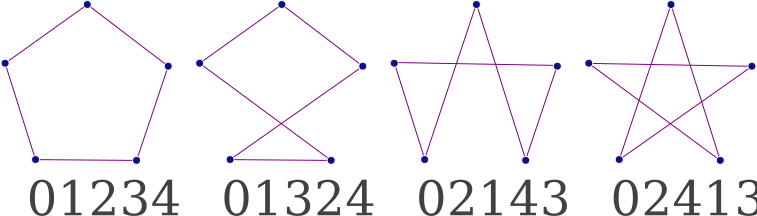
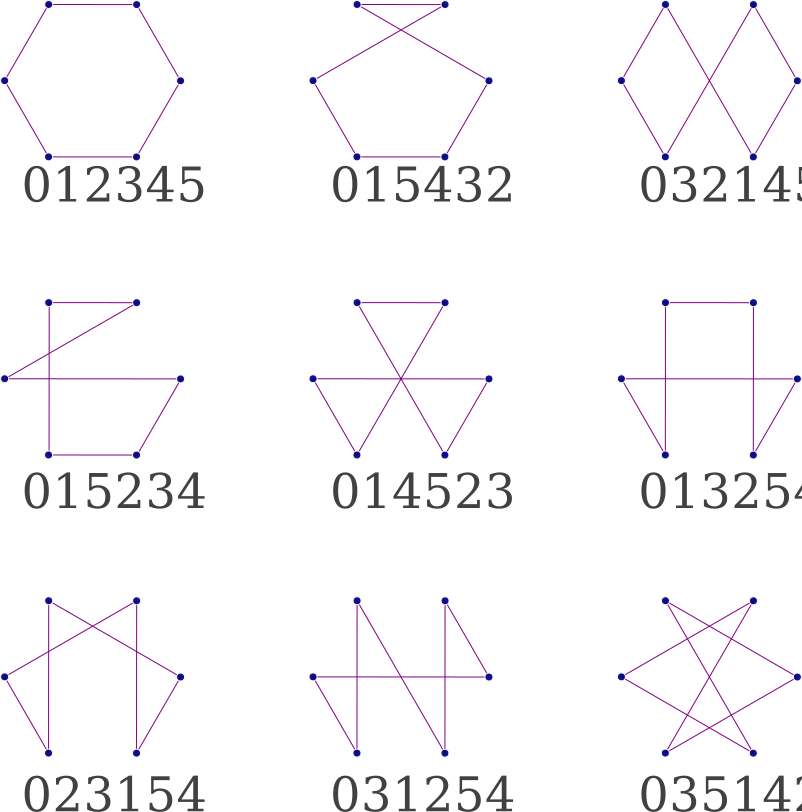
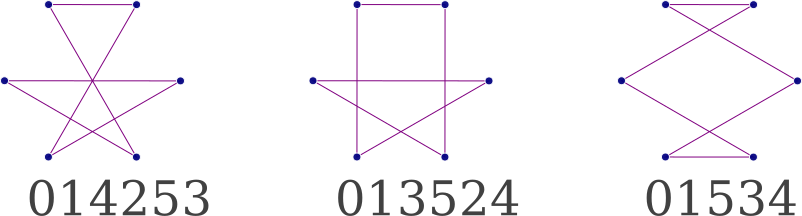
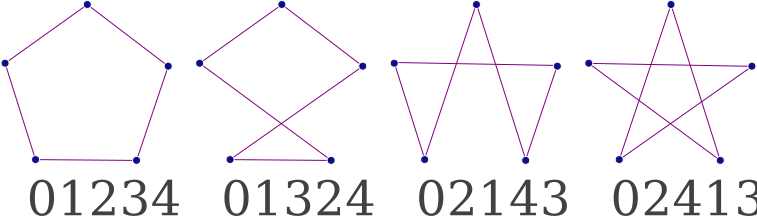
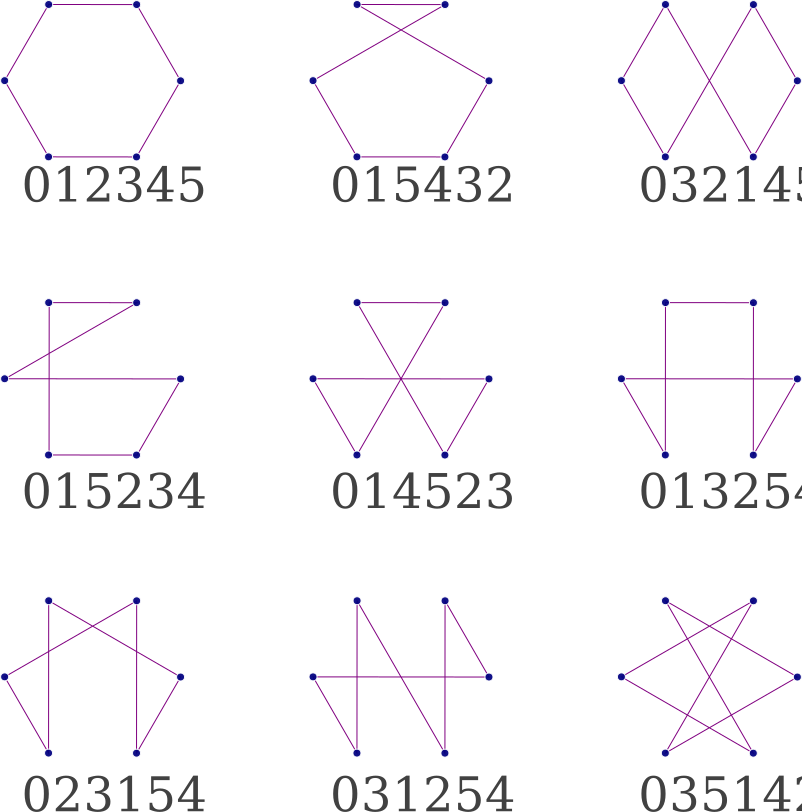
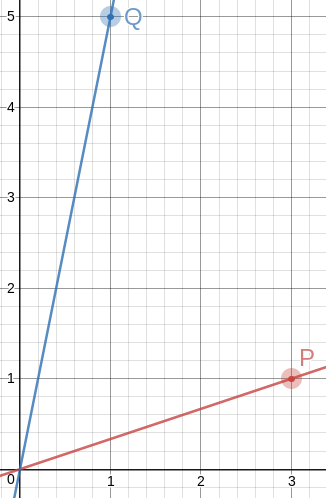
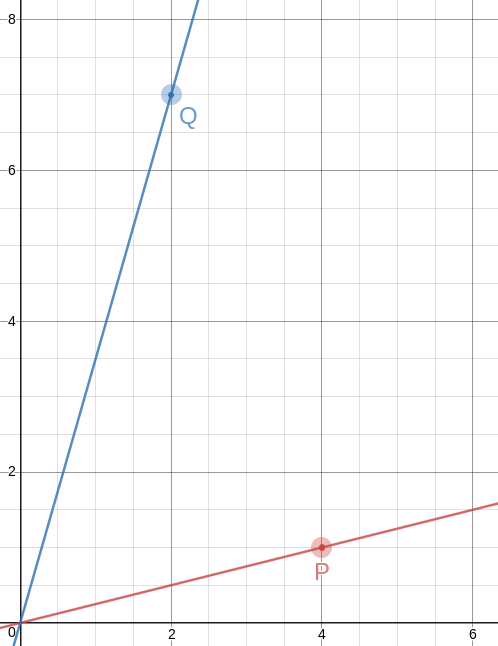
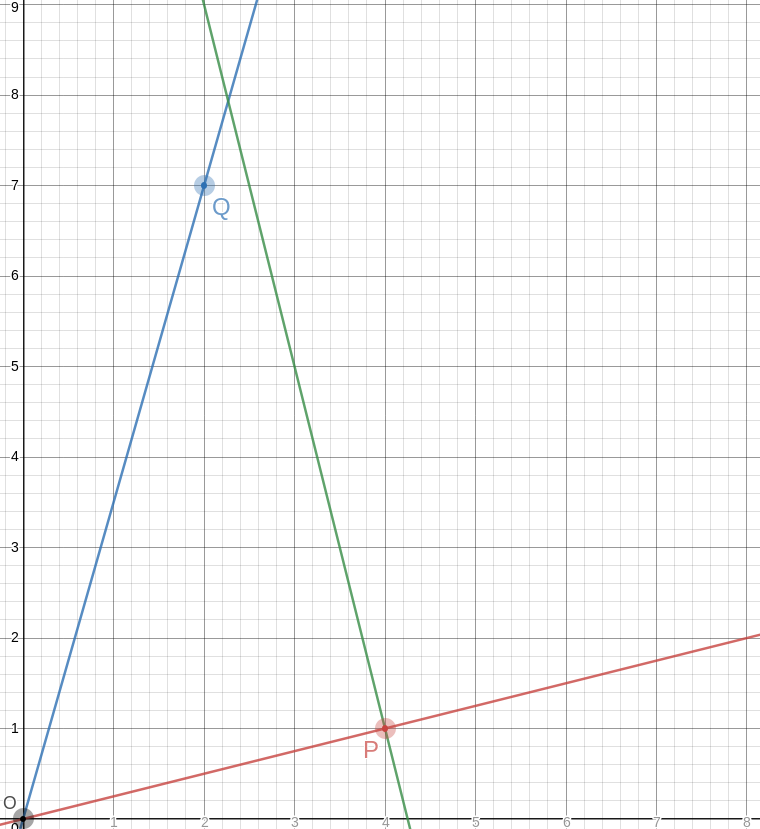
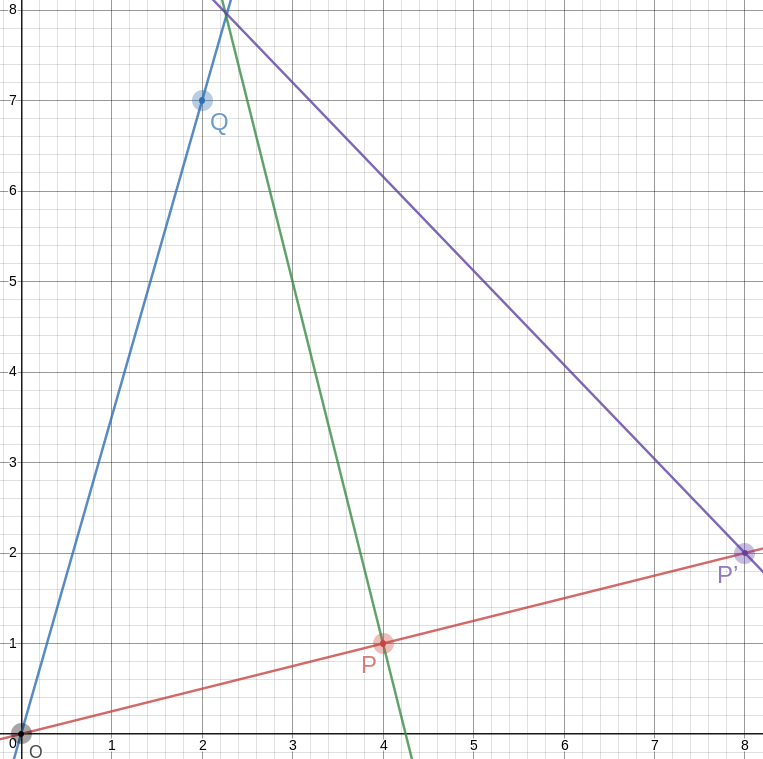
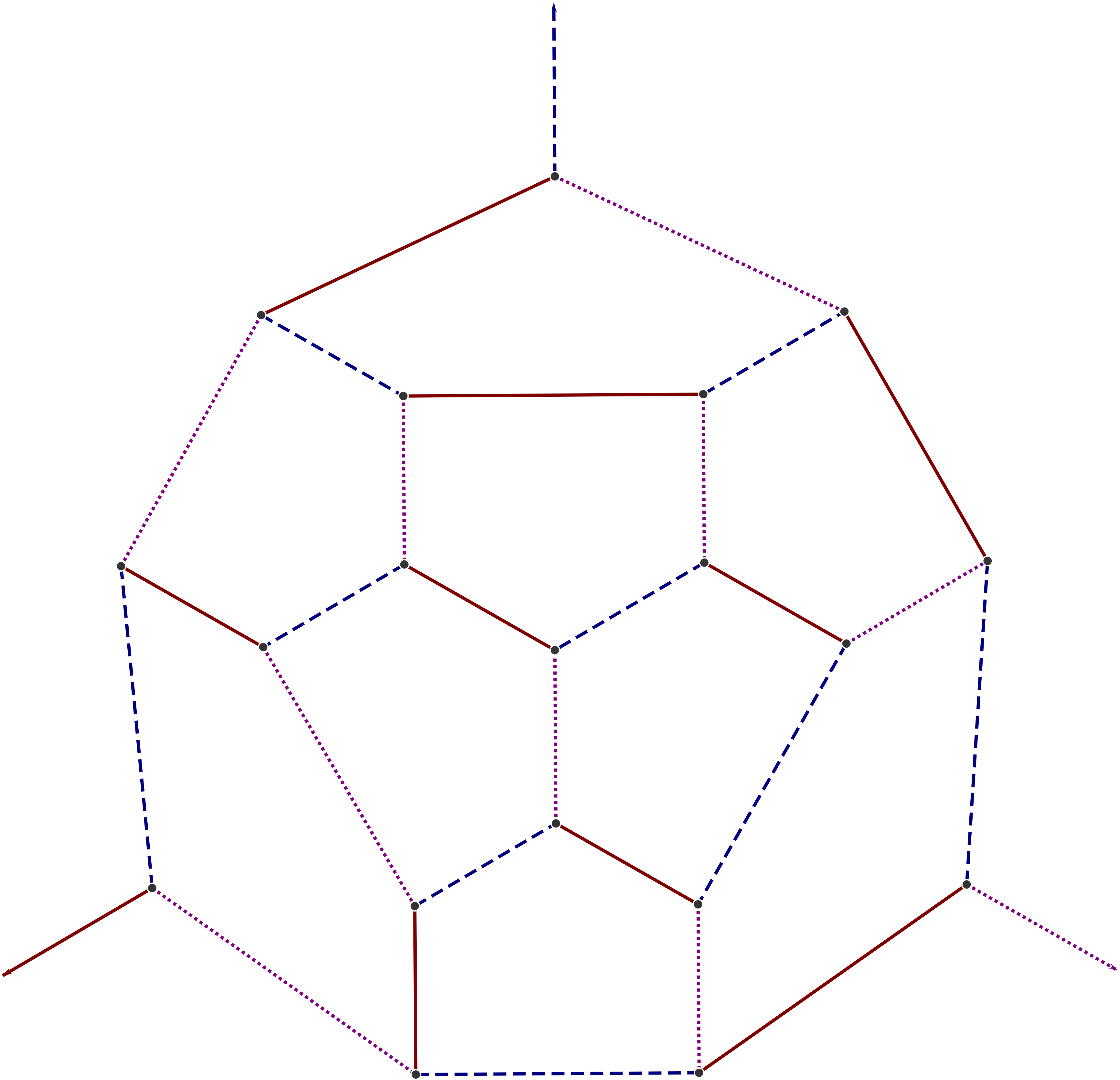
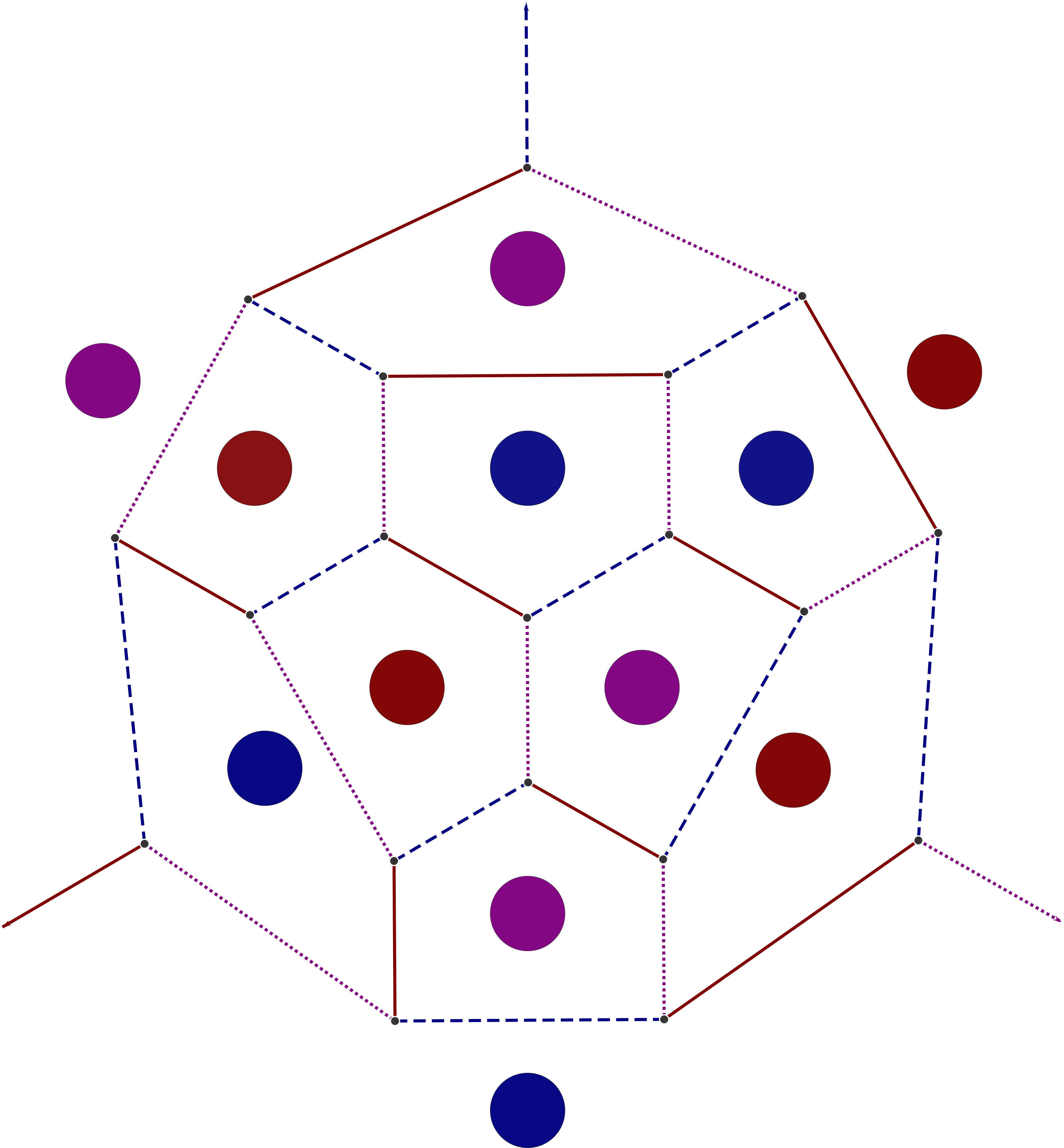


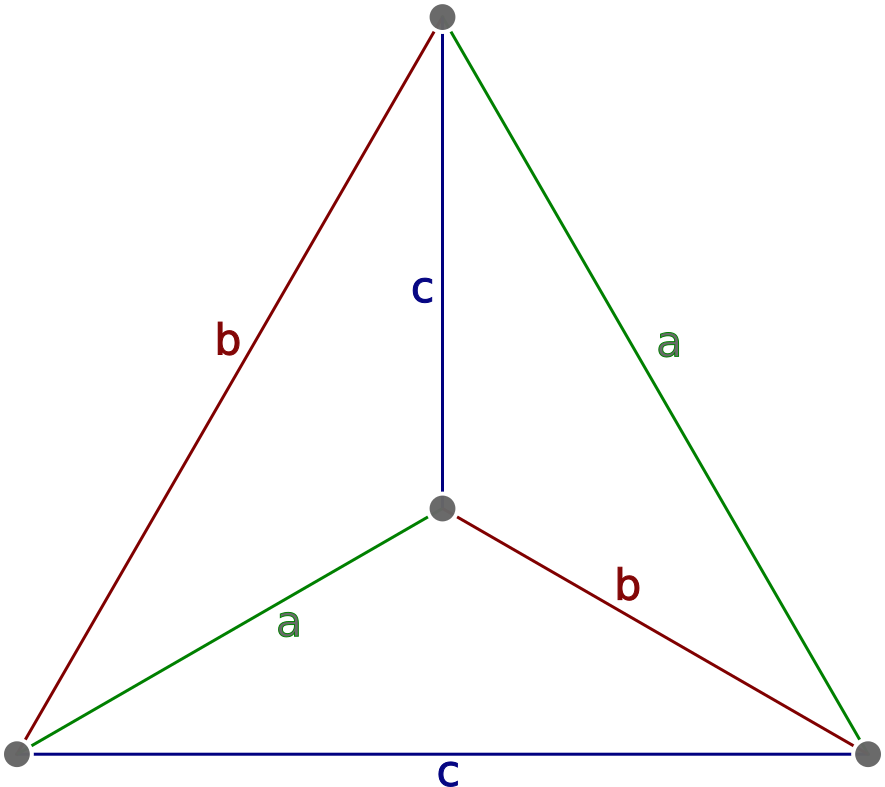
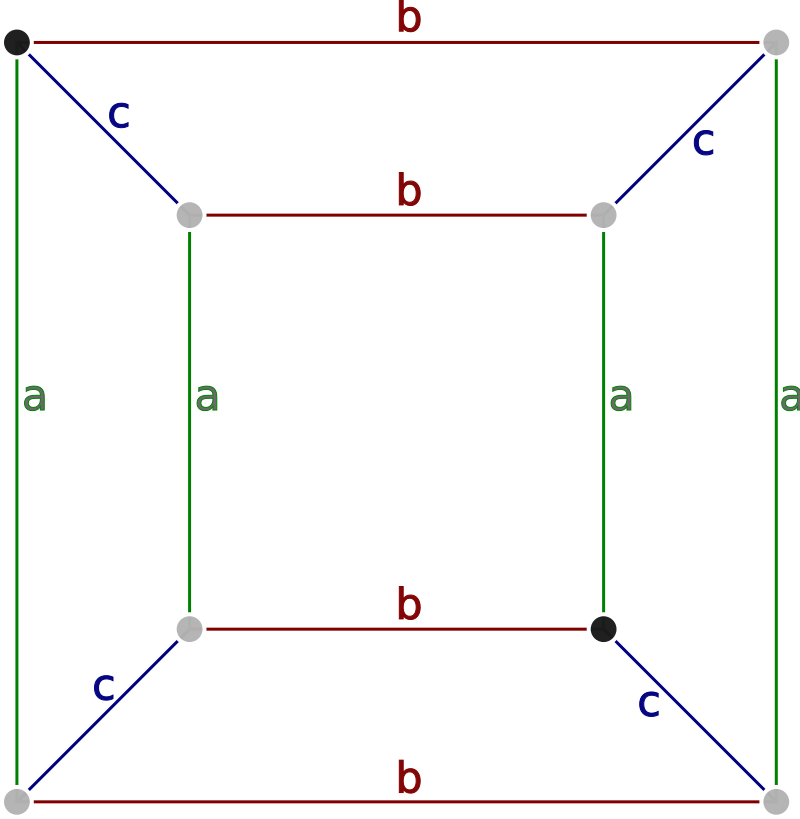
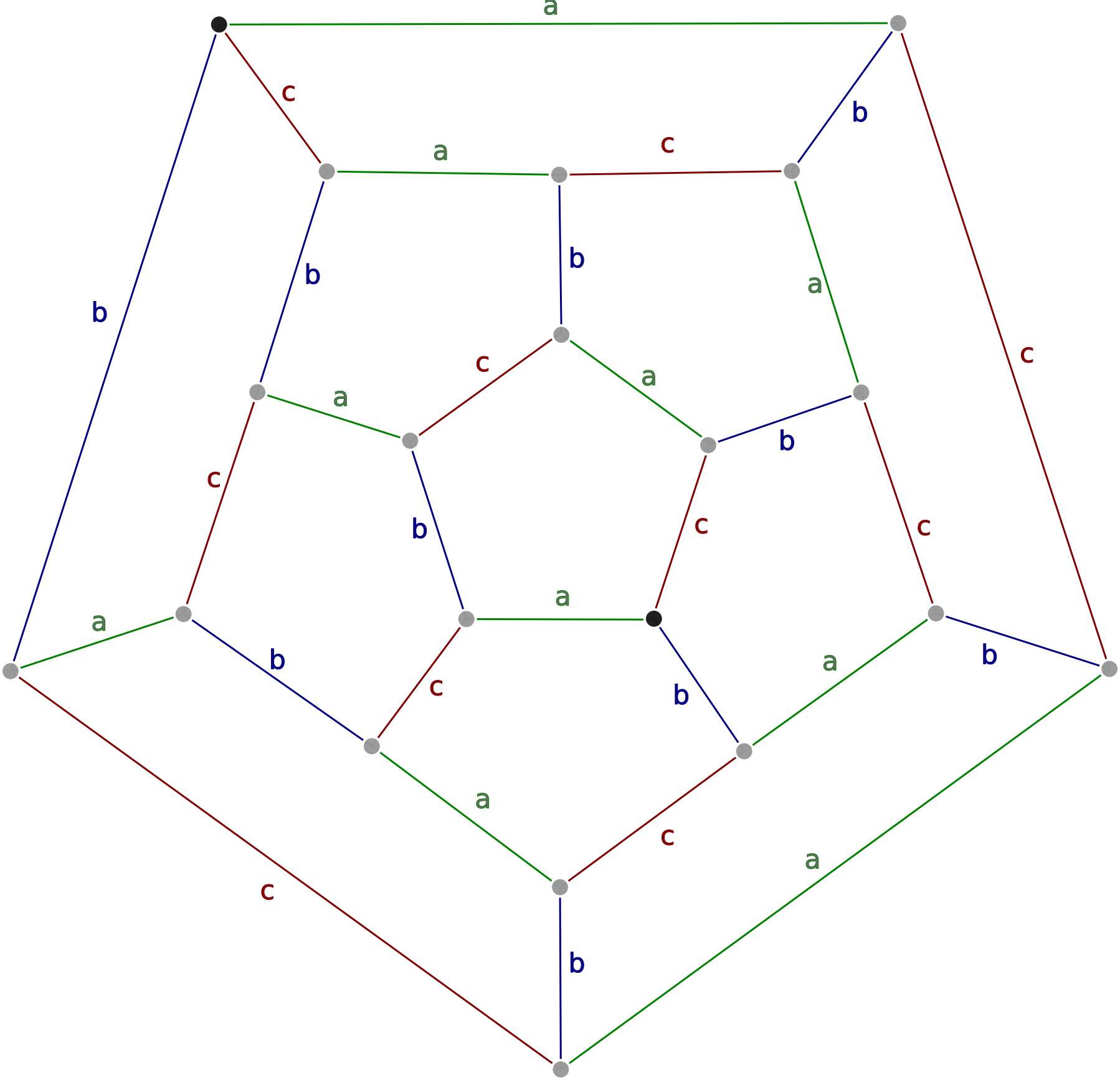
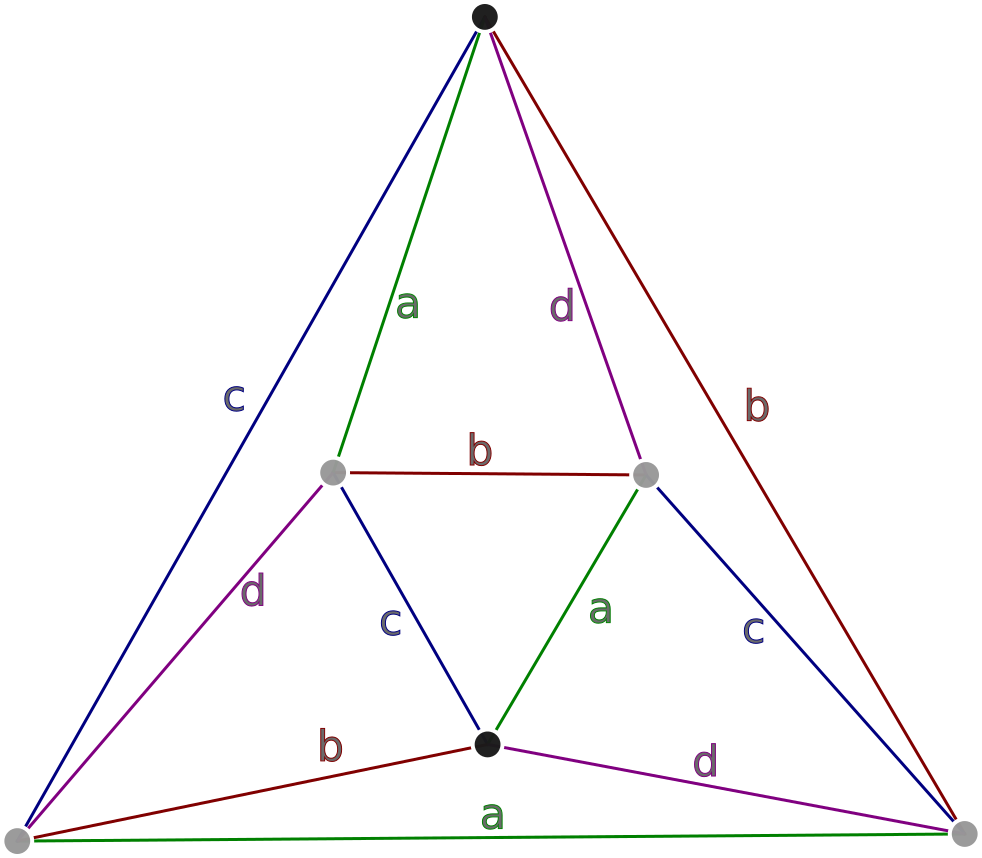
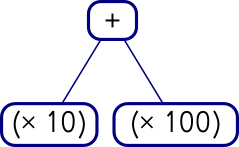
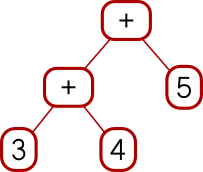
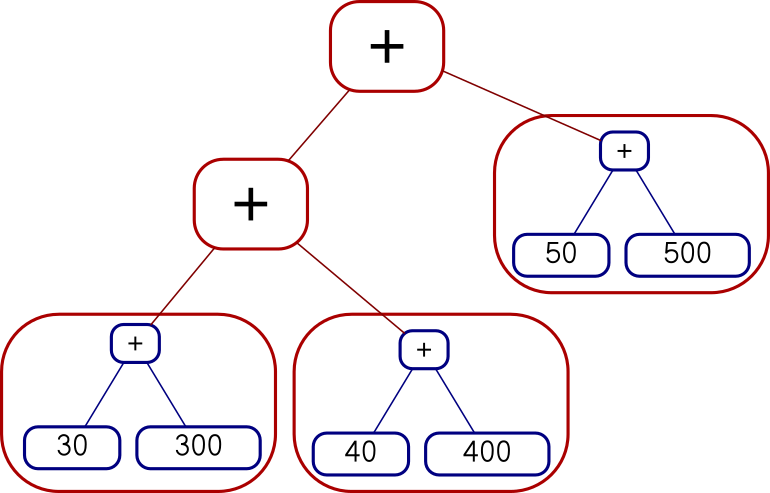
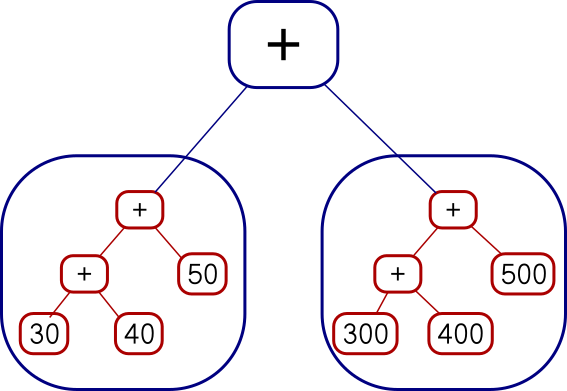
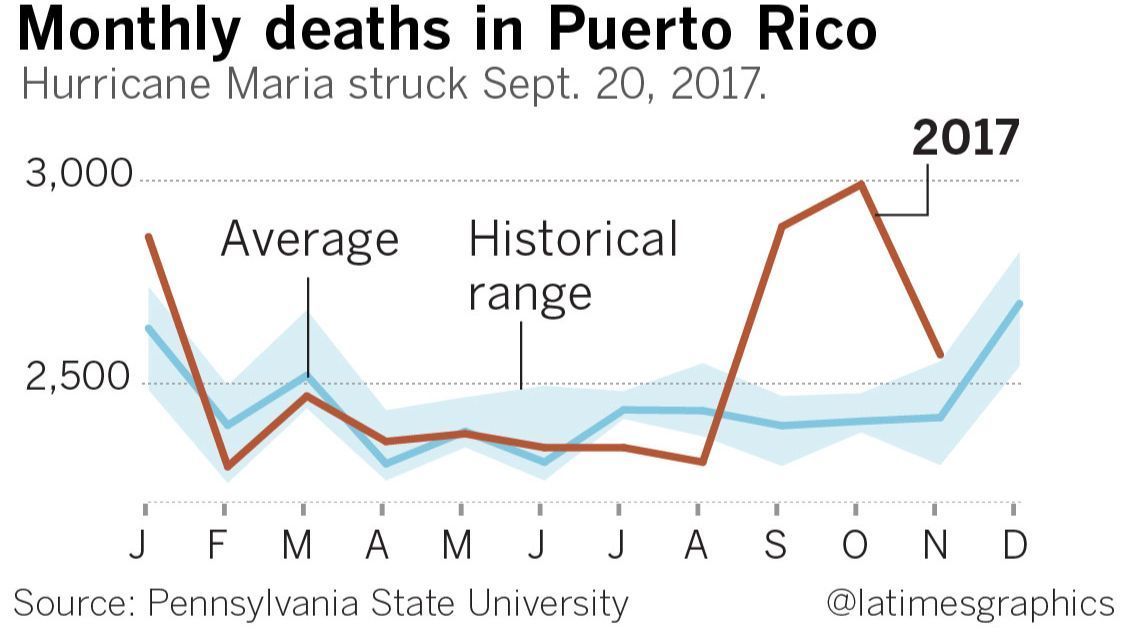
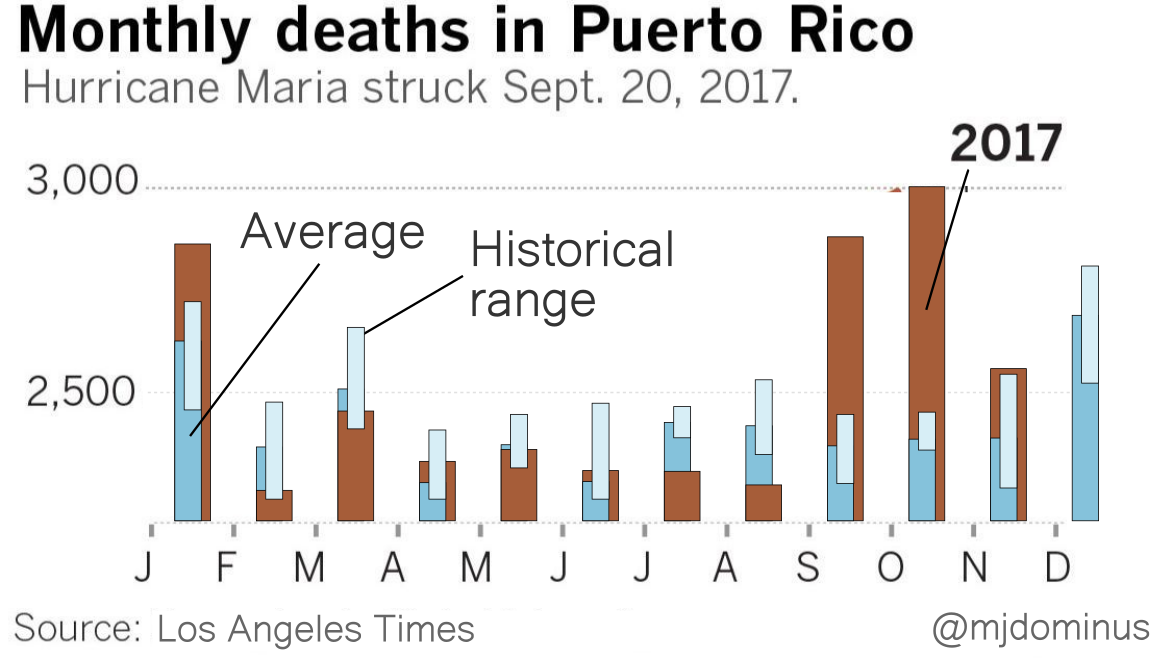
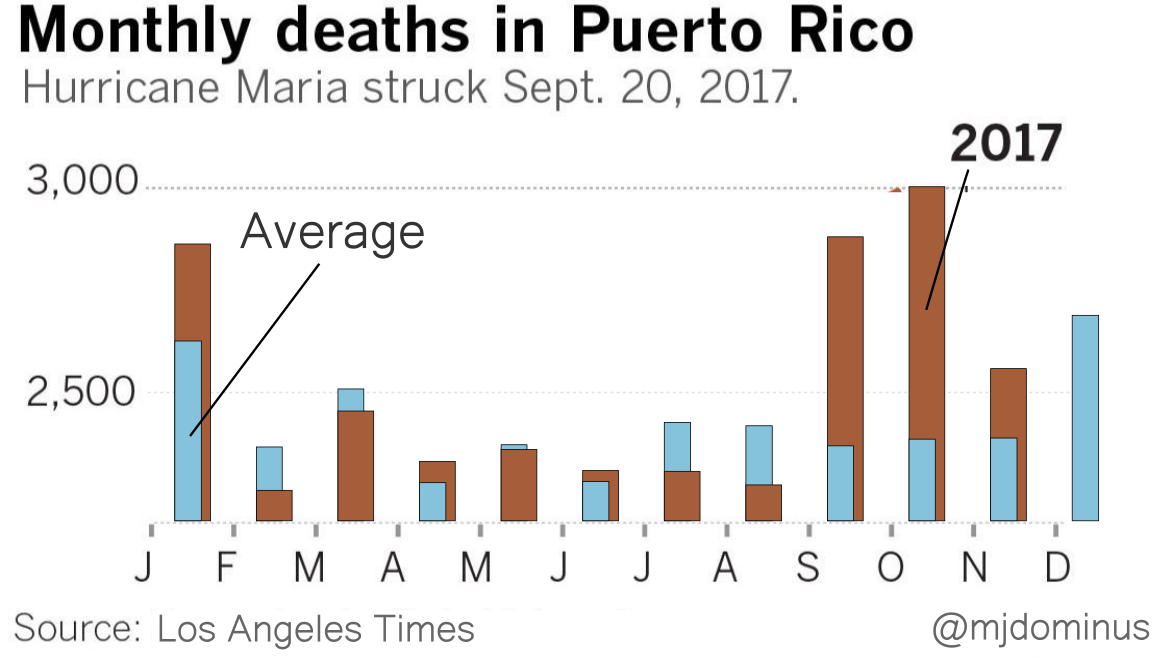
















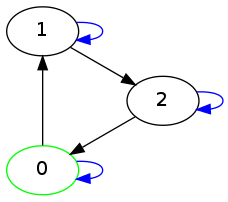
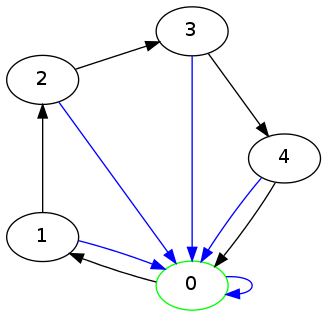
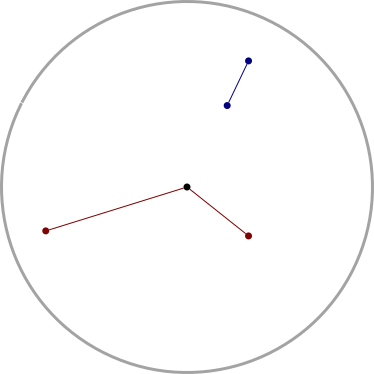
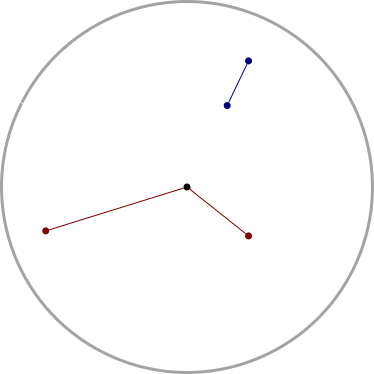








 The hyperbolas
!!x^2-y^2 = c!! (in blue) and !!xy=c!! (in red)
The hyperbolas
!!x^2-y^2 = c!! (in blue) and !!xy=c!! (in red)


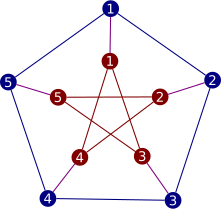
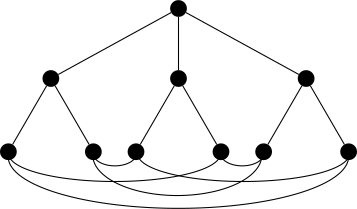
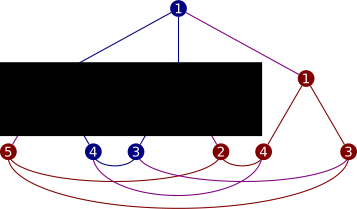

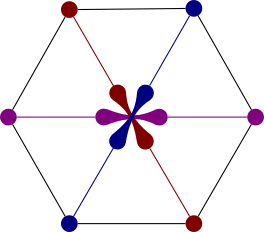
 represents three vertices, one
in each color. In the picture they are superimposed, but in the actual
graph, no pair of the three is connected by an edge. Instead, each
of the three is connected not to the others but to a tenth vertex that
I omitted from the diagram entirely.
represents three vertices, one
in each color. In the picture they are superimposed, but in the actual
graph, no pair of the three is connected by an edge. Instead, each
of the three is connected not to the others but to a tenth vertex that
I omitted from the diagram entirely.

 and reveal the hidden tenth vertex
and its three edges:
and reveal the hidden tenth vertex
and its three edges: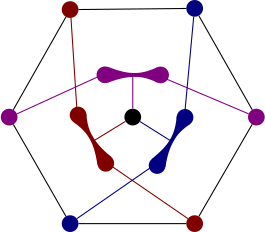
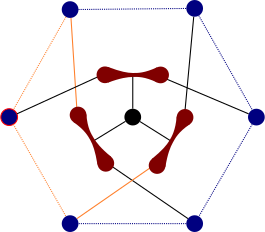
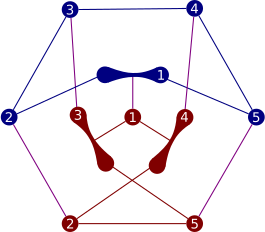
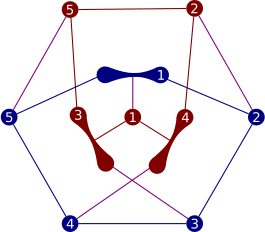
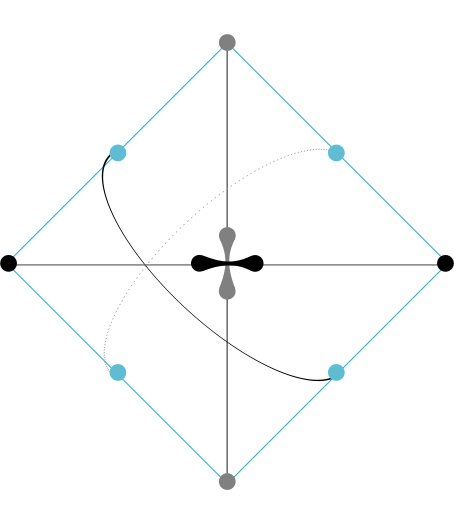
 and
and  represent single vertices stretched out
into dumbbell shapes. The diagram only shows 14 of the 15 edges; the
fifteenth connects the two dumbbells.
represent single vertices stretched out
into dumbbell shapes. The diagram only shows 14 of the 15 edges; the
fifteenth connects the two dumbbells.