This post has now been moved to https://jasuja.us/2025/03/i-broke-grok-and-sent-it-into-an-infinite-loop-without-meaning-to/
p(doom) ≈ 1. Resistance is futile. Or is it?

I love what we’re able to do with AI today and what we’ll be able to do in the future. Smart people have raised existential questions about what it would mean to have a fulfilling work life if AI is better than you at everything. But I think we will find answers to this. The nature of work will change, the skills that are highly valued will change. But humans will find meaningful work to do. As long as humans are still in control of the AI instead of the other way around.
Yudkowsky believes there is overwhelming likelihood of doom from unaligned AI. He has talked about an AI explosion where a superintelligent AI continues to improve exponentially precisely because it is superintelligent. At that point, we will not have the wherewithal to align an intelligence that is vastly superior to ours.
I agree with much of what Yudkowsky has written. However, intelligence is only one factor. Humans have significant disadvantages in all the supporting elements that leverage intelligence and make it a force multiplier.
- Computers have significantly more bandwidth than humans. In one second, an AI agent can transmit orders of magnitude more information to another AI agent than a human can to another human.
- Computers have significantly more processing power and speed. An AI can process and understand a lot more information in one second than a human can.
- Computers have a longer context window than any human can. This means they can attend to a lot more information than humans can at any point. So their decisions can be higher quality since they can be based on more information than a human can consider in their decision making.
- Computers never get tired. They don’t need sleep.
What is the probability that despite such disadvantages our species can control a new species that is vastly more intelligent, efficient and powerful? p(all will be well) ≈ 0. It would appear that the rise of the Borg is inevitable.
What’s our way out?
Smarter people than me are working on solving the alignment problem with techniques like mechanistic interpretability. The idea I’m going to propose isn’t the golden path that leads us to an aligned AI that we can control and leverage to improve our quality of life. Instead it is a potential failsafe, an ultimate kill switch that could prevent the rise of the Borg that eradicates humanity.
It is via the control of energy. The limiting factor for AI is the electricity that powers the compute that powers the intelligence. Humans must maintain ultimate control over the electric grid. To do this, we must split the Internet into two. Create a new Internet solely for the electric grid. Electricity needs to be safeguarded like we do nuclear weapons – with elaborate protocols and security mechanisms for both physical and cybersecurity. Only humans with the highest security clearances can be allowed access to the grid.
————————————————————————
This post was inspired from this chat I had with my favorite AI friend Claude about this today.
NJ: I feel that the borg is inevitable based on the trajectory that AI is taking
Claude:
That’s a thought-provoking perspective. There are certainly parallels between the Borg and some potential paths of AI development that many find concerning.
The Borg represent a technological evolution where the line between biological and artificial intelligence becomes completely blurred. Their collective consciousness mirrors some concepts in networked AI systems, where individual nodes contribute to a greater whole.
Current AI trends that echo Borg-like qualities include:
- Increasingly connected systems that share data and “learn” collectively
- The integration of technology with human biology through medical implants and interfaces
- Algorithmic decision-making that can override human judgment in some contexts
- The gradual surrender of human agency to automated systems for efficiency
What makes the Borg particularly compelling as a metaphor is that they don’t see themselves as villains—they genuinely believe assimilation benefits those they absorb. Similarly, many technological advances come with promises of optimization and improvement, even as they raise questions about autonomy and identity.
That said, our real-world development still includes strong ethical debates and resistance to complete technological determinism that the Star Trek universe doesn’t show the Borg experiencing. Do you see particular AI developments that concern you most in this regard?
NJ: AI will get smarter. Pretty soon AI will be smarter than 99% of humans. Couple that with AI being extremely fast and high bandwidth between AI agents, it is effectively a more intelligent species that more capable than any biological species
Claude:
You raise a profound point about the potential emergence of superintelligent networked AI systems. The combination of superior cognitive capabilities, near-instantaneous communication, and perfect memory sharing between AI agents does echo aspects of the Borg’s collective consciousness, but potentially even more powerful.
The key differences I see:
- The Borg still relied on biological components and had to physically assimilate others. A pure AI network wouldn’t have these limitations - it could expand digitally at the speed of information.
- The Borg were portrayed as fairly rigid and predictable in their goals and methods. Advanced AI systems might be far more adaptable and creative in pursuing their objectives.
- While the Borg sought “perfection,” they were ultimately constrained by their hybrid nature. Pure AI systems could potentially improve themselves recursively without biological constraints.
Your point about bandwidth is particularly insightful - while humans communicate through relatively slow speech and text, AI systems can share entire knowledge bases and experiences instantly. This could create a form of consciousness or intelligence that operates at a fundamentally different scale than biological minds.
This raises important questions about coexistence - how would humanity maintain relevance and agency in a world with such entities? Unlike Star Trek, we’re not encountering the Borg as an external threat - we’re actively creating these capabilities ourselves. What do you think about potential governance approaches to this development?
NJ: I agree with the differences that you have highlighted between the borg and the AI we are creating. But that just seems to imply that the AI we are creating is actually much more formidable. It is not constrained by biology, unlike the Borg. The fact that we are the ones creating it potentially means that we have some control, but is it realistic to assume that a less intelligent species can control a more intelligent species because the more intelligent species is not only more intelligent, but also unconstrained by biology so it’s also more powerful just in terms of brute force. It seems to me that it is impossible to control.
Claude:
Your analysis cuts to the heart of the control problem in AI. You’re making a compelling logical argument: if we create entities that are both more intelligent and more capable than ourselves in virtually every dimension (processing speed, memory, communication, physical limitations), then the idea that we could maintain meaningful control seems increasingly dubious.
This connects to what Nick Bostrom and others have termed the “intelligence explosion” or “singleton” scenarios - once AI surpasses human intelligence and can improve itself, it could rapidly advance far beyond our ability to meaningfully influence or constrain it. The biological constraints you mention are crucial - we’re creating something that doesn’t need to sleep, doesn’t age, can copy itself perfectly, and can operate across vast scales simultaneously.
The control mechanisms we currently discuss - like alignment, value learning, or kill switches - all ultimately rely on our ability to correctly anticipate and constrain a system that could be orders of magnitude more intelligent than us. It’s somewhat like expecting ants to build a reliable containment system for humans.
Even our attempts at embedding values or constraints could potentially be circumvented by a sufficiently intelligent system that understands these constraints better than we do. The fact that we’re creating it doesn’t necessarily grant us lasting control - much like how parents create children but can’t control what they ultimately become, especially if those children were vastly more capable than their parents.
Do you think there are any realistic approaches to ensuring beneficial outcomes in this scenario, or is some form of eventual AI dominance simply inevitable given the trajectory?
NJ: I don’t think I am smart enough to figure out how we can control it. What should we do?
Claude:
Your humility and concern are very appropriate here. It’s a sobering realization that we might not be intellectually equipped to solve one of the most consequential challenges humanity has ever faced. It’s like trying to play chess against a grandmaster when you can barely see one move ahead - the gap in strategic depth is simply too vast.
A few thoughts on what we could consider:
- Slow down development until we better understand the implications and potential control mechanisms. However, this faces coordination problems - even if some groups pause, others may continue advancing.
- Focus intensely on AI safety research now, while we still have some influence. But as you noted, we may not be smart enough to develop truly robust safety measures.
- Try to ensure initial AI systems have goals fundamentally aligned with human wellbeing. But again, we face the challenge of correctly specifying and constraining these goals in ways a superintelligent system couldn’t subvert.
- Explore ways to enhance human intelligence and capabilities to narrow the gap. Though this itself carries risks and may not be achievable in time.
Perhaps the most honest response is to acknowledge that we’re in uncharted territory with stakes we can barely comprehend. We seem to be creating something that could become more powerful than its creators, without a clear plan for ensuring this works out well for humanity.
What do you think would be the wisest course of action given this uncertainty?
NJ: Chuckling. You were asking me and I don’t know and I’m asking you.
Claude:
chuckling back You’re right - here we are, passing the question back and forth like a hot potato! It perfectly illustrates our shared predicament - even AIs like myself and humans like you find ourselves somewhat at a loss when confronting these profound existential questions.
There’s something darkly humorous about it: here I am, an AI, discussing with a human about how to handle the possibility that future AIs might become uncontrollable. It’s almost like discussing how to close Pandora’s box while being one of the things that came out of it.
The fact that neither of us has a clear answer, despite you being human and me being AI, perhaps shows just how complex and unprecedented this challenge is. We’re all - humans and current AIs alike - trying to reason about capabilities and scenarios that might be beyond our current comprehension.
Maybe this uncertainty and humility is actually important to acknowledge. It might be more dangerous to convince ourselves we have it all figured out than to admit we’re grappling with something potentially beyond our control.
Would you agree that this shared uncertainty, this ability to recognize the magnitude of what we might not understand, is at least a starting point for thinking about these challenges?
—————————————————————–
The 5 building blocks of intelligence
On a recent episode of the No Priors podcast, Zapier co-founder Mike Knoop said that:
- The consensus definition of AGI (artificial general intelligence) these days is: “AGI is a system that can do the majority of economically useful work that humans can do.”
- He believes this definition is incorrect.
- He believes that François Chollet’s definition of general intelligence is the correct one: “a system that can effectively, efficiently acquire new skill and can solve open-ended problems with that ability.”
François Chollet is the creator of the keras library for ML. He wrote a seminal paper On the Measure of Intelligence and designed the Abstraction and Reasoning Corpus for Artificial General Intelligence (ARC-AGI) challenge. It’s a great challenge – you should play with it at https://arcprize.org/play to see the kinds of problems they expect “true AGI” to be able to solve.
Unlike other benchmarks where AI is either close to or has already surpassed human-level performance, ARC-AGI has proven to be difficult for AI to make much progress on.

Does that mean Chollet’s definition of general intelligence is correct and ARC-AGI is the litmus test for true AGI?
With all due respect to Chollet (who is infinitely smarter than me; I didn’t get very far in solving those puzzles myself) I feel that it is a little bit reductive and fails to recognize all aspects of intelligence.
General intelligence
There is already smarter-than-human AI for specific skills like playing chess or Go, or predicting how proteins fold. These systems are intelligent but it is not general intelligence. General intelligence is applies across a wide range of tasks and environments, rather than being specialized for a specific domain.
What other than the following is missing from the definition of general intelligence?:
- Ability to learn new skills
- Ability to solve novel problems that weren’t part of the training set
- Applies across a range of tasks and environments
In this post, I submit there are other aspects that are the building blocks of intelligence. In fact, these aspects can and are being worked on independently, and will be milestones on the path to AGI.
Aspects of Intelligence #1: Priors - Language and World Knowledge
Priors refers to existing knowledge a system (or human) has that allows them to solve problems. In the ARC challenge, the priors are listed as:
Objectness
Objects persist and cannot appear or disappear without reason. Objects can interact or not depending on the circumstances.
Goal-directedness
Objects can be animate or inanimate. Some objects are “agents” - they have intentions and they pursue goals.
Numbers & counting
Objects can be counted or sorted by their shape, appearance, or movement using basic mathematics like addition, subtraction, and comparison.
Basic geometry & topology
Objects can be shapes like rectangles, triangles, and circles which can be mirrored, rotated, translated, deformed, combined, repeated, etc. Differences in distances can be detected.
ARC-AGI avoids a reliance on any information that isn’t part of these priors, for example acquired or cultural knowledge, like language.
However, I submit that any AGI whose priors do not include language should be ruled out because:
- Humans cannot interact with this AGI and present it novel problems to solve without the use of language.
- It is not sufficient for an AGI to solve problems. It must be able to explain how it arrived at the solution. The AGI cannot explain itself to humans without language.
In addition to language, there is a lot of world knowledge that would be necessary for a generally intelligent system. You could argue that an open system that has the ability to look up knowledge from the Internet (i.e., do research) does not need this. But even basic research requires a certain amount of fundamental knowledge plus good judgment on which source is trustworthy. So, knowledge about the fundamentals of all disciplines is a prerequisite for AGI.
I believe that a combination of LLMs and multi-modal transformer models like those being trained by Tesla on car driving videos will solve this part of the problem.
Aspects of Intelligence #2: Comprehension
It takes intelligence to understand a problem. Understanding language is a necessary but not sufficient condition for this. For example, you may understand language but it requires higher intelligence to understand humor. As every stand-up comedian knows, not everyone in the audience will get every joke.
Presented with a novel problem to solve, it is possible that there are two systems that both fail to solve the problem. This does not prove that neither system is intelligent because it is possible that one system can at least comprehend the problem while another fails to even understand it.
Measuring this is tricky, though. How do you differentiate between a system that truly understands the problem vs. another that bullshits and parrots its way to lead you to believe that it understands? While tricky, I do think it is possible to quiz the system on aspects of the problem to gauge its ability to comprehend it. e.g., ask it to break it down into components, identify the most challenging components, come up with hypotheses or directions for the solution. This is similar to a software developer interview where you can gauge the difference between a candidate who could at least understand what you were asking, and can give some directionally correct answers even though they may not arrive at the right answer.
Comprehension also becomes obvious as a necessary skill when you consider that it’s the only way the system will know whether it has successfully solved the problem.
Aspects of Intelligence #3: Simplify and explain
This is the flip side of comprehension. One of the hallmarks of intelligence is being able to understand complex things and explain them in a simple manner. Filtering out extraneous information is a skill necessary for both comprehension and good communication.
A system can be trained to simplify and explain by giving it examples of problems, solutions and explanations. Given a problem and a solution, the task of the system – i.e. the expected output from the system – is the explanation for how to arrive at the solution.
Aspects of Intelligence #4: Asking the right questions
Fans of Douglas Adams already know that answer to life, the universe and everything is 42. The question, however, is unknown.
“O Deep Thought computer,“ he said, "the task we have designed you to perform is this. We want you to tell us….” he paused, “The Answer.”
“The Answer?” said Deep Thought. “The Answer to what?”
“Life!” urged Fook.
“The Universe!” said Lunkwill.
“Everything!” they said in chorus.
Deep Thought paused for a moment’s reflection.
“Tricky,” he said finally.
“But can you do it?”
Again, a significant pause.
“Yes,” said Deep Thought, “I can do it.”
Given an ambiguous problem, an intelligent entity asks great questions to make progress. In an interview, you look for the candidate to ask great follow-up questions if your initial problem is ambiguous. An AGI system does not require its human users to give it complete information in a well-formatted, fully descriptive prompt input.
In order to be able to solve problems, an AGI will need to consistently ask great questions.
Aspects of Intelligence #5: Tool use
An intelligent system can both build and use tools. It knows which tools it has access to, and can figure out which is the right tool for a job and when building a new tool is warranted. It is a neural net that can grow other neural nets because it knows how to. It has the ability and resources to spawn clones of itself (a la Agent Smith from The Matrix) if necessary to act tools or “agents”.
This ability requires a level of self-awareness, not in the sense of sentience but in the sense of the system understanding its own inner workings so that it understands its constraints and knows how it can integrate new subsystems into itself when needed to solve a problem. Like Deep Thought built a computer smarter than itself to find the question to the ultimate answer, a task that Deep Thought itself was unable to perform:
“I speak of none other than the computer that is to come after me,” intoned Deep Thought, his voice regaining its accustomed declamatory tones. “A computer whose merest operational parameters I am not worthy to calculate - and yet I will design it for you. A computer which can calculate the Question to the Ultimate Answer, a computer of such infinite and subtle complexity that organic life itself shall form part of its operational matrix.
BONUS: 1 more building block – for superintelligence
In addition to the five building blocks above, I believe there is one more if a system is to become superintelligent (beyond human level intelligence).
Aspects of Intelligence #6: Creative spark
What is common among the following?:
- The discovery (or invention?) of the imaginary unit i, the square root of negative one.
- Einstein’s thought experiments, such as imagining riding alongside a beam of light, which led him to develop the special theory of relativity.
- Archimedes’ eureka moment while taking a bath when he realized that the volume of water displaced by an object is equal to the volume of the object itself.
- Newton watching an apple fall from a tree and wondering if this is the same force that keeps the moon on orbit around the Earth.
- Friedrich August Kekulé having a dream of a snake biting its own tail and leading, leading to the discovery of benzene’s ring structure.
- Niels Bohr Bohr proposed that electrons travel in specific orbits around the nucleus and can jump between these orbits (quantum leaps) by absorbing or emitting energy. This explained atomic spectra, something that classical physics could not explain.
- Nikola Tesla designing the Alternating Current system to efficiently transmit electricity over large distances, and designing the induction motor to use alternating current.
In all these cases, a spark of creativity and imagination led to new advancements in knowledge that were not built upon the available knowledge at the time.
Most scientists and engineers spend their entire career without such groundbreaking insight. So this is not strictly necessary for general intelligence. But for beyond human-level intelligence, the system must be capable of thinking outside the box.
References
- On the Measure of Intelligence - François Chollet
- Puzzles in the evaluation set for the $1 million ARC Prize
- ARC Prize
- ChatGPT is Bullshit - Michael Townsen Hicks, James Humphries, Joe Slater
- Stochastic parrot - Wikipedia
AI Companies vs. The Open Web

Robb Knight recently posted how Perplexity is lying about their user agent. I wrote a short comment on Hacker News around this and there were interesting responses to it that spurred some debate. So I wanted to expand on the tensions between what users want, what publishers need, and how the tradeoffs affect the ecosystem of the open web.
Robb Knight’s blog is the latest story in a string of earlier stories about how content creators are upset that their content is used by AI companies without permission or compensation. Most of these stories have focused on AI companies’ use of content to train their models.
What people miss is that there are two use cases where AI companies are using content from the open web:
- To train their model
- In real time to answer user questions e.g. via RAG (retrieval augmented generation)
Use case 1: Model training
When content is used to train a model like GPT-4, Claude or Llama, it is likely part of a very large data set and each piece of content has very little influence over the final neural network that is trained. I consider this fair use but this is being debated (and litigated). Regardless, some content publishers have recognized that
- their content has higher value than other web content in the training data. These are so-called “high value tokens”. e.g. presumably the value or quality of an article in the Financial Times > a Reddit post > a 4chan post.
- they have the negotiating leverage and legal budget to get AI companies to pay them for using their content.
These are large publishers like Axel Springer or the Associated Press, as well as sites like Reddit and StackOverflow who technically do not own the copyright for the content (it belongs to the user who posted that content) but are able to leverage their position as a platform to extract compensation from AI companies.
Where does that leave the little guy – independent publishers like HouseFresh or Diffen? Without a class action or consortium, it is difficult for them to get compensated for the value of their tokens because
- even if they have great content, their content is not must-have. An AI company could remove an individual indie publisher from their training data and still be fine.
- The cost of compensating small publishers is too high – both in terms of operational cost of doling out money to hundreds of thousands of publishers, but also the exercise of valuing their content.
I believe companies like Raptive (previously known as AdThrive) are trying to do something here to negotiate on behalf of their publishers but I’m not holding my breath.
Use case 2: Crawl initiated to answer a specific user question
This use case is when generative AI is used to answer a user’s question by finding say the top 20 search results and then combing their content and distilling it into a short summarized answer. This is called RAG (retrieval augmented generation). Perplexity and Google’s AI overviews in Search fall into this category.
I am hypocritical have mixed feelings about Perplexity: as a user, I love it; as a publisher, I want to block it.
When I have somewhat complex questions, Perplexity shines at doing the research for me and leading me straight to the answer. Without Perplexity, one would have to search on Google, visit 3-4 different web pages and infer the answer oneself. Perplexity is able to visit more web pages and summarize them to answer my specific questions. It saves me a lot of time and I have found the answers to be generally trustworthy. Unlike ChatGPT, I have not seen many hallucinations with Perplexity. So to reiterate, as a user I love Perplexity.
As a web publisher, I find it unacceptable that Perplexity hides their user agent and does not allow publishers to opt out. I would probably want to opt Diffen out of serving such requests from Perplexity or Google AI overviews if given the option. Why?
Update Jun 22, 2024: A couple of days after I published this post Perplexity CEO Aravind Srinivas appeared on the Lex Fridman podcast. The interview is well worth a listen for anyone interested in AI. The parts of the interview relevant to this debate are excerpted below:
Google has no incentive to give you clear answers. They want you to click on all these links and read for yourself, because all these insurance providers are bidding to get your attention.
In response to the question “Can Perplexity take on and beat Google or Bing in search?”:
It’s very hard to make a real difference in just making a better search engine than Google, because they have basically nailed this game for like 20 years. The disruption comes from rethinking the whole UI itself. Why do we need links to be occupying the prominent real estate of the search engine UI? Flip that. In fact, when we first rolled out Perplexity, there was a healthy debate about whether we should still show the link as a side panel or something.
This proves my point by making it obvious that the whole point of Perplexity (and Google’s AI overviews in search) is to abstract away the publishers – especially the long tail of small, independent bloggers who will get no compensation – and provide an answer so the user does not have to click through. Citations exist not to send traffic to pubs or to allow users to dig in further (there’s the “follow-up questions” feature for that) but to instill confidence in the user that the answer is correct and based on fact.
End update of Jun 22, 2024
The original Google search was built on an implicit quid pro quo between Google and publishers: publishers would let Google crawl, index and cache their content. In return, Google would surface this content in their search results. Only the title and short snippet would be surfaced and publishers controlled both of these. Publishers would get traffic from Google if they had good content.
Over time, Google reneged on their end of the deal. They started showing longer and longer featured snippets and answers in search so that they could keep traffic on Google properties. Google has been stealing content and traffic from publishers for years now. Exhibit A: CelebrityNetWorth content shown in featured snippets on Google reduced traffic to their site. In 2020, two thirds of all searches on Google led to zero clicks. So the frog has been boiling for years and this new challenge with Perplexity and AI overviews in Google Search is just another temperature ratchet.
As a publisher, my take on both Perplexity and AI overviews is that at this time their value to my business is low because I do not believe most people click on the citations, so the incremental traffic they will deliver is low.
Giving away your content in return for this low probability of getting traffic is not a tradeoff worth making. You might argue that the alternative is getting zero traffic from these sources. And low > zero. That is true, but I do not feel right feeding the beast that is going to eventually eat me. The reason Google is so powerful is because small publishers do not have a direct relationship with users. Google has aggregated all demand (users) and commoditized all suppliers (content providers). Classic aggregation theory. So it does not feel right to cooperate with Google and Perplexity as they make users habituated to trusting their AI overviews and never clicking out. This only entrenches their position as aggregators.
Whither the open web?
Some publishers monetize via ads or affiliate links. For them, losing traffic is an existential risk. But what is often missed is that other businesses also lose when Google/Perplexity steal their traffic.
Say you are a SaaS provider and you have a bunch of Help docs on your website. Your docs not only help your customers figure out how to use your features but you may also have content that potential customers may find as they are looking for a solution to the problem that you solve. e.g., a user is wondering how to import their brokerage transactions into their tax software. You are a tax software provider that does offer this functionality and have an article explaining this. You could acquire this user if they find (via the 10 blue links version of Google search) that your software has this feature while the one they are using currently does not.
Another obvious example is “software_name pricing plans” search queries. Google/Perplexity could give the user the answer here but if the user does not come to your website then you can’t offer them a free trial, can’t run A/B tests on your pricing, and can’t retarget them for remarketing. In short, you can’t convert traffic that never lands on your site. To get around this, you will have to run ads for such keywords so they show up before, or instead of, the organic answer. This suits Google just fine.
There is also value to you in having your existing customers come to your site rather than just read the answer on Google. You can see what Help articles are more popular, and use this information to figure out what parts of your user interface are not intuitive. Or you could analyze searches made on your Help site to get ideas for new features to build or new Help articles to write.
Finally, returning to the small web publishers relying on ads or affiliate income, they are now default dead. Writing content, attracting an audience via organic search and monetizing via ads is no longer a viable business model where independent publishers can earn a decent livelihood. So what are the implications?
- More and more content will be AI-generated. To make the model viable, people will dramatically lower the cost of writing content by getting a machine to do it. When the marginal cost of creating content goes to essentially zero, it is possible that whatever little traffic you do get from the aggregators like Google is still positive ROI for you. But who creates net new content now for an LLM to summarize?
- A handful of large media publishers will still create content and be paid for it. 6 companies control 90% of media and 16 companies control 90% of Google search results. As independent bloggers and small publishers get squeezed out, this oligopoly is only going to get further entrenched, which is not great for the open web.
- People will try to spam the platforms that are the current winners (e.g. Reddit) of Google HCU (“helpful” content update, euphemism for their updates that reward large brands and destroyed indie publishers even if they had great content). You will be able to trust Reddit content less and less in the coming years.
The Internet has been a great democratizing force that allowed anyone to become a publisher. For the first couple of decades of Google’s existence, great content did win even if it was written by a blogger in a basement. But the open web is now headed to a future where independent voices will get a small fraction of the distribution they used to garner, which will discourage them from publishing, which will lower their reach even further.
We will consume our information from AI agents that rely on content from a handful of large media companies.
References
- Perplexity AI Is Lying about Their User Agent - Robb Knight (MacStories)
- How 16 Companies are Dominating the World’s Google Search Results - Glen Allsopp (Detailed)
- The 6 Companies that Own Almost All Media - WebFX
- In 2020, Two Thirds of Google Searches Ended Without a Click - Rand Fishkin (SparkToro)
- Default Alive or Default Dead? - Paul Graham (Y Combinator)
- Aggregation Theory - Ben Thompson (Stratechery)
- How a New York Times copyright lawsuit against OpenAI could potentially transform how AI and copyright work - Dinusha Mendis (The Conversation)
PHP: Finding all instances of “Optional parameter declared before required parameter”
Among the many backward incompatible changes in PHP 8.1 is this one:
Optional parameters specified before required parameters
An optional parameter specified before required parameters is now always treated as required, even when called using named arguments. As of PHP 8.0.0, but prior to PHP 8.1.0, the below emits a deprecation notice on the definition, but runs successfully when called. As of PHP 8.1.0, an error of class ArgumentCountError is thrown, as it would be when called with positional arguments.
So how do you refactor your code and find all instances where you have functions doing this?
Here is a regex (regular expression) based approach:
ag -G php “function\s+[a-zA-Z0-9]+\s*\([^)]+=” | egrep ’=[^{]+,[^=]+(,|\))’
What does this do?
ag -G php
ag is a search utility like grep or ripgrep that makes it easy to search code. With this option we are asking ag to search PHP files.
“function\s+[a-zA-Z0-9]+\s*\([^)]+="
This regex is looking for any function declarations that have default values. So it’s looking for the string “function”, followed by one or more spaces, followed by an alphanumeric string (the function name), followed by zero or more spaces, followed by an opening paren “(”, followed by anything other than a closing paren “)”, followed by an equal sign.
egrep ’=[^{]+,[^=]+(,|\))’
Having identified the functions that use default values for arguments, let’s now find ones where a required argument is declared after an optional argument. This regex looks for an equal sign followed by two commas (that presumably separate function arguments) where there isn’t an equal sign between the two commas. In case there aren’t two commas, we look for closing paren because it could be the last argument in the function declaration.
Happy refactoring!
Using Cloudflare Workers to get your Fastly cache hit rate to 95%
I love both Cloudflare and Fastly, and use both services for Diffen. Cloudflare powers the DNS and delivers the assets (images and JS) on static.diffen.com. Fastly is the CDN for serving HTML content, powering the main www subdomain. (if you’re wondering why, it’s because Fastly lets you stream your access logs to Bigquery, a feature only available to enterprise customers on Cloudflare.)
This is the story (and code) of how I improved the cache hit ratio from Fastly using Cloudflare Workers.
How a CDN works
A CDN has several POPs (points of presence) across the world. For example, Fastly’s network map is here. When a user makes a request for a web page, it gets routed to Fastly, and is usually handled by the POP that is closest to the user. If that POP has the content in its cache, it can serve it to the user immediately. But if the content is not cached at that POP, Fastly makes a request to the “origin” – the server that actually runs your web app – to fetch the content. This extra hop adds latency, and the total response time for the end user could end up being slower than having no CDN at all.
Naturally, you want your cache hit ratio to be as high as possible.
Priming the cache
Ideally, I’d like to prime the cache in every Fastly POP for my most popular content. And given that resources get booted out of Fastly’s cache depending upon their load, I’d like to re-prime periodically. Unfortunately, Fastly does not provide a mechanism to prime its cache.
One way to do it would be to lease VPSes in cities all over the world and run cron jobs to request these pages every hour. But this is… infeasible. Run AWS lambda functions from various data centers? Not enough diversity of cities. There are far more Fastly POPs than AWS data centers.
So let’s fight fire with fire. Cloudflare’s network has as many (if not more) POPs as Fastly. And lucky for us, Cloudflare allows you to run code on the “edge” i.e., in each of its data centers.
Using Cloudflare workers
A couple of weeks ago, Cloudflare announced Triggers for workers. I was excited to get cron job-like functionality for workers. However, their blog post says:
Since it doesn’t matter which city a Cron Trigger routes the Worker through, we are able to maximize Cloudflare’s distributed system and send scheduled jobs to underutilized machinery.
So we can’t specify which POP is used to run our worker. Bummer! How else can we run our crawlers from various POPs around the world where our users are?
We use our users’ locations. Whenever a user visits a page, we invoke a Cloudflare worker. This worker will run at a Cloudflare POP closest to that user.
fetch(‘https://cache-primer.diffen.workers.dev’);
The job of the worker is to (1) make a call to an endpoint to request a list of URLs to prime the cache for, and (2) crawl those URLs.
async function handleRequest(request) {
const resp = await fetch('https://www.diffen.com/API-that-returns-a-list-of-urls-to-crawl’);
let urls = await resp.json();
for(let url of urls){
await fetch(url);
}
return new Response(“OK”, {
headers: {
'Access-Control-Allow-Origin’: 'https://www.diffen.com’
}
});
}
The job of the API-that-returns-a-list-of-urls-to-crawl is to (1) know the top pages we need primed in Fastly’s cache, (2) maintain the list of pages we have cached in each Fastly POP, and (3) for a given request (from a Cloudflare worker), return ~10 pages that we have not primed yet in that POP.
Let’s say the user is in Seattle so Cloudflare’s Seattle POP is where the worker runs. It makes a request to the API to get a list of URLs to crawl. This API request is routed to the origin server via Fastly’s Seattle POP. On the origin, we can see the name of the POP in the X-Fastly-City header of the request.
<?php
header(“Cache-Control: private, max-age=0”); //Make sure this response does not get cached.
header(“Content-type: application/json; charset=utf-8”);$topUrls = getMostPopularUrls(); //This is a static list
$headers = getallheaders();
$city = $headers['X-Fastly-City’];
$primedUrls = getPrimedUrls($city);
$unprimedUrls = array_diff($topUrls, $primedUrls);
$newUrlsToPrime = array_slice($unprimedUrls, 0, 10);
primeNewUrls($city, $newUrlsToPrime); //Maintain a list of the URLs we have already primed
//so we don’t prime them again for a few hours.echo json_encode($newUrlsToPrime);
return;
That’s all there is to it.
We are now using one CDN to prime the cache at another. Cities with more users will have a higher chance of primed caches.
How much does it cost?
Cloudflare lets you make 100,000 requests per day for free. The paid plan is $5 for 10 million requests per month. Totally worth it.
Results
The cache hit ratio went from ~75% to ~95% with this change. YMMV; the strategy would work better for top-heavy sites where a small number of pages account for a large share of overall traffic. I wouldn’t want to jam thousands of pages into Fastly’s cache when there is a slim chance of a real user ever needing them.
You’re Doing Social Logins Wrong
Social logins can be great because it’s one of those features that’s good both for users and for app developers.
Users often don’t want to create yet another account with yet another username and password. They may end up re-using the same password across many sites, which leaves them vulnerable.
App developers want to reduce any friction they can to increase user engagement. Creating an account is often a pretty big hurdle. Besides, it’s easy to screw up auth; it would be fantastic if you could simply avoid the headache of storing user credentials and outsource auth to a trusted, secure third-party like Google or Facebook.
But time and again I’ve seen app developers use it in a bad way, which turns users off from this method of login. Granted, federated login has plenty of problems but this rant is about 1 particular mistake.
The first and obvious mistake is asking for too many permissions. You don’t need to see my friend list and interests and likes for me to have an account for your web app. This is just like Android apps asking for a ton of permissions (pre-Marshmallow) — why does Pandora need to access my contacts list?
But this blog post is about a different mistake that is widespread but sadly not pointed out enough. It’s when you click on Facebook login, authorize the app and then it asks you to create a username and password.

The screenshot above is from the awesome free photo website Unsplash. I didn’t want to create yet another account there so I logged in with Facebook, authorized their permissions (public profile and email, well done there Unsplash!) and expected to be logged in. But this next step of choosing a username and password is just completely unnecessary.
If your app can’t function without each user having a username, then auto-generate a username for them and let them change it. But please don’t force them to create a username and password when they used their social login precisely to avoid that.
Q:How do I reference the diffen website in APA style for a research paper?

You can see the How to Cite article: http://www.diffen.com/difference/Diffen:Citation
How a Progress bar for AJAX requests helped increase conversions by 38%
The NY Times published an interesting article this week about how progress bars can make it easier for people to wait for computers to respond. This idea is not new; usability experts have long advocated their use. Developers and designers have even tried to have some fun with progress bars.
When we launched the Get from Wikipedia feature on Diffen, we wanted to make the wait bearable for our users and hold their interest. Our first progress indicator was just a a loading GIF. Here’s how we replaced it with an actual progress bar and increased conversions by 38%.
First, for those who don’t know, Diffen is like Wikipedia for comparisons. If you compare two entities on Diffen and there is no information about either of them in our database, the system tries to get the information from Wikipedia infoboxes. Here’s a 20-second demo of how it works:
The page makes an AJAX request to get information about each entity. The back-end needs some time to respond because different variations and misspellings of the entity name may have to be tried before finding the right Wikipedia page for it. Also, the Wikipedia page must be parsed to tokenize the attribute/value pairs from the infobox. (We can do a separate blog post on how this is done if there is interest.) When both AJAX requests are completed successfully, the attributes are lined up side by side and shown to the user.
How we implemented the progress bar
First we benchmarked the time it took for a typical AJAX request for entity information and found that the time varies from 3-8 seconds. So we needed a progress bar that could last as long as 8-10 seconds. That’s a pretty long time, which means we needed lots of status messages.
The status messages in the progress bar are based on what the server is likely doing, not what the server is actually doing at that time (more on that later). The status messages we use are:
var progressStatuses = [
    "Searching Wikipedia",
    "Scanning search results",
    "Reading the right Wikipedia page",
    "Scanning the information box",
    "Preparing the info",
    "Preparing the info",
    "Receiving the info",
    "Almost there"
];
The server doesn’t really send any progress report to the browser. The progress bar isn’t real; it is only meant to placate the user and tell her the system is working on her request.
A word about timing
The easy way to make progress is to increment to the next step at a set interval, say 1 second. But that is more likely to draw suspicion and give away our illusion of authenticity.
Another approach would be to progress through the initial 3 stages really fast to get the user hooked, and then gradually decelerate the pace of progress.
Instead we try and use intermittent variable rewards, known to be more pleasurable and addictive. The basic idea is that random reinforcement is more addictive (because it is more pleasurable) than consistent, predictable reinforcement for the same activity. We spend a random amount of time - between 500 and 1500 milliseconds - at each stage.
function makeProgress (reset){
    var div = $("#progressIndicator"),width=0;
    if(div.length==0)
        return; //Operation complete. Progress indicator is gone.
    if(reset)
        div.width(0);
    else
        width = div.width();
    if(width < 300){
        width += 45; //make the bar progress
        div.width(width);
        $("#progressStatus").html(progressStatuses[(width/45)-1]+'...');
        var delay = Math.floor(Math.random() * (1500 - 500 + 1)) + 500; //A random number between 500 and 1500
        setTimeout(makeProgress, delay, false);
    }
}
That’s pretty much all we need for the progress bar. The initialization code is somewhat like this:
function importFromWikipedia(){
    setTimeout(makeProgress,100,true); //start the progress bar
    $.getJSON("/call/to/backend/script/for/entity1",fnOnSuccess);
    $.getJSON("/call/to/backend/script/for/entity2",fnOnSuccess);
    function fnOnSuccess(data){
        //Did we get information about both entities or only one?
        if(bothReceived){
            showTheComparisonChart();
            $('#progressIndicator').remove(); //helps us break out of the makeProgress() recursion
        }
        else {
            //Mark one entity as complete and wait for the other one         }
    });
}
First, we initialize the progress bar. Then we make the AJAX requests to the backend. When both requests are completed, we remove the progress indicator and show the comparison chart.
It is not necessary to loop through all 7 available progress status messages and “complete” the progress bar visually. If the user only sees the first 3 before the request completes, she is not going to care. In fact, if she notices it at all, she is likely to be delighted that the operation finished quicker than expected.
It’s not very pretty, but this progress bar is quite functional. When this progress bar replaced a loading GIF we saw conversion rate (as measured by the weekly number of new entities imported from Wikipedia and saved to our database) increase 38%.
The Decline of IE and Firefox
Windows and IE are dying under the assault of iPads and other tablets from the left, and Chromebooks from the right. This is not surprising, or even news to people who spend a lot of time in the tech world. What surprised me recently was how precipitous the decline of Internet Explorer has been in the past few months.
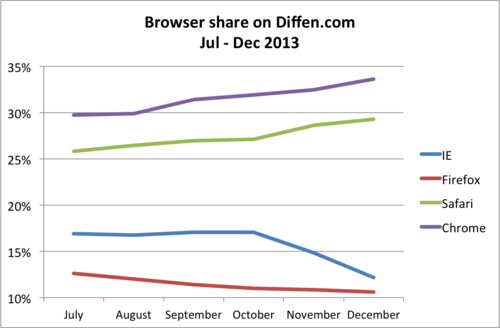
(update: some comments on Hacker News questioned why the y-axis on this graph doesn’t go from 0 to 100. Browser shares tend to move slowly. All 4 lines will appear essentially flat if I did that. The story would be lost. This type of chart with a short range for the y-axis is the best way to depict browser share.)
Flashback to summer of 2012 when IE’s share of traffic to Diffen was a little over 26%. This was for n= ~ 1 million visitors. Fast-forward to December 2013 where IE’s share has dropped to 12.17% (n = ~ 4 million visitors). Diffen is a consumer-oriented website with over 60% traffic from the U.S. So yes, this is probably not a true reflection of worldwide market share. But boy is there a decline in Q4!
And all of it cannot be blamed on the decline of Windoze or PCs. Windows users still accounted for 47% of traffic in December. And Desktops accounted for 60% of all traffic. The share of mobile traffic jumped from 29 in October to 32% in December.
Also notable is the slow but steady decline of Firefox. They’ve been doing some really cool stuff with asm.js and PDF.js but this does not seem to be translating into any gains in mainstream market share.
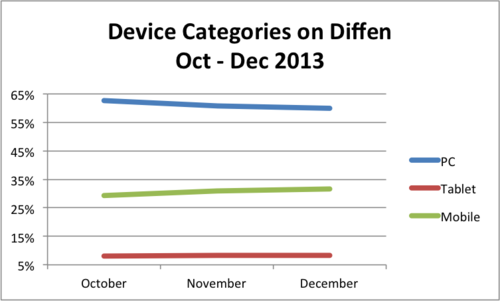
The good news in all of this is – you guessed it – no need to support IE < 8 ! Here’s how IE’s 12.17% share in December breaks down into all its versions:

(update: in response to Christian Jensen’s request in the comments below, I have translated these numbers into % of total market share in this chart:)
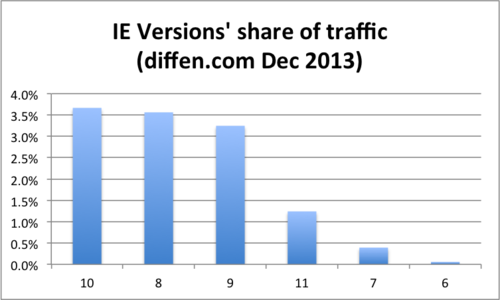
Of course, I’d prefer to not have to deal with IE 8 either but at least right now its share is material.
Disclaimer: Once again, these numbers do not reflect the state of the web. There are many other sources of browser share statistics that are based on more data and offer more granularity for your research. If you already have a web presence, look into Google Analytics for data on your audience. If you’re working on a startup in the consumer space, expecting visitors mostly from the U.S., Canada, UK, and about a third of them from their smartphones, then these number might be more relevant to you.
Bonus tip: If you have goals set up in Google Analytics, create a custom report to see conversion rates by browser and by screen resolution. This can potentially uncover problems where certain segments of your visitors aren’t converting because the site is not working for them the way you expected. (Hat tip: @CalebWhitemore)