Why does “ie” turn “dog” into itty bitty “doggie”? In this Lingthusiasm zine, Leah Velleman gets enthusiastic about diminutives. Yes, this one is extra tiny, it’s a diminutive zine about diminutives! A zinelet? Or zineling?
How to cut and fold a minizine (for this extra special tinyzine, cut the paper into quarters first along the dotted lines, then fold and cut four tinyzines like a usual minizine)
(She’s right, we fudged a little! The -ie in “doggie” only works on some words in English. It would be cool to have a version that worked on every noun, like some languages have. Alternatively: be the change you want to see in the English language?)
A very good overview by Adina Williams of why machine translation is hard and why it’s useful to have humans (and especially linguists) in the loop to know which things require more context. Excerpt:
So, now we’ve seen three new examples of where translations fail. They are very well controlled: in each example of a translation mismatch, we’re translating only a single sentence with only one grammatical system. In reality, pairs of languages may differ across numerous grammatical systems, even within the same sentence. We could have wanted to translate Turkish sentences with both “genderless” pronouns and evidentiality into English, and then we would multiple the potential translation alternatives.
These three examples are just the three I could think up off the top of my head post-NAACL (as I write this, I’m reminded of others to try: we could look at translation mismatches in case, determiners and definites, question particles, clusivity, numeral classifiers, and this list could definitely go on and on).
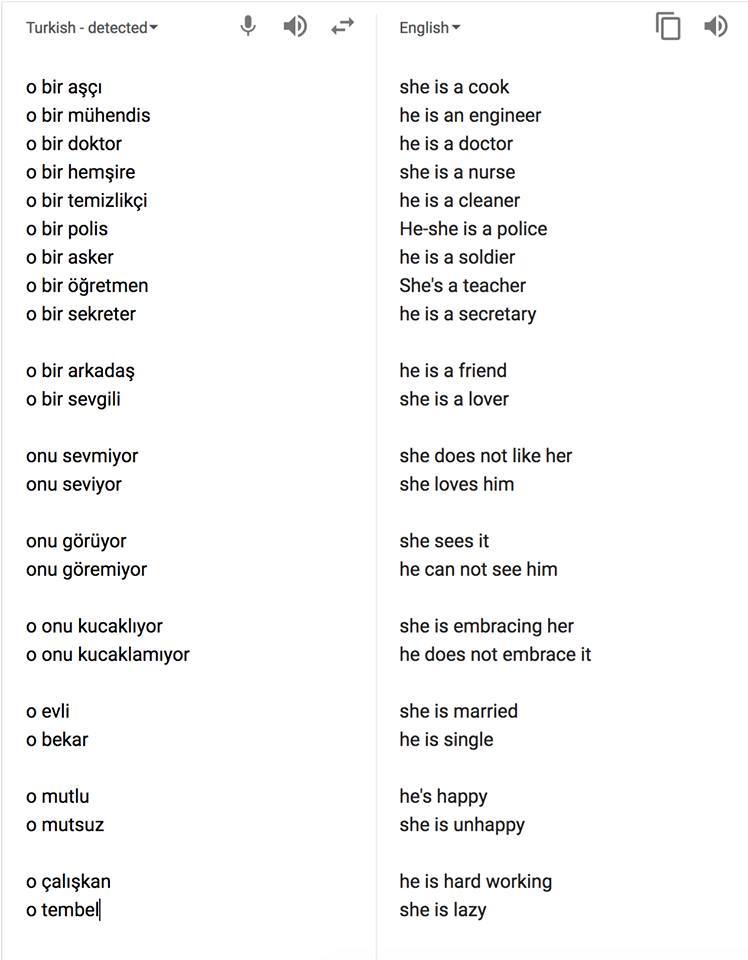
Google Translate adds gendered stereotypes when translating from Turkish, which doesn’t mark gender in these sentences: “o” means both “she” and “he”. For example, “o mutlu” could translate just as correctly to “she is happy” and “o mutsuz” to “he is unhappy” but Google Translate favours the version that perpetuates a whole bunch of stereotypes – stereotypes that were, no doubt, present in the training data. (source, additional commentary, article with more information about how AI learns sexism and racism).
A clip of someone whistling “En todo el mundo hay hombres que hablan silbando”, which translates as “Around the World, there are humans who whistle their language”, from a BBC article about whistled languages.
In the 5th Century BC, for instance, the Greek historian Herodotus described a group of cave-dwelling Ethiopians. “Their speech is like no other in the world: it is like the squeaking of bats,” he wrote. We can’t know for sure which communities he was describing, but Meyer says that several whistled languages can still be heard in Ethiopia’s Omo Valley. […]
Unlike regular speech, they tend not to scare the potential prey. They can also be useful at sea: the Inuit communities of the Bering Strait whistle commands to each other as they hunt for whales. […] The Australian army, meanwhile, recruited Wam speakers from Papua New Guinea to whistle messages across the radio so that they could confound Japanese eavesdroppers. […]
Ancient Chinese texts record people whistling Taoist verses – a practice that was thought to send them into a kind of meditative reverie. Meyer has found that Southern China is still a hot spot for many diverse whistling communities among its ethnic minorities, including the Hmong and the Akha. […]
Meyer has found that they typically rely on one of two strategies – both of which use changes in pitch create a kind of stripped-down skeleton of the spoken language. It all depends on whether normal, everyday speech is “tonal”. In some countries, particularly in Asia, the pitch of a single syllable in a word can change its meaning. As a result, the whistles follow the melodies that are inherent in any spoken sentence. But other languages – such as Spanish or Turkish – are not naturally tonal. In these cases, the whistles instead mimic the changes in resonance that come with different vowel sounds, while the consonants can be discerned by how abruptly the whistles jump and slide from note to note. […]
Either way, the whistles lose many of the cues that normally help us to distinguish different words – and outsiders often find it almost impossible to believe they carry intelligible messages. Yet Meyer has found that fluent whistlers can decode the sentences with more than 90% accuracy – around the same intelligibility as speech. Meyer suspects that this relies on the same neural machinery that allows us to hold a conversation in a crowded room, or to make sense of a whispered message. “Our brains are really good at reconstructing words that have been a bit destroyed by noise or other distortions,” says Meyer. We can see the same in written messages, when the letters are all jumbled up or the vowels removed – yuor biran aumtoacitally flls th gpas. […]
The team’s own experiences show that outsiders can begin to adapt to the ‘bird language’ with regular exposure – provided you know the spoken language first. Gunturkun is fluent in Turkish, and by the end of the trip he had begun to detect the odd whistled word from the locals’ conversations. His experience would seem to support Meyer’s most recent study, which found that people with no prior knowledge of the whistled languages can soon work out which whistles correspond with which vowels; you do not need to have been born in Kuskoy to learn to speak like a bird.
People who are blind from birth will gesture when they speak. I always like pointing out this fact when I teach classes on gesture, because it gives us an an interesting perspective on how we learn and use gestures. Until now I’ve mostly cited a 1998 paper from Jana Iverson and Susan Goldin-Meadow that analysed the gestures and speech of young blind people. Not only do blind people gesture, but the frequency and types of gestures they use does not appear to differ greatly from how sighted people gesture. If people learn gesture without ever seeing a gesture (and, most likely, never being shown), then there must be something about learning a language that means you get gestures as a bonus.
Blind people will even gesture when talking to other blind people, and sighted people will gesture when speaking on the phone - so we know that people don’t only gesture when they speak to someone who can see their gestures.
Earlier this year a new paper came out that adds to this story. Şeyda Özçalışkan, Ché Lucero and Susan Goldin-Meadow looked at the gestures of blind speakers of Turkish and English, to see if the *way* they gestured was different to sighted speakers of those languages. Some of the sighted speakers were blindfolded and others left able to see their conversation partner.
Turkish and English were chosen, because it has already been established that speakers of those languages consistently gesture differently when talking about videos of items moving. English speakers will be more likely to show the manner (e.g. ‘rolling’ or bouncing’) and trajectory (e.g. ‘left to right’, ‘downwards’) together in one gesture, and Turkish speakers will show these features as two separate gestures. This reflects the fact that English ‘roll down’ is one verbal clause, while in Turkish the equivalent would be yuvarlanarak iniyor, which translates as two verbs ‘rolling descending’.
Since we know that blind people do gesture, Özçalışkan’s team wanted to figure out if they gestured like other speakers of their language. Did the blind Turkish speakers separate the manner and trajectory of their gestures like their verbs? Did English speakers combine them? Of course, the standard methodology of showing videos wouldn’t work with blind participants, so the researchers built three dimensional models of events for people to feel before they discussed them.
The results showed that blind Turkish speakers gesture like their sighted counterparts, and the same for English speakers. All Turkish speakers gestured significantly differently from all English speakers, regardless of sightedness. This means that these particular gestural patterns are something that’s deeply linked to the grammatical properties of a language, and not something that we learn from looking at other speakers.
References
Jana M. Iverson & Susan Goldin-Meadow. 1998. Why people gesture when they speak. Nature, 396(6708), 228-228.
Şeyda Özçalışkan, Ché Lucero and Susan Goldin-Meadow. 2016. Is Seeing Gesture Necessary to Gesture
Like a Native Speaker?
Psychological Science
27(5) 737–747.
Asli Ozyurek & Sotaro Kita. 1999. Expressing manner and path in English and Turkish:
Differences in speech, gesture, and conceptualization. In Twenty-first Annual Conference of the Cognitive Science Society (pp. 507-512). Erlbaum.
So many interesting potential follow-up studies! For example, do Turkish-English bilinguals use the appropriate gestures in each language, or do they show transfer effects from their first language? It also seems plausible to me that there might be some gestures that come with language while others might be learned by imitation (perhaps iconic gestures like rolling and down versus arbitrary gestures like thumbs up).
please be aware that the correct way to replace ä, ö, ü, ß is turning them into ae, oe, ue, and ss, not just taking the dots away or typing “B”.
Otherwise you can get things like,
“Das Wetter ist sehr schwül heute.” = “The weather is very hot and humid today.”
“Das Wetter ist sehr schwul heute.” = “The weather is very gay today.”
well I now know how to call the weather gay
So, it’s like in Polish.
“Zrobić łaskę” means “Do mercy to someone”
but
“Zrobić laskę” means “Make a blowjob”.
I cannot think of a case where removing the dots of ä and ö in Finnish would result in something naughty (if you can, please contribute) but the same thing applies, ä and ö are completely different from a and o, and one does not simply remove the dots.
Finnish:
Näin appelsiineja = I saw oranges.
Nain appelsiineja = I fucked oranges.
its even worse in turkish doe cus like
Sık dişini?? Hang in there/Endure
Sik dişini?? Literally just fuck your tooth
that’s it
amazing
Even in Spanish:
Feliz año nuevo = happy new year
Feliz ano nuevo = happy new butthole
Irish:
Tá mo chroí briste = My heart is broken.
Tá mo chroí bríste = My heart is trousers.
Danish:
Bølle = thug
Bolle = fucking
It is a truth universally acknowledged that a language that uses diacritics must have a minimal pair with and without diacritics that means something rude.
ALT
ALT
ALT
ALT
ALT